Social Cognition
Social cognition refers to the mental processes we use to understand other people, their intentions, and social dynamics, rather than just our ability to be chatty or behave easily.
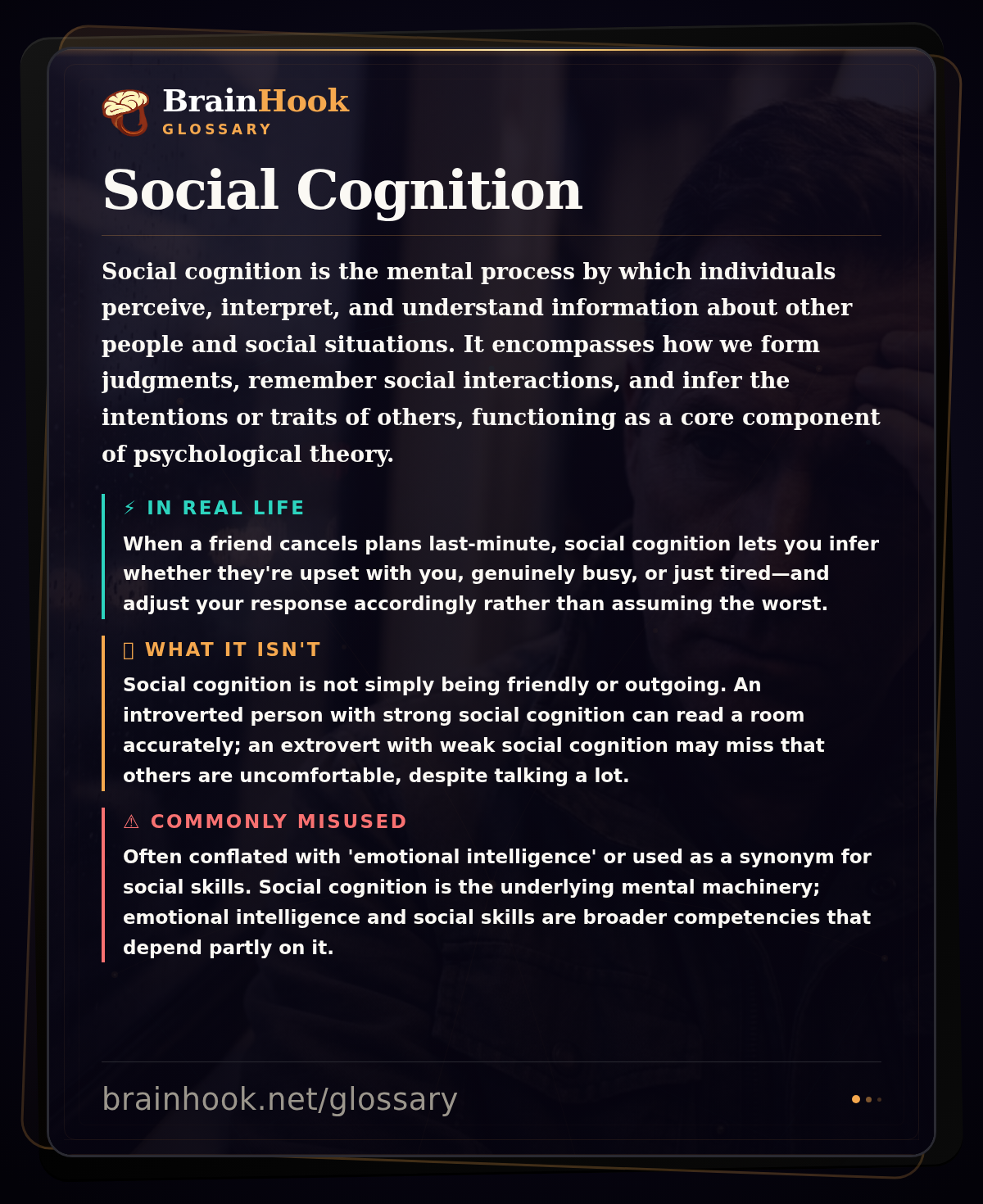
Social cognition is the mental process by which individuals perceive, interpret, and understand information about other people and social situations. It encompasses how we form judgments, remember social interactions, and infer the intentions or traits of others, functioning as a core component of psychological theory.
What this means in real life
When a friend cancels plans last-minute, social cognition lets you infer whether they're upset with you, genuinely busy, or just tired—and adjust your response accordingly rather than assuming the worst.
What it isn’t
Social cognition is not simply being friendly or outgoing. An introverted person with strong social cognition can read a room accurately; an extrovert with weak social cognition may miss that others are uncomfortable, despite talking a lot.
Commonly misused online
Often conflated with 'emotional intelligence' or used as a synonym for social skills. Social cognition is the underlying mental machinery; emotional intelligence and social skills are broader competencies that depend partly on it.