Nature's Nesting Doll of Infection Goes Three Layers Deep in Borneo
Scientists just found a new fungus in Borneo that doesn't bother hijacking ant brains — it just feeds on the fungus that's already doing it.
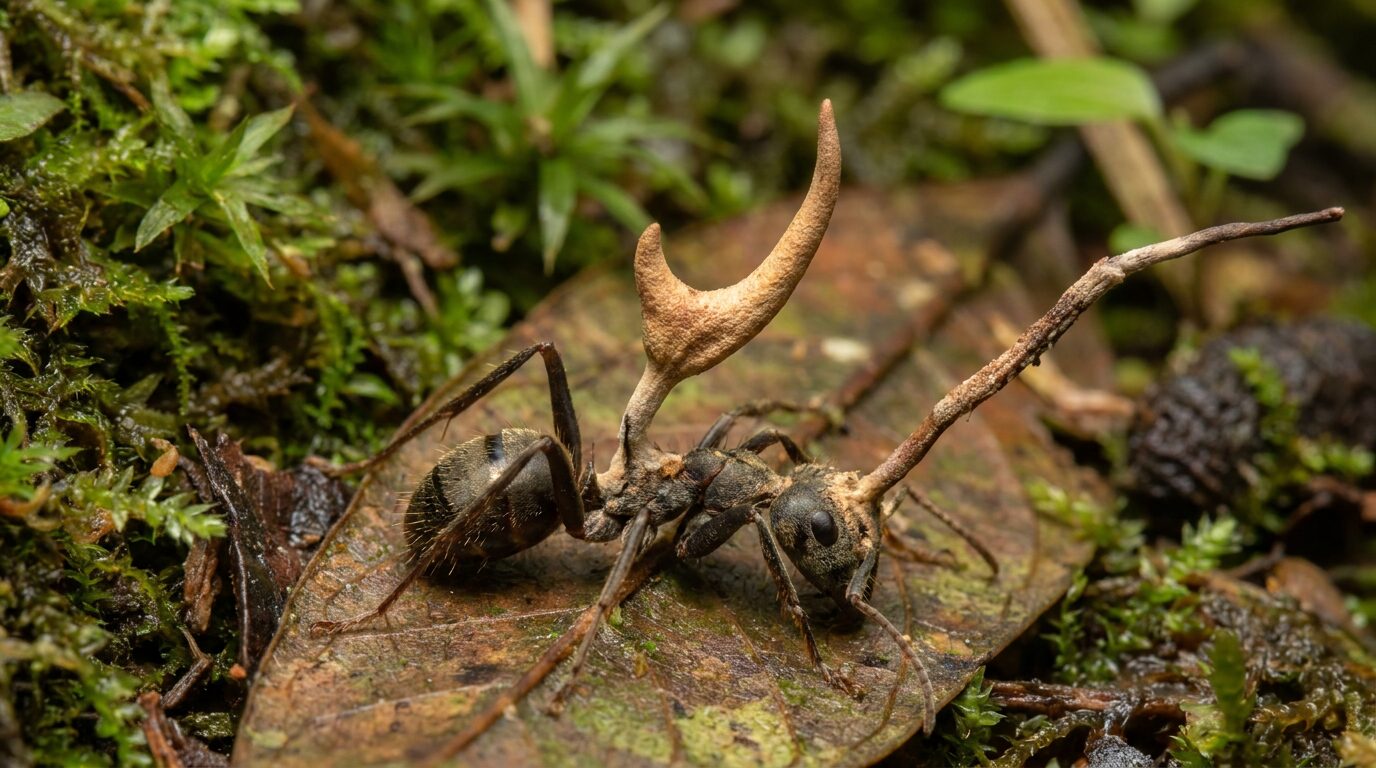
Somewhere on the floor of a Bornean rainforest, an ant has died badly. Not the quick kind of dead — the slow, scripted, catastrophically hijacked kind. Before it expired, the parasitic fungus Ophiocordyceps manipulated its ant victim into zombie-like behavior: walking randomly, displaying convulsions, eventually climbing vegetation to bite into the underside of a leaf and lock its mandibles there permanently. The whole process, from infection to death, takes four to ten days, ending with fruiting bodies growing from the ant's head and rupturing to release the fungus's spores. It is, in the purely mechanical sense, a masterpiece of parasitic architecture.
But here is the thing about dead ants in the tropics: they are not left alone. Researchers from the University of Malaysia Sabah's Institute for Tropical Biology and Conservation have now found a new species of fungus[4] growing on one such carcass in the Danum Valley, a remote tract of old-growth forest in the Malaysian state of Sabah. Rather than manipulating the insect's nervous system itself, this new fungus — Pleurocordyceps cornusynnemata — infiltrates and feeds directly on the thriving Ophiocordyceps tissue inside the host. It is, in the taxonomy of horror, a parasite of a parasite: a hyperparasite. And it comes with a horn.
Named after its unique, distinctly horn-shaped structure, Pleurocordyceps cornusynnemata was discovered after scientists studied a dead ant collected from the Danum Valley. The study describes this new species from an ant, along with two new records of related Pleurocordyceps species from a fly and a cicada nymph. The formal description was published in the New Zealand Journal of Botany, with a further publication appearing in Phytotaxa, the leading journal in taxonomic botany, in April. The full taxonomy paper is available at doi.org/10.11646/phytotaxa.750.4.1[3].
What Hyperparasitism Actually Means
The word "hyperparasite" sounds like the kind of thing someone invents to make a horror film seem more scientific. But it is a real and well-documented ecological category. A hyperparasite is an organism that parasitizes another parasite[5] — it does not bother going directly after the original host, because the original parasite has already done the hard work of establishing itself inside a living body, and now represents a rich, warm, nutritionally dense target. It is predation through exploitation of someone else's exploitation. The food chain does not run in a single line; it coils back on itself.
Pleurocordyceps cornusynnemata was dubbed a "hyperparasite" because it "effectively parasitizes the primary pathogen," according to the institute's deputy director, Jaya Seelan Sathiya Seelan. The genus Pleurocordyceps is not new to science — it belongs to the family Polycephalomycetaceae, a newly established family separated from Ophiocordycipitaceae, and the genus currently comprises 26 species reported from South American and Asian regions. But the horn-like structure of this new species distinguishes it from all 26 other Pleurocordyceps species previously recorded in China, Thailand, and Japan. Malaysia had no Pleurocordyceps records at all before this survey. Now it has three, one of them brand new to science.
“The zombie fungus has already done the hard work. The hyperparasite just shows up to eat the tenant.”
The Architecture of the Infection, Layer by Layer
To appreciate what Pleurocordyceps is doing, you need to understand what it is moving into. Ophiocordyceps — the zombie fungus — is not simply killing its ant host. It is running the ant like a marionette while simultaneously converting its body into a fungal factory. Ophiocordyceps unilateralis, also referred to as the "zombie fungus," is a fungal pathogen considered specific to ants of the tribe Camponotini, and it is currently found predominantly in tropical forest ecosystems. The fungal tissue does not colonize the ant's brain directly; it saturates the body, threading through muscle and connective tissue while, somehow, the behavioral manipulation of the nervous system proceeds. Exactly how that manipulation works remains one of the more genuinely unresolved problems in parasitology. Researchers have stressed that more studies are needed to fully elucidate the infection biology of Ophiocordyceps, and there is accumulating evidence that the secretion of parasite proteins and light-driven biological rhythms are likely involved in the infection and manipulation biology.
What Pleurocordyceps appears to do is intercept the Ophiocordyceps tissue mid-process — not after the ant is long dead and dried, but while the zombie fungus is still actively colonizing the carcass and preparing to fruit. The hyperparasite moves in to attack Ophiocordyceps as the fungal stalk emerges from the ant's body, which can stop the stalk from releasing its spores. The graveyards of dead ants are numerous and spread throughout the surrounding area of the colony, and though Ophiocordyceps unilateralis is very virulent, only about 6.5% of all fruiting bodies are viable spore producers — a rate that may be suppressed by the weakening action of the hyperparasite. This is not incidental. It means the hyperparasite may be acting as a natural brake on how far zombie-fungus infection spreads.
This also reframes what you are looking at when you look at a dead zombie ant. It is not just a corpse with a fungal stalk growing out of it. It is a contested site — real estate that at least two different fungal species are competing to exploit, at different stages, using different strategies, against the same deteriorating insect body. The ant, by this point, is less a character in the story than a venue.
The Hyperparasite Is Not the End of the Chain
The study also found something alongside the hyperparasite discovery that deserves its own sentence: during the same field trips, scientists discovered a new species of spider-killing fungus — Leptobacillium geminatum — which spreads spores through the arachnid before killing it. The team, led by associate professor Jaya Seelan Sathiya Seelan and including PhD candidate Muhammad Shahbaz, went looking for one kind of parasitic fungus and came back with several new ones, which is itself a statement about how much of the tropical forest's microscopic food web remains unmapped. If you are familiar with the ongoing collapse of insect populations even in undisturbed ecosystems, the idea that the insects we haven't lost are running complex multi-layer parasitic dramas entirely beneath our notice carries its own particular weight.
Polycephalomyces species — close relatives of Pleurocordyceps within the same family — are found in subtropical regions and are parasitic or hyperparasitic on insects. The broader group has been turning up as Ophiocordyceps hyperparasites across Asia for years now, with prior species described from southwestern China and Thailand[1], suggesting this pattern — a fungus feeding on the fungus feeding on the insect — is not a curiosity but a recurring ecological relationship, baked deep into the biology of tropical forest floors. Pleurocordyceps cornusynnemata is new, but the strategy it represents is old.
Why Disgust Is the Wrong Frame for This
The popular coverage of zombie fungi tends to reach for horror-movie language — "mind control," "undead," "gruesome" — and that framing is both understandable and a little misleading. The thing that is actually happening is stranger and more interesting than a movie. Ophiocordyceps is not a villain executing a plan with malice. It is a system that evolved, across enormous spans of time, to use a particular animal's body and behavior as a dispersal mechanism. Pleurocordyceps is not a hero checking that system. It is a second system, which evolved to exploit the first system's output. The ant in the middle is not a victim in any meaningful moral sense; it is the medium through which two separate evolutionary strategies are playing out simultaneously.
"These newly documented fungi hold immense potential both as sources for developing next-generation antimicrobial drugs and as highly effective biocontrol agents against agricultural pests," Seelan noted. That practical utility is real, and it matters. But it tends to flatten what is most interesting here, which is the ecological architecture — the fact that infection is not a binary state but a layered one, and that the forest floor is running multi-tiered parasitic food chains in organisms too small and too obscure to have names until very recently. The question is not just "what is infecting what" but how many floors this building has. The answer, in Borneo at least, appears to be more than we thought.
References
- Multigene phylogenetics of Polycephalomyces (Ophiocordycipitaceae, Hypocreales), with two new species from Thailand (nature.com)
Documents a prior Polycephalomyces hyperparasite species described from Thailand, showing the hyperparasitic strategy is established across tropical regions. - Polycephalomyces agaricus, a new hyperparasite of Ophiocordyceps sp. infecting melolonthid larvae in southwestern China (link.springer.com)
Documents a prior Polycephalomyces hyperparasite species described from southwestern China, establishing the pattern as recurring across Asia. - Taxonomy and phylogeny of Pleurocordyceps (Polycephalomycetaceae, Hypocreales) associated with ants and cicadas from Malaysia, including a new species and new records (doi.org)
Contains the formal taxonomic description of the new Pleurocordyceps cornusynnemata species published in Phytotaxa journal. - Scientists discover new parasite in jungle that preys on insect-killing "zombie fungus" (cbsnews.com)
Confirms the University of Malaysia Sabah team's discovery of the new parasitic fungus species in Borneo and its publication in the New Zealand Journal of Botany. - Deep in the Jungles of Borneo, Scientists Just Discovered a “Hyperparasite” Organism That Preys on Zombie Fungi (thedebrief.org)
Provides the definition that a hyperparasite is an organism that parasitizes another parasite, used to explain the ecological category.
About Phoebe Lark
Phoebe Lark writes about the biology and chemistry your body and home would rather you didn't examine too closely — odors, fluids, microbes, parasites, infestations, and the quietly industrious rot happening on and around you right now. She follows disgust down to the mechanism underneath, where the gross thing almost always turns out to be a system doing exactly what it evolved to do.
More like this
A Caterpillar That Wears Its Victims' Bones Was Just Discovered. It Rewrites Insect Predation.
A newly discovered caterpillar doesn't just kill — it collects the remains and wears them as armor, revealing an evolutionary trick that entomologists hadn't imagined possible in this lineage.
Why Candida in Your Gut Can Suddenly Turn Deadly
Fungi have always been part of your gut's ecosystem — but a wave of drug-resistant strains is revealing just how little medicine understood them.