Your Soap Is Reacting with Your Water and Leaving Behind a Chemical Record
That gray crust on your shower tiles isn't dirt — it's a mineral compound your soap manufactures on contact, and it reveals exactly what's dissolved in your water.
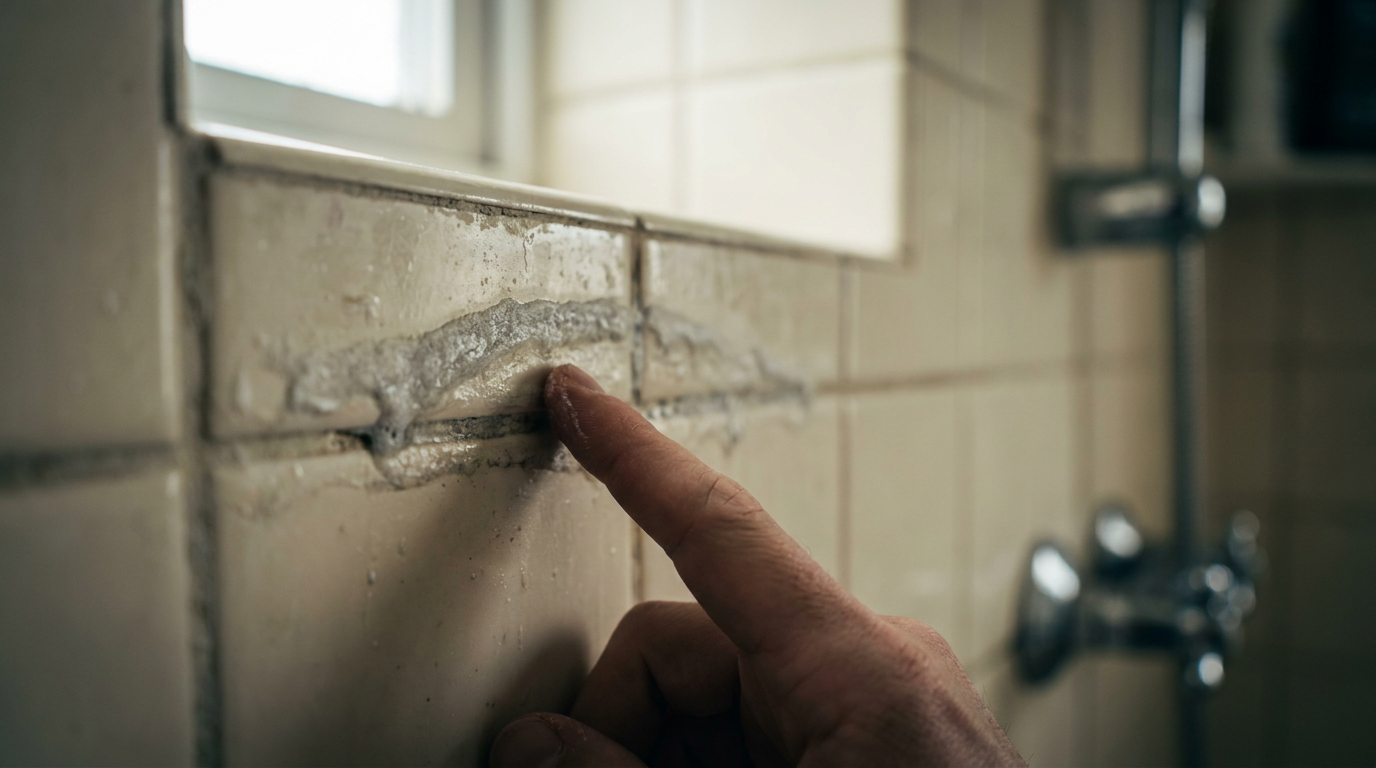
Run your finger along the inside edge of your shower — along the grout line, below the showerhead, around the drain rim where the water lingers longest. What you'll feel is a thin, slightly waxy film, gray-white and faintly chalky, with a texture that isn't quite grime and isn't quite mineral scale. It resists a wet cloth. It laughs at a quick rinse. Most people call it soap scum and leave it at that, as if naming the nuisance were enough to understand it. But soap scum is not the residue of something going wrong. It's the visible trace of a chemical reaction that your soap and your water are running every single morning, right there in the steam and heat, completely without your permission.
The story begins with what soap actually is, which turns out to be stranger than most people suspect. A bar of soap is not a single substance. It's a collection of molecules called fatty acid salts — long carbon chains, typically derived from animal fats or plant oils, that have been treated with a strong alkali like sodium hydroxide in a process called saponification[4]. Each molecule has two ends with entirely different personalities: one end is hydrophobic, meaning it repels water and gravitates toward oils and grease, and the other end is hydrophilic, meaning it bonds readily with water. This split personality is why soap works at all. In water, soap molecules cluster into spherical structures called micelles, trapping oil and dirt at their hydrophobic cores so that water can carry the whole package away. It is an elegant piece of chemistry, refined over centuries. The problem is what happens when the water itself has something to say.
Water that travels through limestone and dolomite aquifers — which describes a significant fraction of the groundwater supply in North America and Europe — picks up dissolved calcium and magnesium ions along the way. This is what water hardness actually means: not a physical texture, but a measurement of how many divalent mineral ions the water is carrying in solution. The ions are invisible, tasteless in low concentrations, and entirely harmless to drink. But they are chemically reactive, and when they encounter the fatty acid anions released from your soap, something immediate and decisive happens. The calcium and magnesium ions bind to the fatty acid molecules, displacing the sodium that originally held them in soluble form. The resulting compound — calcium or magnesium stearate, palmitate, or oleate, depending on the fatty acids in your particular bar — is no longer soluble in water. It precipitates out of solution instantly, forming a sticky, insoluble solid that clings to whatever surface is nearby: your tiles, your grout, your skin, the curtain, the chrome fixtures. That solid is soap scum. It is not leftover soap. It is a new substance entirely.
The reaction itself has a satisfying chemical logic. In solution, sodium stearate — a typical fatty acid salt in soap — dissociates into a sodium ion and a stearate anion. Hard water introduces calcium ions carrying a double positive charge. Because calcium binds more strongly to the stearate anion than sodium does, it outcompetes the sodium and locks onto two stearate molecules at once, forming calcium stearate[2]. This compound has almost no solubility in water — a solubility product so low that it precipitates nearly the moment it forms. The reaction is fast, thermodynamically favorable, and completely ordinary from the perspective of coordination chemistry. From the perspective of your bathroom, it's a slow-motion catastrophe running every time you lather up.
Why Hard Water Is Actually the Starting Material
Hardness is measured in units of milligrams of calcium carbonate per liter, or sometimes in grains per gallon, and the range across different water systems is surprisingly wide. Water with fewer than 60 milligrams per liter is considered soft[1]; anything above 180 milligrams per liter is classified as very hard. Cities drawing from surface reservoirs fed by granite watersheds — like much of the Pacific Northwest or Scotland — often have naturally soft water. Cities drawing from aquifers cutting through carbonate rock — Phoenix, London, much of the American Midwest — can sit well above 200 milligrams per liter. The same bar of soap used in two different cities will produce dramatically different amounts of scum. In soft water, it may produce almost none. In very hard water, the reaction is aggressive enough that you can feel it: the lather feels thinner, less voluminous, because the soap is being consumed by the mineral reaction rather than forming the micelles that create foam. Hard water doesn't prevent soap from cleaning. It just means you're also manufacturing calcium stearate every time you bathe.
“Hard water doesn't prevent soap from cleaning — it just means you're manufacturing a new compound with every lather, and it's sticking to your tiles.”
The calcium and magnesium content of water isn't the only variable. Temperature changes the reaction rate. Hot water accelerates ion exchange, which is partly why soap scum accumulates most heavily in showers rather than bathroom sinks where water is cooler and contact time is shorter. Evaporation concentrates whatever is left behind: as the thin film of soapy water on your tiles dries, the mineral content becomes more concentrated, the precipitate sets more firmly, and the layer becomes harder to remove. Over days and weeks, new layers deposit on top of old ones, each baked slightly by heat and air until the film develops a composite structure — fatty acid salts, calcium carbonate from mineral scaling, and occasionally trapped soap residue, skin oils, and airborne particles — that is genuinely difficult to dissolve.
What the Scum Is Actually Made Of
Soap scum is not a single compound. It is a mixture, and its exact composition depends on the chemistry of both your soap and your water. The dominant components are the calcium and magnesium salts of whatever fatty acids your soap contains — primarily stearic acid, palmitic acid, oleic acid, and lauric acid in most commercial bars. Calcium stearate and calcium palmitate tend to be solid and waxy. Calcium oleate is softer and slightly more tacky, which is why olive-oil-heavy soaps like Castile can leave a different-textured residue than a tallow-based bar. Layered into this are deposits of calcium carbonate and magnesium carbonate from the water's dissolved minerals, which form independently of the soap reaction and contribute the hard, chalky character of older buildup. Some scum layers also incorporate silicates, depending on local geology, giving them a gritty texture that approaches glass in its resistance to mild acid.
The surface the scum lands on matters too. Grout is porous, with a microstructure full of tiny channels that soap-scum particles can penetrate and lock into. Ceramic tile is glazed and comparatively smooth, so buildup tends to sit on top rather than inside the surface — which is why grout lines are always the worst. Natural stone like marble or travertine presents a different problem: it is itself calcium carbonate, and the mild acids sometimes used to dissolve scum can etch the stone surface as readily as they dissolve the buildup. Chrome fixtures accumulate scum at their edges and seams, where water sits longest before evaporating. The pattern of buildup in a shower is almost a map of water flow, contact time, and evaporation — a chemical record of how that particular shower has been used, by someone with a particular water supply and a particular soap, over months or years.
“The pattern of buildup in a shower is almost a map of water flow and evaporation — a chemical record of how that bathroom has been used.”
Why Soap Scum Resists Plain Water
Here is the detail that makes soap scum so stubbornly persistent: because it is formed by fatty acids combining with mineral ions to create insoluble salts, it is not water-soluble. You cannot rinse it off. More water simply adds more mineral ions to the surface, potentially adding to the problem rather than solving it. This is counterintuitive in a context where we think of water as the default cleaning agent, and it explains why people who scrub their showers diligently with wet cloths often feel like they're maintaining rather than removing the accumulation. The chemistry requires a different approach entirely.
Calcium and magnesium stearates are insoluble in water but susceptible to acid. Dilute acetic acid — vinegar — protonates the carboxylate groups in the fatty acid salts, converting them back into free fatty acids while releasing calcium and magnesium ions into solution. The free fatty acids are still not particularly water-soluble, but they become soft and loosened enough that physical scrubbing can remove them from the surface. Commercial bathroom cleaners typically use stronger acids — phosphoric acid, glycolic acid, or sulfamic acid — which work faster and at lower concentrations. Citric acid, naturally abundant in lemon juice, works on the same principle and is gentler on surfaces, though it requires more dwell time. The essential mechanism in all of these is the same: you are reversing the precipitation reaction by donating protons to the carboxylate groups, destabilizing the calcium salt and freeing the surface.
The Soft Water Solution and Its Trade-Offs
Water softeners address the scum problem at its chemical root. The most common household systems use ion exchange resins — beads of a polymer carrying sodium ions that swap for incoming calcium and magnesium ions as the water passes through. The outgoing water has the same volume of dissolved ions, but they are now monovalent sodium ions rather than divalent calcium and magnesium. Sodium ions do not form insoluble salts with fatty acids; sodium stearate is the soluble compound in soap to begin with. Soft water lets soap lather extravagantly, rinse cleanly, and leave virtually no scum behind. Surfaces stay cleaner longer, and significantly less soap is required to produce the same cleaning effect, because almost none of it is being consumed by the mineral precipitation reaction.
The trade-offs are real, though. Softened water carries a higher sodium content, which some people on sodium-restricted diets need to consider, particularly if they drink from softened taps. The resin beds require periodic regeneration with concentrated brine, which flushes the accumulated calcium and magnesium down the drain — a process that uses significant quantities of salt and water. And soft water has a sensory quality that takes getting used to: it feels slightly slippery on skin, because the absence of mineral ions changes the way water rinses and how the skin's surface charge interacts with the water film. Some people find it luxurious. Others find it slightly unsettling, as though the water isn't quite done with them. The sensation is not imaginary. It is the chemical difference between water with and without dissolved mineral buffering, experienced through the mechanoreceptors in your skin.
Synthetic Detergents and Why Your Shower Gel Behaves Differently
Liquid body washes and synthetic detergents — the category collectively called syndets in the cosmetics industry — are engineered around a different class of surfactant molecules. Rather than fatty acid salts derived from saponification, they use synthetic sulfonate or sulfate compounds: sodium lauryl sulfate, sodium laureth sulfate, cocamidopropyl betaine, and their relatives. These molecules are effective surfactants with the same split hydrophobic-hydrophilic architecture, but their calcium and magnesium salts remain soluble in water rather than precipitating out. This is not an accident. It was the specific industrial motivation for developing synthetic detergents in the mid-twentieth century[3], when hard water was common and soap scum was a recognized domestic problem at scale. A bottle of body wash lathers easily in hard water, rinses cleanly, and leaves behind almost no insoluble residue — not because it is more powerful than bar soap, but because its chemistry was designed to be indifferent to dissolved minerals.
This does not mean liquid cleansers are uniformly superior. Syndets have their own issues: some sulfate-based surfactants are more irritating to sensitive skin, and many liquid products contain preservatives, thickeners, and fragrance compounds that bar soap doesn't need. Bar soaps made with syndet bases rather than traditional fatty acid salts have become more common — marketed as soap-free cleansing bars — and they largely avoid the scum problem while preserving the format. The chemistry trade-off at your bathroom shelf is real: traditional bar soap, made the old way, will always react with the minerals in your water. The scum it leaves is not a manufacturing flaw. It is the predictable product of a reaction between two perfectly ordinary substances behaving exactly as their chemistry demands.
“The scum your soap leaves is not a flaw — it is a new compound, faithfully manufactured every morning by chemistry that has been running the same reaction for as long as people have used soap and hard water together.”
The next time you step into the shower and feel that faintly waxy resistance under your fingernail along the grout line, you're touching something that has a precise molecular identity — calcium stearate, most likely, with some palmitate mixed in, built up over weeks of your own routine. It has a formation temperature, a solubility product, a specific acid that will undo it. It carries information about your water supply, the fats in your soap, and the geometry of your shower's drainage. Soap scum is not a sign that you aren't cleaning well enough. It is evidence that chemistry runs continuously in the background of daily life, using your bathroom as a reactor, your morning routine as the protocol, and your tiles as the record.
References
- Hardness of Water (usgs.gov)
Establishes water hardness scale (soft below 60 mg/L) and explains soap scum forms when soap reacts with dissolved calcium. - Calcium stearate (en.wikipedia.org)
Identifies calcium stearate as the specific insoluble compound formed when soap reacts with hard water minerals. - Early Synthetic Detergents (britannica.com)
Provides historical context on the development of synthetic detergents in the mid-twentieth century as an alternative to soap. - Saponification (en.wikipedia.org)
Defines saponification as the chemical process using alkali to convert fats and oils into soap molecules.
About Aris Thorne
Aris Thorne is a microbiologist who writes about the hidden mechanics of ordinary life: the microbes running your home, the chemistry unfolding in food and water, the physics built into familiar objects, and the biological systems quietly keeping the human body alive. His work follows science from kitchens, bathrooms, dust, soil, and city air into wounds, immune responses, infections, medicines, cells, and other worlds. He is most interested in the moment something familiar stops looking simple and reveals the living machinery underneath.
More like this

Your Coffee Goes Cold in Minutes. Your Soup Takes Forever. Here's Why.
Same cup, same room, same starting temperature — but coffee and soup are losing heat through completely different physics, and the gap between them comes down to fat, vapor, and the invisible work happening at the surface.
Your Gym Clothes Smell Worse the More You Wash Them — Here's the Chemistry
Synthetic athletic fabric doesn't just trap body odor — it selectively breeds the bacteria responsible for it, turning every wash cycle into a missed opportunity.
That Oily Rainbow on Your Morning Coffee Is Actually an Optical Instrument
The iridescent film floating on your pour-over isn't a flaw in your brew — it's a self-assembling structure that bends light by the same physics that makes soap bubbles glow.