Your First Friendships Were a Rehearsal. A 30-Year Study Proves It.
A landmark 30-year study tracked 705 people from infancy to adulthood and found a second attachment curriculum running quietly alongside the parent-child bond — one that most developmental psychology coverage has barely touched.
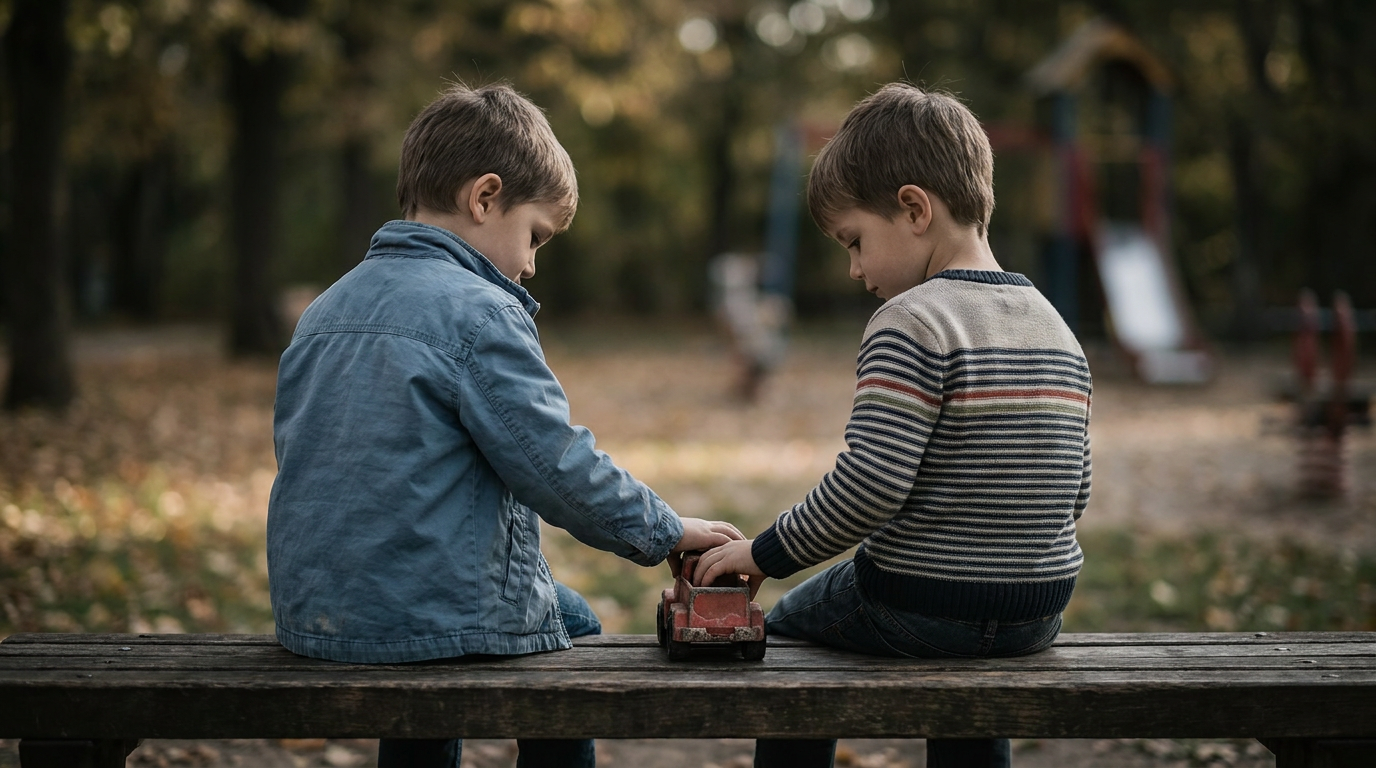
Think about the first person you ever chose. Not a parent, not a sibling placed in your life by the fixed accident of family, but the first friend — the kid from down the street, or across the classroom, someone you found and kept finding. You were probably five or six. Maybe younger. The relationship almost certainly ended by middle school, or high school at the latest, dissolved by a move or a shift in social gravity that neither of you could fully name. You have probably not thought about that person in years. And yet, according to one of the longest-running developmental studies ever conducted, that friendship — and the ones that followed it through childhood — may have shaped the interior architecture of your adult romantic life in ways that research is only beginning to map clearly.
The Minnesota Longitudinal Study of Risk and Adaptation[4] began in the mid-1970s at the University of Minnesota and has tracked the same group of individuals — 705 people in total — from infancy through age 30 and beyond. It is one of the rare studies in developmental psychology that actually followed people across the full arc of early life rather than assembling retrospective accounts or piecing together data from separate cohorts. Researchers observed parent-child interactions in infancy. They monitored temperament. They watched children form friendships in early childhood and followed those social patterns into adolescence and young adulthood. Then they assessed romantic relationship quality in the participants' twenties and thirties. What they found complicated a story that developmental psychology had been telling for decades.
The conventional framework holds that early parent-child attachment is the primary template for later intimacy. This is not wrong — infant attachment security does carry forward. But the Minnesota data revealed something more layered: childhood peer relationships were not simply a downstream expression of parental attachment. They constituted a separate developmental curriculum, with their own lessons, their own repair opportunities, and their own independent contribution to adult relationship security. Children who had close, stable, reciprocal friendships in elementary school showed better outcomes in adult romantic relationships even after researchers controlled for the quality of parental attachment. The friendship track was not just a shadow of the parent track. It had weight of its own.
Most developmental psychology coverage — including the pop-psychology that filters down into books and podcasts and social media — has focused almost entirely on the parent-child bond. Attachment theory as it reaches the general public tends to end at the nursery: secure base, caregiver attunement, early working models of love and trust. What gets left out is the second school, the one that opens when children are first sent out to negotiate the world with other children, where nobody is automatically obligated to love them back.
Two Curriculums, Not One
To understand why peer relationships constitute a genuinely separate developmental track, it helps to understand what they demand that parental relationships do not. A parent-child relationship is structurally asymmetrical. The parent holds more power, more knowledge, more regulatory capacity. Even in the most attuned relationships, the parent is doing something fundamentally different than the child — scaffolding, soothing, organizing. What children learn in that context is enormously important, but it is not the same as what they learn when they are placed with another child who has roughly equal power, equal need, and no obligation to repair the relationship if it breaks.
Childhood friendships are where children first practice reciprocity without a safety net. They are where children learn to negotiate when they want different things, to tolerate being disliked without immediate adult mediation, to repair a rupture with someone who can simply walk away. They are where children discover — at the granular, repeated level of daily social experience — how rejection feels, how inclusion feels, what it costs to stay in conflict and what it costs to back down, what it means to be chosen and what it means to be left out. These are not abstract social skills. They are emotional calibrations that get baked into the nervous system across thousands of small interactions.
“In peer relationships, nobody is automatically obligated to love you back — and that is precisely what makes them such a different school.”
Developmental researchers sometimes distinguish between the vertical attachment relationships[2] children have with caregivers — oriented toward protection and security — and the horizontal relationships they have with peers, oriented toward companionship, belonging, and affiliation. Both are important. But they develop different social and emotional capacities, and they generate different kinds of internal working models. The parent-child model tends to shape how a person expects to be cared for in relationships of dependency and trust. The peer model tends to shape how a person expects to be received in relationships of equality — whether they feel fundamentally likable, whether they trust that connection is available to them, whether conflict feels survivable or annihilating.
What the Longitudinal Data Actually Shows
The Minnesota study did not simply document that children with good friendships became adults with good relationships, which would be easy to dismiss as a personality effect — cheerful, easy children making friends easily and then partnering easily because that is just who they are. The researchers were careful about this. They tracked temperament. They assessed early attachment security with caregivers. They looked at socioeconomic risk factors. And they found that peer relationship quality[1] in childhood and early adolescence predicted romantic relationship quality in adulthood over and above those variables. Children with secure parental attachment but troubled peer relationships showed diminished adult outcomes compared to those with secure attachment and strong friendships. The peer track was doing something additive, not redundant.
Specifically, the mechanisms researchers identified involved social information processing — the subtle cognitive and emotional habits that govern how people interpret ambiguous social signals. A child who has repeated experiences of being reliably included, of having conflicts resolved without relationship destruction, of being sought out after distance, develops a different baseline expectation about what other people are likely to do. This baseline does not always operate at the level of conscious belief. It operates at the level of reflex — the speed of the anxiety spike when a text goes unanswered, the ease or difficulty of trusting a partner's stated feelings, the instinct to flee or freeze or fight when a relationship feels threatened.
Children who experienced chronic exclusion, instability, or cruelty in peer relationships — and this is worth noting carefully, because it does not require dramatic bullying, just consistent unpredictability or rejection — showed higher rates of insecure attachment patterns in adult romantic relationships. Not all of them. Not irreversibly. But the signal was robust enough across the dataset to suggest that something real and lasting was being laid down in those elementary school cafeterias and after-school yards and birthday parties that did or did not include their name.
The Rejection Template
“Rejection sensitivity does not always arrive with the parent. Sometimes it arrives with the third-grade lunch table.”
One of the areas where peer relationship history seems most traceable in adult life is rejection sensitivity — the tendency to anticipate rejection with unusual alertness, to feel it more acutely when it comes, and to respond in ways that can damage the very relationships a person most wants to protect. Research on rejection sensitivity has historically emphasized parental conditional approval as a primary origin: children who received love contingent on performance or compliance learn to scan relationships for signs of withdrawing affection. This remains a well-supported pathway. But the Minnesota data, alongside related research in peer victimization and social exclusion, points to a second, underappreciated pathway.
A child who is repeatedly excluded, dropped, or humiliated by peers is not having the same emotional experience as a child whose parent withdraws approval — but the nervous system output can look similar. Both experiences teach the child that belonging is unreliable, that the self is not quite sufficient for connection, that the signals predicting rejection need to be monitored carefully and early. The peer version of this lesson arrives during a developmental window — roughly ages six through twelve — when children's social identities are under active construction. Being fundamentally rejected during that window, by the people whose opinion feels most pressing at that age, can shape a self-concept that persists well into adulthood without the person ever connecting it to those specific years.
This is not a deterministic claim. Plenty of children who experienced peer rejection went on to develop secure, stable romantic relationships, particularly if they had strong compensatory relationships — a reliable best friend, a warm adult outside the family, later social experiences that offered a corrective emotional reality. The longitudinal data shows probabilities, not destinies. But it does suggest that when an adult notices a pattern — disproportionate anxiety when a partner seems distant, difficulty believing that affection is stable, an automatic assumption of social inadequacy in ambiguous moments — it may be worth asking whether the calibration comes from childhood, and whether the childhood in question involved a classroom as much as it involved a home.
The Corrective Friendship
One of the most quietly significant findings in this area of research is the idea of the corrective peer relationship — a close childhood or adolescent friendship that appears to buffer the effects of earlier insecurity, whether that insecurity originated at home or among other children. Researchers studying resilience in high-risk developmental populations have found repeatedly that a single close, stable friendship in childhood[3] can moderate outcomes in meaningful ways. The mechanism seems to involve what some researchers describe as a revised internal working model: the child learns, through the repeated experience of a reliable peer, that connection is possible for them, that they are genuinely likable to at least one person, that rupture and repair are survivable.
This is why the question of whether someone had a best friend in childhood — not a large social circle, just one consistent, chosen relationship — shows up as a meaningful variable in longitudinal work. A best friendship in middle childhood is not merely a comfort. It is a laboratory in which a child practices the specific skills that adult intimacy requires: tolerating the other person's needs without disappearing, expressing your own needs without assuming destruction, staying through conflict, allowing closeness without bracing for abandonment. The child does not know this is what they are practicing. They just know they like this person and want to keep being liked back.
What Adults Carry Without Knowing It
The developmental significance of childhood peer relationships is easy to underestimate partly because the relationships themselves are so easy to forget. Adults tend to remember their early friendships with a kind of cheerful vagueness — the general warmth of having had a best friend, the general sting of a falling-out — without tracking how specifically those dynamics might have shaped them. This is different from how people remember childhood family dynamics, which tend to feel more weighted, more available for narrative retrospection, more culturally designated as formative. Nobody is writing books about how your third-grade social group built your attachment style. But the data suggests that something consequential was happening in those years, in those specifically peer-shaped relationships, that carried forward.
“Nobody is writing books about how your third-grade social group built your attachment style — but the data suggests something consequential was happening there.”
What adults carry from those years tends not to feel like memory. It feels like personality. It feels like the reflexive ease or unease of new social situations, like the speed with which intimacy starts to feel either natural or dangerous, like the particular flavor of loneliness that arrives even inside relationships that are, by any objective measure, going fine. These are the residues of a social education that ran from roughly age five to twelve, conducted entirely among other children who were also figuring it out, none of whom had any idea they were shaping one another in lasting ways.
The Minnesota study does not suggest that adult relationships are sealed by childhood. People change. New relationships offer new data. Therapy, self-awareness, time, and the ordinary accumulation of life experience all shift the probabilities. But the study does complicate a comfortable assumption — that once you understand your parental attachment history, you more or less understand the developmental roots of your relational life. There was another curriculum running simultaneously, one that involved different teachers, different rules, and a different kind of stakes. You took it alongside every other child in your class, and most of you graduated without ever knowing there was a test.
References
- Conceptualizing the Role of Early Experience: Lessons from the Minnesota Longitudinal Study (pmc.ncbi.nlm.nih.gov)
Supplies longitudinal evidence that peer relationship quality in childhood predicts adult outcomes independently of early parental attachment and temperament. - ERIC - EJ393110 - Social Relationships and Their Developmental Significance., American Psychologist, 1989 (eric.ed.gov)
Establishes the distinction between vertical (parent-child) and horizontal (peer) relationships as separate developmental systems serving different functions. - Friendship moderates prospective associations between social isolation and adjustment problems in young children (pmc.ncbi.nlm.nih.gov)
- The Impact of Early Interpersonal Experience on Adult Romantic Relationship Functioning: Recent Findings from the Minnesota Longitudinal Study of Risk and Adaptation (pmc.ncbi.nlm.nih.gov)
Provides the foundational Minnesota Longitudinal Study data showing early interpersonal experiences predict adult romantic relationship quality and conflict resolution.
About Mara Ellison
Mara Ellison writes about childhood patterns that echo into adult life, including attachment, temperament, rejection sensitivity, emotional learning, family roles, and the early social scripts people keep reenacting without realizing it. Her work focuses on developmental psychology with nuance, clarity, and unusual emotional precision.
More like this

Your Childhood Best Friend Shaped Your Adult Relationships More Than You Think
A 30-year study found that childhood friendship quality independently predicts adult relationship security — which means the attachment story we've been telling is missing a whole chapter.

The Good Child Learned to Disappear. They're Still Doing It.
Research on rejection-sensitive children who conform to belong is revealing how early disappearing acts become so practiced they stop feeling like acts at all.

The Kid Who Conformed to Survive Is the Adult Who Can't Disagree
Research on rejection-sensitive adolescents reveals a pattern more insidious than shyness: the systematic suppression of their own judgment — and it doesn't stop when childhood does.