Your Childhood Best Friend Shaped Your Adult Relationships More Than You Think
A 30-year study found that childhood friendship quality independently predicts adult relationship security — which means the attachment story we've been telling is missing a whole chapter.

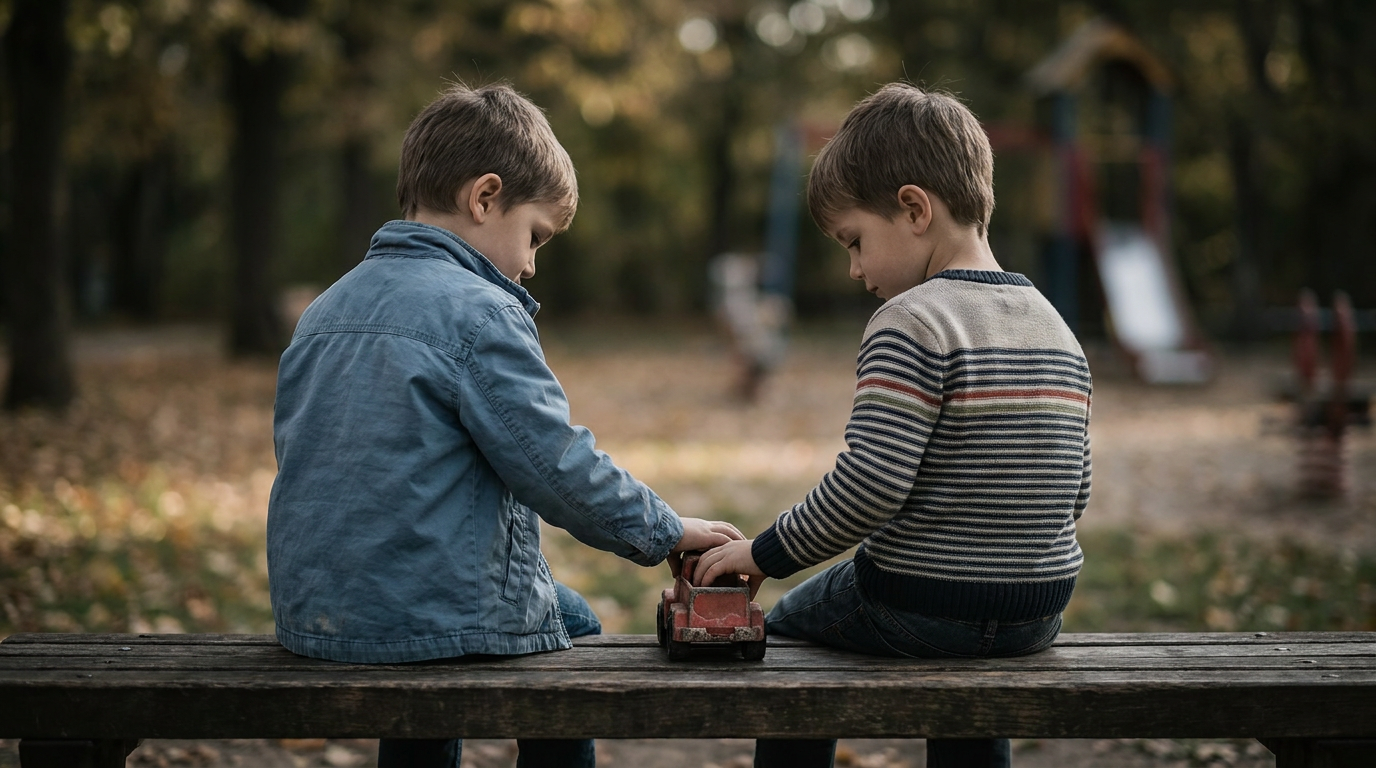
Think about the friend you had in second or third grade. The one you rode bikes with, ate lunch next to, told things to that you did not tell your parents. Maybe you fought and made up. Maybe you had a falling out that felt, at the time, like actual catastrophe. Whatever happened, that relationship was probably not something you've spent much time treating as formative. It was just childhood. Kids stuff. The real shaping, the conventional wisdom goes, happened at home — in the quality of the bond between you and your parents, in whether you were held, soothed, responded to, made to feel secure. Parents are the architects of attachment. Friends are just the furniture.
A long-running study out of the University of Minnesota[2] quietly challenges that assumption in ways that have not yet made their way into the wider cultural conversation about relationships. Over thirty years, researchers followed participants from infancy into adulthood, tracking not just the quality of early parental caregiving but also the quality of children's friendships across middle childhood — and then measuring how those participants functioned in adult romantic relationships. The parental attachment findings confirmed what the field has long suspected. But the friendship data added something the models had not fully accounted for: early peer relationships contributed independently[1], and meaningfully, to how secure adults felt with romantic partners. Not as a proxy for parenting. Not as a downstream effect of it. Independently.
That word — independently — is doing a lot of work. In developmental research, when a variable predicts an outcome independently, it means it is not simply picking up the signal of another variable you already knew about. Early friendship quality was not just a mirror of parental attachment. Children who had warm, reciprocal, stable friendships showed better adult relationship outcomes even when parental attachment history was statistically held constant. And children whose parental attachment was secure but whose peer relationships were troubled showed measurably worse outcomes than the secure-parent, good-friendship group. The peer world, it turns out, was not background noise.
For most people, this will require some mental reorganization. We are very good at tracing adult relationship difficulties back to parents. The anxiously attached adult who needs constant reassurance from a partner, the avoidant one who withdraws when things get close, the person who cannot tolerate conflict without bracing for abandonment — these patterns have been so thoroughly explained through the lens of early caregiving that it can feel almost complete. And the caregiver story is real and important. But it may have been receiving sole credit for something that was always a collaborative project.
What Friendships Are Actually Teaching
The parent-child attachment bond is a vertical relationship. The power differential is absolute and cannot be otherwise. What a parent gives or withholds — attunement, responsiveness, emotional availability — shapes what the child learns to expect from closeness with a more powerful other. But a friendship between two eight-year-olds is horizontal. It is, for many children, their first experience of a relationship where neither person has built-in authority, where affection has to be continuously negotiated, where presence is genuinely voluntary. Your parent has to come home. Your best friend does not have to sit with you at lunch.
That voluntary quality is developmentally significant. When a child's friendship is reciprocal — when both kids seek each other out, when one reaches and the other reaches back — it provides a specific kind of social confidence that parental love, for all its importance, cannot fully supply. It answers a question that parents cannot answer for you: Am I someone other people want to be with when they have a choice? The child whose peer relationships consistently say yes begins building something researchers sometimes call peer-based felt security. It is not the same as attachment security, but it appears to work in similar directions.
“Your parent has to come home. Your best friend does not have to sit with you at lunch.”
Friendships in middle childhood also provide sustained practice in skills that adult romantic relationships depend on heavily: initiating after a rupture, tolerating a friend's bad mood without internalizing it as rejection, negotiating whose idea to follow, surviving the discovery that someone you care about can also be the person who hurts you. A child who moves through multiple friendship cycles in these years — who experiences conflict and repair, closeness and renegotiation — is accumulating something that does not look like emotional work from the outside but is doing the job of it.
When the Peer World Goes Wrong
Consider what the absence of this looks like. A child who is consistently excluded, who wants a close friend and cannot sustain one, who is bullied or treated as peripheral by the peer group — that child is receiving a different signal with equal force. Not the signal that closeness is dangerous, which may be what disrupted parental attachment teaches, but something slightly different: that they are not the kind of person others choose. This is its own wound, and it does not heal automatically when the child grows up and leaves the school that housed it.
Adults who carried persistent peer rejection through childhood often describe something recognizable in their adult relationship behavior: a particular vigilance around being wanted, a tendency to undervalue their own appeal within a relationship, a low-grade assumption that their partner's warmth is either precarious or partly undeserved. This can look like anxious attachment to a therapist trying to locate its origins in parent-child dynamics. And parental history may well be part of the picture. But sometimes the pattern is more specifically peer-shaped — organized around a question of social desirability rather than a question of caregiver reliability.
Rejection sensitivity, which researchers describe as a heightened tendency to expect, perceive, and react strongly to rejection, has long been understood partly through the lens of early caregiving. But its development almost certainly involves the peer environment too. Children are not only watching their parents for signals about their own worth. They are watching the faces of other kids, reading whether they are included or passed over, learning whether their bids for connection tend to land or fall flat. Those readings accumulate. By adolescence they can already feel like facts.
The Adolescent Chapter Gets Its Own Complications
Middle childhood friendship lays important groundwork, but adolescence is where peer relationships begin to carry something closer to the full emotional weight that romantic relationships will later carry. The teenager who has a close, stable friendship — the kind where you can say something vulnerable and have it held rather than used — is practicing a form of emotional intimacy that will eventually transfer. That friendship becomes a training ground for the bidirectional vulnerability that adult love requires, a place to discover whether you can be known and still accepted.
“The teenager with one real friend who actually knows them may be better prepared for adult intimacy than the teenager who is broadly popular but rarely known.”
This is worth pausing on, because it reframes what we tend to celebrate in adolescent social development. Popularity and friendship quality are not the same thing. A teenager who is widely liked but whose connections stay at the surface — banter, status, group belonging — may be accumulating something quite different from a teenager who has one close friend with whom they fight, reconcile, share embarrassing truths, and get back up after disappointment. The research suggests it is the quality of the close dyadic relationship, not social status broadly[3], that does the relevant developmental work. The teenager with one real friend who actually knows them may be better prepared for adult intimacy than the teenager who is broadly popular but rarely known.
How the Past Loops Into the Present
One of the clearest ways early friendship patterns resurface in adult relationships is in how people handle the specific anxiety of voluntary closeness. In a marriage or long-term partnership, both people are, at least theoretically, choosing each other continuously. That freedom is part of what makes romantic love feel significant. It is also part of what makes it feel precarious to people who learned early that voluntary affection was unreliable — that the kid who was your best friend in October had a new best friend by January, and you did not know why. Adults who carry that particular learning may find themselves doing something quietly exhausting: monitoring the relationship for signs of waning interest, interpreting small withdrawals as the beginning of the end, working preemptively to make themselves indispensable.
This pattern is not identical to anxious attachment as it is classically described. It has its own texture. It is less about fear of abandonment in the dramatic sense and more about a specific suspicion around being chosen — a difficulty fully believing that a partner's sustained preference is genuine and stable. People who carry it often describe feeling like they are somehow managing their partner's continued presence rather than simply being in a relationship. They are still doing the social labor they learned to do at ten, in a different room, with higher stakes.
None of this means the pattern cannot shift. The internal working models that organize our expectations of relationships — what psychologists mean when they talk about how early experience creates templates for later connection — are not fixed structures. They update, sometimes slowly, in response to new relational experience. A genuinely secure, consistent partnership can do reparative work over time. So can a friendship in adulthood that proves reliably reciprocal. The update is rarely quick or linear, but it is possible, and that matters.
What It Means to Have Multiple Origins
The Minnesota study's most useful contribution may be conceptual as much as empirical. It pushes against the single-origin story of attachment — the clean narrative in which one relationship, with one caregiver, in one early window, sets the relational template for everything that follows. Real developmental trajectories are messier and more forgiving than that story allows. They involve multiple formative relationships across a longer span of time, each contributing something the others do not. Parental caregiving matters early and matters a lot. But peer relationships, across middle childhood and adolescence, continue writing the same document.
“Peer relationships, across middle childhood and adolescence, continue writing the same document.”
This is actually somewhat reassuring, even if it complicates the map. A child who had difficult early caregiving but found a genuinely close, stable friendship in elementary school has access to a corrective relational experience that the parental-attachment-only model would not have predicted. The peer relationship cannot undo the earlier learning, but it can add new data, new evidence about whether closeness is safe and whether being known leads to being kept. Multiple entry points for shaping also means multiple entry points for repair.
It also means that when adults show up in therapy or self-reflection trying to understand why they pull away from people they love, or why they work so hard to be needed, or why someone canceling plans can set off something that feels disproportionate — the question is worth widening beyond the usual parental inventory. The friendship history is part of the record. The kid who moved to a new school and spent two years on the social margins, the close friend who suddenly stopped calling, the group that excluded them in that particular pointed way that middle schoolers do — these are not footnotes. They are chapters. And sometimes they are the chapter the adult is still living inside, without quite knowing it.
References
- A prospective longitudinal study of the associations between childhood and adolescent interpersonal experiences and adult attachment orientations. (doi.org)
Provides the 30-year longitudinal data showing childhood peer relationships predict adult romantic attachment independently of parental attachment. - Childhood experiences give insights into adult attachment styles (twin-cities.umn.edu)
Establishes attachment theory foundation and confirms that early interpersonal experiences shape adult close relationships. - Close Friendship Strength and Broader Peer Group Desirability as Differential Predictors of Adult Mental Health (pmc.ncbi.nlm.nih.gov)
Demonstrates that close friendship quality in adolescence, not broader peer status, predicts better adult mental health outcomes.
About Mara Ellison
Mara Ellison writes about childhood patterns that echo into adult life, including attachment, temperament, rejection sensitivity, emotional learning, family roles, and the early social scripts people keep reenacting without realizing it. Her work focuses on developmental psychology with nuance, clarity, and unusual emotional precision.
More like this
Your First Friendships Were a Rehearsal. A 30-Year Study Proves It.
A landmark 30-year study tracked 705 people from infancy to adulthood and found a second attachment curriculum running quietly alongside the parent-child bond — one that most developmental psychology coverage has barely touched.

Rejection Sensitivity Doesn't Start with a Broken Heart. It Starts with a Worried Child.
New research on rejection sensitivity's environmental roots reveals something most adults who carry it were never told: it wasn't a flaw they were born with, it was a strategy they built.

The Kid Who Conformed to Survive Is the Adult Who Can't Disagree
Research on rejection-sensitive adolescents reveals a pattern more insidious than shyness: the systematic suppression of their own judgment — and it doesn't stop when childhood does.