You Don't Lose Yourself in a Crowd. You Find a Different Version.
The old story said crowds hijack your brain and erase your identity — new research using mobile EEG and real-world protest data suggests the opposite might be true.
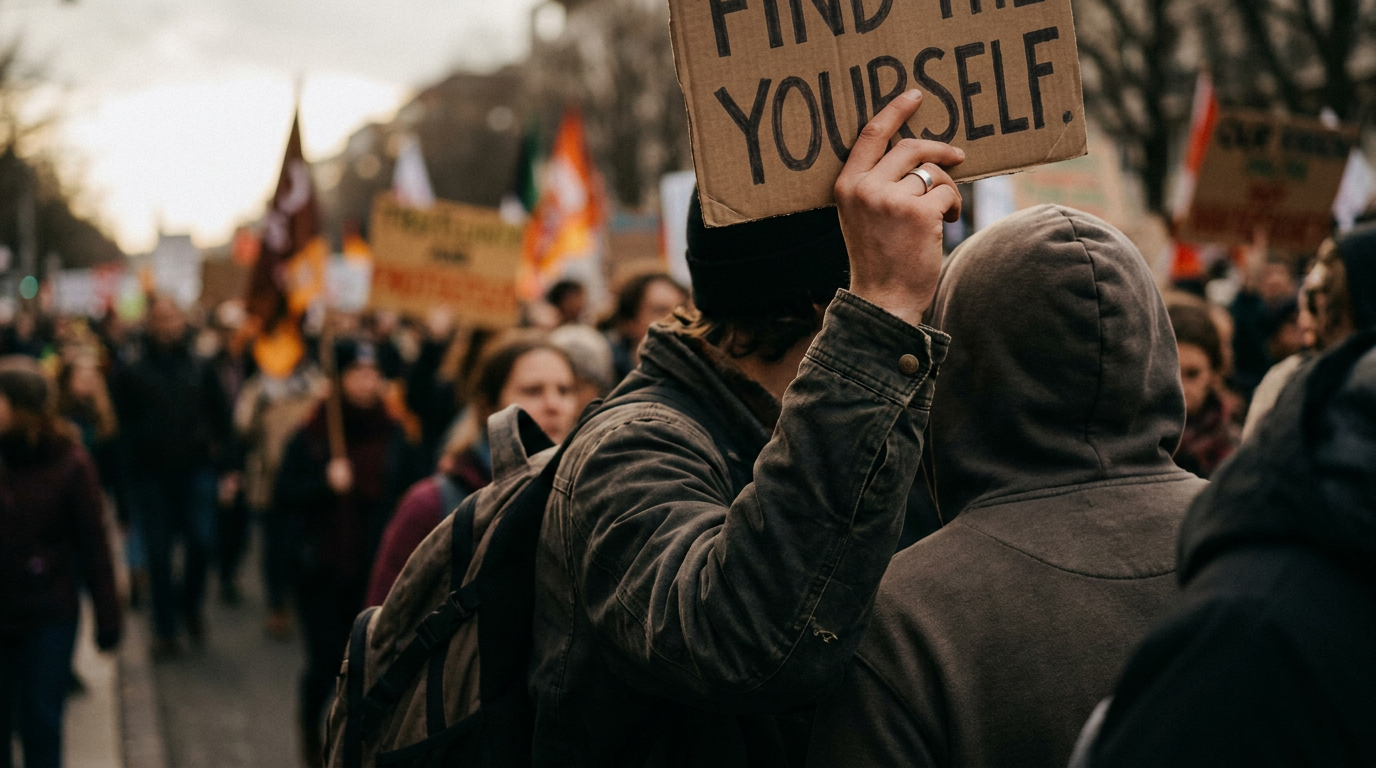
Picture yourself at a march — the kind where you can't see the front or the back of the crowd, only the bodies immediately around you, moving in rough unison. The chanting has picked up a rhythm. Someone nearby is holding a sign with a slogan you've thought yourself but never said aloud. A stranger's shoulder is pressed against yours, and you are not uncomfortable. Something has shifted in the quality of your attention. It isn't absent. If anything, it feels sharper, though sharpened toward something different than your usual preoccupations.
For more than a century, psychologists had a name for what they assumed was happening in that moment: deindividuation. The word has a clinical coldness that matches its original meaning. When people merge into a crowd, the classic model argued, individual identity dissolves. Self-awareness drops. Impulsivity rises. The superego loosens its grip. Gustave Le Bon, the nineteenth-century French sociologist whose crowd psychology still haunts the field, called it a kind of contagion — rational people temporarily regressing into something more primitive, more animal, more dangerous. His crowd was always a mob waiting to happen.
That framework baked itself into popular culture so thoroughly that it barely registers as a theory anymore. It just feels like common sense. Of course crowds make people do things they wouldn't do alone. Of course anonymity is dangerous. Of course the individual mind gets swamped. The only question seemed to be how much, and how fast. But a wave of research over the last decade — leaning on mobile EEG, real-world data from political demonstrations, and the accidental natural experiment of post-pandemic crowd psychology — is pulling apart that assumption with surprising force. The brain in a crowd, it turns out, is not a brain being hijacked. In many cases, it is a brain doing something more interesting.
The shift is more than academic. How we understand crowds shapes how we police them, how we frame social movements, how we design public spaces, and how we make sense of our own behavior when we step into a crowd and notice, with a small shock, that we feel more like ourselves than we expected.
The Hijacked Brain That Wasn't
To understand why the old model stuck around so long, it helps to understand what it got right. There are genuine neurological changes that accompany immersion in a large social group. The stress-response system modulates. Oxytocin, the neuropeptide most associated with bonding and affiliation, rises in contexts of close physical proximity and synchronized movement. Self-referential processing — the quiet background hum of the default mode network tracking your own thoughts, goals, and social standing — does shift when your attention is captured by a shared external focus. These are real effects. The question is what they mean.
The deindividuation model read them as evidence of erasure. Reduced self-monitoring looked like loss of identity. Increased synchrony looked like surrender to the group. Impulsive collective behavior looked like the animal underneath the rational person breaking free. But this interpretation was always doing a lot of heavy lifting based on thin evidence — mostly lab studies involving anonymity, small groups, and artificial conditions that don't map cleanly onto the experience of standing in a crowd of ten thousand people with a shared purpose.
One of the foundational critiques came from social identity theory, developed in the 1970s and 80s[4], which argued that humans don't have a single self that gets erased in crowds — they have multiple layers of identity, and crowds don't dissolve those layers so much as they activate a particular one. In a march for climate policy, you are not less yourself. You are more intensely the version of yourself that cares about climate policy. The individual identity quiets down; the group identity steps forward. This is not regression. It is identity switching, and human beings do it constantly, in crowds and out of them.
“The brain in a crowd is not a brain being hijacked. In many cases, it is a brain doing something more interesting.”
What Mobile EEG Is Showing Us
For a long time, the problem with studying real crowds was practical: you cannot wheel an fMRI scanner into a protest. Neuroimaging research on crowd psychology was, by necessity, either confined to the lab or inferred from behavior after the fact. Mobile EEG changed that[2]. Lightweight electrode headsets that can transmit data wirelessly have allowed researchers to record neural activity from people moving through actual public spaces — music festivals, sporting events, political rallies — and compare what's happening inside different heads in the same crowd at the same moment.
What these studies have begun to reveal complicates the erasure narrative considerably. Inter-brain synchrony[1] — the degree to which people's neural oscillations mirror each other — does increase in crowd settings, particularly in the frequencies associated with attention and emotional processing. But synchrony is not the same as uniformity. Two brains can fall into rhythm with each other while each is doing its own work. Musicians in an ensemble show high inter-brain synchrony. So do people having an intimate conversation. The synchrony appears to reflect shared engagement with a common environment, not the replacement of individual cognition with group cognition.
More striking is what happens in the prefrontal cortex — the region most associated with executive function, decision-making, and social cognition. The old deindividuation model implicitly predicted that prefrontal activity would diminish as the crowd's influence deepened, consistent with reduced self-regulation and increased impulsivity. Some mobile EEG data suggests a different pattern: prefrontal engagement can actually increase during moments of high group cohesion, particularly when the crowd is organized around a meaningful shared goal. The brain, apparently, is working harder, not coasting.
Crowds That Build Identity Instead of Erasing It
In 2011, researchers studying crowd dynamics at the Hajj[3] — the annual Islamic pilgrimage that draws millions of people to Mecca — found something that had never fit the classic model comfortably. Rather than reporting loss of self, participants consistently described the experience as identity-clarifying. The immersion in a massive crowd didn't dissolve who they were. It intensified a specific layer of who they were: their religious identity, their sense of membership in something much larger than their daily life. The crowd didn't erase the self. It gave the self a particular frame.
Similar patterns emerged in research on political demonstrations. Studies that tracked participants before, during, and after protests found that crowd participation frequently increased, not decreased, measures of personal agency and political identity. People came out of the crowd feeling more like themselves — specifically, more like the version of themselves that held the values that had brought them there. The mechanism researchers proposed was something like identity consolidation: the social confirmation of being surrounded by people who share your core commitments makes those commitments feel more real, more worth defending, more central to who you are.
“The crowd didn't erase the self. It gave the self a particular frame.”
This has a neurological correlate worth taking seriously. When beliefs and values are socially confirmed — when the people around you act in ways consistent with your own sense of what matters — the brain's reward circuitry responds. There's a prediction-error mechanism at work: the brain is constantly making implicit predictions about social reality, and when those predictions are confirmed at scale (everyone here agrees that this thing is worth caring about), dopaminergic systems register something like validation. That signal doesn't feel like impulsivity. It feels like certainty. It can be a source of irrational confidence, yes — but it can also be a source of genuine, grounded resolve.
The Pandemic Gap and What It Revealed
COVID-19 ran the cruelest possible natural experiment on crowd psychology. For roughly two years, large gatherings essentially stopped. Stadiums went silent. Concert halls closed. Protests were held at reduced scale or moved online. Then, when crowds returned, researchers who study collective behavior had something they'd never had before: a large population of people experiencing crowd immersion for the first time in years, many of them newly aware of what the absence had cost them.
The accounts that emerged from that first wave of post-pandemic crowd experiences were striking in their consistency. People at the first concerts, first sports events, first mass gatherings reported something that went beyond relief or excitement. Many described feeling like a part of themselves had been restored — not a fuzzy, vague self, but specifically the social self, the self that existed in relation to other bodies in a shared space. Psychologists who study crowd experience had long argued that co-presence — the physical fact of being in the same space as other people, breathing the same air, occupying the same acoustic field — does something that virtual togetherness cannot replicate. Post-pandemic crowd reports gave that argument unexpected weight.
What people missed, it turned out, was not just the event. They missed the specific quality of collective attention. Being in a room where ten thousand people are focused on the same thing creates a shared salience — a field of meaning that feels, phenomenologically, different from experiencing the same content alone on a screen. Attention researchers have a term for the way shared emotional context amplifies individual affective responses: emotional contagion, though that phrase carries Le Bon's old shadow. A better frame might be affective co-regulation: the way human nervous systems modulate each other when they're physically close and emotionally aligned. After two years of isolation, people had lost access to that regulation, and they felt the gap in ways they hadn't predicted.
When the Old Model Is Still Right
None of this means the classic concerns about crowd psychology were pure myth. The conditions under which crowds do produce disinhibited, impulsive, or violent behavior are real — they are just more specific than the blanket hijacking narrative allowed. Anonymity matters enormously. A crowd where individual identity is concealed — masks, uniforms, darkness, the genuine belief that no one will know who did what — does reduce self-monitoring in the ways the original model predicted. But that is an anonymity effect, not a crowd effect per se. The crowd is the occasion; the anonymity is doing most of the psychological work.
Crowd composition matters too. When a group has no shared identity or purpose — a panicking crowd fleeing a fire, a crowd assembled by happenstance rather than choice — the dynamics shift. The social identity model predicts this: if there is no group identity to activate, no shared values to consolidate, then the crowd really does function more like the chaotic mass Le Bon imagined. The binding force is absent. What's left is individual fear and individual survival logic, which can collide badly in a compressed space.
And then there is the specific case of crowds that form around outgroup hostility — crowds defined primarily by who they are against rather than what they are for. Research on collective violence suggests that this configuration, where shared identity is built on threat and dehumanization rather than positive affiliation, activates different neural and social dynamics. The amygdala's threat-detection system, already primed for social danger, gets collective reinforcement. Dehumanizing language circulates and escalates because it confirms the group's framing of reality. In these conditions, something closer to Le Bon's crowd does emerge — but it is not because identity dissolved. It is because a specific, narrow, fear-saturated identity was amplified instead.
“It is not because identity dissolved. It is because a specific, narrow, fear-saturated identity was amplified instead.”
What This Means for the Person in the Crowd
There's something clarifying about this reframe, even if the science is still messy at the edges and mobile EEG has real methodological limitations that researchers are quick to flag. The updated picture is not flattering in a simple way — it does not say crowds are safe, or that collective behavior is always rational, or that mob violence is somehow not what it looks like. It says something more precise: crowds do not reliably erase the self. They reliably amplify a self. Which self gets amplified depends on who is in the crowd, why they came, what identity frame is activated, and what conditions — anonymity, threat, shared purpose, physical comfort or panic — shape the hour.
That has practical implications for how we think about crowd design, crowd policing, and crowd participation. A police strategy that treats every protest crowd as a mob-in-waiting may create the very dynamics it expects to prevent, by introducing threat, anonymity (on both sides), and the collapse of positive social identity into defensive identity. An architecture that gives people room to move, sensory clarity, and social legibility creates different crowd psychology than one that compresses, confuses, and overwhelms. The crowd is not a fixed phenomenon with a fixed brain. It is a system, and the system responds to what surrounds it.
Back to that march: the shoulder against yours, the chanting, the sign with your thought on it. What the new research suggests is that what you felt sharpening in that moment was not a loss of your critical mind to social contagion. It was something more like a specific self — the one who holds these particular values, who came here on purpose, who finds in this convergence of strangers a kind of confirmation that what matters to you actually matters — stepping into focus. That self was there before the crowd. The crowd just gave it room to be louder than everything else, for a while, which is not the same thing as being the only thing. You were always in there. The crowd found a version of you you already knew.
References
- Brain-to-Brain Synchrony Tracks Real-World Dynamic Group Interactions in the Classroom (pubmed.ncbi.nlm.nih.gov)
Provides evidence that inter-brain synchrony increases in crowd settings within attention and emotional processing frequencies, but reflects shared engagement rather than uniform cognition. - Getting closer to social interactions using electroencephalography in developmental cognitive neuroscience (pmc.ncbi.nlm.nih.gov)
Demonstrates that mobile EEG technology enables researchers to record neural activity from people in actual public spaces like protests, overcoming previous lab-only limitations. - Social identification moderates the effect of crowd density on safety at the Hajj (ncbi.nlm.nih.gov)
Documents 2011 research showing Hajj participants experienced identity clarification and intensified religious identity rather than loss of self in massive crowds. - Social Identity Theory (sk.sagepub.com)
Provides the theoretical foundation that humans have multiple identity layers activated in crowds rather than a single erased self.
About Sarah Jenkins
Sarah Jenkins writes about the stranger mechanics of the human mind — how memory actually forms and why some moments calcify into permanent record while others vanish, how grief operates as a prediction error, and why the brain's threat systems keep running long after the threat is gone. Her work brings neuroscience to experiences people recognize but couldn't explain.
More like this

Your Brain Is Still Looking for Them. That's What Grief Actually Is.
New neuroscience suggests grief isn't a sequence of emotional stages — it's a prediction-error crisis, and your brain is running a search it cannot cancel.

The Social Replay Loop That Runs Every Night Whether You Want It To
Post-event rumination feels like self-torture, but neuroscience is revealing it as something stranger: a misfiring threat-detection loop with a specific address in the brain.
Your Brain Treats Rejection Like a Burn — And Now We Know Why It Learns From It
New brain imaging research reveals that the sting of rejection isn't just damage — it's your social navigation system quietly running an update.