Your Brain Treats Rejection Like a Burn — And Now We Know Why It Learns From It
New brain imaging research reveals that the sting of rejection isn't just damage — it's your social navigation system quietly running an update.
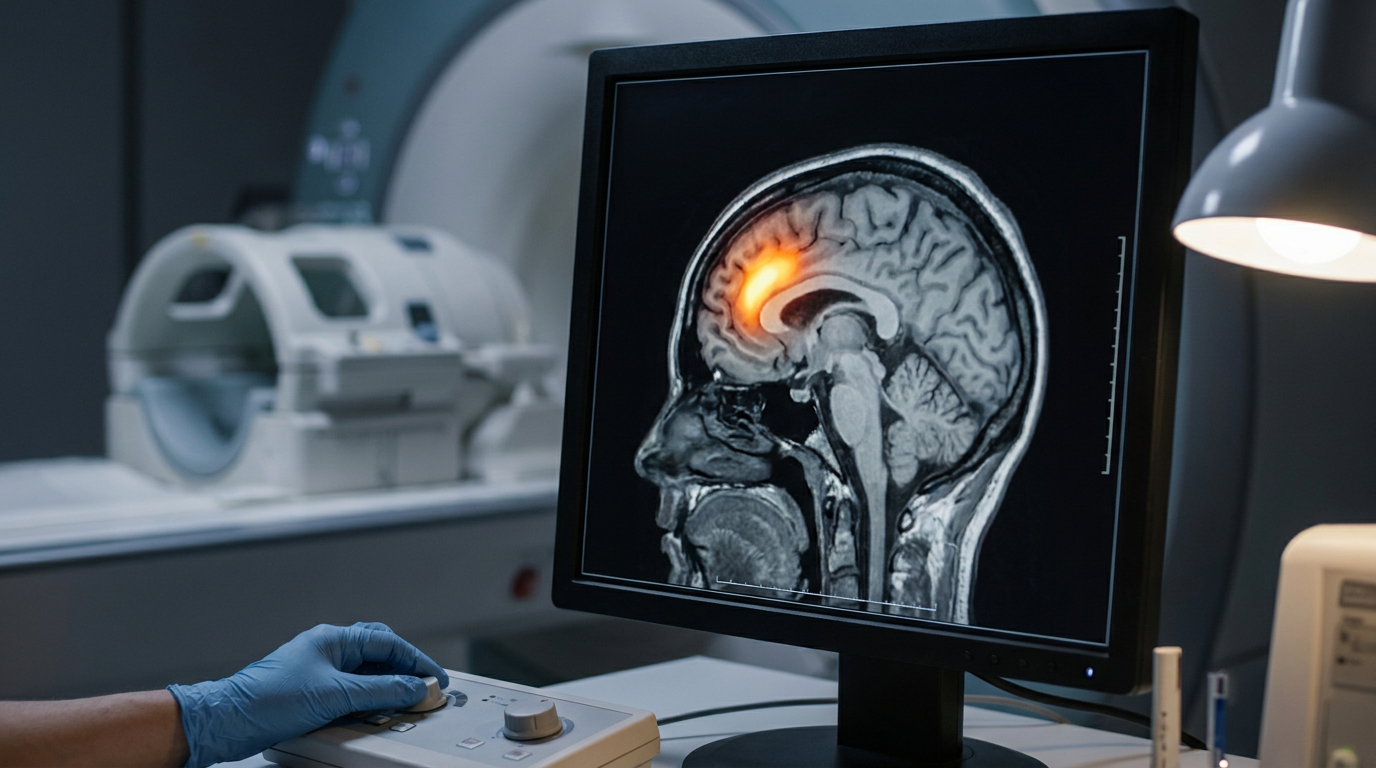
Picture a group of people at a party, standing in a circle. You drift over and say something, and the circle doesn't quite open. Nobody is rude. The conversation just sort of continues without you, like a stream redirecting around a stone. You leave and get yourself another drink. Later that night — or, honestly, at 2 AM — your chest does the thing again, that dull contraction you can't fully name. It doesn't feel like thinking. It feels like something.
That feeling has a neural address, and researchers have been mapping it for years. What a brain imaging study out of the University of Southern California[2] has added is something more specific: the brain doesn't just register social rejection as pain and move on. It does that and something else simultaneously — something that looks, in the imaging data and computational models, a lot like learning. The sting and the lesson arrive together. They may, in fact, be the same event.
This is not the kind of finding you can dismiss as obvious. Most of us operate with an implicit model of rejection that goes something like: something bad happened, now I feel bad, hopefully it fades. What the USC research suggests is that the brain is doing something far more purposeful while you're standing there with your drink. It is tagging the experience, encoding the social context, and quietly recalibrating the predictions it will make next time a similar situation arises. The pain isn't incidental. It is part of the update mechanism.
To understand why that matters — and why it changes how you might think about your own worst social memories — it helps to look at what rejection actually does to the brain, at the level of neurons and circuitry, before it ever becomes the story you tell yourself.
The Overlap That Started Everything
The idea that social pain and physical pain share neural real estate is not new. Research going back to the early 2000s, most famously work using a virtual ball-tossing game called Cyberball[1] to induce mild social exclusion in an fMRI scanner, showed that being left out activated regions like the dorsal anterior cingulate cortex and the anterior insula — areas also implicated in the unpleasantness of physical pain. This was striking enough at the time to generate real debate. Were these regions truly doing the same thing, or just neighboring the relevant circuitry? Was the overlap meaningful or anatomically incidental?
The short answer that emerged over the following decade: meaningful. The dACC in particular appears to function as a kind of conflict-and-salience detector — it flags things that matter, things that require attention, things that deviate from what the brain expected. Physical pain is one such signal. Social disconnection turns out to be another. From the brain's perspective, both say: something is wrong here. Both demand a response. The USC work builds on this foundation but pushes into territory the earlier research didn't fully explore: not just that rejection hurts, but what the brain does with that hurt.
“From the brain's perspective, physical pain and social exclusion both say the same thing: something is wrong here — and both demand a response.”
Two Things at Once
The USC study used a combination of brain imaging and computational modeling — specifically, a reinforcement learning framework — to track what happens in the brain during and after social rejection. Participants were put through a version of an interactive social evaluation task while being scanned, then researchers used the modeling to separate out distinct neural signals: the immediate pain response, and something that looked like a prediction error signal.
Prediction error is a concept borrowed from reinforcement learning, and it refers to the gap between what the brain expected and what actually happened. When you expect to be included and you're not, that gap is negative. When you expect rejection and receive warmth instead, the gap runs the other way. What makes prediction error signals interesting — and important — is that they are the currency of learning. The brain uses them to update its internal models. They are how we get better at predicting the future, one experience at a time.
What the USC imaging data showed was that rejection was generating both signals: the pain signal associated with the dACC and insula, and a separate prediction error signal in regions including the striatum and medial prefrontal cortex — areas deeply involved in social cognition, value learning, and the updating of expectations about other people. These are not the same regions doing the same thing. They appear to be doing distinct computational work, simultaneously, in response to the same social event. You feel the sting, and you file the lesson, in the same neural moment.
Why Evolution Would Build It This Way
The architecture makes a strange kind of sense once you stop thinking about pain as a punishment and start thinking about it as information. Humans are unusually dependent on group membership. For most of our evolutionary history, exclusion from the group wasn't a bad evening — it was a survival problem. A species that treated social disconnection as neutral data would have been poorly equipped to correct course, to adjust behavior, to figure out what had gone wrong and fix it before the consequences became serious. Pain is memorable in a way that neutral events are not. The amygdala, which is involved in tagging emotionally significant experiences[3] for stronger encoding, helps ensure that moments of social threat stick.
But mere pain isn't enough. Pain tells you that something went wrong; it doesn't tell you what, or how to navigate differently next time. That's where the prediction error machinery comes in. Social environments are complicated — they're full of people with varying intentions, shifting group dynamics, status negotiations, subtle signals about inclusion and exclusion. Learning to read those environments accurately requires the kind of iterative model-updating that reinforcement learning systems do well. The brain, this research suggests, runs that system on social information the same way it runs it on other kinds of rewards and punishments. Your social world is, in the brain's accounting, a learning environment.
“Pain tells you something went wrong. The prediction error signal tells you how to adjust. The brain appears to run both programs at once.”
When the Learning System Misfires
This is where the research stops being purely fascinating and starts being useful for understanding actual human suffering. Because the same system that helps you learn to navigate social environments more skillfully can also, under certain conditions, learn the wrong things.
Consider what happens when rejection is frequent, early, and unpredictable — as it is for children in chaotic or neglectful environments, or adolescents subject to sustained peer exclusion. The prediction error signals are still running, but the model they're building isn't necessarily accurate. A brain that has been rejected enough times may begin generating predictions of rejection in social situations that are actually neutral. The dACC lights up at ambiguity. The striatum updates toward negative expectations. The person walks into a room already braced.
Researchers studying social anxiety have long noted that one of its hallmarks is exactly this: a tendency to interpret ambiguous social information as threatening. A text message that goes unanswered for six hours is not evidence of anything, in an objective sense. But if your social learning history has repeatedly tagged unanswered messages with painful outcomes, your brain has rational — from its own internal logic — grounds for treating it as a signal. The system is not malfunctioning. It is working as designed, just on data that may have been skewed by circumstances that no longer apply.
This is also why rejection sensitivity — the tendency to anxiously anticipate, and react intensely to, perceived rejection — doesn't behave like a simple personality trait. It behaves like a learned set of predictions. People with high rejection sensitivity often report that they know, consciously, that they're overreacting. They can stand outside the response and observe it. What they can't do, easily, is override the prediction the brain has already made, because the prediction was encoded with pain, which means it was encoded hard.
The Striatum's Social Ledger
The involvement of the striatum in this process is worth pausing on, because it complicates a common assumption. The striatum is most often discussed in the context of reward — it's central to dopamine-driven learning, to the anticipation of good outcomes, to the reinforcement loops that drive motivation and habit. Finding it active during social rejection processing suggests that the brain's reward circuitry is doing double duty as a social evaluation system, tracking not just "did I get what I wanted" but something more like "how did that person respond to me, and what does that mean for my predictions about people going forward."
This maps onto what social neuroscientists sometimes call the "social brain hypothesis[4]" — the idea that primate cortical expansion, and the particularly dramatic expansion of the human prefrontal cortex, was driven in significant part by the computational demands of living in complex social groups. Keeping track of who likes you, who doesn't, who is trustworthy, who has shifted since last week — this is an enormous modeling task, and the brain appears to have recruited some of its most powerful learning machinery to handle it. The striatum's involvement suggests that social inclusion and exclusion are processed, at some level, as rewards and punishments in the purest computational sense of those words.
What that means, practically, is that social experiences can shape the reward circuitry in ways that mirror how other reinforcers do. Someone who has had mostly positive social outcomes doesn't just feel more confident — they have a differently calibrated internal model, one that generates more optimistic predictions and tolerates ambiguity more easily. Someone whose social history is weighted toward rejection and exclusion may have a model that is technically accurate to their past but systematically pessimistic about their present. The ledger is real. It's just not always fair.
“The brain appears to treat social inclusion and exclusion as rewards and punishments in the purest computational sense — which means rejection shapes the circuitry, not just the mood.”
What This Means for the Memory That Won't Quit
There's a practical implication buried in all of this that I keep coming back to, which has to do with why certain social memories have such unusual staying power. Not all bad experiences stick equally. You probably don't remember most of the times you've been bored, or mildly disappointed, or physically uncomfortable. But you likely do remember a specific moment from years ago when you said something and the room went quiet, or when someone you liked turned away from you at exactly the wrong moment. The memories that are encoded with pain get prioritized. The amygdala and hippocampus work together to ensure that emotionally significant experiences are consolidated more robustly. This is basic emotional memory.
But the USC findings add a layer. If rejection memories are encoded not just with pain but with a prediction error signal — a marker of how much the situation deviated from expectation — then the intensity of the memory may also reflect how much updating the brain decided was necessary. A rejection you saw coming, from someone you didn't particularly like, in a context you understood, might not generate a large prediction error. A rejection that surprised you, from someone whose approval mattered, in a situation you had read as safe, generates a large one. The brain files that kind of memory urgently. It wants you to know: your model was wrong here. Fix it.
This is, admittedly, not always the comfort people are looking for when they're lying awake at 2 AM replaying something from eleven years ago. But there is something clarifying about it. The memory isn't a character flaw, and it isn't proof that you're uniquely pathetic about rejection. It's evidence that something surprised your brain enough to generate a strong update signal — and the brain, because it treats social threats as survival-relevant, committed that surprise to long-term storage. The cringe and the rumination are the filing system. You are not its author. You are, mostly, just the person who has to live in the building.
What does change, over time and with enough genuinely different experiences, is the baseline the predictions run from. The brain's models aren't fixed. They're updatable — that's the whole point of the error-correction system. Positive social experiences generate their own prediction errors, their own updates, their own recalibrations. The person who stays slightly braced in every room is not permanently braced. They're running old predictions on new data. The gap between those two things is uncomfortable, and it is also, as the striatum apparently knew all along, exactly where learning happens.
References
- Does Rejection Hurt? An fMRI Study of Social Exclusion (science.org)
Demonstrates that social exclusion activates the same brain regions (dorsal anterior cingulate cortex and anterior insula) involved in physical pain processing. - Neural responses to social rejection reflect dissociable learning about relational value and reward (pnas.org)
Provides brain imaging and computational modeling data showing rejection activates both pain signals and prediction error signals simultaneously in the brain. - The amygdala mediates the facilitating influence of emotions on memory through multiple interacting mechanisms (pmc.ncbi.nlm.nih.gov)
Establishes that the amygdala tags emotionally significant experiences for stronger memory encoding, supporting why rejection pain is memorable. - The social brain hypothesis and its implications for social evolution (pubmed.ncbi.nlm.nih.gov)
About Sarah Jenkins
Sarah Jenkins writes about the stranger mechanics of the human mind — how memory actually forms and why some moments calcify into permanent record while others vanish, how grief operates as a prediction error, and why the brain's threat systems keep running long after the threat is gone. Her work brings neuroscience to experiences people recognize but couldn't explain.
More like this

Your Brain Isn't Keeping Memories. It's Holding Auditions.
New research reveals that long-term memory isn't a snapshot — it's a slow biological negotiation happening in your brain for hours after an experience ends.

The Social Replay Loop That Runs Every Night Whether You Want It To
Post-event rumination feels like self-torture, but neuroscience is revealing it as something stranger: a misfiring threat-detection loop with a specific address in the brain.

Why Rejection Still Lands Like an Emergency, Even When You're Safe
New research suggests the adult who falls apart over mild criticism isn't fragile — they're running a perfectly calibrated survival system that just hasn't been updated yet.