What 67 Posts in Two Hours Actually Reveals About the Human Brain Under Pressure
Trump's escalating Truth Social posting patterns are genuinely unusual — and a neuroscientist's instinct isn't to diagnose, but to ask the harder questions the data raises.
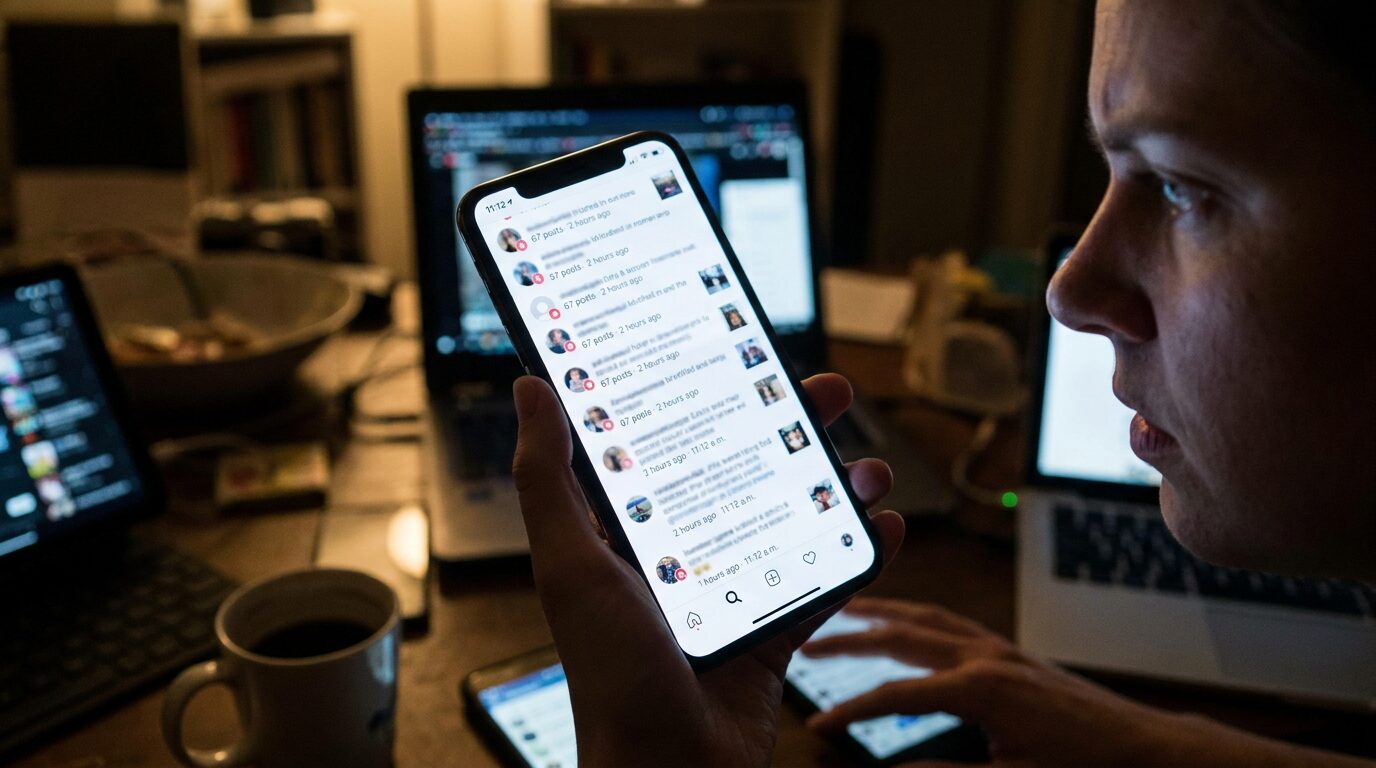
The temptation, when you hear that a sitting president posted 67 times on social media inside a two-hour window — roughly once every minute and forty-five seconds — is to reach for the most alarming clinical label available and attach it firmly. That instinct is understandable. It is also, from a neuroscience standpoint, the wrong move. Diagnosis from a distance is not science. It is pattern-matching dressed up as expertise, and the history of medicine is littered with the wreckage of conclusions drawn too fast from behavior observed too loosely.
But the corollary error is equally sloppy: dismissing the behavioral data as meaningless because it makes us uncomfortable to analyze a political figure's cognition. The numbers are real. According to a Daily Beast analysis[3], President Trump posted on Truth Social 861 times in May 2026 alone — an average of 27 posts per day, or more than once per waking hour. A separate NPR analysis[5] counted 2,249 posts across the first four months of 2026, an average of just under 19 per day. In December 2025, he fired off more than 160 posts in under five hours[7] during a late-night binge, then was awake by 5:48 a.m. the next morning to declare, "TRUTH SOCIAL IS THE BEST! There is nothing even close!!!" And on the Fourth of July, he posted 67 times between 11:12 a.m. and 1:14 p.m.[2] — almost every minute, for two straight hours. These are observable, documented behaviors. A neuroscientist's job is to think carefully about what they might and might not mean.
What the Behavioral Pattern Actually Looks Like
Before any clinical framework gets applied, it helps to describe the behavior plainly. The posting is not evenly distributed throughout the day. The Daily Beast's analysis found that some of the most intense bursts come late at night — and that the content during those late-night spirals shifts in character. What begins as political endorsements can, by the small hours, drift into reposts calling Barack Obama a "traitor" and sharing fawning content that declares Trump "the G.O.A.T." The platform, as NPR reported[5], functions partly as a direct communications channel, bypassing the layers of institutional approval that would normally filter a president's public statements. The volume and the late-night timing are both relevant clinical observations, even if neither one alone means anything definitive.
CNN's Stephen Collinson described Trump[4] as "the most volatile president in living memory" who is "becoming ever more driven by the whiplash of his personal whims." That is political analysis, not neuroscience. But political behavior and neurological health are not cleanly separable in an 80-year-old man whose public output is this voluminous and this irregular. The question a neuroscientist finds genuinely interesting is: what does normal aging do to the systems that regulate the behavior we're watching — and is there any meaningful distance between what we'd expect from a healthy 80-year-old brain and what we're observing?
The Aging Brain and Impulse Regulation
The prefrontal cortex, which sits just behind the forehead and is sometimes called the brain's executive control center, undergoes measurable structural and functional change across the normal adult lifespan. White matter integrity — the quality of the long-range connections between brain regions — declines with age in most people. The prefrontal cortex loses volume. Neural processing slows. Crucially, the circuits that help us inhibit impulses, regulate emotional reactions, and modulate what we say before we say it become less efficient. This is not catastrophic in most people. It is the ordinary biology of getting older. But it is real, and it means that behaviors which require suppression — not responding to every provocation, not posting a thought the moment it forms, not seeking reassurance compulsively when anxious — become genuinely harder to sustain as the brain ages, even in the absence of any disease process.
“The circuits that help us inhibit impulses and modulate what we say before we say it become less efficient with age. This is ordinary biology. But ordinary biology still has consequences.”
Sleep architecture also changes with age in ways that matter here. Older adults tend to spend less time in deep slow-wave sleep and experience more fragmented overnight rest. Poor sleep — and there is ample evidence that late-night social media use both reflects and worsens disrupted sleep — compounds the prefrontal deficit. A tired prefrontal cortex is a less effective brake. The glymphatic system, which performs much of the brain's overnight waste clearance, is most active during deep sleep; disrupted sleep architecture in older adults is increasingly associated with accumulation of the metabolic byproducts that, over years, are implicated in cognitive decline. The late-night posting binges are worth noting not just as curiosities, but because they suggest that the sleep windows most critical to brain maintenance may be compromised.
What the Content Pattern Adds
Volume alone would be interesting. Volume combined with content drift is more so. The Daily Beast's analysis noted that late-night sessions frequently involve self-soothing reposts — content praising Trump, ranking him among the greatest presidents, celebrating him effusively — alongside content expressing sharp grievance and accusation. This is not the posting behavior of someone following a communications strategy. It reads more like the behavior of someone seeking emotional regulation through external validation, repeatedly and urgently. The repetition itself matters: research published in Public Opinion Quarterly[1] found that repeated false claims correlate with shifts in public belief — what psychologists call the illusory truth effect. But the repetition may also tell us something about the poster. Rumination — cycling through the same grievances, the same praise-seeking, the same threats — is a feature of dysregulated emotional processing, and it tends to intensify when the neural systems that interrupt and redirect it are working less efficiently.
None of this is a diagnosis. Sundowner's syndrome — the clinical term is sundowning, and it refers to increased confusion, agitation, and behavioral disturbance in the late afternoon and evening, typically in people with dementia — requires a clinical evaluation, longitudinal cognitive testing, and caregiver observation of functional decline to diagnose. You cannot diagnose it from Truth Social posts. The behavioral pattern is consistent with some things that happen in cognitive decline, but it is also consistent with impulsive personality structure, chronic sleep disruption, anxiety, the particular feedback loops of social media engagement, and simply being an 80-year-old man with an unusually high-stimulation job and no apparent institutional filter on his public output. Consistency with a diagnosis is not the same as evidence for it.
Why the Question Still Deserves to Be Asked Seriously
The Wikipedia entry on age and health concerns about Donald Trump[6] notes that analyses of his speeches over time found them to be "darker, harsher, longer, angrier, less focused, more profane and increasingly rambling" — language that, in a clinical context, would flag a need for evaluation. The posting volume adds a quantitative layer to that qualitative observation. 861 posts in a single month, with content that shifts character after midnight, is not a stable behavioral baseline. It is an escalating one.
The serious version of this concern is not a partisan talking point. It is a structural one. When the person holding the most consequential executive authority in the world shows a behavioral pattern characterized by high impulsivity, poor sleep hygiene, compulsive reassurance-seeking, and escalating volume of unfiltered public communication — and when that person is 80 years old, an age at which even healthy brains have meaningfully diminished executive regulation — the question of cognitive fitness is not gossip. It is a legitimate public health concern that deserves rigorous, good-faith engagement rather than either reflexive medicalization or reflexive dismissal.
What neuroscience can honestly offer here is not a verdict. It is a framework for asking the right questions: Is this behavior escalating over time, or stable? Does it vary by time of day in a patterned way? Is the content becoming less coherent, or simply more frequent? Are there signs of perseveration — the repeated return to the same themes without resolution — that would suggest rumination beyond ordinary political grievance? The answers would require access to the man, not his feed. But the questions are real. And in a democracy where cognitive fitness for office has no formal mechanism for evaluation, the behavioral record — 2,249 posts in four months, 67 in two hours, 160 in a single overnight — is the only data most of us will ever get.
References
- All the President’s Lies: Repeated False Claims and Public Opinion (doi.org)
Establishes that repeated false claims correlate with shifts in public belief, supporting the article's analysis of Trump's repetitive posting pattern. - Trump Goes on 67-Post Rampage After Fireworks Fiasco (thedailybeast.com)
Provides the specific Fourth of July posting data: 67 posts between 11:12 a.m. and 1:14 p.m., with content showing repeated grievances, supporting the article's analysis of content drift and rumination. - Trump Sets Worrying New Record as Mania Spirals Out of Control (thedailybeast.com)
Documents Trump's May 2026 posting volume of 861 times monthly, averaging 27 posts per day, establishing the quantitative baseline for the article's analysis. - Trump’s growing volatility is putting the world on edge (edition.cnn.com)
Supplies the quote describing Trump as 'the most volatile president in living memory' driven by personal whims, contextualizing political behavior observations the article distinguishes from neuroscience. - Trump's Truth Social lays bare narrow obsessions of an extremely online president (npr.org)
Provides separate analysis counting 2,249 posts across first four months of 2026, averaging under 19 daily posts, and describes Truth Social's role as unfiltered direct communications channel. - Age and health concerns about Donald Trump (en.wikipedia.org)
Notes that analyses of Trump's speeches found them 'darker, harsher, longer, angrier, less focused, more profane and increasingly rambling,' providing qualitative language that flags clinical evaluation concerns. - Trump Fires Off Over 160 Truth Social Posts in Frenetic, Late-Night Blitz (yahoo.com)
Confirms the December 2025 late-night posting binge of 160+ posts in under five hours, demonstrating the pattern of nocturnal social media activity the article examines.
About Marcus Okafor
Marcus Okafor covers general wellness, brain health, cognitive aging, sleep, and the biology of staying sharp across a lifetime. His work traces how the body and mind maintains, loses, and sometimes rebuilds — from the nitty gritty science of your bones — to the strange frontiers of the glymphatic system flushing toxins overnight — to the way imagined conflict primes the same stress circuitry as the real thing.
More like this
Lifting Weights Does Something to Your Brain That Running Simply Can't
New expert analysis confirms that aerobic and resistance training drive distinct changes in brain structure and chemistry — meaning the exercise routine most people follow may be protecting only half of what matters.

Your Body Clock Is a Better Dementia Predictor Than Your Sleep Hours
A major study found that people with fragmented circadian rhythms had 2.4 times the dementia risk — and the mechanism points to something sleep duration alone can't fix.
Your Brain Washes Itself at Night. Here's What Breaks the Drain.
A 2025 trial confirmed the brain flushes Alzheimer's proteins overnight — but the specific sleep conditions that make that flush work are messier, and more contested, than anyone is telling you.