When a Political Earthquake Rewires Your Entire Identity
Political ruptures don't just change who people vote for — they restructure the psychological scaffolding that holds a whole identity together.
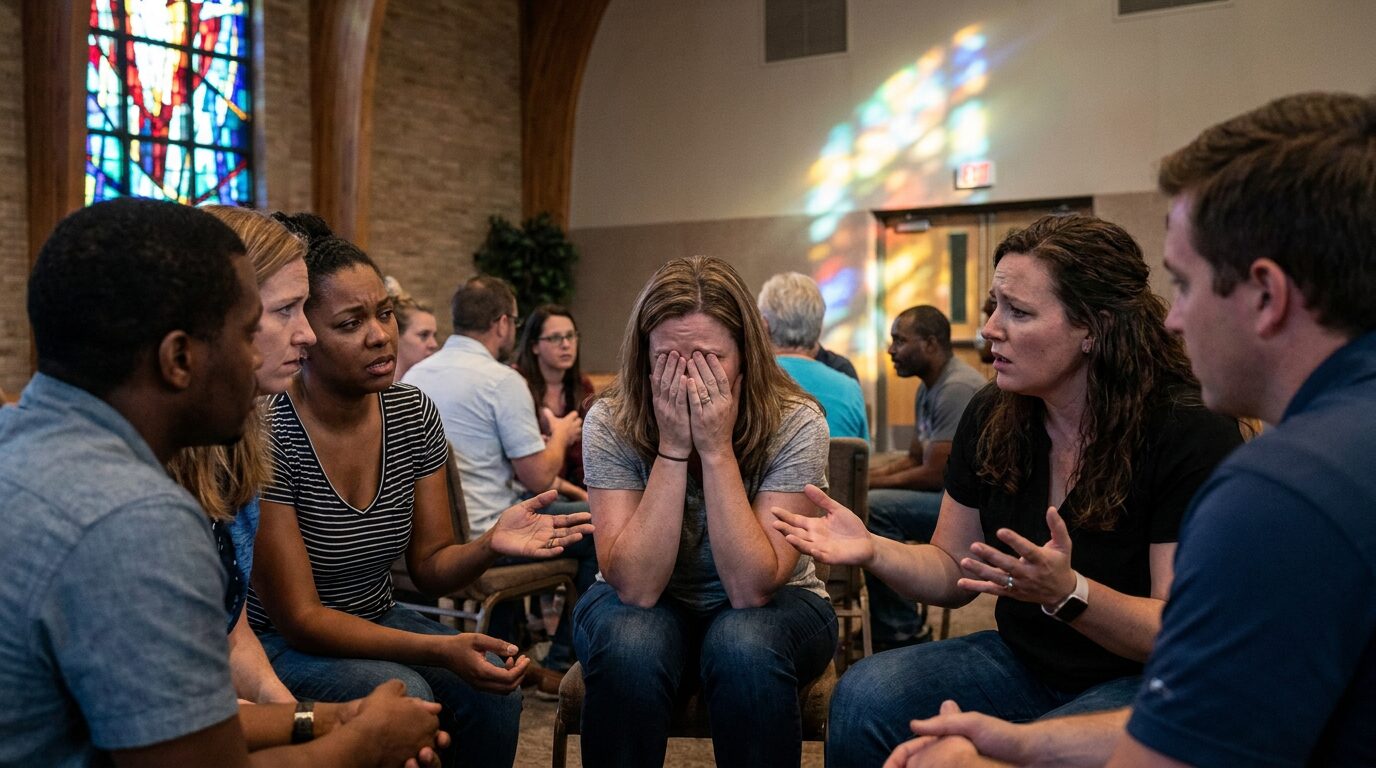
There is a particular kind of crisis that doesn't announce itself as a crisis. It arrives wearing the clothes of a political opinion, a news cycle, a vote. Only later does the person realize that what shifted wasn't just their view on an election — it was the ground their entire sense of self was standing on.
Researchers studying campus climate found that the period before and after the 2016 presidential election produced something measurable: more conversation about gender-based violence, greater support for survivors, more disclosures and help-seeking behaviors, and a detectable shift — in different directions on different campuses — in how communities tolerated or rejected norms around violence. As one Violence Prevention Committee chair described it in a study published in PMC[1], the moment became both "a blessing and a curse." The political environment, in other words, didn't just produce political effects. It restructured the emotional and relational landscape inside institutions that had been largely insulated from that kind of pressure.
For evangelical communities specifically, the same mechanism was operating at a much deeper level. The 2016 election didn't simply ask believers to make a political calculation. It asked them to hold together commitments — to sexual ethics, to truth-telling, to the protection of the vulnerable — that suddenly appeared to be in direct conflict with the political coalition they had spent decades building. That kind of cognitive dissonance doesn't resolve quietly. It tends to keep working on people.
What Identity Foreclosure Actually Costs
Psychologists use the term identity foreclosure to describe what happens when a person adopts a set of commitments — religious, political, social — without having ever genuinely tested them against experience. The commitments become load-bearing. They don't just describe who you are; they hold the structure upright. The danger is structural: when one beam gets knocked loose, the whole frame can shift in ways the person never anticipated and isn't prepared to manage.
Evangelical identity had, for many people, reached precisely this level of integration. Theological belief, political affiliation, community belonging, moral framework, and social status had fused into a single package. To question one was to implicitly interrogate all of them. The 2016 election — and what followed it — introduced enough friction that the package started to come apart.
“When one beam gets knocked loose, the whole frame can shift in ways the person never anticipated and isn't prepared to manage.”
This is not a small thing psychologically. When a person's moral community — the group that validates their values, their behavior, their sense of being a good person — appears to contradict the very values it claims to protect, the experience is closer to attachment injury than to ordinary disagreement. It isn't just "I disagree with my church about this candidate." It is closer to: "The people I trusted to model the values I've organized my life around have just told me, through their actions, that those values were always conditional." That kind of revelation tends to cascade.
Disinformation and the Fracturing of Shared Reality
The psychological cost wasn't only about sexual ethics or moral hypocrisy. It was also about truth. A House Intelligence Committee report[2] examining the 2020 election documents in granular detail how disinformation campaigns — domestic and foreign — were specifically engineered to deepen divisions within American society and erode confidence in institutions. The report makes clear that none of what followed January 6th would have happened without deliberate, sustained manufacturing of false claims, and that foreign adversaries recognized the political environment as an exceptional opportunity to amplify fracture points already present in American communities.
For communities where epistemic authority had long been centralized — where a pastor, a denomination, or a political coalition told you what was true and you trusted that — the flooding of the information environment with competing, irreconcilable claims created a specific kind of disorientation. The structures that were supposed to help you sort truth from lie were now themselves implicated in the lie. The question "who do I believe?" had become genuinely unanswerable through the usual channels. And once a person has had to develop their own answer to that question — once they have been forced to evaluate claims independently rather than defer — it is extraordinarily difficult to return to pure deference. The capacity for independent evaluation, once activated, doesn't switch back off.
The Psychology of Deconstruction as a Cascade
What the research on campus climate illuminates — and what applies with equal force to evangelical communities processing the political ruptures of the past decade — is that once a person begins asking questions about one pillar of a belief system, the questioning tends to generalize. This is not weakness or disloyalty. It is how human cognition works when foundational assumptions get destabilized. The mind, suddenly aware that certainties it had treated as bedrock were actually constructed, begins applying that awareness everywhere.
Psychologists who study religious deconstruction — the process by which people dismantle and reconstruct their belief systems — note that the process rarely remains contained to theology. It moves through community, through relationship, through self-concept. A person who begins by questioning their church's political endorsements may find, within months or years, that they are also reexamining their views on gender, sexuality, biblical interpretation, and eventually the metaphysical claims themselves. The cascade is not inevitable, but it is common. And it is difficult to stop once it achieves a certain momentum, because each question answered honestly tends to generate two more.
This is what makes the political rupture of 2016 — and the subsequent years of disinformation, institutional stress, and public moral failures — so consequential for evangelical identity specifically. It wasn't a single shock. It was a sustained series of friction events, each one activating the questioning process again before the previous round had settled. The people most vulnerable to this cascade were those who had the most integrated identities: those for whom faith, politics, community, and moral self-concept had fused most completely.
What Happens to the Self When the Container Breaks
The psychological experience of religious deconstruction shares certain features with other forms of identity disruption: grief, disorientation, a loss of the social scaffolding that made daily life legible. People describe feeling unmoored in a way that doesn't map cleanly onto ordinary sadness or doubt. The community that would normally help them process distress is often the same community they are now uncertain about. The language they would use to make sense of difficulty — prayer, scripture, pastoral counsel — has become compromised by its association with the very things that triggered the crisis.
This is the part that tends to get underestimated in political coverage of evangelical decline. The numbers — falling church attendance, rising religious disaffiliation — are real and measurable. What those numbers don't capture is the interior texture of the experience: the profound disorientation of finding oneself outside a meaning-system one never chose to leave, having been effectively pushed out by the system's own contradictions.
“The capacity for independent evaluation, once activated, doesn't switch back off.”
Research on democratic backsliding — the gradual erosion of institutional trust and civic participation — identifies the Jim Crow era as among the most-cited historical examples[3] of how rights and belonging can be structurally dismantled, and notes that 21st-century backsliding has produced measurable erosion of confidence in governmental and civic institutions. The psychological parallel for faith communities is instructive: when the institutions that were supposed to be the guardians of values become visibly compromised by the pursuit of power, the people most invested in those values are often the ones who suffer the most acute crisis of meaning. They believed the institution was what it said it was. The evidence that it wasn't hits them harder than it hits the cynics.
The Questions That Can't Be Unasked
What clinical psychology understands about this kind of rupture is that it rarely resolves through a simple return to the previous state. Identity that has been forced open doesn't seal cleanly. People who go through serious deconstruction typically end up in one of several places: a reconstructed faith with different foundations, a secular worldview, a kind of ongoing agnosticism about the whole project, or — in some cases — a retreat back into the original system accompanied by active suppression of the questions that were raised. That last option is psychologically costly. Suppressed doubt doesn't disappear. It tends to calcify into rigidity, or to leak out in the form of disproportionate anger toward anyone who asks the questions openly.
The communities now showing the most aggressive policing of theological and political conformity may be, in part, communities in which a critical mass of people chose that last option. The hostility isn't incidental to the fracture. It is a response to it — an attempt to stabilize, through enforcement, an identity that can no longer hold itself stable through genuine conviction alone.
That is the inside of the earthquake no headline quite captures: not a clean split between believers and former believers, but a community in which some people are quietly reconstructing everything, some are trying to hold on by gripping harder, and some are simply waiting in the rubble, uncertain which direction to walk. The political event was the detonator. But the material it ignited had been accumulating for a long time — the merger of faith with partisan identity, the conflation of moral authority with political power, the displacement of grace by tribalism. The 2016 election didn't create those contradictions. It just made them impossible to look away from.
References
- “A Blessing and a Curse”: The Impact of Sociopolitical Events and National Discourse Surrounding Sexual Violence on College Campuses (pmc.ncbi.nlm.nih.gov)
Documents measurable shifts in campus discourse and help-seeking behaviors around sexual violence before and after the 2016 election. - House Intelligence Committee report (docs.house.gov)
Describes how domestic and foreign disinformation campaigns were engineered to deepen divisions and erode institutional trust surrounding the 2020 election. - Democratic backsliding (en.wikipedia.org)
Provides historical context on democratic backsliding and erosion of institutional trust as a documented pattern of structural dismantling.
About Jennifer Marsden
Jennifer Marsden writes about personality structure, emotional dysregulation, attachment wounds, trauma patterns, and the science beneath behaviors people are too quick to moralize. Her work focuses especially on borderline and narcissistic traits, not as internet villains, but as complex human adaptations with real consequences.
More like this

The Loneliness of Leaving: When Losing Your Faith Means Losing Everything
Online spaces for questioning faith can feel like rescue — but without addressing the underlying trauma, they often just swap one closed system for another.
Institutional Collapse Doesn't Look Like a Coup. It Looks Like Everyone Deciding Not to Fight.
Political scientists have a name for the pattern where courts, corporations, universities, and legislators each decide individually that resistance isn't worth it — and the math of those private surrenders adds up to the end of accountability itself.
The President Who Talks Policy to Death
Trump's compulsive, contradictory public speech isn't just noise — it's quietly dismantling the machinery that turns American words into American law.