The President Who Talks Policy to Death
Trump's compulsive, contradictory public speech isn't just noise — it's quietly dismantling the machinery that turns American words into American law.
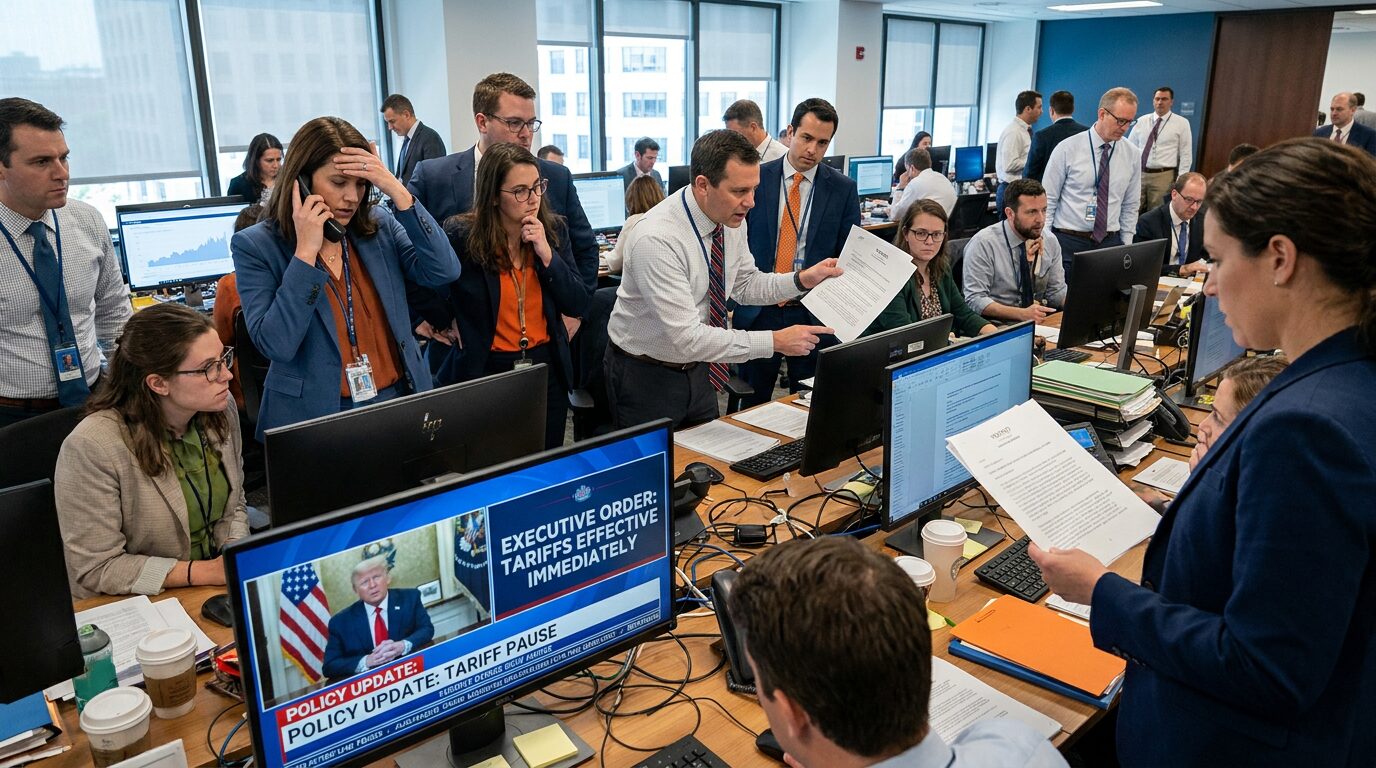
There is a basic infrastructure behind presidential speech that most people never think about because it usually works without much drama. A president says something — in a press conference, a signed statement, an executive order — and agencies interpret it, lawyers implement it, markets price it, allies and adversaries calibrate to it. The speech becomes action. The action becomes policy. The policy becomes the material world people live inside. The whole chain depends on one thing: the words meaning what they appear to mean.
Donald Trump broke that assumption in his first term and has been smashing it methodically in his second. He announces tariff policy on social media, contradicts it in a press gaggle four hours later, overrides the correction with a signed order three days after that, then calls the whole situation perfect in a rally. His aides tell reporters one thing. The official White House statement says another. The president posts a third version at midnight. The Federal Register eventually says something that may or may not match any of the above. This is not a communication style. It is a governing condition, and it has consequences that go far deeper than bad PR.
Why Presidential Words Have Weight
Political scientists who study executive power talk about what they call the rhetorical presidency[1] — the idea, which solidified over the twentieth century, that presidents govern substantially through public speech. Not just through formal powers but through the political energy that speech mobilizes, the agenda it sets, the priorities it signals to a bureaucracy too large for any one person to personally direct. The bureaucracy needs signals. Congress needs to read intent. Courts look at executive statements when interpreting scope. Allies need to know what a commitment means. Markets are betting real money on whether a trade threat is theater or policy. All of these systems are built to take presidential words as meaningful inputs. Feed them garbage, and the outputs become unpredictable in ways that compound fast.
The deeper problem is that the machinery itself cannot easily stop and wait for clarity. Regulatory agencies operate on timelines. Treaties have compliance windows. Budget decisions have deadlines. When the signal from the top is incoherent, the system does not freeze politely — it lurches, improvises, contradicts itself, or quietly stops functioning while everyone waits for a version of the statement that will stick. That administrative paralysis has real costs that never make the headline cycle because they are boring and distributed and don't attach cleanly to any single announcement.
“Feed the bureaucracy garbage signals, and the outputs become unpredictable in ways that compound fast.”
Contradictions at Scale
Consider what happened with tariff announcements in 2025. Trump's team announced sweeping global tariffs. Markets cratered. Hours later, there were suggestions of a ninety-day pause[3]. Then partial reversals. Then new carve-outs. Then contradictions between what the Treasury Secretary said and what the president posted. Businesses that needed to sign supply chain contracts in that window — long-term decisions that can't be paused while Washington sorts itself out — faced a genuine policy vacuum. Not a bad policy. No policy. Ambiguity is not neutral. In international trade, ambiguity is its own costly condition, and the companies that absorbed those costs were mostly not the ones whose executives eat at Mar-a-Lago.
The same pattern appears in foreign policy. NATO allies have watched Trump praise the alliance, threaten to abandon it, demand payment, imply it's unnecessary, then praise it again — sometimes across a single news cycle. The problem is not that the position evolved. Positions evolve. The problem is that there is no stable position to evolve from. Allied governments have to make defense spending decisions, basing decisions, and intelligence-sharing decisions against a backdrop in which American commitment is genuinely uncertain not because of a stated policy shift but because the president's statements have no consistent relationship to intent. That uncertainty has a name in international relations: credibility erosion. It is slow, hard to see, and nearly impossible to reverse quickly once it sets in.
The Distraction Architecture
There is a version of this analysis that treats Trump's verbal chaos as a deliberate strategy — a brilliant, Machiavellian fog machine that keeps opponents off-balance. That case gets overstated. Some of it is probably tactical. Most of it appears to be compulsive, driven by a personality that research on narcissistic leadership styles suggests treats any available moment of attention as an opportunity to dominate and any silence as a threat. If you're curious about what the underlying psychology is actually doing, the piece we ran on what Trump's psychology tells us about power, policy, and ourselves covers the structural personality dynamics worth understanding there. The governing consequence is the same whether the chaos is designed or instinctual: the volume of output makes substantive accountability nearly impossible.
Accountability in democratic governance depends partly on legibility. Citizens, journalists, and opposition politicians need to be able to identify what the government said, compare it to what it did, and assign responsibility for the gap. When statements pile up at a rate of dozens per day, when each new announcement partially cancels the last one, when official channels and social media and press briefings all carry different versions simultaneously — the accountability circuit breaks. You cannot hold a government responsible for a policy position it never held for long enough to be held responsible for. This is how a president who governs through chaos ends up, paradoxically, governing with a kind of insulation that more disciplined predecessors never had. The story keeps changing before the last chapter can be reported.
“You cannot hold a government responsible for a policy position it never held for long enough to be held responsible for.”
What Gets Decided in the Noise
Here is what tends to happen inside administrations that operate this way: actual policy authority migrates away from formal channels and toward whoever the president spoke to last, whoever has direct personal access, and whoever is most willing to act fast before the next statement changes the frame. That creates a patronage-adjacent system where proximity to the president matters more than institutional position or subject matter expertise. Cabinet officials who cannot get a stable directive stop trying to implement one and start trying to survive. Career civil servants, who are neither loyal courtiers nor political appointees but simply the people who know how the plumbing works, find themselves unable to act without cover they can't get. Research on bureaucratic behavior under ambiguous political leadership consistently shows that administrative capacity erodes not just when agencies are defunded but when directive clarity disappears.
The visible policy announcements — the executive orders, the tariff lists, the social media declarations — become something like stage sets. They look like governance from a distance. Behind them, implementation either stalls, improvises in ways the president never intended, or gets captured by whichever faction within the administration moved fastest. The president does not lose power in this arrangement — he remains the center of gravitational pull — but the policy outcomes increasingly reflect the preferences of the people nearest him rather than any coherent governing agenda. That is a form of soft capture, and it operates almost entirely below the noise line.
What Democratic Norms Were Actually For
The norms around careful, stable, coordinated executive communication were not etiquette. They were load-bearing. They existed because the entire American system of governance — federalism, separation of powers, bureaucratic implementation, treaty relationships, market confidence — depends on a minimal level of interpretable executive output. When political scientists write about democratic backsliding[2], as they increasingly do, they tend to focus on courts and elections and legislative capture, all of which matter enormously. But the quieter form of backsliding — the one that doesn't make the alarm go off — is the degradation of the capacity to govern coherently at all. A democracy can survive a bad policy. It is much slower to recover from the institutional atrophy that sets in when the mechanisms for making and implementing policy stop working reliably.
The real danger of Trump's compulsive talking is not that it says the wrong things, though it often does. It is that it has made presidential speech cheap — made it something the system has learned to discount rather than operationalize. Agencies hedge. Allies wait. Markets brace. Congress watches without acting. Everyone is adapting, rationally, to a communication environment in which the words at the top carry less predictive value than they are supposed to. That adaptation is not temporary. The habits of interpretation, the institutional responses, the reduced willingness to commit on the basis of a presidential statement — those calcify. The credibility gap Trump is running up is not going to close on Inauguration Day whenever he leaves. The next president will speak into a room that has already been trained, by years of compulsive noise, to half-listen.
References
- The Rhetorical Presidency (press.princeton.edu)
Establishes the twentieth-century concept that presidents govern substantially through public speech and political energy mobilized by their words. - Democratic backsliding (en.wikipedia.org)
Defines democratic backsliding as the weakening of democratic institutions and the shift toward more arbitrary exercise of political power. - Liberation Day tariffs (en.wikipedia.org)
Documents Trump's April 2, 2025 tariff announcement and the subsequent contradictions and reversals that created policy ambiguity for businesses. - The Transatlantic Relationship You Knew Is Gone (lawfaremedia.org)
Provides the term 'credibility erosion' to describe how inconsistent presidential statements on NATO undermine allied confidence in American commitment.
About Paul Wardell
Paul Wardell writes about politics, institutions, voters, media, class, power, polarization, and the incentives that make public life feel dumber than it needs to be. Left-leaning but stubbornly practical, his work focuses on how systems actually behave, not how partisans wish they behaved.
More like this
Institutional Collapse Doesn't Look Like a Coup. It Looks Like Everyone Deciding Not to Fight.
Political scientists have a name for the pattern where courts, corporations, universities, and legislators each decide individually that resistance isn't worth it — and the math of those private surrenders adds up to the end of accountability itself.

When a Political Earthquake Rewires Your Entire Identity
Political ruptures don't just change who people vote for — they restructure the psychological scaffolding that holds a whole identity together.

Acquiescence Is the Mechanism. That's What Makes It Dangerous.
The latest democracy research shows American backsliding isn't being driven by force — it's being driven by voluntary surrender, and political science explains exactly why that's harder to reverse than a coup.