Institutional Collapse Doesn't Look Like a Coup. It Looks Like Everyone Deciding Not to Fight.
Political scientists have a name for the pattern where courts, corporations, universities, and legislators each decide individually that resistance isn't worth it — and the math of those private surrenders adds up to the end of accountability itself.
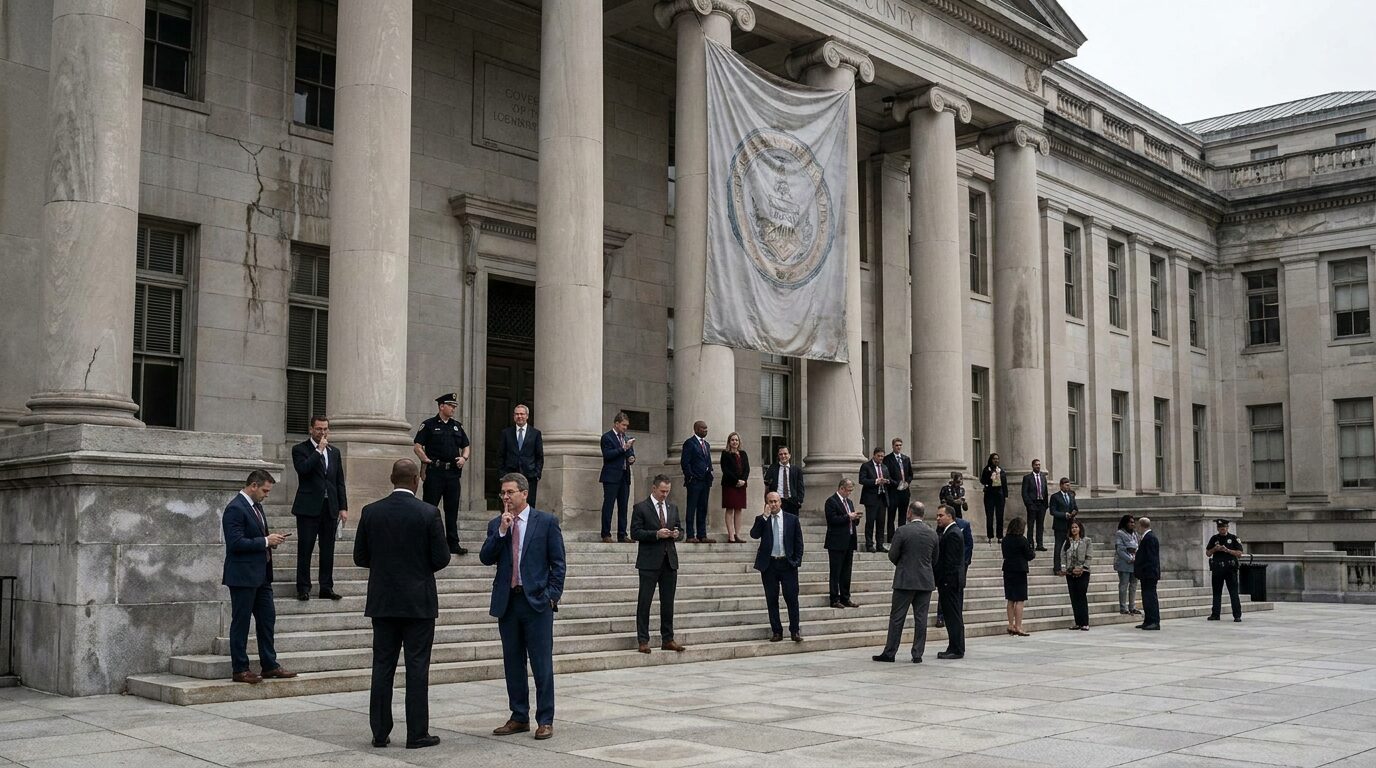
There is a version of democratic collapse that arrives with jackboots and a dramatic declaration. History gave us enough of those that we built the imagery into every school textbook: the torchlit crowd, the burning parliament, the radio address that ends in one voice replacing many. That version is almost reassuring in its legibility. You know when it happens. You know who did it. You can point at the photograph.
The version unfolding in the United States in 2025 does not look like that. It looks like a law firm declining to represent a client whose case might draw federal scrutiny. It looks like a university president choosing careful silence over a clear statement of principle. It looks like a senator calculating that a confrontation with the executive branch will cost more in the next primary than the norm being violated is worth defending. It looks like a federal judge writing an opinion that technically rules on the narrow question before the court while assiduously avoiding the larger constitutional one. Taken individually, each of these decisions is defensible, even reasonable. Taken together, they are catastrophic.
Harvard political scientist Steven Levitsky — who with Lucan Way produced some of the most influential comparative work on competitive authoritarianism[2], and who with Daniel Ziblatt authored the warnings about American democratic erosion[4] that Washington's political class mostly ignored — has been tracking what he and colleagues describe as an acquiescence cascade. The term captures something specific: not a conspiracy of surrender, but a coordination failure where each actor's private rational calculation produces a collectively irrational outcome. Nobody decides to end accountability. They all just decide not to die on this hill. And the hills run out.
Erica Chenoweth, whose research on civil resistance movements at Harvard's Kennedy School established that nonviolent mass movements succeed at roughly twice the rate of violent ones[1] when they achieve meaningful participation thresholds, has been equally direct about the 2025 moment. What concerns Chenoweth isn't the strength of the authoritarian push — it's the weakness of the institutional response. When the institutions that are supposed to create friction against power concentration decide friction is too expensive, the math changes entirely. As we've previously covered, democracies rarely send a warning before the transition completes. The cascade is the warning. Most people miss it because it looks, day to day, like normal politics.
The Geometry of Giving Up
Political scientists who study democratic backsliding[3] have spent decades cataloguing the ways that formal institutional structures — constitutions, courts, legislative chambers, regulatory agencies — can coexist with the effective destruction of democratic governance. The formal apparatus stays standing. The substance drains out. What makes the acquiescence cascade distinct from ordinary institutional weakness is its self-reinforcing geometry. Each actor who decides not to resist makes it marginally more rational for the next actor to do the same. The cost of resistance rises as the company of resisters shrinks. The cascade is not simultaneous — it moves through institutions in sequence, which is part of why it's so hard to interrupt. By the time the pattern is undeniable, it's deeply entrenched.
Comparative studies of democratic erosion — Hungary, Turkey, Venezuela, Peru — show a consistent structure. The executive branch tests a norm. The response from other institutions is either delayed, divided, or hedged. The norm violation is absorbed without consequence. The next test is larger. What gets called polarization is often just the asymmetric information that results: one side escalates in coordinated steps while the other side argues internally about whether the last step was actually a step, whether the response should be proportionate or forceful, and whether the optics of resistance are better or worse than the optics of capitulation. That argument takes time. The escalation doesn't wait.
“Nobody decides to end accountability. They all just decide not to die on this hill. And the hills run out.”
In the United States in 2025, the cascade moved through recognizable layers. The corporate layer moved first, and moved fast. The speed was notable. Companies that had spent years building DEI programs, climate commitments, and careful public-facing values language began dismantling those structures before any specific legal requirement forced them to — because the signal from the executive branch was clear enough, and the cost of being visibly oppositional seemed higher than the cost of preemptive compliance. This is textbook rational-actor behavior under soft coercion. You don't wait for the punishment. You calculate that the punishment is coming and rearrange yourself to avoid it. The logic is individually sensible. The aggregate effect is that the administration learns, correctly, that the threat of scrutiny alone is sufficient to produce conformity without formal enforcement.
What Courts Do When They Choose Not to Decide
The judiciary is supposed to be the institution where the cascade stops. The constitutional design imagines courts as the arena where raw political power hits a wall of legal principle, where the executive branch's preferences have to survive contact with the text and with precedent. That design depends on judges who are willing to rule in ways that make powerful people angry. It also depends, critically, on the executive branch's willingness to comply with rulings it doesn't like — which is an unwritten norm, not an enforceable mechanism. When an administration signals that compliance is conditional, every judge calculating their next ruling has to factor in not just whether they're right, but whether being right will mean anything.
This is how courts participate in the cascade without becoming corrupt in the ordinary sense. Individual judges can write scrupulously honest opinions while collectively the judiciary tilts toward the path of least resistance — staying narrow, deferring where possible, avoiding the confrontation that would force a showdown whose outcome is uncertain. The research on judicial behavior under political pressure suggests this kind of strategic avoidance is neither rare nor irrational. Judges are political actors embedded in political institutions, and studies of judicial independence under authoritarian pressure consistently find that formal tenure protections are necessary but not sufficient. What matters is the institutional culture around judicial courage — whether the profession rewards clarity or rewards caution. Right now, in the United States, the signals are not good.
Universities and the Silence That Costs Nothing to Hear
Higher education's capitulation has been both swift and revealing. Universities are, in theory, among the institutions with the most structural insulation from political pressure: tenure, academic freedom norms, deep endowments, legal protections for research. Harvard has a $50 billion endowment. It is not financially vulnerable in any ordinary sense. And yet the pattern at elite institutions across 2025 has been one of preemptive concession, strategic ambiguity, and institutional silence exactly where institutional voice would be most consequential. The Harvard case is worth examining precisely because the institution's resources make pure financial coercion an insufficient explanation. What's happening is not just about money. It's about legitimacy anxiety — the fear that being seen as the enemy of the state will erode the institutional standing that the endowment is supposed to protect.
“Preemptive compliance is still compliance — and the administration learns, correctly, that the threat of scrutiny alone is enough to produce conformity.”
This is a trap with no clean exit, and the people running these institutions mostly know it. Resistance invites targeting. Silence enables the targeting of others. The calculation that makes silence feel rational at any given moment is the same calculation that, when made simultaneously across dozens of institutions, produces a landscape in which there is no organized opposition left standing. As this piece's companion analysis has noted, acquiescence is a mechanism, not just a posture — it actively restructures the terrain, making future resistance harder by eliminating the networks, coalitions, and norms that resistance would depend on. Each institution that goes quiet makes the next institution's silence marginally more likely. The cascade is named correctly.
Legislators and the Math of the Next Primary
Congress is where the acquiescence cascade becomes most legally consequential and most politically legible. The Constitution gives the legislative branch tools that could, in theory, interrupt any executive overreach: the power of the purse, oversight authority, the confirmation process, the impeachment mechanism. That these tools exist on paper and have not been deployed is not an accident or an oversight. It reflects a specific calculation made by Republican legislators who would, privately, prefer a functioning constitutional order, but who have determined that the cost of defending one exceeds the cost of living without one. The base has been told that institutional resistance is elite sabotage. Defending a norm now reads as disloyalty. The primary threat is real. The consequence is a legislature that has effectively outsourced its constitutional role to whoever controls the executive branch.
Research on legislative behavior under democratic backsliding across multiple countries shows that ruling-party legislators almost never defect in sufficient numbers to halt executive aggrandizement unless their electoral survival depends on it — and in systems with tight partisan identity, it almost never does. The American case adds a layer: the primary system, which was designed to increase democratic participation, has functioned in practice to concentrate power among the most mobilized ideological factions, which in the Republican Party are the factions most aligned with executive consolidation. This is an institutional design failure that interacts lethally with the cascade. The people who might resist have been structurally incentivized not to.
Why Naming the Pattern Matters
“The cascade doesn't need a conspiracy. It only needs everyone to do the math alone.”
Chenoweth's civil resistance work offers the most rigorous framework for what interrupts a cascade once it's moving. The findings are counterintuitive to people who think of effective opposition as requiring intensity: it's breadth, not depth, that matters most. Studies of successful resistance movements consistently show that once roughly 3.5 percent of a population is engaged in sustained nonviolent action, the probability of regime change — or, in less dramatic cases, of institutional norm restoration — rises sharply. The implication for 2025 isn't that protest is futile. It's that the bottleneck isn't passion; it's coordination. Individual actors calculating in isolation will almost always choose safety. The cascade ends when enough of them can see that the others are moving, and that the cost of collective action is lower than they assumed when they were calculating alone.
That is a harder problem than it sounds, because the cascade actively degrades the information environment that coordination depends on. When institutions go quiet, when law firms stop taking certain cases, when university presidents stop making certain arguments, when legislators stop forcing certain votes, the public loses the visible signals that would tell them resistance is happening, that it's possible, that others are doing it. The silence is not just passive. It actively misleads. And the administration understands this. The point of early, visible retaliation against resisters is not primarily to punish the resisters. It's to signal to everyone watching that resistance produces consequences. That signal works best when resistance is rare enough to be isolating. The cascade doesn't need a conspiracy. It only needs everyone to do the math alone.
What Levitsky and Chenoweth are describing — and what the 2025 data keeps confirming — is that the survival of democratic institutions depends less on their formal design than on the collective willingness of people inside and outside those institutions to treat their obligations as real even when the costs of doing so are personal and immediate. Rights that only survive when defending them is costless are not rights. Norms that only hold when violating them is publicly embarrassing are not norms. Courts, universities, corporations, and legislators that only resist when resistance is safe are not institutions at all. They are mirrors, reflecting back whatever the most powerful actor in the room wants to see. The cascade ends when enough people decide to be something other than a mirror — not because it's safe, but because the alternative is the permanent arrangement of power that follows when everyone finishes deciding it isn't worth the fight.
References
- Erica Chenoweth illuminates the value of nonviolent resistance in societal conflicts (hks.harvard.edu)
Documents Chenoweth's research finding that nonviolent mass movements succeed at roughly twice the rate of violent ones when achieving meaningful participation thresholds. - The Path to American Authoritarianism: What Comes After Democratic Breakdown (foreignaffairs.com)
Establishes Levitsky's expertise in comparative authoritarianism and documents the shift from 2016 democratic concern to 2025 indifference about democratic threats. - Democratic backsliding (en.wikipedia.org)
Defines democratic backsliding as structural transition from democracy toward authoritarianism with weakening of institutions and restriction of political participation. - How Democracies Die (en.wikipedia.org)
Identifies Levitsky and Ziblatt's 2018 book on how elected leaders gradually subvert democratic processes through backsliding.
About Rafael Tomlin
Rafael Tomlin writes about current politics from a fiercely populist perspective: pro-worker, pro-renter, anti-billionaire capture, anti-authoritarian, and deeply hostile to the machinery that turns public life into cruelty for profit. His work focuses on power, policy, class, democracy, corruption, and who actually pays when political theater becomes law.
More like this

Acquiescence Is the Mechanism. That's What Makes It Dangerous.
The latest democracy research shows American backsliding isn't being driven by force — it's being driven by voluntary surrender, and political science explains exactly why that's harder to reverse than a coup.
Democracies Don't Warn You Before They Stop Being One
Political scientists have spent two decades mapping exactly how democracies die without a coup — and the indicators they built now point at the United States.

Republicans Are Happier Under Authoritarianism. That's Not a Paradox.
A psychological concept called 'person-environment fit' explains why some voters thrive under conditions that look, from the outside, like democratic collapse.