The Scientist Who Decided Loneliness Was a Medical Emergency — In 1958
John Bowlby had the physiological evidence before most doctors believed social disconnection could hurt you — and the story of how he was dismissed tells you something important about how medicine decides what's real.
In 2023, the U.S. Surgeon General issued an advisory declaring loneliness a public health crisis[3], estimating that roughly half of American adults reported measurable levels of social isolation. The language was clinical, the concern urgent, the framing novel. Except it wasn't novel. A British psychiatrist named John Bowlby had been making a version of this argument since the late 1950s, and the medical establishment had spent the better part of two decades telling him, politely and then less politely, that he was wrong about what kind of problem he was describing.
Bowlby was not wrong. He was early — which in medicine is sometimes the more dangerous condition.
What Bowlby Actually Said
Bowlby's central claim, developed across decades of clinical work and theoretical writing, was that the human need for close attachment was not a psychological preference or a learned behavior layered over more primitive drives. It was a primary biological system, as fundamental as hunger or thermoregulation, with its own physiological substrate and its own measurable consequences when disrupted. When the attachment system was chronically unmet — when a person was isolated, separated from caregivers in infancy, or locked in relationships that could not provide secure connection — the body registered that as a form of threat. Not metaphorically. Measurably.
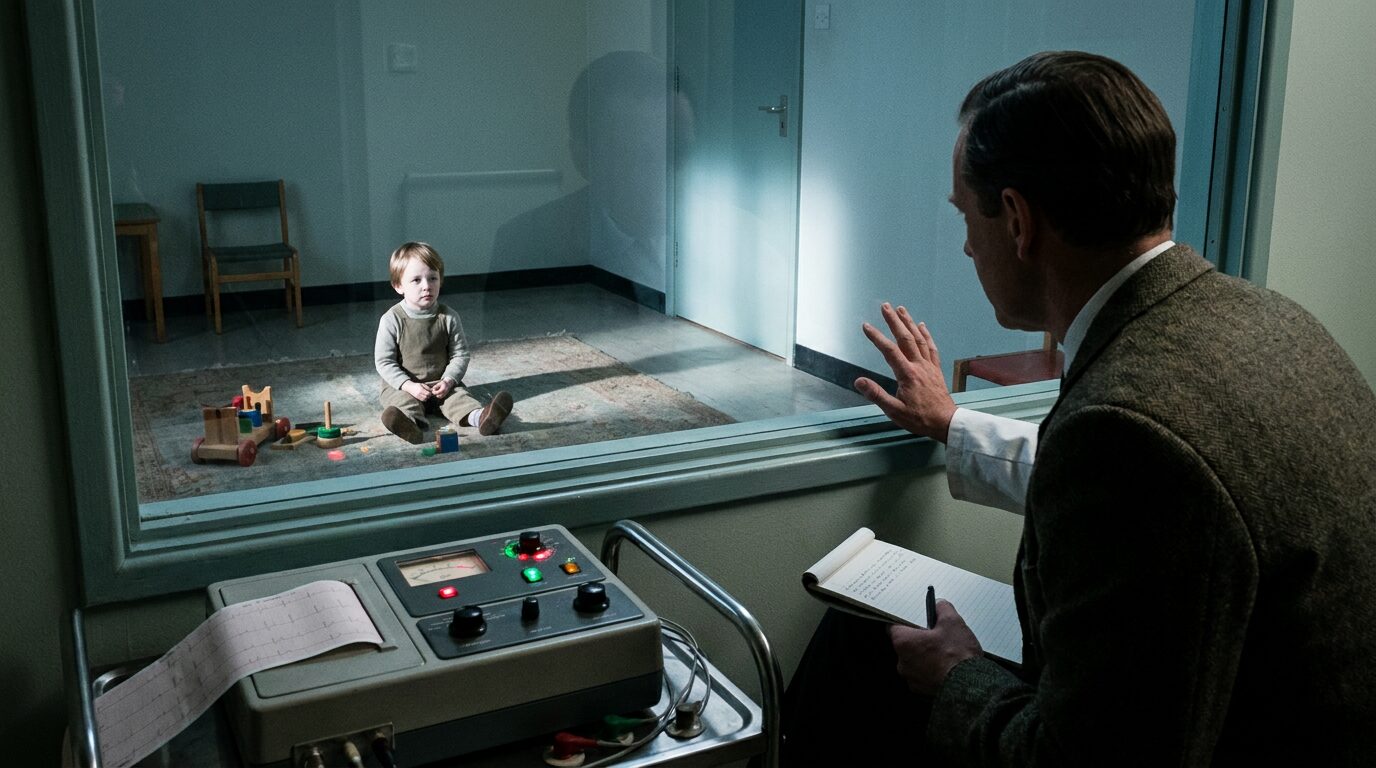
His early work in the late 1940s and 1950s focused on institutionalized children — children separated from parents, raised in orphanages or long-term hospital wards with adequate nutrition and medical care but minimal emotional responsiveness. What Bowlby observed, and documented with unusual methodological care for the era, was that these children did not simply become sad. They became physiologically dysregulated. Growth was impaired. Immune response was compromised. The syndrome had a name by then — failure to thrive — but the dominant explanation was nutritional or infectious, not relational. Bowlby looked at the same children and saw something the medical consensus was not equipped to process: that the absence of a responsive human relationship was doing damage that food and antibiotics could not fix.
“Failure to thrive had a name. The dominant explanation was nutritional. Bowlby looked at the same children and saw something the field wasn't equipped to process.”
The Establishment's Problem With His Argument
The psychoanalytic world that Bowlby was trained in — and that he was trying to reform — had its own framework for understanding early childhood and its consequences. The dominant Freudian and Kleinian models held that the infant's attachment to the mother was essentially derivative: the infant attached because the mother provided feeding and oral gratification, not because attachment itself was a primary drive. The emotional bond was a secondary formation built on top of more fundamental biological needs. Bowlby thought this was exactly backwards, and he said so, repeatedly and in print. This was not a small disagreement. It was a direct challenge to the theoretical foundations of mid-century psychoanalysis, and the response was proportionate to the threat.
The British Psychoanalytical Society, where Bowlby presented early versions of his attachment framework, received his papers with visible hostility. The critique was not primarily methodological — it was categorical. Analysts objected that Bowlby was reducing rich psychological experience to what they saw as crude behavioral and biological mechanisms. He was borrowing from ethology, from Konrad Lorenz's work on imprinting in birds, from control systems theory and early cybernetics, and from animal studies that his colleagues considered irrelevant to human interiority. What he was actually doing was building an evidence base. The establishment heard it as a category error.
The medical world had a parallel version of the same problem. If Bowlby was right — if social disconnection caused measurable physiological harm — then loneliness was not a mood or a social condition. It was a disease vector. And mid-century medicine was not ready to operationalize that. It had no good instruments for measuring social isolation, no framework for treating relationship deficits as clinical targets, and a strong institutional preference for biological causes that could be isolated, tested, and intervened upon with drugs or procedures. A psychiatrist insisting that the presence or absence of a loving relationship had downstream effects on immune function, cardiovascular health, and developmental physiology was asking medicine to expand its causal vocabulary in ways that felt uncomfortably soft.
The Biology He Couldn't Quite Prove Yet
The frustrating irony is that Bowlby was pointing at real mechanisms that the science of his era simply couldn't see clearly enough to confirm. The physiological pathways he intuited — that social threat would activate stress response systems, that chronic isolation would produce measurable changes in cortisol regulation, inflammatory signaling, and autonomic function — are now among the better-documented findings in health psychology and psychoneuroimmunology. Research on social isolation and stress physiology has since established that loneliness activates the hypothalamic-pituitary-adrenal axis[2] in ways that parallel other chronic stressors, and that the resulting cortisol dysregulation has compounding effects on immune competence and cardiovascular risk over time.
The neuroendocrinology wasn't accessible to Bowlby in 1958. But the behavioral evidence was, and he used it. His three-volume work Attachment and Loss, published between 1969 and 1980, laid out a model of how early relational experience shapes the nervous system's baseline settings — what he called internal working models — which then mediate how a person perceives threat, regulates emotion, and tolerates closeness throughout life. This is now essentially the substrate of developmental neuroscience. As research on early adversity and nervous system development has accumulated, Bowlby's framework has not been refined so much as confirmed at a biological level he couldn't reach. The inhibited toddler's nervous system that contemporary neuroscience can now image and measure is, in meaningful part, Bowlby's argument in neural substrate.
How Science Buries and Then Rediscovers
The rehabilitation of Bowlby's core claims is not a clean vindication story. It happened slowly, through adjacent disciplines that didn't carry his name, via researchers who sometimes didn't know they were confirming what he'd already argued. Social epidemiology began accumulating evidence in the 1970s and 1980s that social integration — measured crudely, by whether people had close relationships and community ties — predicted mortality rates in ways that rivaled or exceeded standard behavioral risk factors like smoking. The Alameda County Study[4], which followed nearly seven thousand adults across nine years, found that people with fewer social connections died at roughly twice the rate of those with more, after controlling for health status, income, and health behaviors. The study's authors, Lisa Berkman and Leonard Syme, were not citing Bowlby. They were producing data that made his theoretical framework look prescient.
The psychoneuroimmunology research that followed — tracking how social isolation altered immune cell behavior, inflammatory cytokine production, and gene expression in pathways related to threat response — eventually created a literature substantial enough that dismissing it required active effort. Work on loneliness and immune dysregulation showed that the signal was not subtle. Chronically lonely people showed elevated inflammatory markers, altered natural killer cell activity, and a pattern of immune gene expression that looked less like psychological distress and more like a body on sustained alert. This is what Bowlby, working with orphaned children and developmental observations in postwar Britain, had described in structural terms six decades earlier.
“Chronically lonely people showed a pattern of immune gene expression that looked less like psychological distress and more like a body on sustained alert.”
What Medicine Decides Is Real
The history of Bowlby's reception is partly a story about one man's stubbornness and intellectual range. But it's more usefully read as a case study in how medicine decides what qualifies as a legitimate disease mechanism. The gatekeeping is not usually corrupt or cynical — it's structural. New causal claims that require expanding the discipline's model of what counts as a pathogen face genuine epistemological resistance, not just political resistance. When Bowlby said social disconnection was physiologically dangerous, he was not just proposing a new treatment. He was proposing a new category of cause, and that category required medicine to treat the relational environment as a biological variable, which in turn required instruments, measurements, and interventions that didn't yet exist.
Medicine tends to recognize diseases when it can measure them precisely, intervene on them specifically, and assign them to known biological mechanisms. Loneliness failed all three tests in 1958. It passes most of them now. Research on friendship and health outcomes has moved far enough that the biological pathways are no longer speculative — the question has shifted to how to operationalize intervention at scale, which is precisely where the Surgeon General's 2023 advisory was trying to point policy. The language is new. The underlying argument is older than most of the doctors making it realize.
There is a version of this story that treats Bowlby as a tragic hero, ignored by small minds until the evidence forced them to listen. That version is too clean. He was genuinely hard to categorize — not quite a clinician, not quite a biologist, borrowing from fields that hadn't yet proven their relevance to human development. Some of the resistance to his work was methodological, and not entirely unreasonable. Science's caution about novel causal claims is a feature, not only a failure mode. The problem is that caution is not evenly distributed. It tends to be applied most forcefully to claims that challenge the field's dominant model of what causes disease and what kind of evidence counts as proof. Bowlby's claims were correct and they were inconvenient, and those two things are easier to separate in retrospect than they are in real time.
What the story really shows is how long it takes for a mechanism to become legible after the observation that points to it. Bowlby could see the damage in the children in front of him. He could describe the system that would explain it. What he couldn't do was make the immune assays run or the neuroimaging appear before the technology existed to produce them. He was standing at the correct answer waiting for science to build the instruments that would let everyone else catch up. That is a particular kind of intellectual patience — or perhaps a particular kind of stubbornness — that medicine does not always reward in time.
References
- A new foundation for the study of bird behaviour: Konrad Lorenz’s ‘Kumpan’ paper of 1935 (link.springer.com)
Documents Konrad Lorenz's foundational work on animal behavior and imprinting that Bowlby drew from to build his attachment theory framework. - Hormonal and Behavioral Consequences of Social Isolation and Loneliness: Neuroendocrine Mechanisms and Clinical Implications (mdpi.com)
Documents the neuroendocrine mechanisms linking loneliness to stress response systems, confirming Bowlby's intuited physiological pathways through HPA axis activation. - Our Epidemic of Loneliness and Isolation: The U.S. Surgeon General’s Advisory on the Healing Effects of Social Connection and Community (ncbi.nlm.nih.gov)
Provides the 2023 U.S. Surgeon General's official declaration that loneliness is a public health crisis, establishing the modern context for Bowlby's earlier claims. - SOCIAL NETWORKS, HOST RESISTANCE, AND MORTALITY: A NINE-YEAR FOLLOW-UP STUDY OF ALAMEDA COUNTY RESIDENTS (doi.org)
The Alameda County Study data showing social isolation predicted mortality rates twice as high as those with more connections, confirming Bowlby's theoretical predictions.
About Vera Sloane
Vera Sloane writes about emerging technology, synthetic media, AI interfaces, robotics, digital environments, and the strange ways the future slips into ordinary life before most people have language for it. Her work focuses on near-future drift, where innovation stops feeling hypothetical and starts rearranging daily behavior, expectation, and mood.
More like this

BPD Is Not a Personality Disorder. Some Researchers Think It Never Was.
A landmark 2025 paper argues that borderline personality disorder isn't a personality problem at all — and the evidence for where it really lives in the brain has been hiding in plain sight.
Chronic Loneliness Rewires the Brain — And the Damage Is Not Metaphorical
Prolonged social isolation doesn't just feel bad; it triggers a cascade of stress signaling and neuroinflammation that measurably reshapes the aging brain.

Friendship Doesn't Just Feel Good. It's Structural — And You're Losing It Quietly.
Researchers tracking adult social networks have found it's not loneliness you should be watching for — it's the specific number of close friendships you're quietly shedding every decade.