Failure Mode
A failure mode is the predictable way a system fails under stress, like fracture or leakage. It's not just 'failure' but the specific pattern of breakdown engineers track to prevent disasters.
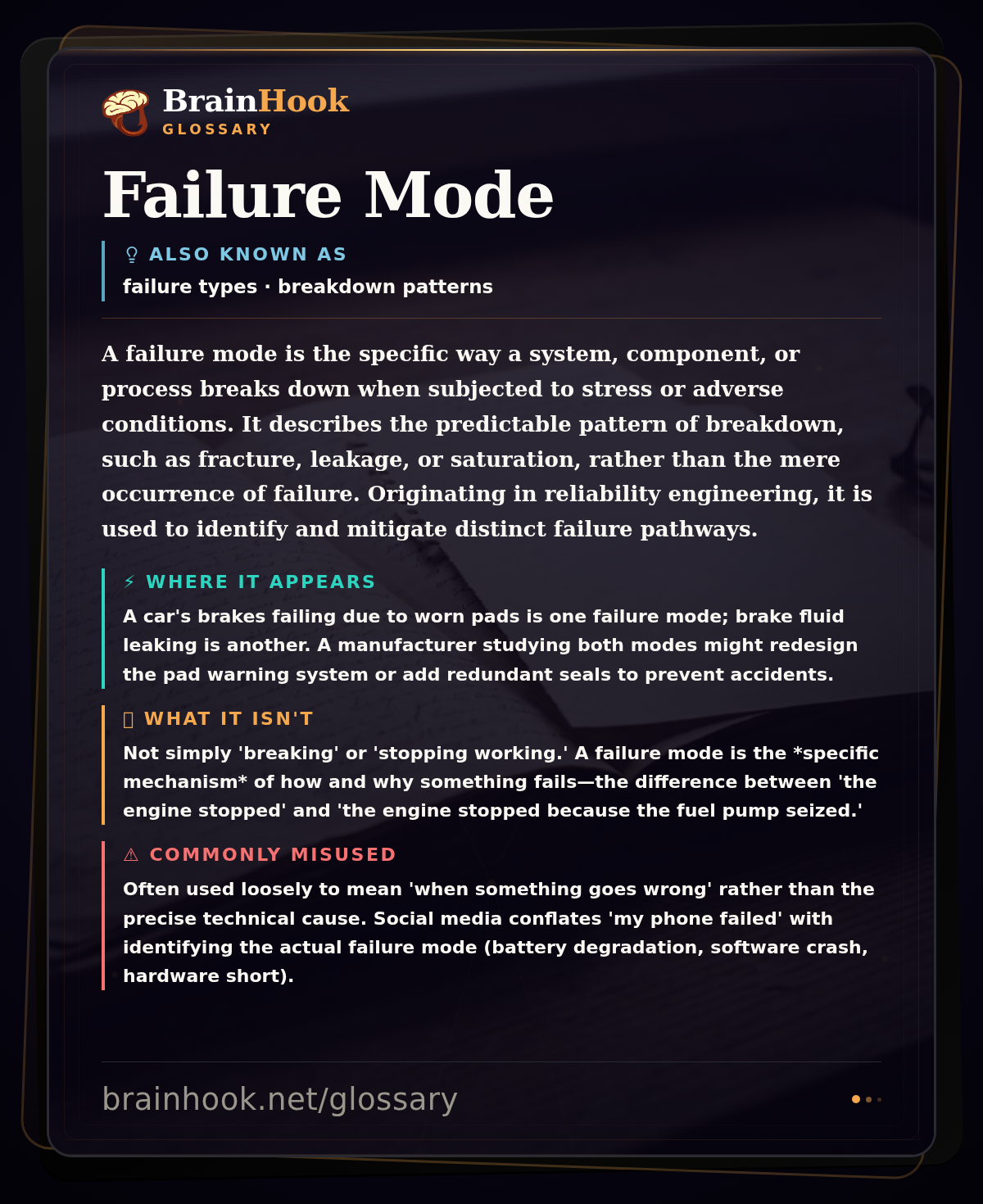
A failure mode is the specific way a system, component, or process breaks down when subjected to stress or adverse conditions. It describes the predictable pattern of breakdown, such as fracture, leakage, or saturation, rather than the mere occurrence of failure. Originating in reliability engineering, it is used to identify and mitigate distinct failure pathways.
What this means in real life
A car's brakes failing due to worn pads is one failure mode; brake fluid leaking is another. A manufacturer studying both modes might redesign the pad warning system or add redundant seals to prevent accidents.
What it isn’t
Not simply 'breaking' or 'stopping working.' A failure mode is the *specific mechanism* of how and why something fails—the difference between 'the engine stopped' and 'the engine stopped because the fuel pump seized.'
Commonly misused online
Often used loosely to mean 'when something goes wrong' rather than the precise technical cause. Social media conflates 'my phone failed' with identifying the actual failure mode (battery degradation, software crash, hardware short).