Developmental Neuroscience
The study of how the brain and nervous system form, mature, and change from infancy to adulthood, focusing on the biological mechanisms behind neural growth.
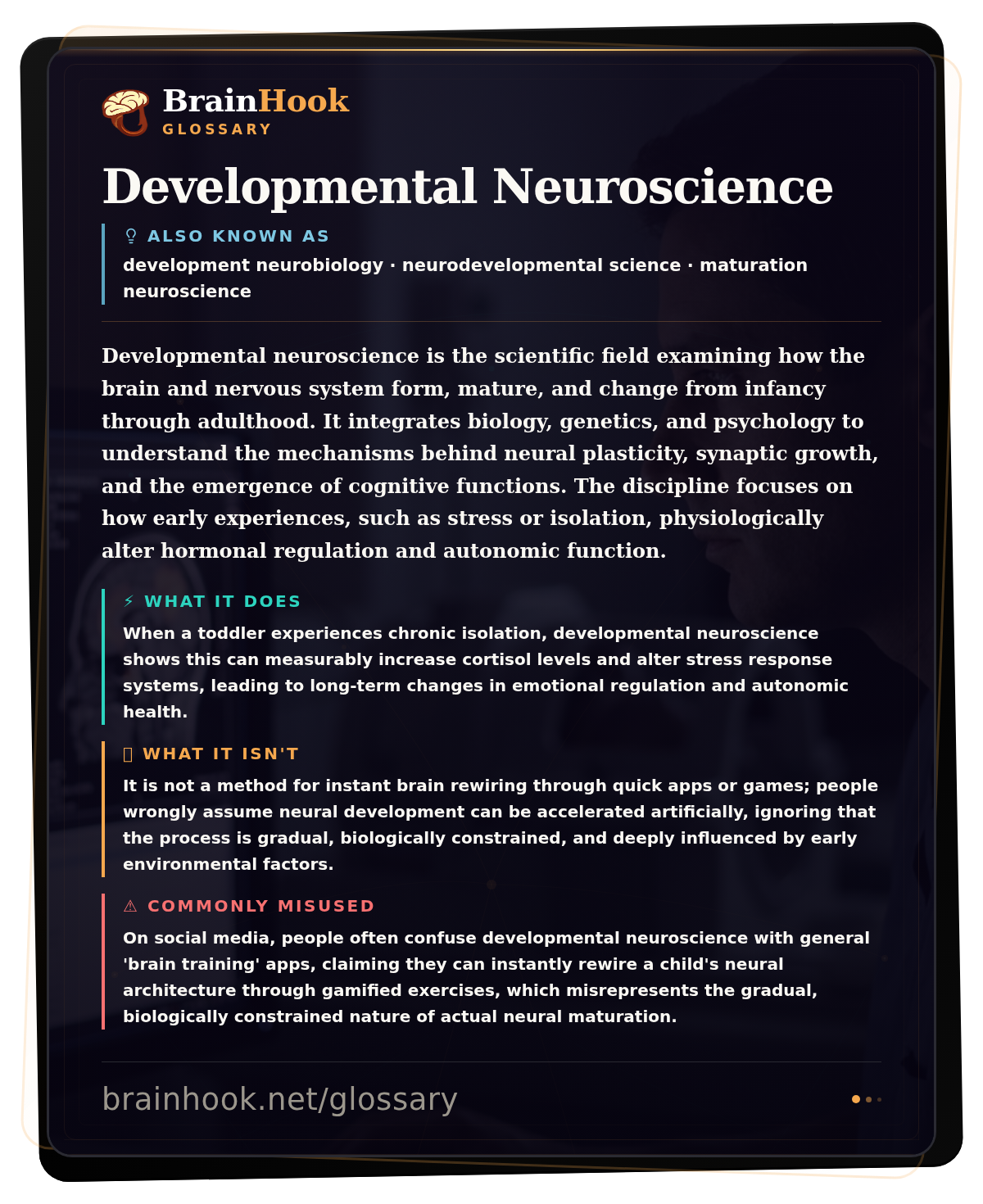
Developmental neuroscience is the scientific field examining how the brain and nervous system form, mature, and change from infancy through adulthood. It integrates biology, genetics, and psychology to understand the mechanisms behind neural plasticity, synaptic growth, and the emergence of cognitive functions. The discipline focuses on how early experiences, such as stress or isolation, physiologically alter hormonal regulation and autonomic function.
What this means in real life
When a toddler learns to walk, their cerebellum and motor cortex are actively rewiring neural connections; developmental neuroscience explains why practice strengthens these pathways and why early movement experience matters for coordination.
What it isn’t
It is not simply child psychology or education theory. Developmental neuroscience is the biological study of brain structure and function changes, not behavioral observation alone—though it informs both.
Commonly misused online
Often conflated with 'brain plasticity' or 'neuroplasticity' as if they are the same thing; developmental neuroscience is broader and includes plasticity but also covers genetics, critical periods, and maturational milestones.