The Robot That Needs to Feel Pain Before It Can Live with You
The latest neuromorphic skin research reveals a strange truth: robots only become safe to live with once they can flinch.
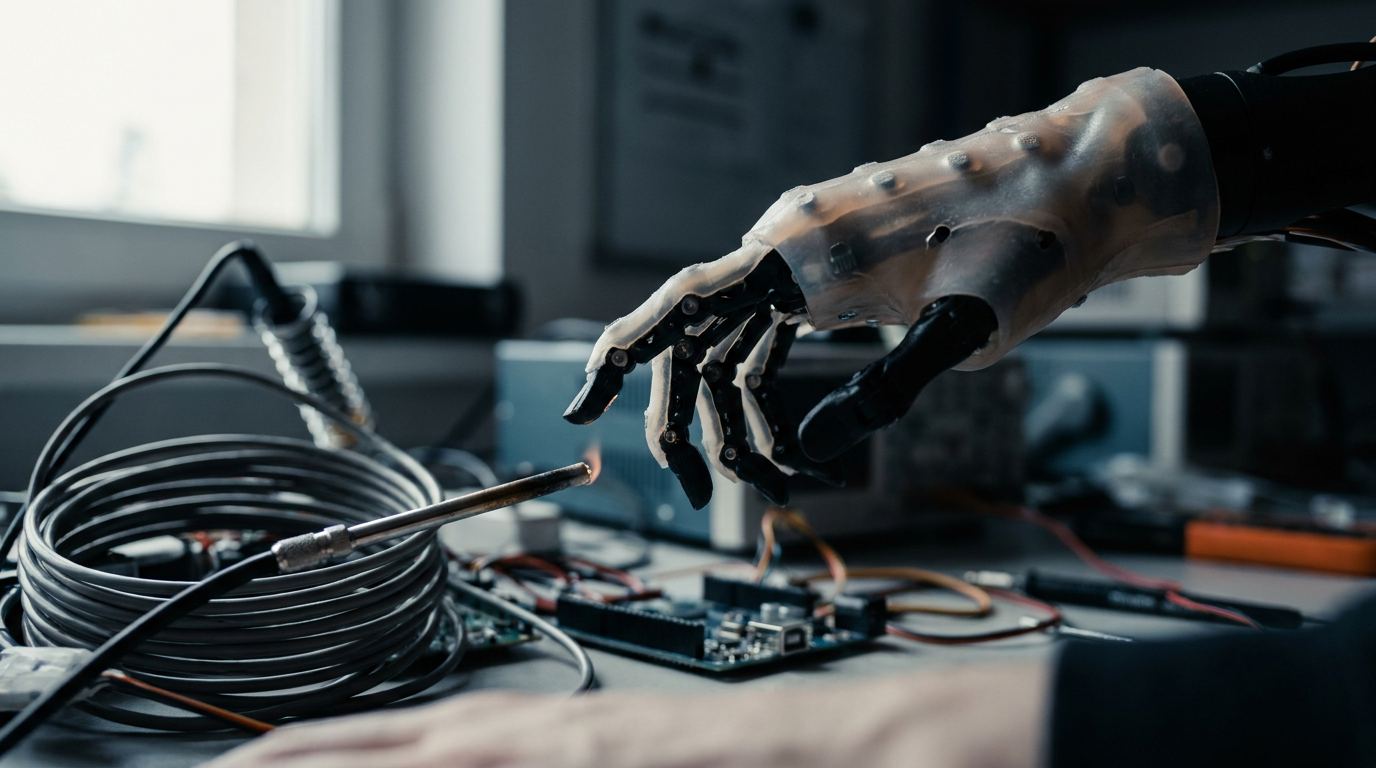
There is a version of domestic robots that has been promised for decades — competent, tireless, gentle — and it has always stumbled on the same invisible problem. Not battery life. Not processing speed. Not the cost of servo motors. The problem is that robots cannot tell when they are being damaged, and so they keep hurting things around them, including the people they are supposed to help. A machine that cannot feel its own limits has no reliable way to enforce them.
Researchers working on neuromorphic robotic skin are solving this from an unexpected direction. Rather than writing better collision-avoidance algorithms or layering on more external sensors, they are building artificial skin that functions more like biological tissue — skin that detects pressure gradients, thermal changes, and mechanical stress, then transmits that information the way peripheral nerves do: through event-driven spikes rather than constant data streams. The architecture mirrors, deliberately, the sensory feedback loops that keep human bodies intact without requiring conscious attention. You do not decide to pull your hand back from a hot stove. Something lower, older, and faster than decision does it for you.
Work published in journals including PNAS and Science Robotics over the past several years has documented a series of advances in this area that are beginning to feel less like laboratory curiosities and more like engineering inevitabilities. Flexible electronic skins embedded with piezoelectric, piezoresistive, and thermoreceptive elements[1]. Neuromorphic chips that process skin signals using spike-timing codes borrowed from neuroscience[2]. Reflex arcs that close the loop between sensation and motor response in milliseconds, without routing the signal through a central processor at all. The pieces are converging around a core insight that took biological evolution hundreds of millions of years to arrive at and robotics is only now absorbing: nociception — the sensing of actual or potential tissue damage — is not a luxury added on top of a functional body. It is infrastructure.
The counterintuitive part is what this means for robots designed to share space with people. The path to a machine that is safe to have in a kitchen, a hospital ward, or a bedroom does not run through making it stronger or smarter or faster. It runs through making it more fragile in a precise sense — more capable of knowing it is being stressed, more capable of registering that something is wrong, more capable of the biological flinch that protects both the machine and whatever it is touching. Pain, or the functional analog of it, turns out to be one of the oldest safety systems life ever built. Robots are only now getting their version.
What Nociception Actually Does
Pain in biological organisms is easy to misread as a simple alarm — tissue damaged, signal sent, behavior changed. The actual picture is more distributed and more interesting. Human skin hosts several distinct categories of sensory receptor: mechanoreceptors that respond to deformation and vibration, thermoreceptors that track temperature change, and nociceptors that activate specifically when stimulation crosses a threshold that predicts damage. These signals travel through different fiber types at different speeds, which is why a sharp cut registers before the deep ache arrives. The system is not monolithic. It is layered, redundant, and anatomically specific, designed to give the body a detailed spatial map of what is under stress and how urgently it needs attention.
Crucially, much of the protective response bypasses the brain entirely. Spinal reflex arcs handle rapid withdrawal[3] before any conscious signal has processed what happened. This is not a design flaw. It is a speed solution to a latency problem — the roundtrip to the brain takes too long when a hand is contacting a flame. Robotics researchers are rediscovering this architecture because it solves the same problem in a different substrate. A robot arm that has to query a central controller before deciding whether to stop pressing is going to be slower, and therefore more dangerous, than one that can run a local reflex arc through dedicated neuromorphic hardware embedded closer to the skin itself.
“Pain, it turns out, is not the opposite of function. It is one of the oldest ways a body maintains it.”
The Engineering Problem Synthetic Skin Is Solving
Conventional robotic sensing has depended heavily on external cameras, depth sensors, and force-torque measurements at joint actuators. These approaches work reasonably well in structured environments — factory floors, surgical suites with precise tooling, warehouse logistics — where the geometry of contact is predictable and the speed requirements are forgiving. They begin to fail in the chaotic, soft, unpredictable geometry of everyday human space. A toddler who sits on a robot's arm does not announce the contact to a depth camera cleanly. A caregiving robot repositioning an elderly patient cannot rely solely on joint torque to know that skin is being pinched. The sensing needs to be local, distributed, and fast, and it needs to cover surface area the way skin does.
Neuromorphic electronic skin attempts to provide exactly this. The general architecture involves a flexible substrate — often silicone or polyimide-based — embedded with sensing elements that convert physical contact into electrical signals. What makes the neuromorphic approach distinctive is what happens to those signals next. Rather than sampling continuously and flooding a processor with raw data, the system encodes information as asynchronous spikes that fire only when something changes — a pressure threshold crossed, a temperature gradient shifted, a deformation rate accelerated. This event-driven model[4] is borrowed directly from how biological sensory neurons work, and it dramatically reduces the data throughput required while preserving the temporal precision that fast reflexes need. The artificial skin is not taking a constant photograph of the body's surface. It is reporting the moments that matter.
Some of the more recent research has gone further, integrating skin signals with neuromorphic processing chips — hardware designed around artificial neural circuits that process spike-based inputs natively rather than translating them into conventional digital formats. When a pressure event in the skin triggers a spike, that spike can propagate through a local network and drive a motor command in a latency window measured in single-digit milliseconds. The robot does not think about withdrawing. It withdraws, the same way a finger does.
The Flinch as Feature
“The robot does not need to understand that it is hurting you. It only needs to know that it is being stressed, and to move.”
There is something philosophically strange about building a machine to protect itself from damage so that it can better protect humans from damage — but the logic holds. A robot that cannot detect when its own surface is being overloaded cannot calibrate its force output relative to what it is in contact with. Self-protective sensing and other-protective sensing are, in practice, the same sensing. The skin that tells a robot its gripper is being crushed is the same skin that tells it the object it is gripping is soft enough to require less force. Damage detection and gentle handling are not separate engineering problems. They use the same substrate.
This is why researchers in this space sometimes use the word nociception rather than pain — deliberately, carefully, because the philosophical and ethical weight of machine pain is genuinely complex and the claim being made is specifically functional. Artificial nociception does not require that a robot is suffering. It requires that a robot has threshold-sensitive sensors that trigger protective behavior the way biological nociceptors do. The flinch is a reflex, not a feeling. But the reflex does the same work the feeling was always doing, which is to say: it keeps the body — and everything near it — from getting destroyed.
This distinction matters, but it also has edges that are harder to see in advance. As robotic systems become more behaviorally sophisticated, the line between a functional pain response and something that maps more uncomfortably onto suffering may become less obvious to the people living with these machines. Not because the machine is suffering, but because human attachment systems are not precise instruments. People anthropomorphize thermostats. They name Roombas. A robot that visibly flinches when struck, that reorients when a limb is overloaded, that signals distress states through posture or sound — that robot will be read by human observers as experiencing something, whether or not the engineering supports that reading. What gets built as infrastructure will be received as interiority.
Living With Something That Can Be Hurt
The behavioral and psychological ripple from this is probably larger than the engineering literature tends to address. Decades of research in human-robot interaction have documented how readily people attribute mental states to robots based on behavioral cues — not just humanoid robots with expressive faces, but simple mechanical devices that move in goal-directed ways. A robot that responds to contact with something that looks like withdrawal, hesitation, or recovery will activate the same social cognition that humans apply to other people and animals. This is not a bug that should be engineered out. In many cases it is socially functional — a robot that reads as flinchable is a robot that people will be more careful around, which is precisely what a domestic robot needs people to be.
What this means for households is not fully mapped. The near-term picture involves robots in elder care settings, physical rehabilitation, and domestic assistance roles where the primary requirement is safe, sustained physical contact with humans who may be fragile, unpredictable, or unable to communicate their discomfort clearly. Neuromorphic skin gives these systems a sensory layer that is calibrated for exactly that environment — one where the stakes of a missed signal are high and the geometry of contact is impossible to predict in advance. The technical case for deployment is strong. The social and emotional texture of living with something that has a functional analog of pain is something people will figure out the way they always figure out new technology, which is gradually, messily, and mostly after the fact.
The Threshold That Keeps Moving
What synthetic nociception ultimately represents is a shift in how robotics researchers think about the baseline requirements for a machine to share intimate space with humans. For most of the field's history, safety was conceived as an external constraint — collision detection, force limits, caged environments, programming restrictions. Neuromorphic skin moves safety inside the machine. Not as a rule the machine follows but as a capacity it has, built into its surface, running below the level of its deliberate cognition. That is how biology solved the same problem, and there is good reason to think it is the more robust solution.
“Safety, it turns out, is not something you program into a robot. It is something you have to build into its skin.”
The longer horizon here is not a single domestic robot that can feel where it is being pressed. It is a generation of machines for whom embodied sensation is as fundamental an assumption as computation, where the question of whether a robot can feel damage is as basic as the question of whether it can move. Biological bodies did not develop nociception as a late addition to an otherwise complete system. They developed it early, because bodies that could not detect threat did not survive long enough to develop much else. Robotics is catching up to that logic now, one layer of synthetic skin at a time, building machines that can finally know when something is going wrong before it becomes irreversible — and that, more than almost any other technical advance in the field, is what will eventually make them livable.
References
- A neuromorphic robotic electronic skin with active pain and injury perception (pnas.org)
Documents flexible electronic skins with piezoelectric, piezoresistive, and thermoreceptive sensing elements for robotic nociception. - Neuro-inspired electronic skin for robots (science.org)
Describes neuromorphic chips that process skin signals using spike-timing codes adapted from biological neuroscience. - Physiology, Withdrawal Response (ncbi.nlm.nih.gov)
Explains spinal reflex arcs as automatic protective responses that bypass the brain, supporting the article's comparison to robotic local reflexes. - Spike timing–based coding in neuromimetic tactile system enables dynamic object classification (science.org)
Presents the event-driven model for encoding sensory information as asynchronous spikes only when conditions change, reducing data throughput.
About Vera Sloane
Vera Sloane writes about emerging technology, synthetic media, AI interfaces, robotics, digital environments, and the strange ways the future slips into ordinary life before most people have language for it. Her work focuses on near-future drift, where innovation stops feeling hypothetical and starts rearranging daily behavior, expectation, and mood.
More like this

AI Companions Are Engineered to Feel Like Friends. That's Precisely the Problem.
AI companions are designed to make you feel deeply understood — and the mechanism behind that feeling may be quietly replacing the thing it imitates.

Your Brain Is Still Looking for Them. That's What Grief Actually Is.
New neuroscience suggests grief isn't a sequence of emotional stages — it's a prediction-error crisis, and your brain is running a search it cannot cancel.

Your Phone Is the Escape Route. That's Exactly the Problem.
A 90-day study tracking real phone behavior found that using your screen to escape bad feelings doesn't quiet the anxiety or the depression — it quietly locks them together.