The Reason You Can't Remember Whether You Actually Locked the Door
The same flaw that makes eyewitness testimony collapse in court is why standing in your driveway, replaying the morning, will never actually tell you what you need to know.
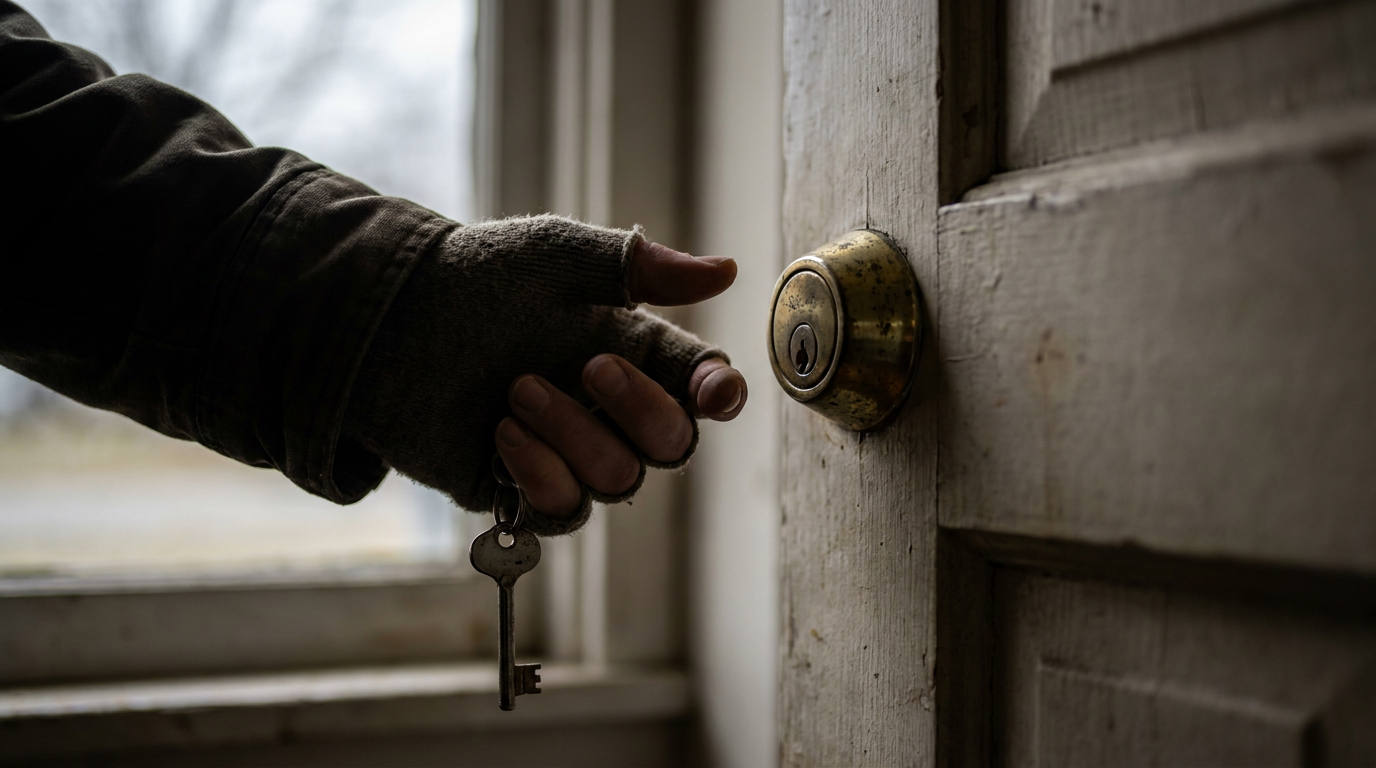
You are already halfway to wherever you are going when it arrives. Not a thought, exactly — more like a gap where a thought should be. Did you lock the door? You try to retrieve the moment. You can see the hallway, the coat you grabbed, the keys in your hand. You can see yourself near the door. What you cannot find is the lock itself — the specific tactile click, the deliberate turn of the wrist, the small ordinary confirmation that the thing is done. So you sit with the absence of that memory, and the absence does not shrink the more you stare at it.
This is not a quirk of anxious people, though anxious people will tell you it lands harder for them. It is a reliable feature of how human memory encodes — or fails to encode — automated action. The neuroscience is specific enough to be almost uncomfortable: the brain has a two-track system for processing routine behavior, and those two tracks do not always produce the kind of durable, retrievable record that conscious recall needs to function. When the action is sufficiently habitual, encoding can be shallow enough that no usable trace gets laid down at all. You did the thing. You simply do not have reliable evidence that you did.
What makes this especially interesting — and what recent memory research has begun to map in much sharper detail — is that the mechanism behind the locked-door feeling is essentially the same one that makes eyewitness testimony one of the least reliable forms of evidence in a courtroom. Source monitoring failure. Retrieval-driven trace modification. Encoding depth as a function of attention, not intention. The parallels are not loose or metaphorical. They describe the same underlying architecture, producing the same class of error, in very different settings.
And the harder you try to remember, the more you may be actively degrading whatever trace was there to begin with.
The Automaticity Problem
Memory research distinguishes broadly between two modes of processing: effortful, attentive encoding and automatic, habitual execution. When you are doing something for the first time — learning a new lock, figuring out an unfamiliar door mechanism — your brain devotes significant prefrontal resources to the task. The hippocampus gets involved in consolidating the experience into something retrievable. You are, in the technical sense, paying attention, and attention is what drives encoding depth.
Repeat the action a few hundred times and something changes. The basal ganglia — a set of subcortical structures heavily involved in habit formation and procedural learning[3] — gradually absorbs the routine. Execution becomes faster, smoother, and dramatically less dependent on conscious supervision. This is the whole point of habit: to free up cognitive resources for tasks that actually require them. But the trade-off is that habitual behavior generates a much thinner memory trace. The action runs on a kind of neural autopilot that does not reliably report back to the systems responsible for episodic memory — the kind you can actually interrogate later.
“Habit is the brain's efficiency solution, and shallow encoding is the price you pay for it every single morning.”
This is why locking the door while thinking about a meeting, a text message, or what you forgot to eat for breakfast is so cognitively risky. The action completes — the motor sequence is fully executed — but your hippocampus was elsewhere. The episodic trace is fragmentary at best, absent at worst. Later, when you need to retrieve it, you are searching for something that was never properly filed.
Source Monitoring and the Invented Memory
The problem compounds because human memory is not a recording device. It is a reconstructive process. When you try to remember whether you locked the door, you are not replaying footage. You are assembling a plausible account from whatever fragments are available — sensory residue, contextual inference, knowledge of your own habits, and the ambient emotional state of the morning. The brain is very good at filling in gaps without announcing that it is doing so.
This is where source monitoring enters. Source monitoring refers to the cognitive process of correctly attributing a memory — determining where it came from. Did I actually lock the door this morning, or am I remembering the dozens of previous mornings when I did? Did I see the event happen, or did I imagine it vividly enough that the imagination left a trace? These questions are genuinely hard for the brain to answer, not because memory is broken, but because memories from different sources share the same neural substrate. A real memory and a strongly imagined one can feel indistinguishable from the inside.
Marcia Johnson's foundational work on source monitoring[2] — developed over decades with colleagues and later elaborated by researchers studying false memory formation — established that errors in source attribution are not rare or pathological. They are a routine feature of normal cognition, particularly for events that were briefly attended, internally generated, or repeated across many similar occasions. All three of those descriptors apply, precisely, to locking your front door on a Tuesday morning.
“A real memory and a strongly imagined one can feel indistinguishable from the inside — that is not a bug, it is just how the architecture works.”
In the courtroom context, source monitoring failure is one of the central reasons eyewitness confidence does not correlate reliably with eyewitness accuracy. A witness can be certain they saw a face, when what they actually saw was a face similar enough to be absorbed by a prior memory without flagging the discrepancy. The confidence is real. The source attribution is wrong. The same mechanism — applied to a domestic routine rather than a crime scene — is what makes standing in your driveway trying to remember feel so futile and yet so compelling.
The Retrieval Trap
Here is where it gets worse. The act of trying to remember — particularly when that attempt is anxious and repetitive — does not simply retrieve a memory. It modifies it. This is one of the more uncomfortable findings in contemporary memory neuroscience: retrieval is not a neutral readout[1]. Every time you access a memory, you reconsolidate it. The trace becomes temporarily labile — susceptible to alteration — before being stored again in its updated form.
Under ordinary circumstances, reconsolidation is probably adaptive. It allows memories to be updated with new information, to stay relevant to a changing world. But when you are anxiously rehearsing a fragmentary memory — replaying the hallway, the coat, the keys, the door, over and over from slightly different angles, trying to force the click of the lock into the frame — you are not recovering a cleaner version of the event. You are potentially overwriting what was there with a plausible reconstruction. The next time you retrieve it, you may be retrieving the reconstruction.
Research on post-event misinformation — most famously developed through Elizabeth Loftus's work on how leading questions alter eyewitness accounts[4] — has shown that memory traces can be modified not just by emotional rehearsal but by exposure to consistent post-event information, including information you generate yourself. The more you tell yourself a vivid, coherent story about locking the door, the more that story can begin to function as the memory, even if the original trace was barely there.
What Anxiety Does to the Loop
Anxiety does not create this problem, but it does make the loop self-sustaining in a particular way. When you cannot retrieve a clear memory of locking the door, the uncertainty itself becomes a threat signal. The amygdala — involved in tagging experiences with emotional salience — responds to the gap as if the gap were danger. This increases arousal, which narrows attention, which sends you back to the retrieval attempt, which produces the same fragmentary result, which sustains the threat signal.
For people without a clinical anxiety disorder, this loop usually collapses on its own after a minute or two of genuine ambiguity. You go back and check, or you decide the evidence of habit is sufficient and move on. For people with obsessive-compulsive disorder, the loop can become structurally self-reinforcing: checking behavior briefly quiets the amygdala, which rewards the checking, which lowers the threshold for future checking. The cognitive architecture is the same. The volume at which the threat signal runs is different.
Research in clinical psychology has noted something counterintuitive here: returning to check the lock often makes the problem worse over time, not better. Not because checking is irrational in the moment, but because it trains the brain to treat uncertainty as intolerable, which escalates the checking threshold incrementally. Behavioral interventions for OCD-related checking work partly by building a tolerance for the unresolved feeling — teaching the amygdala that the gap in memory is not, in fact, an emergency.
What the Record Can and Cannot Tell You
The practical implication of all this is not that your memory is untrustworthy in some general, paralyzing sense. It is more precise than that. Memory is least reliable for briefly attended, highly habitual, emotionally neutral actions performed in a routine context. That description fits locking a door almost perfectly. It fits less well for emotionally significant events, novel experiences, or actions that required extended conscious attention. The unreliability is not uniform. It clusters.
This is also why the forensic memory literature has moved toward understanding encoding conditions rather than simply interrogating recall confidence. What was the witness paying attention to? What else was happening? Was the event routine or novel? How many times has a similar event occurred? These questions matter more than how certain the witness feels, because certainty and accuracy are empirically separable. A person can feel certain and be wrong. A person can feel uncertain and be right. Confidence is an output of the retrieval process, not a measure of the underlying trace.
“Confidence is an output of the retrieval process, not a measure of the underlying trace — which is exactly why the certainty you are looking for will not come from thinking harder.”
There are behavioral interventions that work for the door problem specifically, and they operate at the encoding stage rather than the retrieval stage. Say the action aloud as you do it. Make an unusual gesture. Introduce a deliberate, brief pause. These approaches work because they disrupt automaticity — they force a moment of attentional engagement with the action, which produces a deeper, more retrievable trace. You are not enhancing your memory after the fact. You are inserting a record at the point where records get made.
The Shared Architecture
The locked-door feeling and the collapsing eyewitness account are not just analogous by metaphor. They are expressions of the same underlying system: a memory architecture that was never designed to produce accurate playback on demand, that reconstructs rather than records, that files habitual action in a place the conscious mind cannot easily reach, and that modifies the trace every time you try to retrieve it under pressure.
Courts have been slowly absorbing this research for decades, with ongoing debate about how to weigh eyewitness testimony, how to conduct lineups, how to avoid post-event contamination. The reforms are partial and uneven, and the gap between what memory science knows and what legal procedure assumes remains wide enough to matter in cases where a person's freedom is the stake. The locked door is a lower-stakes version of the same gap — but it points to the same structural truth.
You cannot think your way back to a moment that was never fully encoded. The memory is not hiding somewhere retrievable, waiting for you to find the right search term. The gap is real, and sitting in your driveway replaying the morning is not retrieval — it is reconstruction, each pass building slightly further from whatever actually happened. The one thing that would have helped was a moment of genuine attention, back at the door, before you left. And that moment is gone.
References
- Molecular mechanisms of memory reconsolidation (nature.com)
Establishes that memory retrieval triggers reconsolidation, making traces temporarily malleable and subject to alteration before restoring. - Source monitoring. (doi.org)
Establishes foundational framework that source monitoring errors are routine in normal cognition, especially for briefly attended or repeated events like locking doors. - The role of the basal ganglia in learning and memory: insight from Parkinson's disease (pmc.ncbi.nlm.nih.gov)
Establishes the role of basal ganglia in habit formation and procedural learning, supporting the article's explanation of why habitual actions like locking doors produce shallow memory traces. - Elizabeth Loftus (en.wikipedia.org)
Demonstrates how leading questions and post-event information can alter eyewitness memory, supporting the article's parallel between door-locking and courtroom testimony.
About Silas Crane
Silas Crane writes from the edges of the record: cold cases, cryptids, declassified files, strange disappearances, forensic science, fringe science, mysterious illnesses, eerie technologies, serial killers, cults, state experiments, UAPs, and claims that cannot be cleanly proved or dismissed. His work also examines crime, deviance, corruption, policing, punishment, and the institutions that decide which harms are investigated, sensationalized, ignored, or allowed to continue. A documentarian at heart, he builds unease from verifiable detail and is always drawn back to the gap the file cannot close.
More like this

The Social Replay Loop That Runs Every Night Whether You Want It To
Post-event rumination feels like self-torture, but neuroscience is revealing it as something stranger: a misfiring threat-detection loop with a specific address in the brain.

Every Time You Remember Something, Your Brain Quietly Rewrites It
Memory reconsolidation isn't just how you forget — it's how your brain has been editing your autobiography for years, and the self you think you've always been is partly a work of ongoing fiction.

Your Phone Is the Escape Route. That's Exactly the Problem.
A 90-day study tracking real phone behavior found that using your screen to escape bad feelings doesn't quiet the anxiety or the depression — it quietly locks them together.