The Radio Burst Lasted a Millisecond. The Argument About It Has Lasted Years.
Fast radio bursts arrive from across the universe in under a millisecond — brilliant, violent, and until recently, assumed to be unrepeatable. A handful of them have since proved that assumption wrong, and the physics debate that followed is far from over.
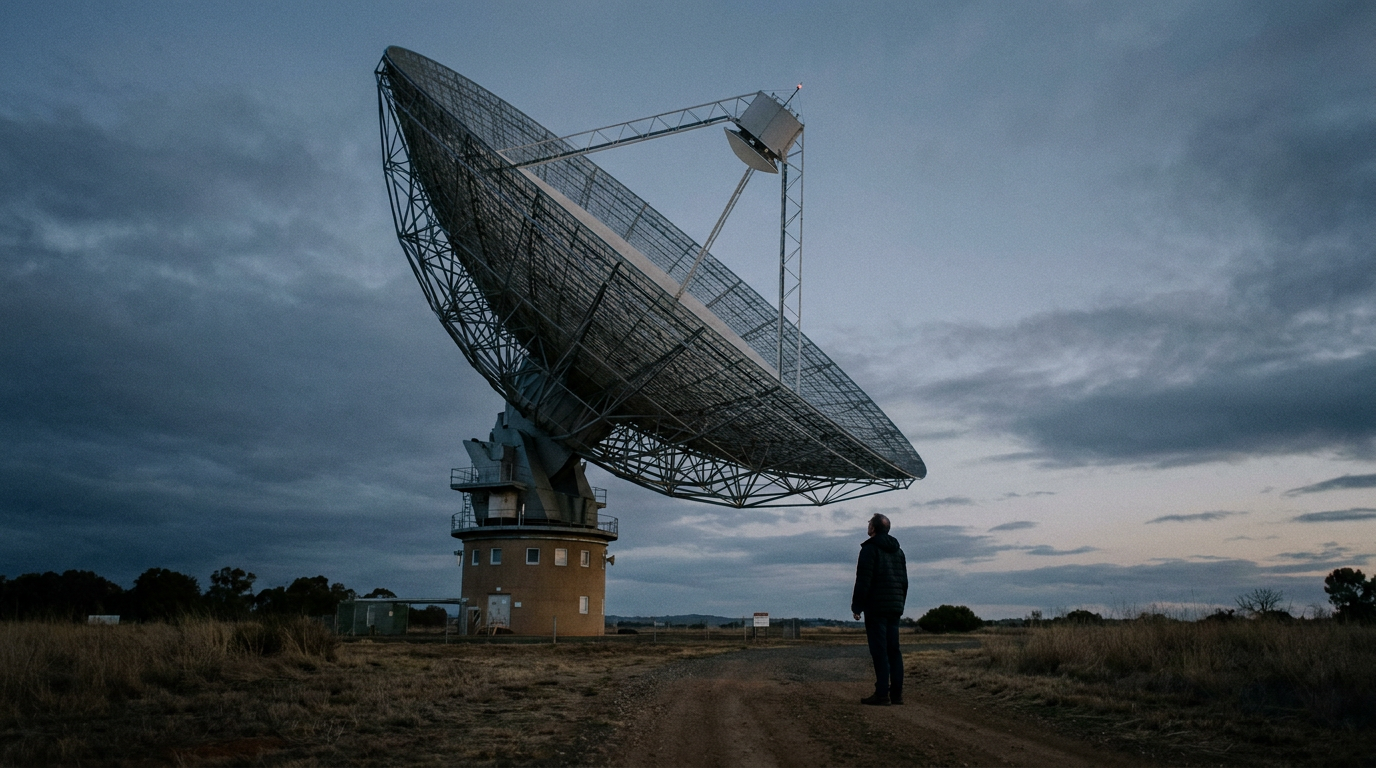
On a single day in 2007, a pulse of radio energy was discovered hiding in archival data from the Parkes Observatory[1] in New South Wales, Australia. The detection itself was quiet — a spike in a spectrograph, a momentary brightening that lasted less than five milliseconds. But the numbers attached to it were not quiet at all. The signal's dispersion measure — the degree to which its lower frequencies lagged behind its higher ones as they traveled through ionized intergalactic plasma — indicated a source not in our galaxy, not in a nearby galaxy cluster, but somewhere billions of light-years away. The pulse had released, in that fraction of a second, roughly as much energy as the sun emits in three days.
This was the first confirmed fast radio burst[3], now designated FRB 010724 and sometimes called the Lorimer Burst after the astronomer who found it in the data. For years afterward, the field was small and strange, populated by researchers who had one event and no coherent explanation for it. A single catastrophic event seemed like the obvious mechanism — a neutron star collapsing into a black hole, two compact objects merging, a magnetar releasing a colossal flare. These are the kinds of cosmic events that happen once and leave nothing behind to interrogate. The universe detonates something, the signal crosses billions of light-years of intergalactic space, and we catch one brief echo of it. Clean, if not simple.
Then the field got complicated. Detections multiplied. The Canadian Hydrogen Intensity Mapping Experiment, better known as CHIME, came online in 2018 in British Columbia and immediately transformed the FRB catalog. Its design — a fixed cylindrical reflector that sees a broad swath of sky every day — made it far better suited to catching rare transient events than traditional steerable dishes. Within its first year of operation, CHIME had detected dozens of bursts. Among them were repeaters: sources that fired more than once, then fired again, sometimes on timescales of hours, sometimes days. One of them, FRB 20180916B, turned out to be cycling on a period of roughly 16 days[2], active for about four days at a time before going quiet again. Another, FRB 20121102A — the first repeater ever identified, originally caught by the Arecibo Observatory in Puerto Rico — showed no clean periodicity, but it had fired hundreds of times. That is not a catastrophe. Catastrophes do not repeat.
What astronomers now have is a population split that refuses to resolve neatly. Some fast radio bursts appear to be one-off events. Others repeat. And whether these two populations share a common mechanism — whether they are different expressions of the same physics, or fundamentally different phenomena — is one of the most genuinely contested questions in observational astrophysics right now. The instruments are better than they have ever been. The data is richer. The argument has not gotten easier.
What the Dispersion Measure Actually Tells You
Before getting into the argument, it helps to understand what a fast radio burst looks like to an instrument. Radio waves traveling through plasma — the ionized gas that fills the space between galaxies — do not all arrive at the same time. Lower frequencies slow down slightly more than higher ones. The amount of smearing, measured in parsecs per cubic centimeter, is the dispersion measure. For local signals — a pulsar inside the Milky Way, say — the dispersion measure is modest and accountable for. For FRBs, the dispersion measures are often so large that the intervening plasma alone cannot explain them without invoking vast intergalactic distances. In the cleanest cases, astronomers have pinned specific bursts to host galaxies at known redshifts, confirming that these events are happening well outside our own cosmic neighborhood. The dispersion measure, in this sense, is not just a curiosity. It is an indirect ruler for cosmic distance, and for fast radio bursts it routinely reads out in billions of light-years.
The duration of the bursts creates a separate constraint. Something that emits for less than a millisecond must, by the light-travel argument, have an emission region no larger than a few hundred kilometers across. That is a hard upper limit. The physical structures that can generate coherent radio emission on that scale and at that luminosity are not numerous: neutron stars, and specifically the exotic subset of neutron stars called magnetars, dominate nearly every serious theoretical model. A magnetar is a neutron star with a magnetic field strength that can reach ten to the fifteen times that of Earth's — so intense that it warps the fabric of the electromagnetic environment around the star, drives crust-quakes, and can release enormous bursts of X-ray and radio energy. In April 2020, a magnetar inside our own galaxy, SGR 1935+2154, released a burst detected simultaneously by CHIME and the STARE2 array[4] in California. It was, by some estimates, three orders of magnitude less energetic than a typical extragalactic FRB — but it was a radio burst, from a magnetar, at a distance where we could actually identify the source. That single detection did enormous work for the magnetar hypothesis.
“A magnetar field is so intense it can crack a neutron star's crust. Whether it can also explain a burst that repeats on a sixteen-day cycle is where the model starts to strain.”
Where the Magnetar Model Runs Into Trouble
The magnetar detection in our galaxy was a breakthrough, but it was also a warning. SGR 1935+2154's burst was weaker than extragalactic FRBs by a factor of roughly one thousand. To account for the most energetic extragalactic bursts under a magnetar model, you either need a much more extreme event than the Milky Way source produced, or you need conditions in distant host galaxies that are meaningfully different from what we can observe locally. Neither is impossible. But the comfort the 2020 detection provided was partial.
The repeaters are a sharper problem. Standard magnetar flare models do not naturally produce a periodically repeating source. Magnetar activity can be irregular, storm-like, clustered in time — but a 16-day cycle with a consistent active window suggests something more structured than a series of random flares from a magnetically stressed crust. Several explanations have been proposed: orbital modulation, where the burst emission is blocked or beamed depending on the position of a companion star or disk in the system; precession of the neutron star itself, causing the emission beam to sweep in and out of our line of sight on a predictable schedule; or some form of geometric periodicity tied to the star's rotation and magnetic axis. Each of these can be made to fit the data with the right parameters, but none of them follows straightforwardly from the core magnetar framework without additional assumptions. The risk in theoretical astrophysics is always the same: a model that can be tuned to fit anything explains nothing cleanly.
The situation is further complicated by the morphology of individual bursts. High-time-resolution data from CHIME and from the European VLBI Network has revealed that some bursts have complex substructure — multiple sub-pulses within a single event, drift patterns across frequency, and what appears to be a characteristic frequency downward drift sometimes described as a "sad trombone" pattern. This drift is hard to produce in simple magnetospheric emission models without invoking specific geometric effects or propagation through structured plasma. Some researchers have pointed to mechanisms involving plasma lensing or scattering in the dense environment around an active neutron star. Others have argued that the emission itself is fundamentally different from what magnetar models typically predict. The data is rich enough now to see the structure; it is not yet clear enough to arbitrate between models.
Two Populations or One Source Family?
“The cleanest version of the FRB mystery — one event, one catastrophe, one explanation — dissolved as soon as the repeaters started accumulating.”
One of the more uncomfortable possibilities sitting in the literature is that there is no single answer. Non-repeating FRBs and repeating FRBs may differ in more than behavior. Their host galaxy environments differ: some repeaters have been localized to star-forming regions with strong magnetic environments, while some apparent non-repeaters have been traced to older, quieter galaxies. Their burst widths differ on average. Their polarization properties differ. If these distinctions hold up as sample sizes grow, they may eventually point toward genuinely distinct progenitor populations — different physical mechanisms producing similar signatures — rather than a single class of object caught at different stages of activity.
This is not unusual in astrophysics. Gamma-ray bursts were initially treated as a single phenomenon, and it took years of data — from CGRO's BATSE instrument, then from Swift and Fermi — to establish that short gamma-ray bursts and long gamma-ray bursts are produced by different events: neutron star mergers for the short ones, collapsing massive stars for the long ones. The split was visible in the duration distribution long before the mechanism was confirmed. Something similar may be happening with fast radio bursts. The repeaters and non-repeaters may simply be the astronomers' first rough cut of what will eventually separate into distinct astrophysical categories.
What New Instruments Are Adding to the Picture
CHIME's sensitivity and sky coverage have been transformative, and its catalog has grown into the hundreds. But the next phase of FRB science requires more than detection — it requires localization precise enough to identify the host galaxy and, ideally, the specific environment within that galaxy where a burst originates. Milliarcsecond localization demands interferometry, which is why the field has turned increasingly to VLBI networks and purpose-built arrays. The Deep Synoptic Array in California, the Australian Square Kilometre Array Pathfinder, and the MeerKAT telescope in South Africa are all contributing to the effort to pin bursts to precise locations. Each successful localization is a data point about the kinds of environments that produce these events — dense star-forming regions, outskirts of dwarf galaxies, globular clusters, galactic centers — and those environments carry information about which progenitor models survive contact with reality.
The Square Kilometre Array, currently under construction across South Africa and Australia, will operate at a scale and sensitivity that dwarfs current facilities. When its collecting area reaches full deployment, it will be capable of detecting fast radio bursts at redshifts that current instruments cannot reliably probe, extending the FRB population into early cosmic history and dramatically expanding the range of host environments available for comparison. Some researchers have proposed that FRBs, once understood, could serve as cosmological probes in their own right — their dispersion measures carrying information about the distribution of ionized matter across cosmic time, a method for measuring the density of the universe's diffuse gas that would be independent of, and complementary to, other techniques. This is one of those cases where an unresolved astrophysical mystery is worth solving twice: once for what it tells us about the sources, and again for what the sources might tell us about everything else.
The Argument That Isn't Over
“The universe rarely gives us phenomena that sit quietly at the boundary of our instruments and wait to be understood at our pace.”
The magnetar model remains the leading framework, and the 2020 Milky Way detection remains its strongest single piece of evidence. But leading is not the same as established. The model accounts for the energy scale, the emission region size, and the general behavior of extreme neutron stars. What it has not fully accounted for is the repeating structure, the sub-burst morphology, the periodicity, and the diversity of host environments in a way that does not require significant additional machinery. Competing proposals — binaries with stellar winds, geometric precession, charge-starved magnetospheres, even compact objects other than magnetars — remain live options in the literature, not because they have strong independent confirmation but because the magnetar picture still has seams in it.
What makes the fast radio burst debate genuinely interesting, rather than just technically difficult, is the combination of extreme timescales involved. The bursts themselves last a fraction of a second. The signals travel for billions of years to reach us. The debate about them has been running for less than two decades. And the observations that might resolve it depend on instruments that are still being built, at sensitivities that are still being reached, looking for events that are still being cataloged. The universe has been generating these pulses — or something like them — for most of its history. We have been watching for a few years. There is no reason the answer should already be obvious, and some reason to think the structure of the mystery itself — one population or two, one mechanism or several, catastrophe or cycle — will turn out to be more informative than any single clean solution.
References
- A bright millisecond radio burst of extragalactic origin (arxiv.org)
Documents the discovery of the first fast radio burst in archival Parkes Observatory data, establishing the foundational 2007 detection. - A CHIME/FRB study of burst rate and morphological evolution of the periodically repeating FRB 20180916B (arxiv.org)
Establishes the 16.3-day periodicity of repeating FRB 20180916B, a key example of periodic behavior that challenges standard magnetar models. - A decade of fast radio bursts (nature.com)
Provides historical context and designation for the first confirmed fast radio burst, FRB 010724, also known as the Lorimer Burst. - A fast radio burst associated with a Galactic magnetar (nature.com)
Provides observational evidence that a Galactic magnetar produced a radio burst, supporting the magnetar hypothesis for FRBs.
About Elias Voss
Elias Voss writes about astronomy, space missions, telescope discoveries, and cosmic anomalies - and why it matters to us here on Earth. When the universe's physics reaches down and touches life on our planet, he follows it there too. He specializes in translating dense data into vivid, precise stories without sacrificing accuracy.
More like this
The FRB That Fired Once, Left a Partner Behind, and Broke the Rulebook
A fast radio burst caught inside a binary star system just overturned the leading explanation for what produces them — and the real problem is that the burst only fired once.
The Signal That Fooled the World's Best Radio Telescopes for a Decade
The Lorimer Burst triggered years of real astrophysics before scientists could confirm the source wasn't their own equipment — and that uncomfortable gap is the most instructive part of the story.
The Brightest Radio Flash Ever Detected Has a Silence Problem
For the first time, astronomers pinpointed a record-breaking fast radio burst to a region smaller than most star clusters — and what they found there quietly threatens the theory meant to explain all of them.