The Signal That Fooled the World's Best Radio Telescopes for a Decade
The Lorimer Burst triggered years of real astrophysics before scientists could confirm the source wasn't their own equipment — and that uncomfortable gap is the most instructive part of the story.
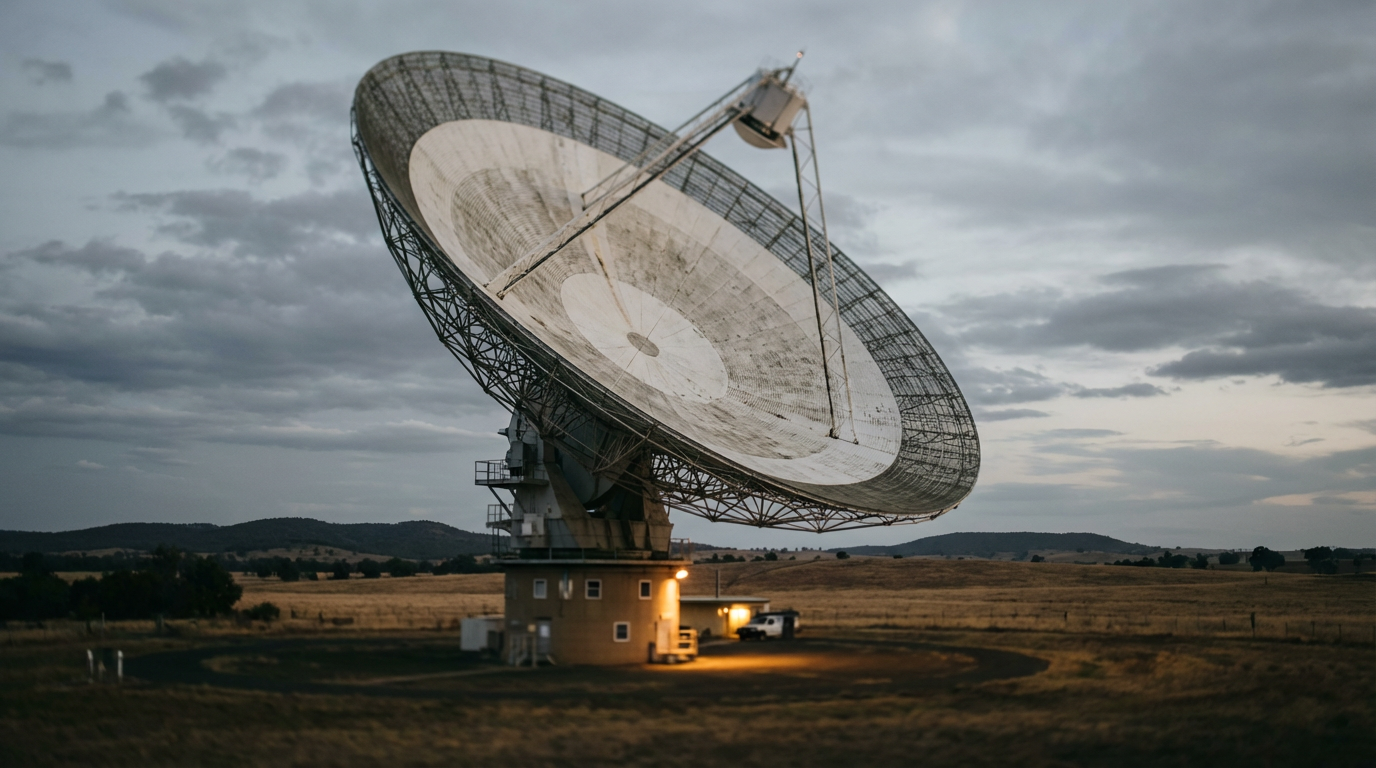
In 2007, Duncan Lorimer and his student David Narkevic were working through archival data from the Parkes radio telescope[1] in New South Wales when they found something that did not fit. A burst of radio emission, lasting roughly five milliseconds, had been recorded in 2001 — too bright, too brief, and too spectrally distinctive to be easily explained away. It had arrived dispersed across frequencies in the specific pattern that indicates travel through ionized plasma, which meant, if the signal was real and astrophysical, it had crossed an enormous distance. The dispersion measure pointed to a source well outside the Milky Way. Extragalactic. Something had screamed in the radio spectrum from a cosmological distance, and the beam had struck exactly one dish on the surface of the Earth during exactly the right fraction of a second.
The paper announcing what would become known as the Lorimer Burst was cautious. It described the event, offered the dispersion analysis, noted the extragalactic implication, and acknowledged that the source was unknown. That kind of announcement, under normal circumstances, produces a wave of follow-up observations and a settled resolution within a few years. That did not happen. What happened instead was a decade-long dispute over whether the burst was a real astrophysical phenomenon or an artifact of the instrument, the local environment, or human error. The community was being asked to accept an extraordinary claim on the basis of a single archival detection, from a signal that lasted five thousandths of a second and could never, by definition, be re-observed directly.
That uncertainty would not remain sterile. Before the source was confirmed, before a second event was reliably detected, before the mechanism was understood, theorists had already begun generating explanations. Colliding neutron stars. Evaporating black holes. Rotating magnetars. Exotic phase transitions in dense stellar objects. The field of fast radio burst astrophysics — a field built around a single disputed signal — was accumulating hypotheses faster than it was accumulating data. This is not unusual in science, exactly, but it is uncomfortable. It makes the Lorimer Burst story not just a tale about a strange cosmic signal, but a case study in the epistemology of discovery: how much architecture do you build on a foundation you cannot yet verify?
The answer the field eventually arrived at is both reassuring and instructive. The Lorimer Burst was real. Fast radio bursts are real. They are among the most energetic transient phenomena in the observable universe. But the path from that first archival detection to confident confirmation was longer, stranger, and more epistemically tangled than the popular account usually acknowledges. To follow it carefully is to understand something important about how science handles anomalies — and why the gap between observation and interpretation is never as clean as it looks in retrospect.
One Signal, No Repeat, No Explanation
The core problem with the Lorimer Burst was irreproducibility. Not in the experimental sense — no one was claiming the result could not be repeated in a lab — but in the observational sense. It had happened once, been captured accidentally in archival data from a survey aimed at something else, and had never recurred. Radio astronomy has a complicated relationship with one-off events. The sky is full of transient phenomena: solar radio bursts, satellite interference, terrestrial broadcasts leaking into the band, aircraft, lightning, radar. Telescope systems, especially ones operating at the edge of their sensitivity, also generate internal artifacts that can masquerade as signals. A single bright burst in archival data, however compelling the dispersion signature, sits in genuinely ambiguous territory.
The skepticism intensified in the years after the initial paper. Other radio telescopes attempted to detect similar events and found nothing. This proved little — a rare extragalactic transient might simply require an enormous amount of observing time to catch — but the silence was discouraging. Then came a development that seemed to validate the doubters. In 2011, researchers identified a class of radio bursts that appeared to originate from near the Parkes telescope itself. These were called perytons, and they were startling: they showed frequency-dependent dispersion patterns similar to those seen in the Lorimer Burst, which had been one of the primary arguments for an astrophysical origin. Perytons were eventually traced to microwave ovens in the observatory's kitchen[4] — specifically, to staff opening the microwave door before the cycle finished, which caused the magnetron to leak radio frequency energy into the receiver. This was not a cover-up or an embarrassment. It was a straightforward lesson in how terrestrial radio frequency interference can produce signatures that look, at first pass, astrophysical.
“The dispersion signature that argued for a cosmological source was the same kind of signature that microwave ovens, under the right conditions, could fake.”
The peryton discovery did not prove the Lorimer Burst was a microwave oven. The timing and characteristics were different enough that a direct identification was not supportable. But it demonstrated convincingly that the Parkes system was capable of producing dispersion-mimicking artifacts from local sources, which raised the obvious and uncomfortable question: what, exactly, was the Lorimer Burst? The field had been operating under a working assumption that the signal was extragalactic, had been publishing theoretical papers in that assumption's wake, and now faced the possibility that the assumption was built on shaky ground.
The Architecture of a Field Without a Foundation
This is the part of the story that tends to get compressed in popular accounts, because it is uncomfortable. Between 2007 and roughly 2013, fast radio burst theory was a functioning subdiscipline. Physicists were calculating the expected rates of cosmological fast radio bursts based on the Lorimer Burst detection statistics. Papers estimated source populations, redshift distributions, and implied energy budgets. Proposals were made for using fast radio burst dispersion measures as cosmological probes — a way of measuring the baryon density of the intergalactic medium and potentially constraining cosmological parameters independently of other methods. This last idea was genuinely elegant and remains scientifically compelling today. But it was being developed on the basis of evidence that, at the time, consisted of a single ambiguous archival detection.
The charitable interpretation is that this is how physics often works. You detect an anomaly, you build out the theoretical landscape, and you use the theory to motivate the next generation of instruments and observations. The theory can be wrong in ways that are still productive — the scaffolding helps you think more clearly about what you are looking for. The less charitable interpretation is that motivated reasoning and publication incentives can cause a field to over-commit to an interpretation before the evidence has earned that commitment. Both interpretations are probably partially correct, and the fast radio burst case is unusual mainly because the gap between initial detection and reliable confirmation was long enough that both pressures had time to operate visibly.
Confirmation and the Shape of Real Mystery
The field's foundation solidified in 2013, when the Thornton et al. paper reported four new fast radio bursts, all detected in archival Parkes data from the High Time Resolution Universe Survey[3]. Four events, independently characterized, showing the same class of dispersion signature, originating from different parts of the sky. This was no longer a single anomalous data point. The statistical picture had changed. The events clustered at high galactic latitudes, consistent with an extragalactic origin — signals from within the Milky Way would have shown different galactic distribution patterns. The dispersion measures were too high to be explained by the known electron content of our galaxy. The implied energetics were extraordinary: each burst was radiating as much energy in milliseconds as the sun emits in days, just in radio wavelengths.
“Four independent detections at high galactic latitudes did what one archival burst never could — they turned an anomaly into a phenomenon.”
What followed was rapid. Dedicated fast radio burst search programs were established. CHIME, the Canadian Hydrogen Intensity Mapping Experiment, became a particularly effective detection machine, logging hundreds of events and revealing that some fast radio bursts repeat — a crucial discovery, because repeating sources could be studied in a way that one-off events never could. The repeating fast radio bursts allowed follow-up campaigns in multiple wavelengths, enabling researchers to localize them precisely enough to identify host galaxies. The first repeating source, FRB 121102, was pinned to a dwarf galaxy more than three billion light-years away. The dispersion interpretation had been right. The objects were genuinely cosmological.
The source mechanism remains contested, though the leading candidate has strengthened considerably. Magnetars — neutron stars with extraordinarily powerful magnetic fields — became the prime suspect after a fast radio burst was detected in 2020 from a known magnetar inside the Milky Way, SGR 1935+2154[2]. This was the first time a fast radio burst had been associated with a specific identified source at a known distance. The burst was less luminous than extragalactic events by several orders of magnitude, which suggested magnetars might span a wide range of burst energetics, or that other source classes exist alongside them. Neither conclusion closes the case, but both are far more grounded than anything the field could have claimed in 2008.
What the Dispersion Measure Can and Cannot Tell You
One of the things that makes fast radio bursts genuinely useful as scientific instruments — not just as phenomena to explain — is the dispersion measure itself. Radio waves at different frequencies travel at slightly different speeds through ionized plasma. A burst that began as a simultaneous emission across the radio spectrum arrives at a telescope smeared in time, with lower frequencies trailing higher ones. The amount of smearing encodes the total column density of electrons the signal passed through. Strip out the contribution from our own galaxy and the host galaxy, and you are left with an estimate of the electron content of the intergalactic medium along that line of sight. This is a direct probe of matter in the largely empty spaces between galaxies — the cosmic web in its most diffuse form — which is otherwise extraordinarily difficult to measure.
The promise of this technique is that fast radio bursts could help resolve the missing baryon problem: the observation that the ordinary matter we can directly account for in the local universe represents only a fraction of what cosmological models predict should be there. The rest is thought to be in the intergalactic medium, too diffuse and too hot to emit or absorb light efficiently, but theoretically detectable through dispersion. A large enough catalog of fast radio bursts at known redshifts could, in principle, constrain the baryon density of the cosmic web in a way that no other current instrument can manage. The astrophysics here is legitimate and active. The tool that theorists began describing before anyone confirmed fast radio bursts were real has matured into a genuine measurement program.
The Lesson That Isn't Just About Radio Telescopes
“The Lorimer Burst was real, but it took years to prove it — and the field did not wait for proof before starting to think.”
The Lorimer Burst story is sometimes told as a triumph of persistence: anomaly detected, skeptics quieted, mystery resolved. That framing is too clean. The peryton episode did real damage to the field's credibility at a moment when credibility was the only currency it had. The years of theorizing on thin evidence created a literature that had to be sorted, retroactively, into the parts that survived confirmation and the parts that didn't. The eventual confirmation did not retroactively validate the process that preceded it — it just happened to produce a survivable outcome.
What the case actually demonstrates is something more specific: that the hardest part of working with transient, unrepeatable, instrument-edge phenomena is calibrating how much weight to give an observation before you have a second one. The answer the fast radio burst community arrived at, not through explicit policy but through the ordinary friction of publication and criticism, was roughly this — theorize freely, but track the evidence carefully, and do not mistake theoretical elegance for empirical support. The signal that fooled nobody and everybody at once turned out to be real. The field that built itself around it, on faith and good math, turned out to be legitimate. But the distinction between those two outcomes is never guaranteed in advance, which is exactly why keeping the tension alive — between the strange signal and the instrument that caught it, between the hypothesis and the data, between the anomaly and the explanation — is not a failure of resolution. It is the actual method.
References
- A Bright Millisecond Radio Burst of Extragalactic Origin (science.org)
Contains the original 2007 Lorimer Burst detection data and dispersion analysis that initiated the decade-long dispute over the signal's astrophysical origin. - A fast radio burst associated with a Galactic magnetar (nature.com)
Demonstrates that magnetars can produce fast radio bursts, supporting one of the theoretical explanations proposed during the decade of uncertainty. - A Population of Fast Radio Bursts at Cosmological Distances (science.org)
Reports the 2013 Thornton et al. detection of four independent fast radio bursts that confirmed the phenomenon was real, not instrumental artifact. - Identifying the source of perytons at the Parkes radio telescope (academic.oup.com)
Documents the peryton discovery showing microwave ovens could produce dispersion-mimicking artifacts, raising doubts about whether the Lorimer Burst was a local interference source.
About Rowan Ellery
Rowan Ellery writes about anomalies, unexplained sightings, strange signals, and the uneasy border between observation, misinterpretation, and genuine mystery. Their work focuses on keeping curiosity alive without letting evidence dissolve into folklore.
More like this
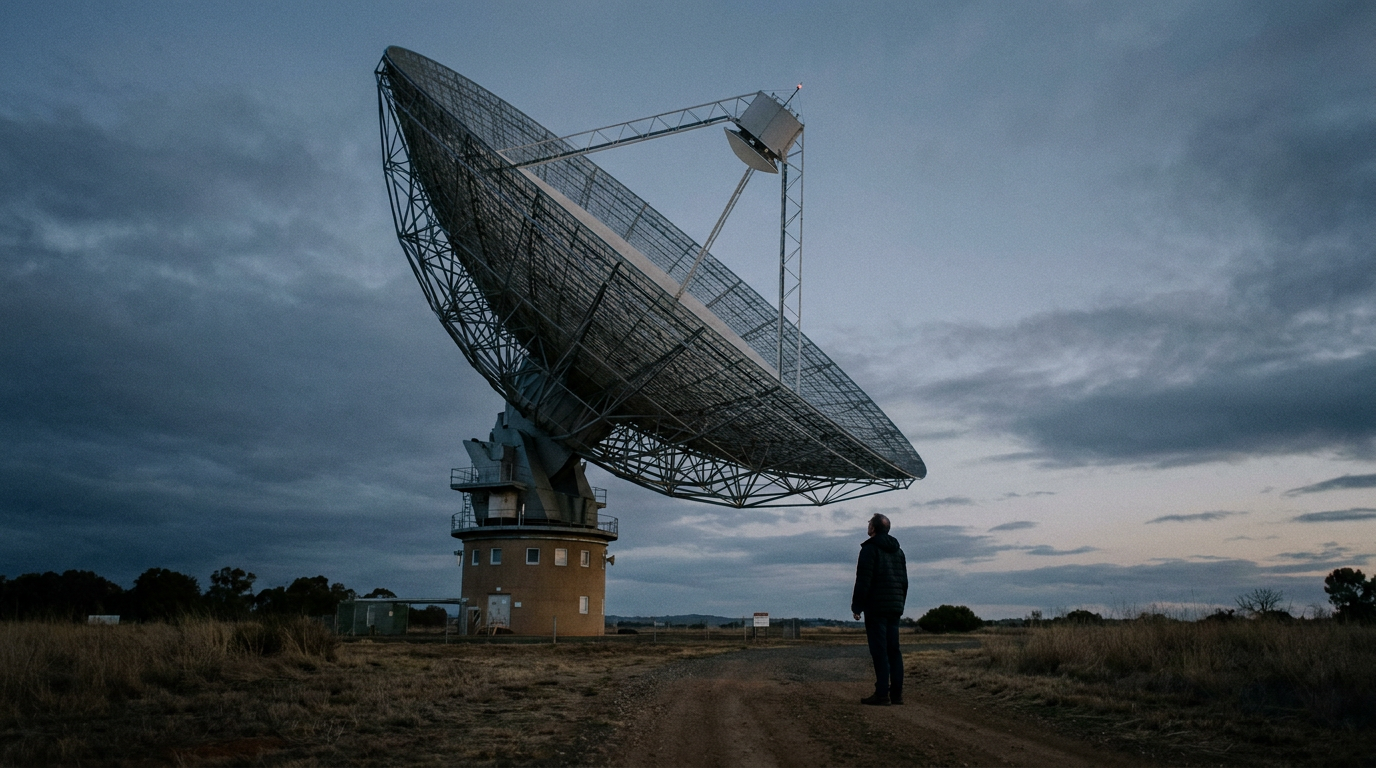
The Radio Burst Lasted a Millisecond. The Argument About It Has Lasted Years.
Fast radio bursts arrive from across the universe in under a millisecond — brilliant, violent, and until recently, assumed to be unrepeatable. A handful of them have since proved that assumption wrong, and the physics debate that followed is far from over.
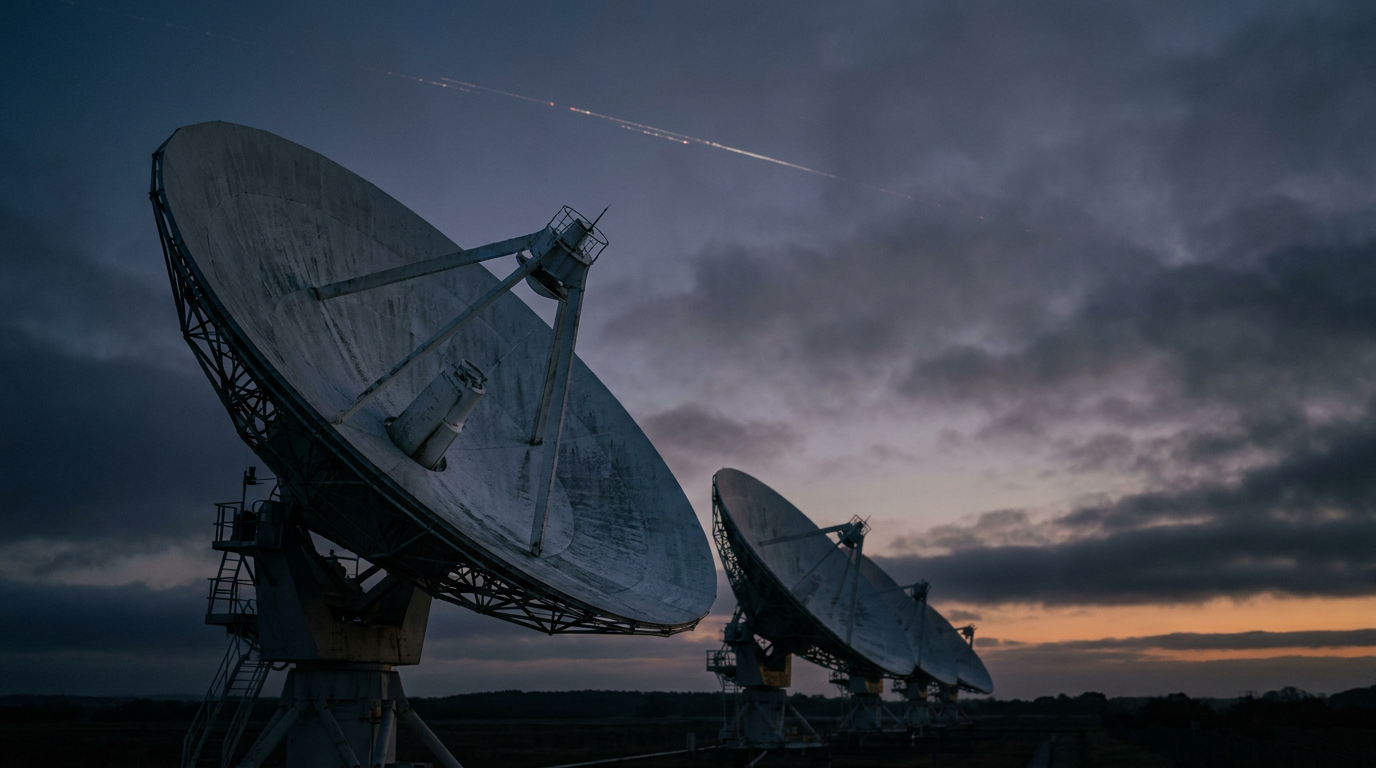
The FRB That Fired Once, Left a Partner Behind, and Broke the Rulebook
A fast radio burst caught inside a binary star system just overturned the leading explanation for what produces them — and the real problem is that the burst only fired once.
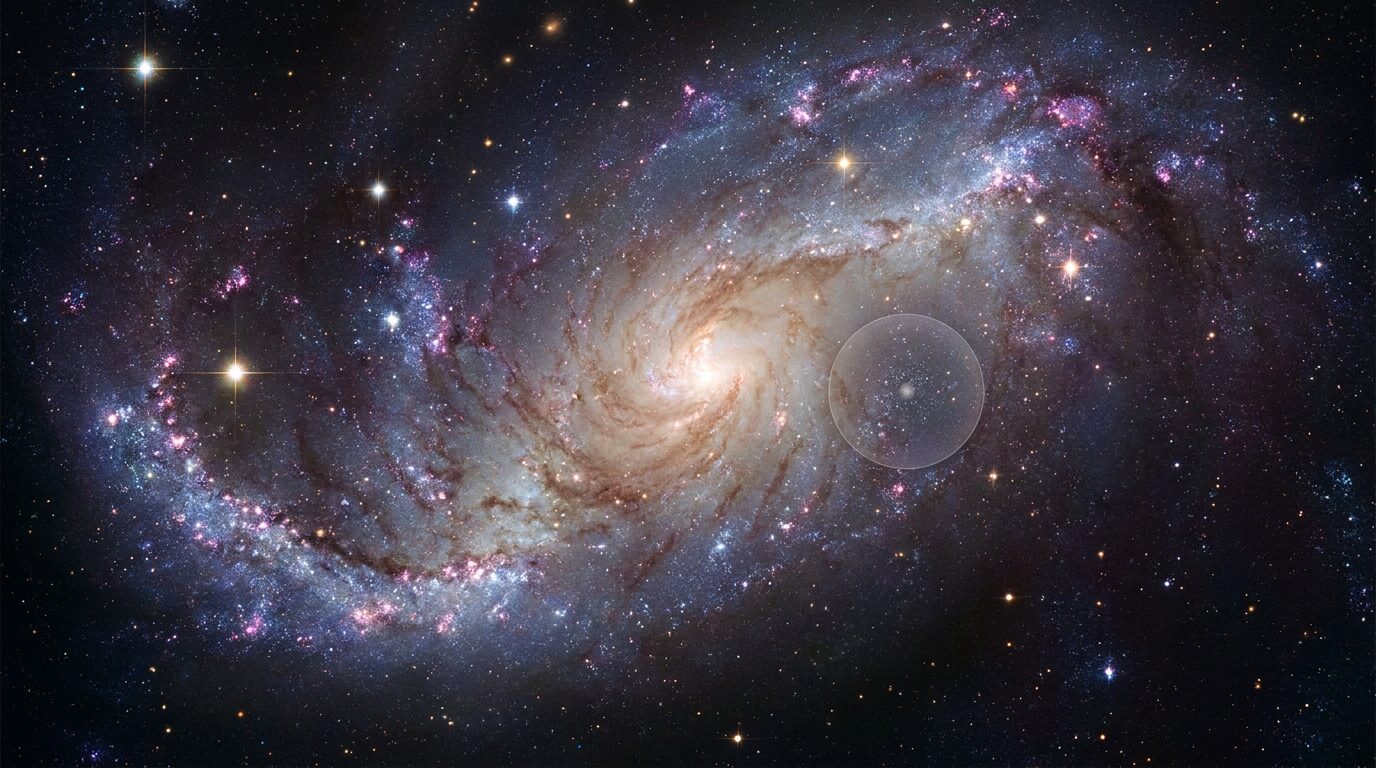
The Brightest Radio Flash Ever Detected Has a Silence Problem
For the first time, astronomers pinpointed a record-breaking fast radio burst to a region smaller than most star clusters — and what they found there quietly threatens the theory meant to explain all of them.