The Most Famous Wallpaper Designer in England Said the Deaths Were Hysteria. His Family Owned the Mine.
Victorian England's arsenic wallpaper crisis lasted half a century partly because its most eloquent defender had a financial stake in the very mines producing the poison.
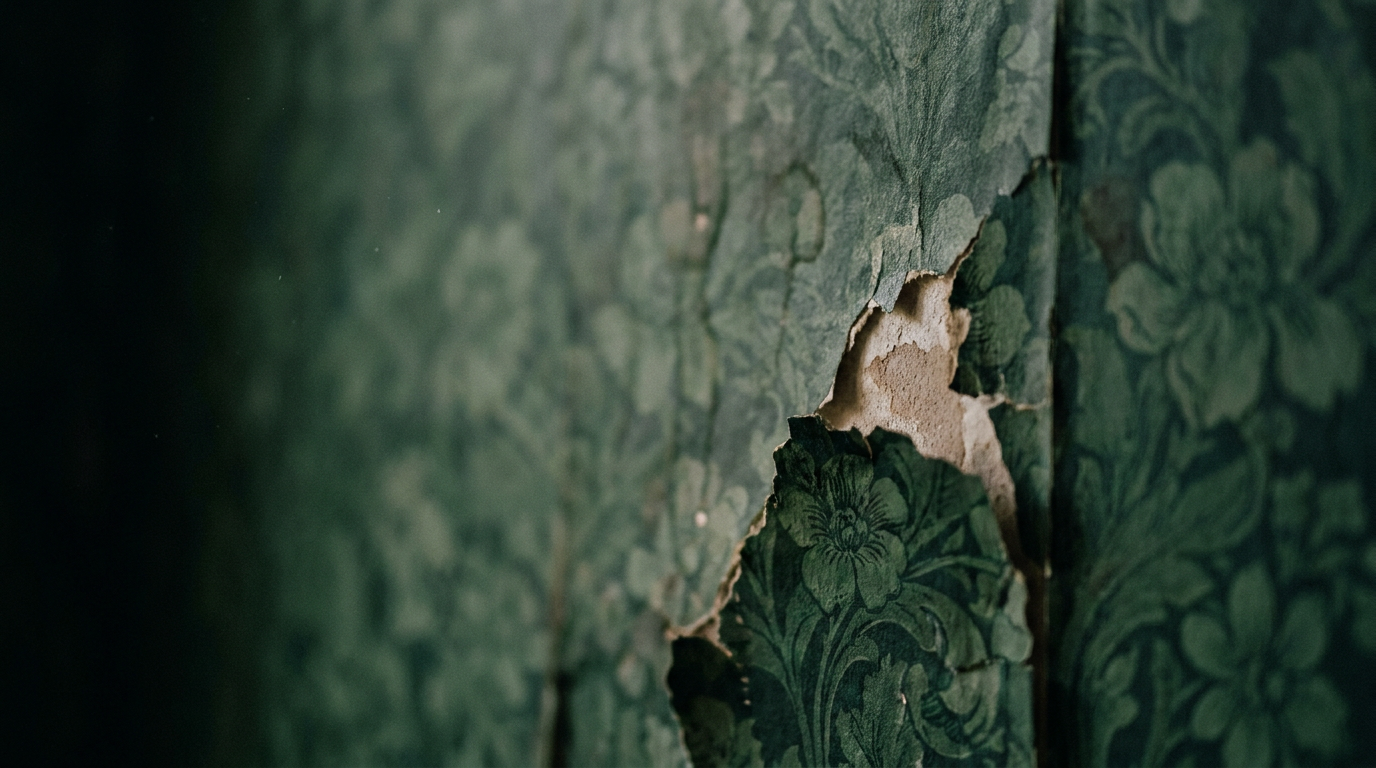
The color was extraordinary. A vivid, almost electric green that no pigment available before 1775 had quite managed to produce — deep enough for foliage, stable enough for fabric, cheap enough to scale. Carl Wilhelm Scheele, the Swedish chemist[3] who formulated it, was more interested in its commercial potential than its chemistry. What he had made was copper arsenite: one part copper, one part arsenic trioxide, bonded into a compound that held its color well and its toxicity better. Within decades, Scheele's Green was everywhere in English homes. It was in wallpaper, artificial flowers, dress fabric, candles, children's toys, and the printed wrappers of penny candy. It was, by any measure, a design sensation. It was also, by documented biological mechanism, a slow and inconsistent poison.
The inconsistency is part of what kept it on walls. Arsenic compounds do not behave identically in every environment. Dry conditions can suppress their volatility. Good ventilation can dilute exposure below the threshold for acute symptoms. Not everyone in a poisoned room got sick at the same rate, and not everyone who got sick was diagnosed correctly. Victorian physicians encountered children with recurring nausea, skin eruptions, unexplained hair loss, and nervous symptoms and reached, more often than not, for explanations that did not require them to implicate the décor: bad drains, miasma, constitutional weakness, damp. The wallpaper was beautiful. The alternative was ugly and expensive.
By the mid-nineteenth century, the medical evidence was not exactly hidden. Toxicologists had traced the mechanism. Investigators had documented clusters of illness that cleared when families moved or stripped their walls. A German chemist named Johann Ernst Reinsch had refined a detection test for arsenic in the 1840s; James Marsh had published his version[2] a decade earlier. The science of arsenical poisoning was available, if not yet unified into clinical consensus. What it lacked was institutional force. The people with the most authority to act on it — manufacturers, retailers, prominent designers — had the most to lose by doing so.
This is where the story gets specific in a way that most retrospective accounts soften. The most famous wallpaper designer in England, a man whose name is still synonymous with Victorian decorative arts, dismissed the concerns publicly and with considerable eloquence. William Morris called the warnings overblown. He said the panic was driven by sensation-seeking journalism and a public that did not understand chemistry. What the public did not know — and what Morris did not volunteer — was that his family's company, Devon Great Consols, was one of the largest arsenic-producing mines in the world. He held shares. The compound under discussion was, in a traceable financial sense, a product his family helped supply.
The Mine Beneath the Pattern
Devon Great Consols opened in 1844[1] in the Tamar Valley, on the Devon-Cornwall border. It was, for a time, the richest copper mine in the world. As copper prices fell in the second half of the century, the mine pivoted. Arsenic trioxide — a byproduct of copper smelting — became its primary export. By the 1860s and 1870s, Devon Great Consols was supplying a significant portion of the global arsenic market, and Morris & Co., the firm William Morris had founded, was producing wallpapers that used arsenic-based pigments as a matter of standard practice. The design and the supply chain ran, if not through the same office, then through the same family balance sheet. Morris inherited shares in the mine from his father. He benefited from them throughout his career as a designer.
“The compound under discussion was, in a traceable financial sense, a product his family helped supply.”
Morris's public position was consistent and forcefully argued. In letters and statements, he maintained that the fears about arsenical wallpaper were exaggerated, that no credible scientific consensus supported the alarm, and that his own workers — who handled the materials daily — showed no ill effects. The last point is worth pausing on. Workers in print shops handling arsenic pigments did, in fact, report symptoms; the occupational literature of the period documents this. Whether Morris was unaware of these reports, disbelieved them, or chose not to reference them is not entirely clear from the surviving record. What is clear is that his dismissals were public, were repeated, and carried the cultural weight of his reputation as an artist and intellectual.
He eventually removed arsenic pigments from Morris & Co. wallpapers — not in response to the public health argument, by his account, but because customer demand had shifted. The distinction matters. An aesthetic market correction and a public health capitulation are different things. One concedes the science; the other just follows the money in a new direction.
How a Poison Stays in a Nursery
Understanding how arsenical wallpaper actually poisoned people requires a brief stop in the chemistry of damp walls, because the mechanism is not simply contact. The compound becomes significantly more dangerous when it is metabolized by certain molds — particularly Scopulariopsis brevicaulis, a common household fungus[4] — into trimethylarsine, a volatile organoarsenic gas. This process, first rigorously described by the Italian chemist Bartolomeo Gosio in the 1890s, explained something that had puzzled observers for decades: why some rooms with arsenical wallpaper produced illness while others, apparently identical, did not. The critical variable was moisture. Damp walls fed mold. Mold metabolized the arsenic into a gaseous form the occupants breathed. Dry walls could harbor the same pigment for years without releasing it in toxic concentrations.
Nurseries were particularly vulnerable. They were frequently on the upper floors of Victorian townhouses, where rising damp and poor ventilation were common. They were papered with bright patterns — flowers, birds, leaves — precisely the designs that used the most vivid pigments. Children spent more continuous time in those rooms than anyone else in the household. And children, with their lower body weight and still-developing nervous systems, metabolized arsenic at higher effective doses per kilogram than adults. The geometry of the risk was almost architectural: the most poisonous rooms, in the most poisonous configurations, tended to contain the most vulnerable people.
“The geometry of the risk was almost architectural: the most poisonous rooms, in the most poisonous configurations, tended to contain the most vulnerable people.”
Physicians who did suspect the wallpaper often found themselves unable to compel action. There was no regulatory body with jurisdiction over domestic interior products. The medical establishment had not reached formal consensus. And the families involved were, in many cases, precisely the prosperous middle-class households that had spent real money on fashionable décor. To tell them that their expensive wallpaper had made their child ill was to ask them to hold two uncomfortable ideas at once: that they had been poisoned and that they had paid for it. The denial was not entirely irrational. It was the psychological arithmetic of people who could not yet afford the truth.
The Medical Record, Read Carefully
The documented cases from the mid-Victorian period follow a pattern that is, in retrospect, recognizable. A family moves into a newly papered home or redecorates an existing one. Within weeks or months, one or more occupants — most often children, most often those sleeping in freshly papered rooms — begin presenting with recurring nausea, digestive disturbance, skin eruptions on exposed surfaces, and, in some cases, neurological symptoms including limb weakness and sensory disturbances. Physicians are called. Diagnoses include gastric fever, general debility, bad air, or — in one of the more illuminating choices of Victorian clinical vocabulary — "sewer gas poisoning," which was both almost accurate and almost entirely wrong about the source.
The cases that became legible as arsenical poisoning were usually those where a physician happened to test for it, or where a family moved and the symptoms resolved, or where a second family moved into the same house and experienced an identical pattern. This kind of epidemiological detective work was occurring, but it was informal, case-by-case, and not yet organized into the kind of systematic evidence that compels regulatory response. Doctors like William Aitken documented arsenical cases in the 1860s. The Lancet ran coverage. Scientific American published alarmed surveys of American households where arsenical pigments were detected. The information existed. It just kept losing to the combined weight of manufacturing interest, consumer reluctance, aesthetic attachment, and the genuine diagnostic complexity of a poison that did not always announce itself.
What Denial Actually Looks Like in the Record
Denialism, in the historical sense, rarely looks like a villain's speech. It looks like Morris's letters: confident, articulate, not without internal logic, and structured around the weakest available version of the opposing argument. The warnings were overblown — some of them were. The science was unsettled — it was, though less than he implied. His workers showed no clear symptoms — at least none he acknowledged. Each individual claim had some defense. Assembled together, they formed a wall of reasonable-sounding doubt that kept serious reconsideration at arm's length for years.
This pattern — manufactured uncertainty around a hazard whose basic reality is documented but whose edges are genuinely unclear — appears in other industrial health histories of the same period. Lead in paint. Phosphorus in match manufacturing. The precise mechanisms were contested while the general harm was being accumulated in real bodies in real time. The uncertainty was not entirely false; it was, in some cases, the accurate description of an incomplete science. What made it toxic as a public argument was how it was deployed: not to motivate better research, but to forestall action until the research was complete — which, by the nature of chronic, low-level, multifactorial poisoning, it never quite was.
“The uncertainty was not entirely false — it was the accurate description of an incomplete science, deployed not to motivate better research but to forestall action until the research was done.”
The Slow Exit
Arsenical wallpapers did not disappear overnight, and they did not disappear because of a regulatory ban. They disappeared through the slow accumulation of market pressure — consumers who asked whether their wallpaper was arsenical, retailers who began offering "arsenic-free" papers as a selling point, manufacturers who found it less costly to switch pigments than to defend the old ones. William Morris's own eventual transition away from arsenical pigments fits this pattern. The William Morris Society, which curates his legacy with care, acknowledges the conflict of interest while noting the complexity of the historical record. That seems right. The complexity is real. So is the conflict.
The Gosio mechanism — the mold-to-gas conversion — was not widely understood until the 1890s, after the wallpaper's commercial peak had already passed. So part of what sustained the crisis was genuine scientific incompleteness: the exact pathway by which the pigment became a poison in a lived environment was not confirmed until the harm was largely historical. This is the version of the story that is most uncomfortable to sit with. It was not simply that the truth was known and suppressed, though suppression was a real factor. It was that the truth was genuinely partial, genuinely contested, and exploited for delay by people who stood to lose from the fuller picture.
The wallpaper samples survive. Museums in England hold them behind glass now — brilliant greens, precise botanical prints, some of them William Morris designs — and the arsenic is still there, measured and documented by conservators who handle them with precautions that the families who hung them on nursery walls never took, because no one told them they needed to. The file on this one is not cold. It is just old enough that the people responsible for filling it have been dead for a hundred years, which is not the same as the questions being answered.
References
- Devon Great Consols (en.wikipedia.org)
Confirms Devon Great Consols opened in 1844 near Tavistock, Devon, with William Morris's father among the founding investors. - Marsh test (en.wikipedia.org)
Establishes that James Marsh published his arsenic detection test in 1836, a key forensic tool available during the Victorian wallpaper crisis. - Scheele's green (en.wikipedia.org)
Identifies Scheele's green as copper arsenite, the vivid green pigment formulated by Swedish chemist Carl Wilhelm Scheele. - Scopulariopsis brevicaulis, a common household fungus (pubs.rsc.org)
Documents Scopulariopsis brevicaulis as the household fungus that metabolizes arsenic pigments into toxic volatile gas on damp walls.
About Silas Crane
Silas Crane writes from the edges of the record: cold cases, cryptids, declassified files, strange disappearances, forensic science, fringe science, mysterious illnesses, eerie technologies, serial killers, cults, state experiments, UAPs, and claims that cannot be cleanly proved or dismissed. His work also examines crime, deviance, corruption, policing, punishment, and the institutions that decide which harms are investigated, sensationalized, ignored, or allowed to continue. A documentarian at heart, he builds unease from verifiable detail and is always drawn back to the gap the file cannot close.
More like this

The Debt Collector Called. Your Nervous System Never Recovered.
New research separates debt collection pressure from debt itself — and what it finds about who gets harmed most should change how we talk about financial stress entirely.
Indoor Mold's Real Threat Isn't the Stain — It's the Air Around It
A new method for detecting airborne mycotoxins confirms what the stain on your wall can't tell you: the toxic part already left.

Your Therapist Might Be Stigmatizing NPD Without Knowing It
A 2025 study found that therapist hostility systematically warps clinical judgment about narcissistic personality disorder — and the bias operates quietly enough that most clinicians never notice it in themselves.