The Isdal Woman Had Nine Aliases, Fourteen Countries, and No Name. Norway Still Doesn't Know Why.
A burned body, a coded notepad, and labels cut from every piece of clothing — the Isdal Woman case is not short on evidence. It is short on a name, and the difference turns out to matter enormously.
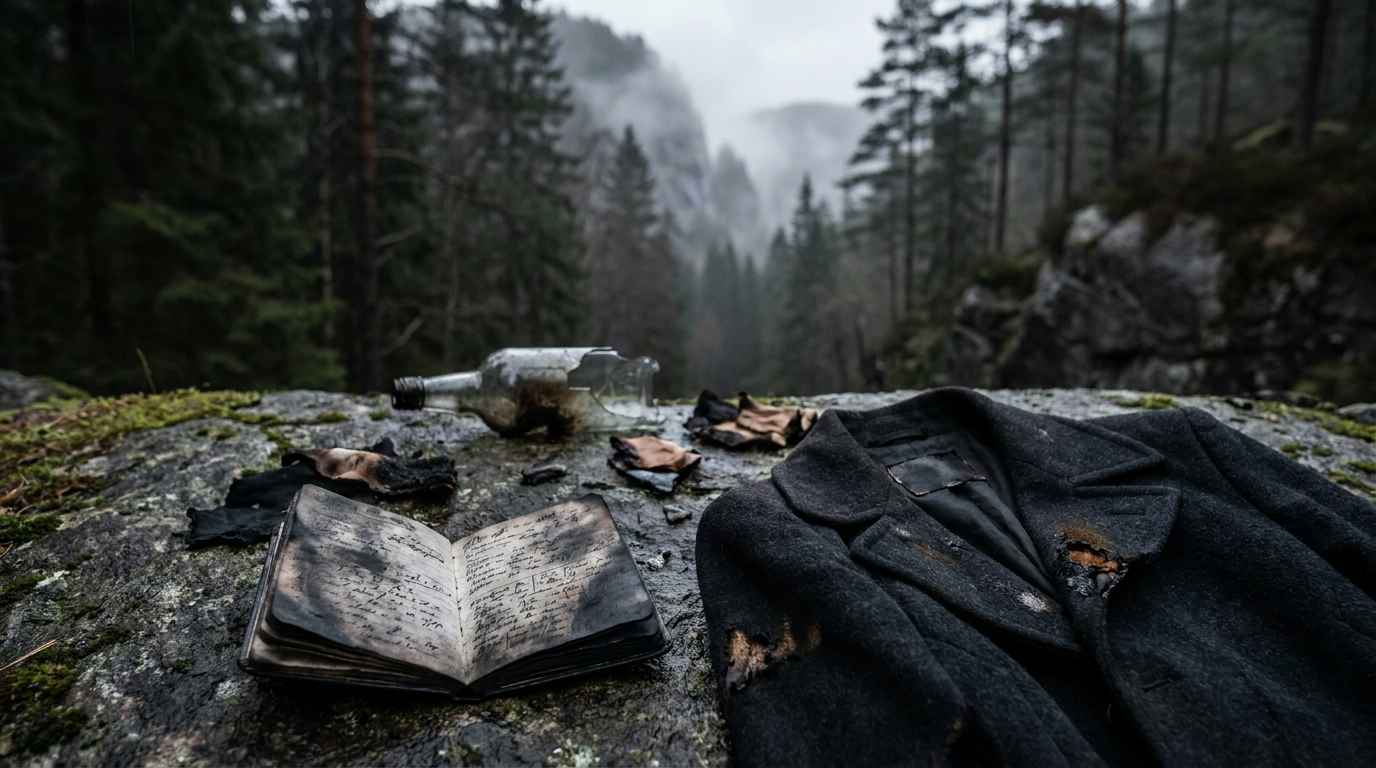
On November 29, 1970, two hikers in the Isdalen valley outside Bergen, Norway, found a body[2] lying in a hollow between rocks. The woman was partially burned. Around her were personal items — bottles, a passport photo, remnants of clothing — arranged, or left, in a way that read less like a crime scene and more like a campsite from which the person had simply failed to depart. The pathologist who examined her found sleeping pills in her system at a concentration inconsistent with an accident and difficult to reconcile with a clean suicide. Her face had been burned. Her fingertips had been burned. Every label had been cut from every piece of clothing she wore.
Norwegian police traced her backward with unusual success. Within days they had located her luggage at the Bergen railway station, abandoned in a locker. Inside: a coded notepad, wigs, currency from multiple countries, and nine distinct sets of identity documents. She had stayed at hotels across Norway under at least nine different names — Claudia Tielt, Finella Lorck, Vera Jarle, Elisabeth Leenhouwer, and others. Investigators eventually documented travel through fourteen European countries. She was fluent, witnesses said, in French and German, and spoke with no identifiable accent in either. She spoke some English. No one could place her origins.
The code in the notepad was broken by investigators relatively quickly. It turned out to be a simple substitution cipher — dates, place names, hotel details, what appear to be contact references. The decoded content described her movements with precision. It did not describe her employers, her purpose, or her name. Norwegian police interviewed hundreds of witnesses. Interpol was notified. The case was formally classified as an unexplained death. In 1971, without a clear identification or motive, the investigation was closed.
She was buried in a coffin paid for by the city of Bergen, beneath a stone marker that reads: "Ukjent Kvinne" — Unknown Woman. The case did not disappear. It moved instead into the category of file that refuses to stay quiet: periodically reopened, revisited by journalists, taken up by cold-case investigators, subjected to new forensic methods as those methods became available. More than fifty years later, she still has no name in any official record. What makes the Isdal case unusual is not the mystery. It is the extraordinary quantity of documentation surrounding a person whose most fundamental fact was never established.
What the Record Actually Contains
The evidentiary record of the Isdal Woman is dense by cold-case standards. Police collected testimony from hotel staff across Norway who remembered a woman traveling alone, sometimes nervous, sometimes composed, always paying cash. She reportedly told one hotel receptionist she was a businesswoman selling porcelain. She told another she was a photographer. Witnesses described a woman in her mid-thirties, dark-haired, well-dressed, careful. Several noted she seemed to be watching the room. One witness at a train station reported seeing her in the company of two men she appeared not to know well. That detail was never corroborated.
The forensic evidence was re-examined in 2016 when NRK, Norway's public broadcaster[3], undertook a significant reinvestigation of the case in collaboration with researchers from several universities. Isotope analysis of her teeth and bones — a method unavailable in 1970 — suggested she had grown up in a French-speaking region, possibly France, Belgium, or the French-speaking part of Switzerland. The analysis was not conclusive, but it narrowed the field. Mitochondrial DNA was extracted. As of the most recent public reporting, that profile has not matched any submitted sample from families of missing persons, though the database of potential matches is limited.
The sleeping pills found in her system were Fenemal — phenobarbital — present at a level that Norwegian toxicologists at the time considered potentially lethal on its own, and certainly accelerated by alcohol also present in the blood[1]. The manner of death has never been formally ruled homicide. It was not ruled suicide either. The official classification has remained "unexplained." The burning was post-mortem, or at minimum coincident with death. What that burning was meant to accomplish — whether to conceal, to destroy, or for reasons that had nothing to do with concealment at all — is genuinely unknown.
“Every label had been cut from every piece of clothing she wore — not torn, not worn away, but cleanly, deliberately removed.”
The Architecture of an Erased Identity
The removal of labels deserves specific attention because it is not a casual act. Clothing labels, in 1970, carried manufacturer names and country-of-origin markings that were meaningfully different across European nations. Removing them takes time and tools — scissors, patience, attention. To remove every label from every garment suggests not panic but preparation. The same logic applies to the aliases: nine separate identities with corresponding documents implies infrastructure, not improvisation. You cannot produce nine sets of usable identity papers across multiple countries by yourself, in 1970, as a private individual with no institutional support.
This is the detail that most consistently draws intelligence-service speculation to the case, and it is also the detail that most justifies treating that speculation seriously. The architecture of the woman's travel — the aliases, the cash, the coded notes, the multilingual fluency, the deliberate movement through multiple countries in short intervals — matches patterns documented in declassified accounts of Cold War operational tradecraft. That does not prove she was an intelligence operative. It is equally compatible with someone involved in criminal networks, someone hiding from a private threat, or — much less likely given the scale — someone with extreme personal reasons to conceal themselves. The speculation that she was an agent of some government, observed and then silenced, is not without grounding. It is also not proven by anything currently in the public record.
What is documented: the Norwegian Security Police, known as POT, opened their own inquiry parallel to the criminal investigation. That file has not been fully released. What was shared with the public investigation, and what was withheld, is not entirely clear. In 2016, Norwegian authorities confirmed that some material related to the case remained classified. The stated reason was protection of sources and methods — language that is itself a kind of answer, though not a complete one.
“Nine separate identities with corresponding documents implies infrastructure, not improvisation.”
The Theories, and What Each One Requires You to Accept
The dominant theories break into roughly three categories: intelligence operative killed by a foreign or domestic service, criminal figure eliminated or suicided under pressure, and private individual with extreme reasons for secrecy who ended her own life or was killed by a personal acquaintance. Each theory accounts for some of the evidence. None accounts for all of it cleanly.
The intelligence theory requires you to accept that a professional operative was burned and left in a public valley rather than disappeared quietly — which is unusual, though not unheard of in documented Cold War cases — and that no government has ever acknowledged her in any declassified record, even partially. The criminal theory struggles against the absence of any known criminal network she can be placed inside, and against the isotope and linguistic evidence suggesting a background that doesn't align with organized crime figures documented in Norway at the time. The private person theory requires explaining how a private individual produced nine documented alias sets, and why she was in Bergen at all — a city that in 1970 was a significant NATO port and logistics hub, a detail that is either meaningful or coincidental.
Several researchers and journalists have noted that her movements in Norway included Stavanger, which was then developing as a center of North Sea oil infrastructure, and Bergen, with its NATO significance. She was also documented in areas of Germany near American military installations, though the specificity of that claim varies depending on the source. The geographic pattern has been pointed to as suggestive. It is also not probative. People travel through significant places for reasons that have nothing to do with the significance of those places.
What Forensic Progress Has and Has Not Resolved
The 2016 NRK reinvestigation brought meaningful new evidence into the record and did not close the case. The isotope analysis gave investigators a narrowed geographic origin. The DNA profile gave investigators something to match against. Neither produced an identification. Cold-case forensic work of this kind operates against a specific limitation: it depends on someone submitting a reference sample, which requires someone to suspect a connection. If the Isdal Woman's family does not know she is missing — or knows she is missing but not that she ended up in a Norwegian valley in 1970, or has simply never encountered the case — the DNA profile sits in a file with nothing to match against.
Facial reconstruction has been performed. Composite images and, more recently, forensic sculpture have produced representations of what she may have looked like. These have been circulated publicly in Europe. No confirmed identification has resulted. Requests for DNA comparison submitted through the NRK project and through Interpol channels have produced responses from families of missing women in several countries, none of which matched the Isdal profile. As of the most recent reporting available, the case remains open in a technical sense — Norwegian police have not formally closed it — but active investigative work is not publicly ongoing.
The coded notepad, the most cinematic element of the case, has perhaps received the most disproportionate attention relative to what it actually revealed. The substitution cipher was cracked. The content described her schedule, not her employers. Analysts who have reviewed it describe a personal logistical record — the kind of document someone might keep to track their own movements — rather than operational communication. That does not mean it had no operational significance. It means the cipher itself was not the hidden key that unlocks the rest of the case. It was a woman's calendar, written in a code that was probably not very hard for a trained analyst to read.
What the Absence Tells You
“The file describes her movements across fourteen countries with considerable precision. It does not contain her name. Those two facts together are themselves a kind of evidence.”
No one has ever come forward to identify her. Not a former colleague, not a family member, not an acquaintance from the hotels where she stayed for days at a time. Not a handler, if she had one. Not a government, even obliquely, in any declassified document across five decades. The silence around the Isdal Woman is not the ordinary silence of a cold case where leads dried up and witnesses died. It is a specific silence: the silence of a person who was known to a number of people — hotel staff, transit workers, possibly intelligence officers, possibly criminal associates, possibly simply people she met — and whom none of those people have ever publicly claimed.
That silence could mean many things. It could mean the people who knew her are afraid, dead, or institutionally prevented from speaking. It could mean they genuinely do not connect what they know to the woman described in Norwegian police files. It could mean the identification has been made privately and suppressed for reasons that remain active. Or it could mean the case has simply not yet reached the right person — the one surviving relative, the one former colleague, the one record that links a name to a face to a Bergen hotel check-in on a date in November 1970. Cold cases close on stranger coincidences than that. They also remain open for longer than fifty years on sparser evidence than this one contains.
What you are left with, reviewing the file, is not the supernatural and not quite the political thriller. It is something more specific and harder to shake: a woman who moved through the world with obvious skill, left behind an unusually complete record of her movements, and arranged — or had arranged around her — a nearly total erasure of her origin. The valley preserved her. The record preserved her schedule. Fifty years of forensic science has narrowed the region she likely came from to somewhere within a few hundred kilometers. And somewhere in that radius, or in a classified archive, or in the memory of a person who has simply never known to connect what they know to this case, there is presumably an answer. The file does not contain it. That is the specific fact the Isdal case has been communicating, with considerable patience, for more than half a century.
References
- Phenobarbital (ncbi.nlm.nih.gov)
Explains phenobarbital's mechanism and toxicity, supporting the article's claim that the drug was lethal, especially combined with alcohol. - Isdal Woman (en.wikipedia.org)
Confirms the woman's multiple aliases, possible Belgian citizenship, and isotope evidence suggesting French or German education background. - Do you remember this woman? (nrk.no)
Documents the 2016 NRK reinvestigation that applied new forensic methods and identified at least eight fake identities used across Europe.
About Silas Crane
Silas Crane writes from the edges of the record: cold cases, cryptids, declassified files, strange disappearances, forensic science, fringe science, mysterious illnesses, eerie technologies, serial killers, cults, state experiments, UAPs, and claims that cannot be cleanly proved or dismissed. His work also examines crime, deviance, corruption, policing, punishment, and the institutions that decide which harms are investigated, sensationalized, ignored, or allowed to continue. A documentarian at heart, he builds unease from verifiable detail and is always drawn back to the gap the file cannot close.
More like this
The Government Called Unidentified Remains a 'Silent Disaster.' Now DNA Is Naming the Dead.
America's unidentified dead have been piling up in morgues for decades — and the forensic genealogy companies working to name them are doing it with science that would have seemed impossible fifteen years ago.
The Redaction Is the Document. How to Read What Governments Leave Out.
Intelligence historians have spent decades building a rigorous method for reading government absences — and it changes what you see in every document dump from the JFK files to the UAP disclosures.
The Pentagon Built a UAP Sensor. It Found Mostly Balloons. That's Not the Whole Story.
The Pentagon's new UAP sensor system quietly entered field testing — and what it's already revealing is less about what's up there than about how badly we've been trying to look.