The Redaction Is the Document. How to Read What Governments Leave Out.
Intelligence historians have spent decades building a rigorous method for reading government absences — and it changes what you see in every document dump from the JFK files to the UAP disclosures.
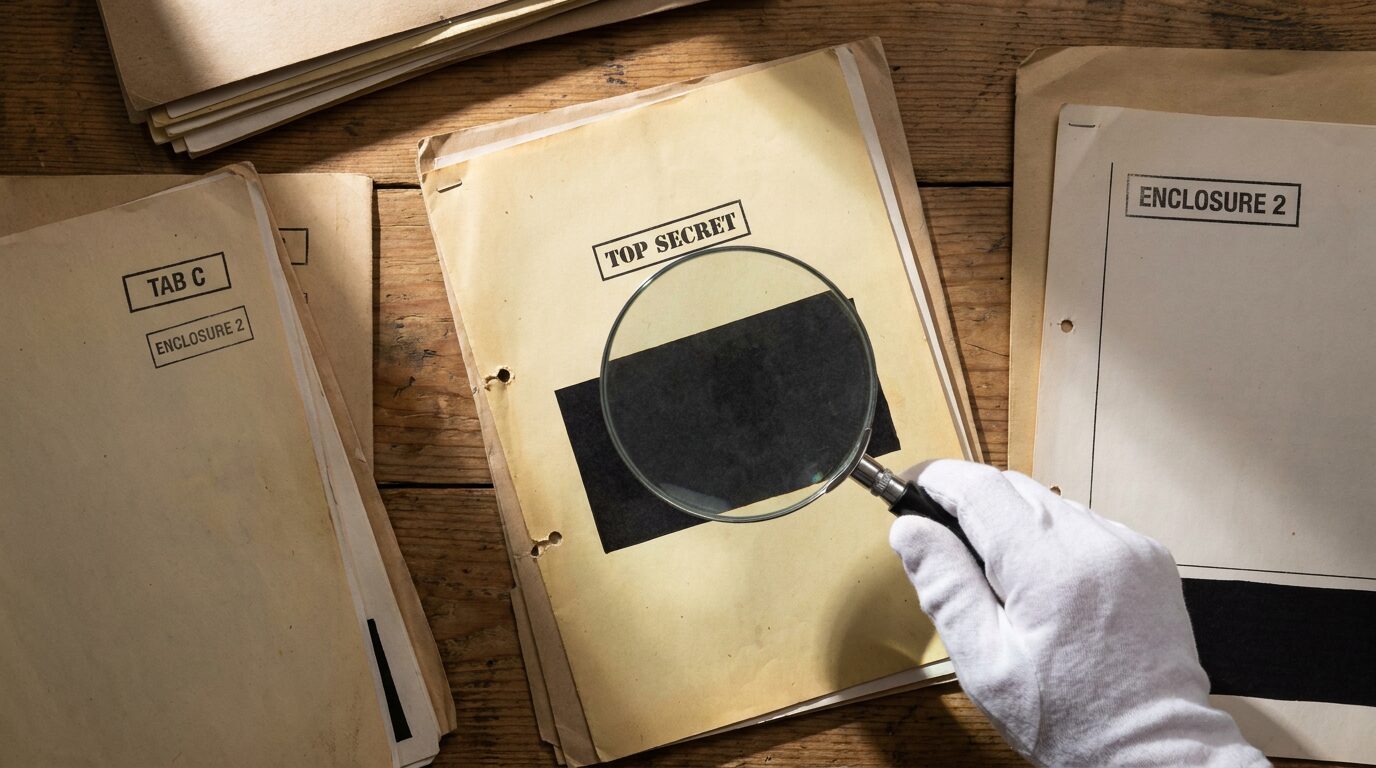
There is a specific kind of document that historians of intelligence have learned to treat as evidence in its own right. It arrives in a released file, stamped and signed, and it refers — precisely, bureaucratically, without embarrassment — to an attachment that is not there. Not redacted. Not blacked out. Simply absent. The parent document refers to it as "Tab C" or "Enclosure 2" or "the above-referenced cable," and the released file ends without it. In a declassification review, this is sometimes a processing error. Sometimes it is a decision. The skill — the one that separates archival work from amateur sleuthing — is learning to tell the difference, and learning what each possibility means.
When the National Archives has released tranches of JFK assassination records over the past several years — most recently under extended deadlines pushed repeatedly by successive administrations — the coverage has focused on what the documents say. The headlines describe named individuals, foreign contacts, surveillance operations, the texture of intelligence work in 1963. What receives less attention is the architecture of the release itself: how many documents appear with date ranges removed, how many carry source-notation redactions that are invisible from the outside but alter the entire meaning of the surrounding text, and how many reference other documents that appear nowhere in any public catalog. The absence is structured. It has a shape.
The same is true of the UAP disclosure process that accelerated after the 2017 release of military encounter footage and was formalized through the 2022 and 2023 intelligence authorization acts. Documents have been released. Hearings have been held. Officials have testified under oath about programs they cannot fully describe in open session. And each release has come with its own architecture of omission: sensor data referenced but not attached, witness statements described but not included, the names of specific sensor platforms replaced with generic institutional language. The documents perform disclosure. Whether they achieve it is a separate question.
Reading these documents as documents — rather than as confirmations of theories already held — requires a method. That method exists. It was not invented for UAP files or assassination records. It was built, over decades, by historians working in the archives of the Cold War, trying to reconstruct operations where the operational cables survived but the policy decisions that generated them did not. The methodology is specific, teachable, and applicable to any document dump that presents itself as transparency. Here is how it works.
The Bureaucratic Fingerprint
Every government document is a product of a bureaucratic process, and that process leaves traces whether or not the substantive content survives. A classification marking — TOP SECRET / NOFORN, for instance — tells you which compartments the originating agency believed the document touched. A distribution list tells you who was supposed to receive it, which in turn tells you what level of seniority considered the content relevant. A "handle via" routing stamp tells you that the document moved through a channel restricted enough that its existence, not just its contents, was considered sensitive. These structural markers are almost never redacted, because the reviewers focused on substantive content. They are also among the most informative things on the page.
Historians working in the Church Committee records from the 1970s[4] — the Senate investigation into intelligence community abuses — developed a practice of reading distribution lists against known organizational charts of the period. If a document about a domestic surveillance program went to the counterintelligence division but not to the legal counsel's office, that was itself a finding. It suggested the program was being kept from internal legal review. The document did not have to say that. The routing said it instead. This technique applies directly to more recent releases. The UAP materials submitted to Congress through the All-domain Anomaly Resolution Office have carried routing and classification markers that, read against the current intelligence community org chart, suggest involvement from components that have not been publicly named in the UAP context. The structure implies what the content withholds.
“The distribution list tells you who was supposed to know. The routing stamp tells you who was supposed to not know. The absence of the legal office tells you the rest.”
The Taxonomy of the Black Bar
Not all redactions are equivalent, and the declassification framework — primarily Executive Order 13526[1] in the current era, with its nine enumerated categories of classifiable information — requires reviewers to apply a specific exemption to each removal. In practice, those exemptions appear in the margin as coded notations: (b)(1) for national security, (b)(3) for information exempted by statute, and so on under the FOIA framework. A document that carries a consistent (b)(3) redaction across multiple paragraphs is telling you that a specific statute — likely either the National Security Act or the Central Intelligence Agency Act[3] — is being invoked to protect the source or method, not merely the content. That is a meaningful distinction. The information itself might be declassifiable in theory. The method by which it was obtained is not.
Within the JFK records specifically, a recurring pattern drew the attention of researchers when the 2017 and subsequent releases came through: documents that were released in full carried (b)(1) exemptions applied to the same phrase in multiple separate files. The repeated protection of an identical string of text — sometimes just a location name, sometimes what appears to be a cryptonym — suggests the reviewers were following a current, active protection list rather than evaluating each document on its own merits. That is standard and legal. It also means that what was withheld in 1963-era documents was withheld because it remains sensitive in 2023, not because it was sensitive then. That gap is the story. Whatever that phrase or location represents, it has ongoing operational relevance sixty years later. The redaction is not a historical artifact. It is a live signal.
The Document That References Its Own Ghost
The missing attachment problem is subtler and more consistently underreported than the black bar. A bureaucratic document in any large institution is rarely self-contained. It references prior correspondence, attaches supporting analysis, summarizes a conversation recorded elsewhere. When a document is released and its attachments are not, the parent document sometimes contains enough description of the missing material to reconstruct its approximate content. Historians call this technique reading the citation trail — following what a document claims to have been based on, even when that basis is absent.
In several of the AARO-related UAP disclosures, released documents have described sensor readings in summary form while noting that raw data was attached. The raw data does not appear in the public release. This is documented — advocates and researchers have filed detailed FOIA requests specifically for the cited attachments and received either no-record responses or referrals to other agencies, which is itself a finding. A no-record response to a request for a document that a released document explicitly says exists is not a bureaucratic dead end. It is a data point about where the information is being held and under what authority. The ghost document teaches you something even in its absence.
“A no-record response to a document the government's own file says exists is not a dead end. It is a map to where the record actually lives.”
The Meaningful Gap in the Date Range
Declassification releases are almost never complete sweeps of a topic. They are releases of specific record groups, specific date ranges, specific agency holdings. The selection of what to release — even when framed as a dump of everything on a given subject — is a curatorial act, and the curation has a shape. Intelligence historians working on the Bay of Pigs documents in the 1990s noticed that the released record was dense from 1960 through early April 1961 and resumed in late May 1961, with the intervening weeks — the period of the actual invasion — represented by a thin cluster of after-action summaries that referenced operational cables never released. The gap was not random. The gap was the invasion.
The same structural reading applies to the JFK and UAP materials. In the JFK releases, the record is notably sparse for specific months in 1963 that researchers have independently identified as periods of operational activity relevant to the case. In the UAP materials, the public record has a visible gap roughly corresponding to a specific period of increased military reporting that has been mentioned in congressional testimony but not explained. Date-range gaps in bureaucratic record sets are sometimes innocent — agencies have different retention schedules, physical records degrade, transfers between facilities create losses. But when the gap aligns with a known event or a period of documented high activity, the alignment is the signal. Archivists call this a structured absence. The phrase is technical but the implication is not: someone knew where the story was, and the story is not in the released set.
What the Language Itself Signals
Beyond structure, there is the prose. Government documents are written in a bureaucratic register that is, paradoxically, quite expressive to trained readers. Certain phrases appear in intelligence documents when the author is describing something they cannot fully name. "Anomalous phenomenon" was used in Cold War-era technical intelligence reports when sensor readings defied known aircraft performance envelopes and the author could not attribute the reading to a known platform. The phrase was procedurally neutral. It meant: we recorded this, we cannot explain it, and we are not going to say what we think it might be because saying so would require either invoking a program we cannot reference or making a claim we cannot substantiate.
The AARO documents use a version of the same evasion. "Unattributed aerial phenomenon" and "object of interest" appear in contexts where the surrounding text makes clear the sensor data was anomalous by the reporting officer's own assessment, but the formal document language refuses to assign a cause. Read in isolation, this sounds like appropriate scientific caution. Read against the history of that specific bureaucratic register, it sounds like something more constrained: an author writing inside a framework that provides no legitimate category for what they are describing, and choosing the available neutral language over the alternative of creating a record that requires escalation. The hedging is not ignorance. It is institutional self-protection, and it is documented behavior going back at least to the early Cold War-era reporting on unidentified aerial objects.
“When a government document refuses to name what it clearly described, the refusal is the finding.”
How to Read a Document Dump Without Getting Played
There is a specific danger in document dumps that intelligence historians have written about with increasing clarity: the performative release. A large-scale document release creates the impression of transparency while functioning, in practice, as a controlled environment for public attention. The released documents are genuine. They may also be the documents least damaging to ongoing operations or current institutional interests. The theatrical scale of the release — thousands of pages, extensive press coverage, official briefings — can function as a distraction from what was not released, particularly when no independent audit of the withheld set exists. This is not a conspiracy theory. It is a documented feature of declassification practice, acknowledged by former classification reviewers and archival scholars who have written about it in accessible published work.
The practical defense is methodical. When a document dump is announced, the useful questions are not "what did they release" but "what record group does this come from," "what is the date range of the released set," "what agencies are represented and which are not," "how many documents were withheld in full versus partially released," and "what do the released documents themselves reference that is not included." The JFK Records Collection database maintained by the National Archives[2] allows researchers to see the total count of withheld documents alongside the released ones. The ratio is informative. As of recent counts, thousands of documents remained withheld in full, decades after the assassination. That number is not an accusation. It is a documented fact about the shape of the release, and it tells you that the released set is not the complete set.
None of this methodology produces certainty. That is the point. What it produces is a more precise map of ignorance: you stop not knowing what you don't know and start knowing specifically where the gaps are, what shape they hold, and whether their contours align with anything independently documented. The redacted line might protect a source who died in 1971. The missing attachment might be genuinely lost. The date-range gap might correspond to a filing anomaly rather than an operational secret. These are possible. They are also testable against other evidence, other archives, other released sets from allied agencies, open-source records, contemporaneous journalism, and the testimony of people who worked inside the system and have since spoken. The method does not resolve the mystery. It narrows the question until the remaining gap is small enough to be honest about — and honest about being unable to close.
References
- Executive Order 13526- Classified National Security Information (obamawhitehouse.archives.gov)
Establishes the nine enumerated categories of classifiable information and FOIA exemption framework (b)(1), (b)(3), etc. that reviewers apply to redactions in declassified documents. - JFK Assassination Records Processing Project - 2022 Update (archives.gov)
Documents the National Archives' processing of JFK assassination records released over multiple years, providing the source material analyzed in the article's discussion of JFK file redaction patterns. - National Security Act or the Central Intelligence Agency Act (cia.gov)
Defines the statutory exemptions (b)(3) that reviewers invoke to protect classified information under FOIA framework. - Senate Select Committee to Study Governmental Operations with Respect to Intelligence Activities (senate.gov)
Provides historical example of how distribution lists reveal bureaucratic decision-making, specifically showing how routing patterns indicated surveillance programs were kept from legal review.
About Silas Crane
Silas Crane writes from the edges of the record: cold cases, cryptids, declassified files, strange disappearances, forensic science, fringe science, mysterious illnesses, eerie technologies, serial killers, cults, state experiments, UAPs, and claims that cannot be cleanly proved or dismissed. His work also examines crime, deviance, corruption, policing, punishment, and the institutions that decide which harms are investigated, sensationalized, ignored, or allowed to continue. A documentarian at heart, he builds unease from verifiable detail and is always drawn back to the gap the file cannot close.
More like this
Trump's Name Was Redacted Dozens of Times. Here's What the Shape of That Silence Tells Us.
The released Epstein documents don't prove a conspiracy — but the architecture of what's been withheld is its own kind of evidence.
The Pentagon Released 162 UAP Files. The Unresolved Ones Are the Interesting Part.
The May 2025 file release is historic, but the official language used to explain every unresolved case quietly reveals something more useful than any alien hypothesis.

The U.S. Government Is Watching You More Efficiently Than Ever — And Outsourcing the Hard Part
For decades, the hard limit on government surveillance was human attention. A December 2025 GAO report and ACLU documentation of federal AI profiling tools reveal what happened when that limit disappeared.