When the Pulpit Becomes a Polling Place, Who Actually Wins?
The IRS just broke with seventy years of precedent on church political endorsements — and exposed the gap between what political operatives want from faith communities and what faith communities want for themselves.
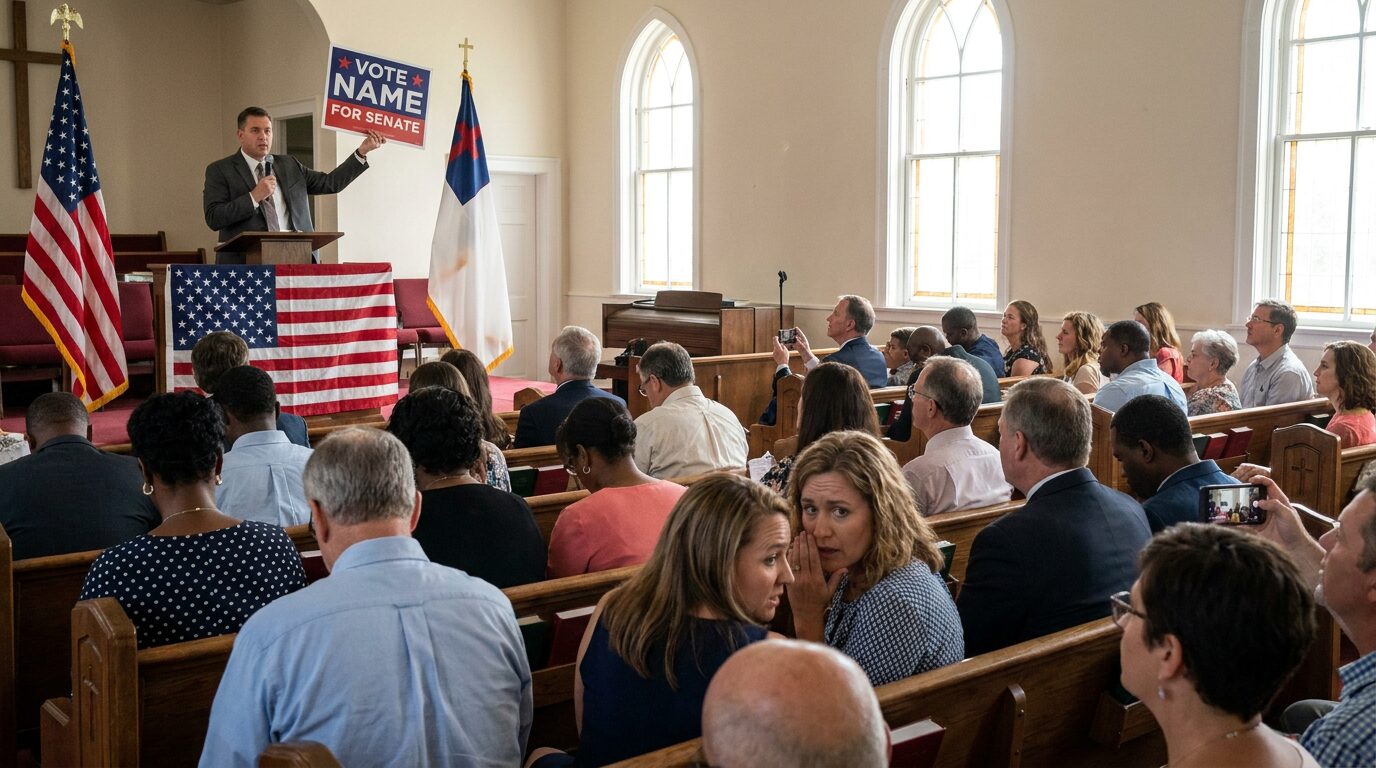
The Johnson Amendment has been an American fixture since 1954. Its logic was simple: if the government subsidizes your institution through a tax exemption, that institution cannot become a campaign arm. Churches could preach on any moral issue under the sun. They could march, lobby, advocate, and protest. What they could not do — without risking their 501(c)(3) status — was officially endorse a candidate for public office. Seventy years of rough consensus. Then, in July 2025, the IRS filed a court document in Texas that quietly suggested the whole thing might not apply the way anyone thought.
The case was National Religious Broadcasters v. Long, brought by an evangelical media group and a pair of Texas churches who argued the Johnson Amendment chilled their First Amendment rights. The IRS, rather than defending the law as written, agreed to a proposed consent judgment: that political speech by a house of worship delivered to its congregation "through its customary channels" in connection with religious services didn't constitute the kind of campaign intervention the law prohibits. A federal judge killed the settlement in March 2026, ruling the court lacked jurisdiction to approve it. But the damage — or the signal, depending on who you ask — was already out. For the first time in the amendment's history, the IRS had publicly, formally questioned whether it applied to churches at all.
That signal matters more than the dismissed case. The Trump administration has since announced it intends to issue new guidance on the Johnson Amendment's application to religious organizations, and Treasury Secretary Scott Bessent confirmed the administration "remains committed" to "protecting religious freedom" in this space. The settlement may be dead, but the administrative intention is not. What we are watching is not a legal ruling. It is a slow-motion regulatory retreat dressed up as constitutional clarity — and it is happening right as the 2026 midterms put every swing congressional seat in play.
The Law Nobody Enforced, and Why That Still Mattered
To understand why dismantling a barely-enforced rule still matters enormously, you have to understand what the rule was actually doing. The Johnson Amendment has been enforced against a church exactly once in its entire history — Branch Ministries v. Rossotti, back in 2000. Plenty of churches openly flirted with violations. Alliance Defending Freedom organized "Pulpit Freedom Sundays" for years, explicitly trying to bait the IRS into a constitutional challenge. The IRS didn't bite. As Loyola University tax law professor Sam Brunson told NPR, the IRS filing didn't really represent a change in how the Johnson Amendment had functioned in practice — because it had barely been enforced as a punitive mechanism at all.
But a law doesn't have to be frequently enforced to shape behavior. Its existence on the books created a deterrent, a norm, and critically — a defense. A pastor who didn't want to wade into partisan candidate wars could point to the IRS rule and say: my hands are tied. The rule functioned less as a regulatory hammer and more as a permission structure for restraint. Stripping it away — or even broadcasting that the executive branch won't defend it — removes that excuse precisely when political operatives are most eager to exploit it.
“A law doesn't have to be frequently enforced to shape behavior. Its existence gave pastors a permission structure for restraint. Stripping it away removes that excuse.”
The Money Question Is the Real Story
Here is where the political science becomes uncomfortable for everyone involved. Churches occupy a uniquely privileged position in the American nonprofit ecosystem. Unlike most 501(c)(3) organizations, churches don't have to file a Form 990[6] — the public transparency report that allows journalists, researchers, and regulators to see where money flows. Church donations are tax-deductible. Donors don't need to report them individually. The institution reports nothing to the IRS about who gave what. This is a disclosure architecture specifically designed around the assumption that churches are not political actors. The moment they become political actors — even informally — that architecture becomes a campaign finance loophole so wide you could drive a PAC through it.
The Joint Committee on Taxation flagged this during the 2017 Tax Cuts and Jobs Act debate, when congressional Republicans tried to slip a Johnson Amendment repeal into the bill. Chief of Staff Thomas Barthold testified that repeal would effectively create a mechanism for political contributions to flow into deductible form that is not deductible today. The provision was removed from the final bill. The concern didn't go away. What the IRS's 2025 court filing managed to do was reopen that window without going through Congress — bypassing the democratic institution responsible for tax law, using a friendly lawsuit and a proposed consent decree in a conservative district to get administratively what couldn't be legislated.
Opponents of the change warned explicitly that weakening the Johnson Amendment risked "flooding elections with even more dark money"[7] by transforming houses of worship into political action committees. That's not hyperbole. It's basic incentive logic. If you can funnel tax-deductible, undisclosed donations through an institution that can then deliver candidate endorsements from the most morally authoritative voice in many communities, you have created the most efficient political money machine in American history. And it comes with a steeple.
What the Congregants Actually Want
The grim irony of this entire fight is that the people sitting in the pews don't want any of it. According to a 2023 PRRI survey[4], three in four Americans — 75% — opposed allowing places of worship to endorse political candidates while retaining their tax-exempt status. Only 20% favored it. These numbers have been stable for years: in 2017, 71% opposed and 22% favored. A 2022 Pew Research Center survey[2] put opposition at 77%. Even among Republicans, the most sympathetic partisan group, only 31% supported the idea. Among white evangelical Protestants — the people this policy is most loudly designed to empower — just 36% were in favor. The constituency for partisan pulpits is a minority of a minority.
This is a recurring feature of religious-political capture: the people doing the capturing claim to speak for a community that has not, in fact, authorized them to do so. Christian nationalist Adherents — the most fervent supporters in the PRRI data, at 45% in favor — represent a slice of the broader evangelical world, which is itself divided. Most religious Americans, including most Christians, do not want their pastor handing them a ballot recommendation from the pulpit. They want what congregations have always offered at their best: community, meaning, mutual support, and some shelter from the relentlessness of the news cycle. What they are being offered instead is a new front in a partisan war.
The Polarization Trap Waiting in the Pews
The USC Dornsife Center for Religion and Civic Culture's 2026 trends report[1] identified a dynamic that captures this precisely. The researchers noted that plenty of faith leaders — mostly white, mostly trying to hold multipartisan communities together — are actively avoiding political positioning heading into the midterms, hoping to keep their congregations intact. But they also noted that the IRS's shift means faith leaders "no longer have an excuse to avoid pressure from politically active parishioners to endorse candidates." The old rule wasn't just a legal firewall. It was a social one. It protected a pastor from his most politically aggressive members by giving him a neutral, external reason to hold the line.
Remove it, and the internal politics of the congregation become a proxy war. The vocal MAGA member in the third row who donates generously and expects his political identity validated from the altar now has leverage. So does the progressive activist in the back who wants the church on the right side of history. The pastor who just wants to do ministry is now exposed to both simultaneously, with no institutional cover to decline either. This is not a hypothetical. It is the described reality of countless congregations already managing the intrusion of polarization — the same social sorting and partisan identity pressure that has been fracturing faith communities for years, now with official federal permission to get worse.
CRCC researchers specifically flagged that whether faith communities can survive this moment "may depend on the algorithmic authority of vocal members on either side of the divide." That phrase — algorithmic authority — is doing a lot of work. It means the loudest voices, amplified by social media ecosystems, setting the temperature inside institutions that were not designed to operate at that temperature. The congregation that could once hold a Democrat and a Republican in the same pew, bonded by shared belief, is now being asked to pick a side by the same political infrastructure that has been sorting Americans into increasingly separate realities for two decades.
The Bigger Institutional Bet
What the Trump administration is betting on here is that evangelical political loyalty translates into organizational capacity — that if you free the pulpit, you unlock a delivery system for Republican turnout operations with a moral authority no campaign mailer can replicate. The bet is not crazy. The relationship between white evangelical Protestantism and Republican coalition politics is one of the more durable alignments in modern American electoral history. But the bet also carries a risk the political operatives never fully account for: institutional legitimacy is a finite resource.
The Johnson Amendment was, among other things, a legal articulation of a social compact: we subsidize your institution because you serve a function that transcends partisan competition. Collapse that distinction — make the church another vector for campaign messaging — and you erode the very thing that made it valuable to the people inside it. A 2026 PNAS study found that nearly 15% of predominantly evangelical churches engaged in direct political advocacy and endorsements[3] during the three months surrounding the 2020 and 2024 elections, even while the Johnson Amendment nominally applied. The appetite is real. So is the blowback: church attendance and affiliation have been trending downward for years, and the accelerating fusion of evangelical identity with MAGA politics is widely cited as a driver of the deconstruction and disaffiliation surge among younger Americans who grew up in those communities.
“Institutional legitimacy is a finite resource. Make the church another vector for campaign messaging and you erode the very thing that made it valuable to the people inside it.”
The court blocked the consent decree on jurisdictional grounds, not on the merits. Treasury has already announced it will issue new guidance. The administration has placed the Johnson Amendment on its 2025–2026 Priority Guidance Plan. The fight is not over. It has barely started. What comes next is either a formal IRS rule redefining what counts as prohibited political activity inside a house of worship, new litigation in a more favorable procedural posture, or a legislative vehicle if the political will can be assembled. Any of those outcomes will test whether American congregations can absorb the politics they have been quietly absorbing for years — now out in the open, with no legal excuse left to pretend otherwise.
References
- 6-7 Trends to Watch in Religion and Society in 2026 (dornsife.usc.edu)
Identifies that faith leaders avoiding political positioning no longer have institutional cover to resist pressure from politically active parishioners to endorse candidates. - Most in US oppose churches endorsing political candidates, 2022 survey shows (pewresearch.org)
Reports 77% of Americans opposed churches endorsing political candidates, with only 31% support among Republicans. - Johnson Amendment (en.wikipedia.org)
- Most Americans Oppose Churches Endorsing Political Candidates (prri.org)
Shows 75% of Americans opposed churches endorsing candidates while retaining tax-exempt status, with only 20% in favor. - Religious Organizations and Political Activity: A 2026 Election-Year Guide (natlawreview.com)
Documents the National Religious Broadcasters v. Long case where the IRS agreed to a consent judgment questioning Johnson Amendment application to churches. - The IRS and the Johnson Amendment: Will Your Church Endorse Politicians? | Christian Standard (christianstandard.com)
Establishes that churches are not required to file Form 990 transparency reports, unlike other 501(c)(3) organizations. - What is Happening with the Johnson Amendment? (interfaithalliance.org)
Provides the warning that weakening the Johnson Amendment risks flooding elections with dark money through tax-deductible church donations.
About Paul Wardell
Paul Wardell writes about politics, institutions, voters, media, class, power, polarization, and the incentives that make public life feel dumber than it needs to be. Left-leaning but stubbornly practical, his work focuses on how systems actually behave, not how partisans wish they behaved.
More like this
What Your Pastor Can Legally Say From the Pulpit in 2026—And Why the IRS Just Changed the Rules
The IRS quietly broke with seven decades of precedent on church political endorsements, a court blocked the move, and new guidance is still coming—here's what the law actually says right now.
How a Church Mobilizes Millions of Voters Without Breaking Campaign Finance Law
The LDS Church has mobilized millions of voters through satellite broadcasts, sacred pulpits, and apostolic instruction — and the law has almost never touched them for it.

How Foreign Money Hides Inside Your Favorite Nonprofits
Foreign money doesn't walk through the front door of an election — it takes a much more respectable route.