Consent Judgment
A court order agreed to by both parties without admission of guilt, settling a dispute by mutual consent rather than trial.
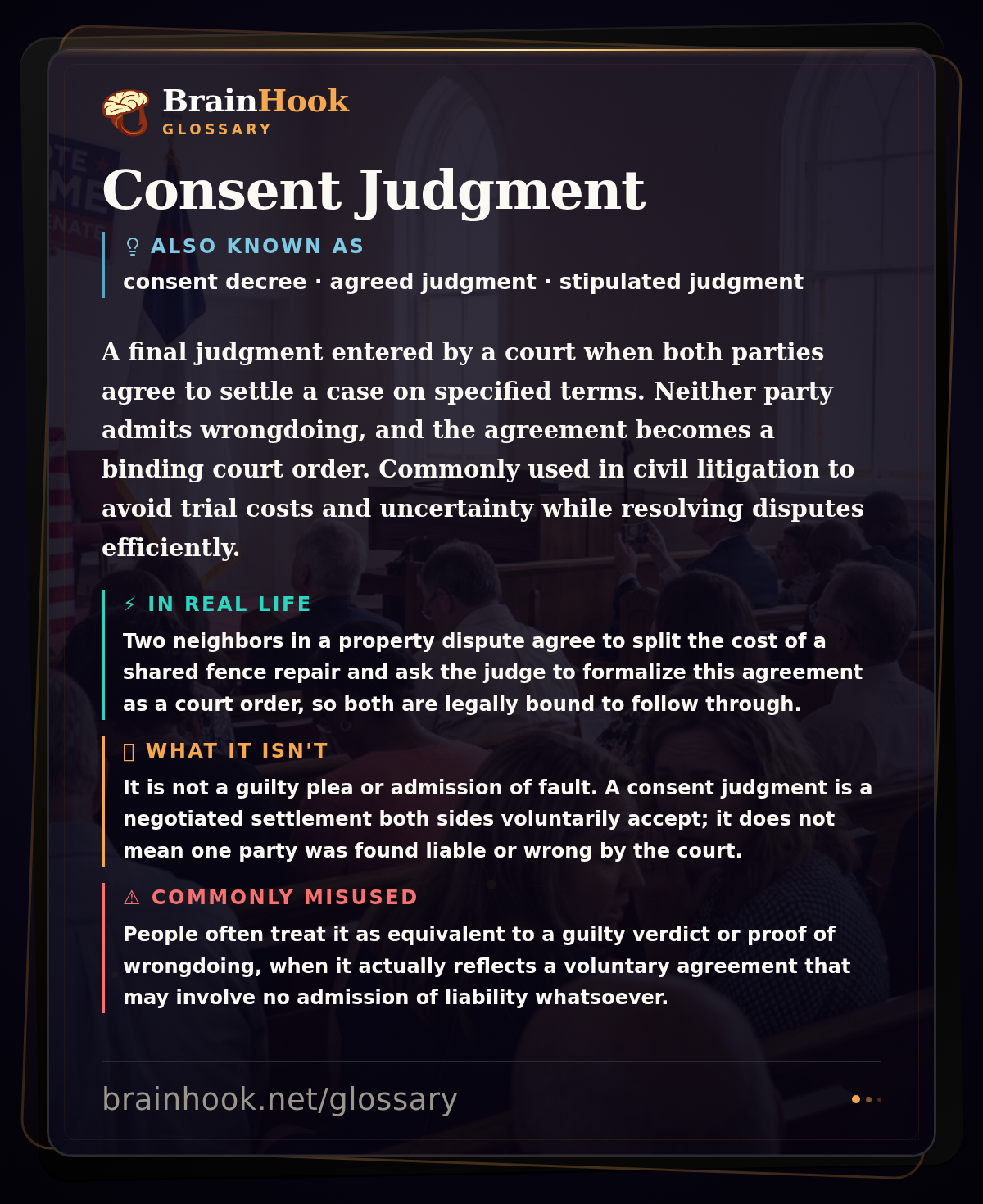
A final judgment entered by a court when both parties agree to settle a case on specified terms. Neither party admits wrongdoing, and the agreement becomes a binding court order. Commonly used in civil litigation to avoid trial costs and uncertainty while resolving disputes efficiently.
What this means in real life
Two neighbors in a property dispute agree to split the cost of a shared fence repair and ask the judge to formalize this agreement as a court order, so both are legally bound to follow through.
What it isn’t
It is not a guilty plea or admission of fault. A consent judgment is a negotiated settlement both sides voluntarily accept; it does not mean one party was found liable or wrong by the court.
Commonly misused online
People often treat it as equivalent to a guilty verdict or proof of wrongdoing, when it actually reflects a voluntary agreement that may involve no admission of liability whatsoever.