How Foreign Money Hides Inside Your Favorite Nonprofits
Foreign money doesn't walk through the front door of an election — it takes a much more respectable route.
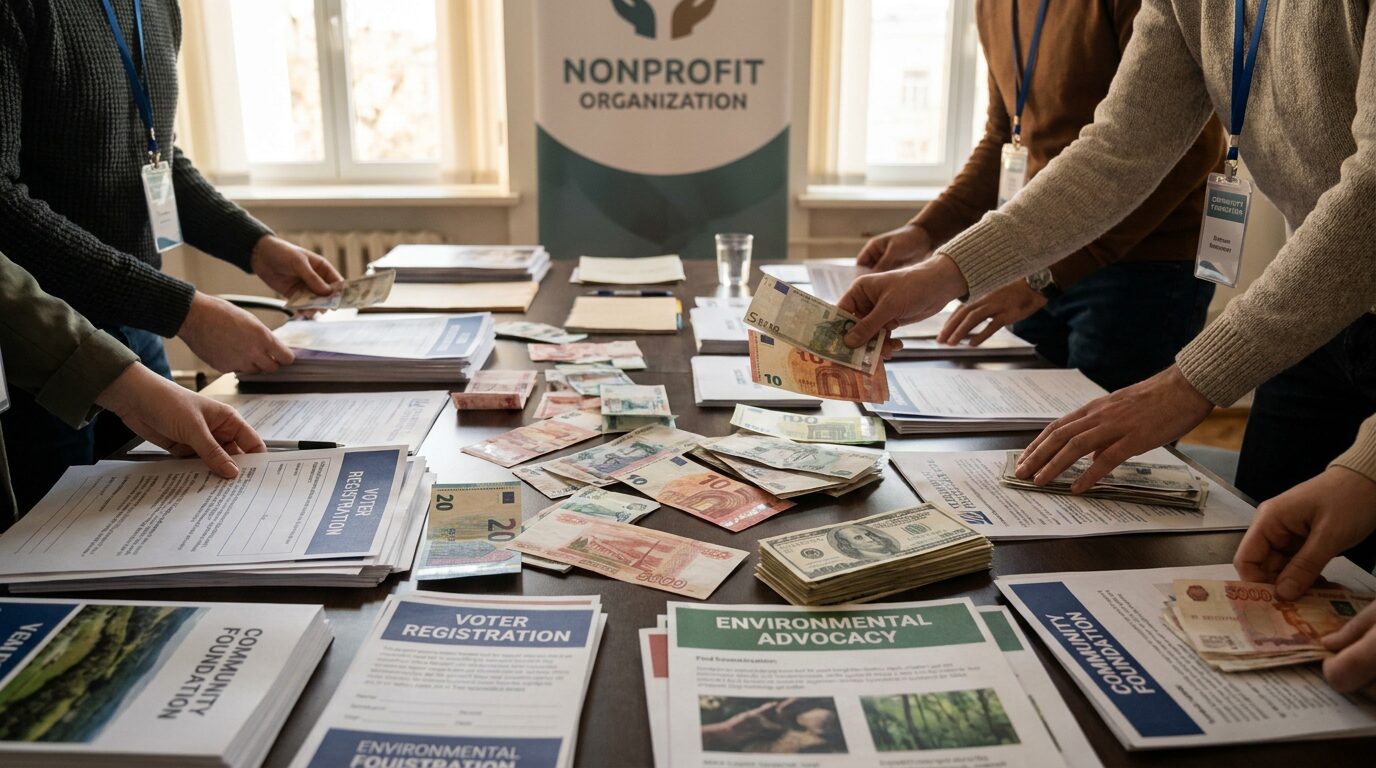
Imagine you donate $50 to a nonprofit you've heard of, maybe one focused on voter registration or environmental policy. It has a real website, a mission statement, maybe a board of trustees with recognizable names. It feels legitimate because it is legitimate — at least on the surface. What you almost certainly cannot see is that somewhere several layers above your $50, a foreign billionaire or a state-adjacent influence operation has moved money into the same pool, and that money has been traveling under cover of your trust ever since.
This is not a conspiracy theory. It is a structural feature of American campaign finance law, and it is becoming one of the defining vulnerabilities of the 2026 midterm cycle. With 42 major elections happening worldwide in 2026, and foreign adversaries deploying increasingly sophisticated tools, the question of how illicit money moves through civil society has moved from a niche regulatory concern to something closer to a national emergency — one that almost nobody has the forensic infrastructure to detect.
The Architecture of Invisible Money
The mechanism is less dramatic than it sounds, which is part of what makes it so effective. Federal law prohibits contributions, donations, expenditures, and disbursements solicited, directed, received or made directly or indirectly by or from foreign nationals in connection with any federal, state, or local election. That prohibition has been on the books for decades. The problem is not the law — it is the gap between what the law prohibits and what the financial architecture of modern civil society actually makes visible.
The term "dark money" refers to money spent in elections by groups that aren't required to disclose their funders. For example, 501(c)(4) organizations are not required to disclose their donors, but they are permitted to spend money to influence elections. That asymmetry — you can spend, but you don't have to say where the money came from — is the crack in the wall. And the crack is wide enough to move enormous sums through.
Dark money groups, nonprofits and shell companies that spend on elections without revealing their donors, plowed more than $1.9 billion into last year's election cycle, a dramatic increase from the prior record of $1 billion in 2020. That is not a rounding error. It is a structural shift. And tucked inside that number is the core problem: because foreign funds can be funneled through dark money groups and shell corporations, it can be nearly impossible to trace — and thus nearly impossible for Americans to truly comprehend the magnitude of this threat.
“The money doesn't arrive labeled 'foreign.' It arrives looking like civic virtue.”
How the Layering Works
In financial crime, the laundering process has three stages: placement (getting the dirty money into the system), layering (obscuring its origin through transactions), and integration (deploying it in ways that look clean). What has evolved in American election finance is something remarkably similar. A foreign national — or a state-backed actor — doesn't wire money directly to a super PAC. Instead, the money enters through a foundation, which grants to a 501(c)(4), which transfers funds to another nonprofit, which eventually seeds a super PAC. Each hop is legal. Each hop erases a little more of the original fingerprint.
There is no real requirement that a 501(c)(4) on Form 990 discloses anywhere that they are receiving foreign funds. This is a huge threat to foreign interference in our elections. The Ways and Means Committee has been probing this gap, and what they have found is not reassuring. Currently, these nonprofit organizations are allowed to move millions of dollars from foreign nationals through the political system without a trace.
A concrete illustration: the Berger Action Fund, a nonprofit backed by Swiss billionaire Hansjörg Wyss, transferred more than $60 million to progressive groups in 2022 and 2023. One major nonprofit that receives funding from the Berger Action Fund is the Sixteen Thirty Fund, a dark money nonprofit that received $35 million from Berger Action between 2022 and 2023. Sixteen Thirty Fund gave out more than $150 million to Democrat-aligned groups between 2022 and 2023. Wyss is not a U.S. citizen. The money is not labeled as foreign. And this has played out in real time with the 1630 Fund, which is simultaneously funded by Swiss billionaire Hansjorg Wyss and bankrolling super PACs — and this happened in the 2018 cycle, 2020, 2022, 2024, and it's going to happen again in 2026.
The technique is not limited to any one political direction. In a recording released by The Telegraph, a GOP political operative was heard describing how a foreign national could pass a $2 million contribution to a PAC through shell companies and 501(c)(4) nonprofit dark money groups. The FEC tried to pursue it. The operative was charged with knowingly soliciting illegal funds from a foreign national but declined to cooperate, and the FEC ultimately deadlocked on whether to pursue the matter further. The system, in other words, flagged the problem and then shrugged.
The Trust Exploit
There is a behavioral dimension to this that doesn't get enough attention, and it's where my own beat intersects with what looks like a purely political story. The reason this architecture is so durable is not just legal — it is psychological. Nonprofits occupy a specific cognitive category for most people: they are trusted by default. They are not corporations extracting profit. They are not politicians angling for power. They are civic institutions doing work we've decided society needs. That halo is not accidental — it is the feature being exploited.
The FATF's own typologies research on nonprofit abuse makes this plain. The high level of public trust in the good work done by the NPO sector means NPO activities are generally not scrutinised as consistently as other sectors. Terrorist networks — and by extension, illicit financial actors — abuse this public trust by piggybacking on the legitimate activities of an unwitting NPO, or by mimicking legitimate NPOs. The same dynamic applies to foreign election interference. The nonprofit isn't necessarily complicit. It is a vessel whose trustworthiness is the asset being borrowed. This is something of a recurring pattern in illicit finance — credibility is used as camouflage, and the more respectable the vehicle, the harder the money is to see.
This is why forensic finance is the only real tool here. Advocacy, legal prohibition, and public awareness all matter, but none of them can see through layered nonprofit structures in real time. What that work actually requires is the patient tracing of money through Form 990 filings, grant records, and intermediary organizations — a kind of financial archaeology that takes months and that most newsrooms, regulatory bodies, and civil society watchdogs lack the capacity to perform at scale.
The Detection Gap Is Getting Worse
At precisely the moment when this problem is growing in complexity and scale, the federal infrastructure for detecting it is being dismantled. The Trump administration has degraded the federal infrastructure for detecting and countering foreign election threats, leaving states to prepare for these threats largely on their own for the first time since 2016. The Brennan Center has been documenting this deterioration in real time. For the first time since the designation of election infrastructure as critical infrastructure, the federal government's support is notably absent this cycle — federal agencies are no longer funding security improvements, providing cybersecurity support for elections, or sharing threat information about foreign actors.
Meanwhile, despite the amount of attention that President Trump and many of his supporters have given to past foreign influence operations, the Intelligence Community's 2026 Annual Threat Assessment fails to even mention risks of election influence from foreign adversaries — a stark departure from recent years. The threat is not being named by the people whose job is to name it. And three countries — China, Iran, and Russia — are poised to attempt to influence the 2026 midterms, with access to increasingly sophisticated artificial intelligence tools and little federal pushback against them.
According to recent estimates, the major political nonprofit groups tied to the 2024 presidential candidates raised almost $900 million from donors whose identities remained entirely secret. The largest single donation, at $97.5 million, came to Forward Future USA Action from an "unidentified person or group." More than a year after Election Day, nobody knows who made the single largest dark-money donation in the presidential race. Whether that money is American or foreign is, at this point, an open question with no institutional mechanism left to answer it.
“The largest single dark-money donation in the 2024 presidential race came from an unidentified person or group. We still don't know who it was.”
The Loophole That Keeps Surviving
Congress has been aware of this gap for years. The federal ban against foreign interference in U.S. elections has not been updated since the Supreme Court's 2010 decision in Citizens United opened the door to unlimited campaign spending by corporations. Since then, dark money groups have spent at least $4.3 billion on federal elections without being required to disclose their donors. Bipartisan legislation to close the shell company loophole has been introduced — the Shell Company Abuse Act[1] would make it a felony to use a corporation to conceal illegal political activity by a foreign national — but it has not moved. In 2025, five states enacted new state foreign campaign contribution laws, while ten others advanced similar bills, suggesting the appetite for reform exists at the local level even when Congress stalls.
The Financial Action Task Force[2] — the intergovernmental body that sets global anti-money laundering standards — has its own framework for protecting nonprofits from financial abuse, called Recommendation 8. But as the Royal United Services Institute has noted, that framework cuts both ways: while FATF has pursued this important mission through its uniform standards, a worrying trend has emerged whereby these standards have been misused, putting powerful tools for suppression into the hands of ill-intentioned states — with the most visible impacts in relation to Recommendation 8 on preventing the abuse of non-profit organisations. There is, in other words, a risk that the regulatory response to this problem creates its own form of damage — sweeping legitimate civil society into the same net meant for bad actors.
The United States is currently undergoing its own FATF Mutual Evaluation. The public report is likely to be published in late 2026 or early 2027, and given the primacy of the dollar within the global financial system, the risk of significant domestic and international financial consequences for non-compliance with FATF standards makes this among the year's most important external accountability processes for the United States. How that evaluation handles the nonprofit-as-conduit problem will shape global standards for years.
What Forensic Finance Can Actually See
The honest answer is that most of the money moving through this system right now is invisible — not because it is hidden in offshore accounts or encrypted transactions, but because it is hiding in plain sight inside legal structures that were never designed with this problem in mind. The nonprofit was built to do good. The 501(c)(4) was built to enable civic organizing. The super PAC was built after a Supreme Court ruling premised on the assumption that disclosure would follow. Citizens United was premised significantly on the Court's assumption that all of this newly permitted election spending would be transparent. In reality, many of the groups the Court allowed to spend money on elections were not required to disclose their donors.
What forensic analysts can do — and what the best investigative work in this space actually does — is trace the paper trail between foundation grants, 990 filings, and downstream political expenditures. It is slow, underfunded, and frequently outpaced by the speed at which new entities can be created. As one expert testified, organizations like Arabella Advisors have literally hundreds of fiscally-sponsored groups, and nothing in the 990 requires disclosure about those particular groups, which lets those groups hide in greater darkness than a regular nonprofit. Greater darkness, inside structures most people associate with civic light.
The money is not behaving irrationally. It is behaving exactly as money always does when given a frictionless path: it moves toward the outcome it wants, using whatever vessel offers the least resistance and the most legitimacy. Right now, that vessel is the nonprofit sector — trusted, opaque, and structurally exempt from the disclosure rules that govern every other form of political spending. Until the architecture changes, forensic finance will keep finding what it always finds: the money was there, and by the time we traced it, the election was already over.
References
- Congressman Crow Introduces Bipartisan Bill to Limit Foreign Interference in U.S. Elections (crow.house.gov)
- FATF BPP Combat Abuse NPOs Public Consultation (fatf-gafi.org)
Provides research on how terrorist networks and illicit actors exploit public trust in nonprofits by piggybacking on legitimate NPO activities.
About Priya Shah
Priya Shah writes about the psychology of money — why financial threat hijacks the same attentional systems as physical danger, why saving feels impossible when the brain is running triage, and how scarcity reshapes cognition in ways that compound over time. Her work focuses on what's actually happening neurologically and emotionally underneath the surface of financial behavior.
More like this
When the Pulpit Becomes a Polling Place, Who Actually Wins?
The IRS just broke with seventy years of precedent on church political endorsements — and exposed the gap between what political operatives want from faith communities and what faith communities want for themselves.
Washington Is Writing the Rules for Frontier AI Without Calling Them Rules
The White House is finalizing a pre-release review framework for the most powerful AI models ever built — and the benchmarks that determine who qualifies are secret.
How a Church Mobilizes Millions of Voters Without Breaking Campaign Finance Law
The LDS Church has mobilized millions of voters through satellite broadcasts, sacred pulpits, and apostolic instruction — and the law has almost never touched them for it.