The First Climate Tipping Point Has Already Fallen. Here's What Comes Next.
The 2025 Global Tipping Points Report didn't warn that coral reefs might cross a threshold — it confirmed they already have, and the cascade of consequences that unlocks is not a future problem.
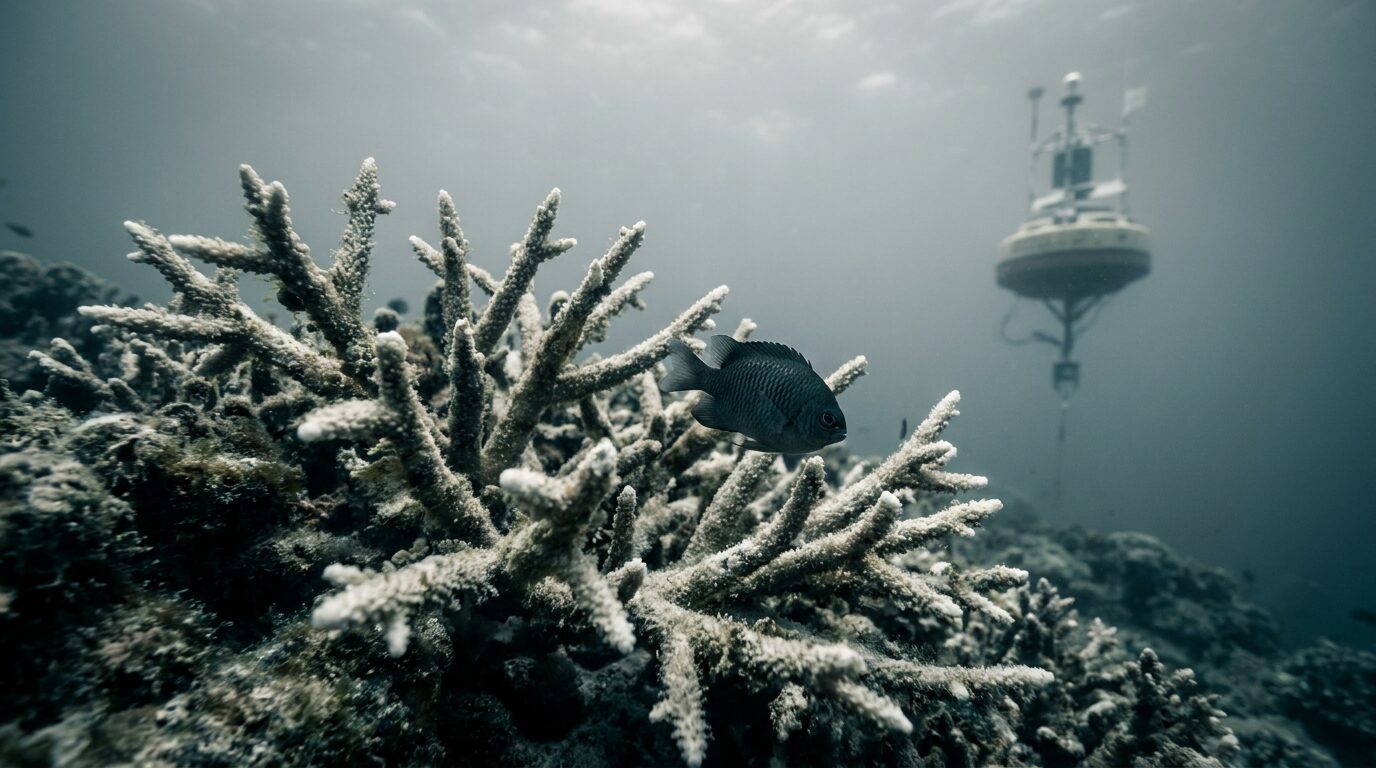
There is a particular kind of scientific announcement that the news cycle is structurally unable to handle: not a warning, not a projection, not a worst-case scenario, but a confirmation that something irreversible has already happened. In early 2025, the Global Tipping Points Report — assembled by 160 scientists across 85 institutions and led by the University of Exeter[1] — delivered exactly that. Warm-water coral reef ecosystems have crossed their thermal tipping point. The past tense is intentional. The threshold is behind us.
What that means, precisely, requires some unpacking — because tipping points are not events in the dramatic, Hollywood sense. They are structural shifts in how a system organizes itself. Once crossed, they tend to self-reinforce rather than reverse. The reef system did not simply experience mass bleaching, though it has done that repeatedly and catastrophically. It crossed into a state where the combination of baseline ocean temperature, thermal spike frequency, and ocean acidification has made functional recovery — at anything approaching historical scale — physically implausible under current warming trajectories. The reefs are not dead everywhere yet. They are dying in a way that the system itself can no longer interrupt.
This matters for reasons that go well beyond ecology, though the ecological loss alone is staggering. Coral reefs occupy less than one percent of the ocean floor and support roughly a quarter of all marine species at some point in their life cycle. They are nurseries, food sources, storm buffers, and the protein foundation for hundreds of millions of people, the majority of them in low-income coastal nations in Southeast Asia, the Pacific Islands, East Africa, and the Caribbean. The destruction of that foundation is already a humanitarian event — slow-moving, distributed, politically invisible, but real. And because reefs are a linchpin in several interconnected Earth systems, their collapse does not stay contained within coral biology.
The deeper story in the Exeter report is not just the reef confirmation. It is the architecture of interdependence that confirmation reveals — a network of tipping elements, some triggered by temperature directly, others by the cascading disruption of systems that were previously absorbing the shock. Warm-water coral reefs were, in the scientists' framing, the first domino. The question is not whether the others are wobbling. The question is how fast and in what order.
What a Tipping Point Actually Is
Climate scientists use the phrase "tipping point" to describe a threshold in an Earth system — ocean circulation, ice sheets, forests, permafrost — beyond which internal feedbacks take over and drive the system toward a new state, largely independent of further human forcing. The critical distinction is between systems that resist change up to a threshold and then reorganize rapidly, versus systems that degrade gradually in proportion to stress. Coral reefs fall into the first category. They evolved in a relatively stable thermal envelope, and they respond to even short excursions above that envelope with bleaching — the expulsion of symbiotic algae that both colors and nourishes the coral. Mild bleaching events allow recovery. Severe or frequent ones do not. Research tracking bleaching frequency across the Great Barrier Reef and Indo-Pacific systems has shown that the window between bleaching events has collapsed from years to months in many reef systems, eliminating the recovery time the ecosystem requires. As we've tracked at BrainHook, the Great Barrier Reef has now bleached nine times — and the intervals are getting shorter, not longer.
The 2025 report distinguishes between "tipping points passed" and "tipping points approaching" along a risk ladder calibrated to global mean temperature. At current trajectories — roughly 1.5°C above pre-industrial average, with 2025 on track to be the hottest year in recorded history — coral reefs are confirmed crossed. The West Antarctic Ice Sheet and the Greenland Ice Sheet are described as dangerously close, with their crossing potentially locking in meters of sea level rise over centuries regardless of subsequent emissions cuts. The Atlantic Meridional Overturning Circulation, the vast ocean current system that moderates European and North American temperatures, is flagged as weakening at a pace that recent oceanographic research suggests may be underestimated by standard models. These are not speculative dangers. They are systems already under measurable structural stress.
“The reefs are not dead everywhere yet. They are dying in a way that the system itself can no longer interrupt.”
The Cascade Mechanism
What makes tipping point science genuinely frightening is not any single threshold but the interaction effects between them — what researchers call "tipping cascades." The logic is straightforward: many tipping elements are connected through shared physical processes, so crossing one threshold can accelerate the approach of another. The Amazon rainforest is a textbook example. It generates a substantial fraction of its own rainfall through evapotranspiration — trees pulling groundwater up and releasing it as vapor, which recirculates as rain. Deforestation reduces that moisture cycling. Combined with regional warming, it pushes the southeastern Amazon toward a savannification threshold — a shift from rainforest to drier, less carbon-dense grassland that scientists have been tracking in real time. As we've reported, the Amazon already has a specific temperature limit that scientists have identified, and the combination of deforestation and regional warming is pushing multiple Amazon sub-regions toward it simultaneously.
The reef collapse feeds this cascade in ways that aren't immediately obvious. Healthy coral ecosystems modulate coastal chemistry, support fish populations that sustain coastal and island communities, and act as physical barriers that reduce storm surge damage. As they degrade, those buffering functions fail. Coastal flooding becomes more destructive. Food systems collapse. Climate migration increases, concentrating vulnerable populations in inland areas that face their own climate stressors — heat, drought, crop failure. Those displaced populations rarely have the political leverage to access meaningful adaptation resources, because climate displacement remains legally invisible in most of the world's refugee and asylum frameworks. The ecological tipping point becomes a political one: states unable to feed or protect their coastal populations lose legitimacy and institutional coherence, which further degrades their capacity to respond to the next shock.
None of this is new theoretical territory. What the 2025 report adds is confidence: confidence that the cascade is not a risk being modeled for some future temperature scenario, but a process already underway at current temperatures, with the reef confirmation as its most visible marker. The oceans themselves tell part of this story — the ocean broke its heat record for the ninth consecutive year, and as that piece makes clear, the surface temperature numbers vastly understate the total thermal energy the ocean system is absorbing and redistributing.
Who Pays for This
“The ecological tipping point becomes a political one: states unable to feed or protect their coastal populations lose legitimacy and institutional coherence.”
The distribution of harm from reef collapse is not random. It follows existing lines of global inequality with brutal precision. The nations most dependent on coral reef fisheries for food security and livelihoods are not the nations most responsible for the cumulative emissions that pushed the reefs past their threshold. The Philippines, Indonesia, Papua New Guinea, Fiji, the Maldives, Kiribati, and coastal Kenya and Mozambique — these are the front lines. The per-capita emissions of these countries are a fraction of those in the United States, Australia, the European Union, or the Gulf states. The people losing their protein supply, their coastal protection, and their livelihoods are not the people who built the fossil fuel economy. They are paying a debt they didn't run up, with a currency they don't have.
This is not a novel observation, but the reef confirmation sharpens it in a specific way: the harm is no longer preventable for these communities through any mitigation pathway. Even if global emissions went to zero tomorrow, ocean temperatures would continue rising for decades due to thermal lag, and reefs would continue to degrade. What they need now is adaptation funding, food system transition support, and legally enforceable loss-and-damage mechanisms — precisely the things that wealthy nations have spent thirty years of climate diplomacy avoiding, delaying, watering down, and underfunding. The 4th global bleaching event hit 84% of reefs in 2024, and as BrainHook's coverage of that event noted, the number that actually matters is buried in the fine print of who can't replace what's been lost.
What the Models Still Get Wrong
One of the most consequential findings in the Exeter report — stated carefully, because scientists are careful people — is that standard climate models systematically underestimate tipping point risk. The models that inform IPCC projections and national policy targets were largely built before the field of tipping point dynamics matured, and they tend to treat Earth systems as smoothly responsive to forcing rather than as threshold-driven systems capable of abrupt reorganization. This means the targets embedded in the Paris Agreement — 1.5°C as the aspirational ceiling, 2°C as the danger threshold — were calibrated against models that may significantly undercount the probability of cascade events at those temperatures. Some tipping elements, including work on ice sheet instability and permafrost carbon feedbacks, appear likely to trigger at lower temperatures than models predicted even a decade ago.
This is not a reason for nihilism. Every fraction of a degree still matters, because it shifts the probability distribution of how many cascades activate and how fast. The difference between 1.8°C and 2.5°C is not a difference between bad and catastrophic in a binary sense — it's a difference in how many tipping elements cross their thresholds, how many cascade interactions occur, and how many millions of people face displacement, food insecurity, and political destabilization as a result. The loss of coral reefs is irreversible. The loss of the Amazon, the AMOC, and the major ice sheets is not yet confirmed — and preventing those crossings would be among the most consequential things humans could do. The biology of reef ecosystems also harbors lessons that matter beyond grief: studying the insects, birds, and organisms connected to these systems keeps revealing interdependencies we didn't know existed before they started breaking.
The Political Trap
“Every fraction of a degree still matters — not because the reefs can be saved, but because it shifts how many other systems follow them.”
There is a political pathology that tipping point science tends to expose: the framing of climate action as a choice between alarmism and reassurance, as if the only two options are panic and complacency. Tipping point confirmation demolishes that framing, because it forces a third position — grief combined with urgency, loss accepted alongside action on what remains preventable. The reef confirmation does not mean "give up on climate." It means "understand precisely what has been lost, who lost it, who caused it, and what must be prevented next." That requires a politics capable of holding moral accounting alongside genuine emergency mobilization. Most of what passes for climate politics in wealthy nations is not capable of either. It oscillates between performative ambition at international summits and legislative retreat at home, while the systems doing the actual work of planetary stabilization cross their thresholds one by one.
The first confirmed tipping point is not the end of a story. It is the opening of a harder one — about cascades that are already in motion, about the communities already paying for decisions they didn't make, and about whether the political systems of wealthy, high-emitting nations are capable of anything more than promising action slightly too late. The coral reefs did not fall because the science was unclear. They fell because the science was clear and the politics failed, repeatedly, over decades, in ways that were always traceable to the economic interests of a small number of industries and the governments that protected them. Understanding that history — and being honest about it — is the minimum requirement for not repeating it with the next threshold, and the one after that.
References
- ‘New reality’ as world reaches first climate tipping point (news.exeter.ac.uk)
Confirms the 2025 Global Tipping Points Report was assembled by 160 scientists across 85 institutions and led by the University of Exeter.
About Sable Pike
Sable Pike writes about habitat loss, ecosystem strain, species decline, climate disruption, and the quiet unraveling of natural systems people once assumed were permanent — and the way that unraveling reaches into economies, politics, and daily life. Her work brings emotional weight to ecological change without sacrificing scientific rigor.
More like this
Scientists Measured How Much Extra Heat the Ocean Holds. Then They Had to Find a Comparison Big Enough.
A new study put a number on the ocean's heat surplus that makes annual energy statistics look like pocket change — and the rate is still climbing.

The Amazon Makes Its Own Rain. Deforestation Is Breaking That.
The Amazon recycles its own rainfall through vast airborne moisture corridors — and new data shows that eastern deforestation is already strangling the forests furthest downstream.

The Amazon Has a Specific Temperature Limit. Scientists Just Found It.
A new study puts a precise number on the Amazon's tipping point — and what happens just past it rewrites what we thought we knew about rainforest resilience.