The Feeling of Broke Doesn't Care What's in Your Account
A new survey found nearly half of Americans feel financially insecure despite stable numbers — and the reason has less to do with self-doubt than with what scarcity teaches you to believe about yourself.
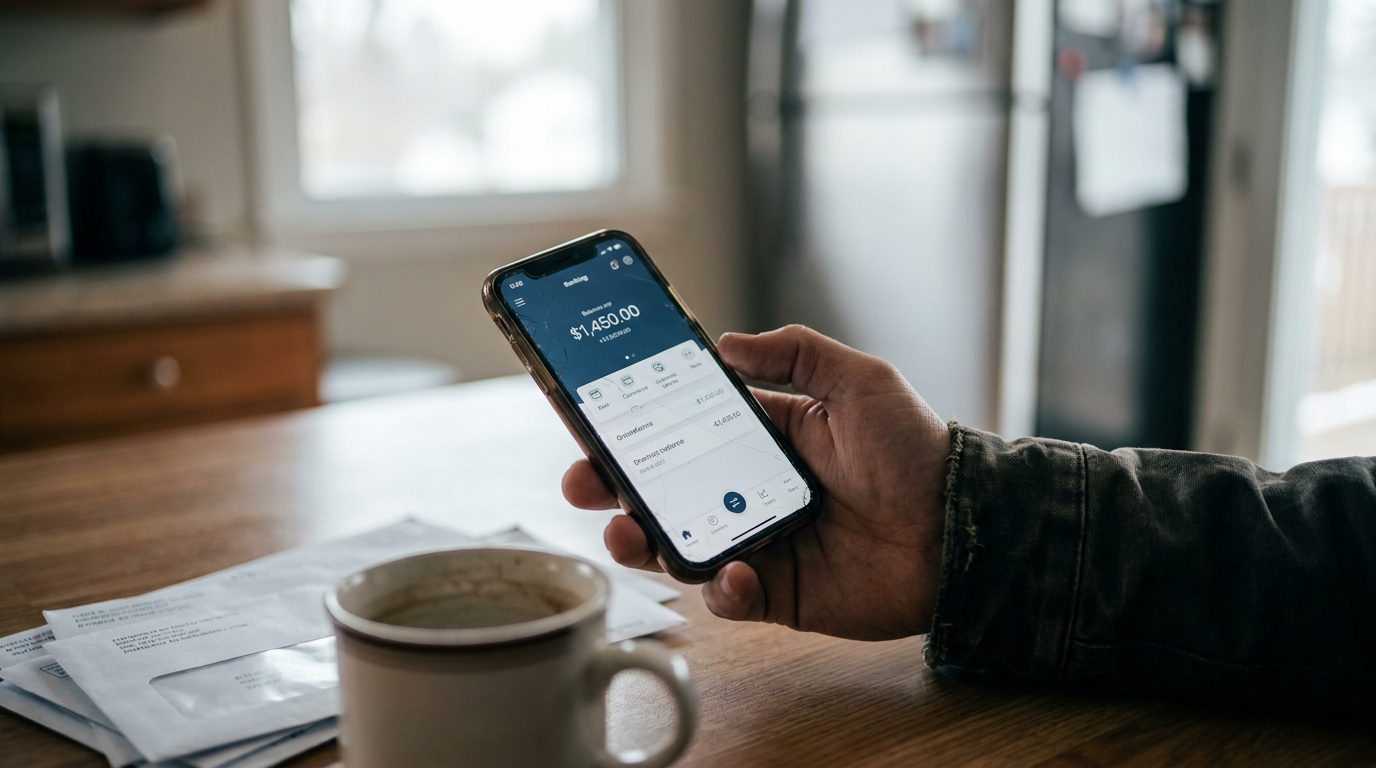
The direct deposit clears. The rent is covered. There is food in the refrigerator and a small cushion left over, the kind you used to think would feel like safety. And yet the dread doesn't move. The stomach still tightens when the phone buzzes. The banking app still feels like something you brace for before opening. The money is there, and somewhere in your body, you cannot quite believe it.
This is not confusion, and it is not ingratitude. It is something more structural: a learned orientation toward scarcity that doesn't simply dissolve when the numbers improve. KeyBank's 2025 Financial Mobility Survey[3] put data to what many people have felt privately for years. Nearly half of Americans describe themselves as financially insecure even when, by measurable metrics, their situation has stabilized. Enough income. Reasonable savings. Bills getting paid. And still: the persistent, low-frequency conviction that it is about to fall apart.
The term that has emerged for this is financial imposter syndrome — a phrase that borrows from the workplace concept but lands differently when you apply it to money. In professional contexts, imposter syndrome is usually framed as self-doubt outrunning competence. But what the survey data describes isn't really about doubting your abilities. It's about doubting your right to feel okay. And that distinction matters enormously, because the cause of one is psychological and the cause of the other is often historical.
People who grew up with financial instability — who learned money as something that disappears, that gets taken, that was never quite enough — often carry that knowledge into stability the way soldiers carry hypervigilance into peacetime. The threat changes. The nervous system doesn't get the memo. And the financial behaviors that were once genuinely adaptive — constant monitoring, catastrophizing, hoarding small amounts against imagined emergencies, refusing to spend even on necessities — can persist for years, sometimes decades, after the conditions that created them have changed.
What Scarcity Teaches You to Expect
Scarcity isn't just a material condition. It is an education. When money is genuinely tight for long enough, your brain runs a continuous background process: what's coming in, what's going out, what's overdue, what's about to get worse. Researchers who study scarcity cognition — the work of Sendhil Mullainathan and Eldar Shafir[4] being among the most cited — have documented how that cognitive load reshapes attention, narrows planning horizons, and gradually rewires the default lens through which you interpret uncertainty. You stop assuming things will work out. You start assuming they won't, because they mostly didn't.
That's a rational adaptation. When your track record with money is one of loss, shortfall, and emergency, pessimism is not irrationality. It's pattern recognition. The problem is that pattern recognition trained on one set of conditions doesn't automatically retrain when the conditions shift. The neural pathways that once protected you — the constant readiness for disaster, the refusal to feel settled, the instinct to treat calm as the lull before something goes wrong — are durable. Stability doesn't automatically dissolve them. Often, it just gives them less material to work with, which doesn't mean they disappear.
“Pessimism about money isn't irrationality when your track record with money is one of loss, shortfall, and emergency — it's pattern recognition.”
This is why the feeling of financial insecurity can persist well past the point where the numbers would justify it. You are not misreading the account balance. You are reading it through a framework built by years of a different account balance — one where stability was brief, illusory, and often followed by something worse. The brain doesn't file that under 'past.' It files it under 'likely.'
Class Conditioning Is Not the Same as Low Self-Esteem
The workplace version of imposter syndrome has become so familiar that it carries a certain comfort. It fits into a tidy narrative: you succeeded, but you don't feel like you deserve it, and with some therapeutic reframing you can reconnect confidence to achievement. Financial imposter syndrome is messier, and the framing matters. It would be easy — and wrong — to treat it as a self-esteem problem. The people who feel financially insecure despite stable numbers are not, in most cases, suffering from a failure to appreciate what they have. They are suffering from something closer to class memory.
Class conditioning is the full-body set of lessons that low-income or working-class life teaches about what resources mean, how long they last, and who is allowed to expect them. People who grew up watching parents scramble — who learned that a good week could be erased by a car repair, that the lights sometimes went out, that 'fine' had a much narrower definition than the one middle-class culture uses — absorb those lessons into something deeper than opinion. They become the baseline assumptions through which everything else gets filtered. When you grew up knowing money as volatile, you don't intellectually update to 'stable' just because the number in your account changes. Your body still knows what volatile feels like. And stable feels suspicious.
This is distinct from anxiety disorder, though it can coexist with one. It is distinct from depression, though the grinding quality of financial dread can feed depression over time. It is a conditioned orientation — learned, functional in its original context, and deeply resistant to being unlearned simply by improving the circumstances. The research on intergenerational poverty and financial stress repeatedly points to this: economic mobility is not the same as psychological mobility. You can move the money without moving the framework the money sits inside.
The Behaviors That Give It Away
Financial imposter syndrome doesn't just live in feelings. It shows up in behavior, and often in behavior that looks paradoxical from the outside. People who experience it frequently describe a persistent inability to enjoy financial stability — an unease with spending even on ordinary things, a reluctance to make purchases they can comfortably afford, a compulsive relationship with checking balances that doesn't come from not knowing what's there, but from not trusting that it will stay. There's also the opposite failure mode: stress spending, the brief hit of control that comes from buying something small when the ambient dread has been simmering too long. Both behaviors are about trying to manage a feeling that the numbers alone don't resolve.
“Economic mobility is not the same as psychological mobility — you can move the money without moving the framework the money sits inside.”
There's often a specific relationship with savings that reveals this clearly. People with financial imposter syndrome frequently maintain emergency funds in a way that doesn't feel reassuring. They know the cushion is there. They built it deliberately. And yet the cushion doesn't produce the security it was theoretically designed to produce. The money feels like it exists in a different emotional register than the one the dread operates in. The dread is in the body; the savings are in the account. They don't speak the same language. This is why 'just save three months of expenses' advice, while not wrong, doesn't actually address what is wrong for this population.
Avoidance is another signature. Not the kind that comes from not knowing the numbers — these are often people who know their numbers precisely — but avoidance of planning forward, of allowing themselves to imagine a financially stable future, because that kind of imagination has historically been the setup for disappointment. The protection is not to hope too clearly for something that has always turned fragile. If you never fully believed the stability, you can't be fully blindsided when it ends.
When 'Feeling Poor' Becomes Its Own Tax
The consequences of living with persistent financial dread despite objective security are not trivial. Chronic stress — even anticipatory, unfounded stress — carries real physiological and cognitive costs. Cortisol that stays elevated strains cardiovascular health[2]. Attentional resources spent on monitoring for financial threat are attentional resources not available for other things. Decision-making under chronic low-level anxiety tends to narrow toward short-term risk avoidance in ways that can, over time, produce the very financial outcomes that were feared. The feeling of being broke, maintained long enough at sufficient intensity, can generate broke-adjacent behavior even when the money says otherwise.
There is also a social cost that rarely gets named. People who grew up working-class and moved into greater financial stability often describe a persistent sense of not quite belonging in either world — too financially comfortable to identify with where they came from, too alert to volatility to trust where they've arrived. The class dislocation that follows economic mobility is well-documented in sociology and increasingly in psychology[1], and financial imposter syndrome sits squarely inside it. The insecurity isn't only about whether the money is real. It is also about whether you are the kind of person who gets to have it.
What Actually Moves the Feeling
There is no clean intervention for financial imposter syndrome, and anyone promising one is selling something. But there are a few things that appear to help — not cure, help — and they tend to have one thing in common: they work on the framework rather than the numbers. Cognitive behavioral approaches adapted for financial anxiety can create some movement when they focus on helping people recognize triggered responses versus current-conditions responses — the difference between 'this feels dangerous because something is wrong' and 'this feels dangerous because this is how danger has always felt.' That distinction is subtle and hard to maintain, but it is real.
“The insecurity isn't only about whether the money is real — it is also about whether you are the kind of person who gets to have it.”
Financial therapy as a field — still young, still building its evidence base — operates on the premise that money problems are rarely just math problems, and that the emotional history someone carries about resources has to be part of the treatment. Practitioners in this space often focus less on budgeting mechanics and more on the narratives people carry about money: where they came from, what they were taught to expect, who in their family had it or didn't. That kind of excavation is slow, but it is the only thing that actually addresses the substrate of the dread rather than its surface.
Social connection with people who share similar class histories — without the pressure to perform financial confidence — also appears to have some protective effect. The shame that financial imposter syndrome often carries feeds on isolation. When people discover that their dread is common, that it makes historical sense, that it is not evidence of some private irrationality, the grip tends to loosen, at least somewhat. Not because the feeling disappears. But because something that has a name and a cause feels like less of an accusation.
The Gap Between the Account and the Body
The KeyBank survey data is striking partly because it is so ordinary. Half of Americans. Not a rare edge case. Not a clinical population. Half. And what it points to is something that financial advice culture is almost structurally incapable of addressing, because financial advice culture believes that the numbers are the thing. Get the numbers right and the feelings follow. Automate the savings. Build the fund. Hit the income milestone. The feelings, in this framework, are just lagging indicators of the math.
But the feelings are not lag. For a lot of people, the feelings are a separate layer entirely — one built over years of material conditions that the new numbers have not yet overwritten. You can know you are safe and still not feel it. You can prove to yourself, on paper, that the panic is not proportionate, and still find the panic waiting for you at 2 a.m. when a bill you've already paid surfaces in your memory. The account balance and the nervous system are running different software, compiled under different conditions, and they do not automatically sync.
What that means, practically, is that getting better with money and getting better about money are two separate projects — and for many people, the second one is harder and gets far less support. The infrastructure for financial literacy is thin enough. The infrastructure for financial emotional history is nearly nonexistent. And so millions of people carry around an old dread in a new account, checking the balance again not because they don't know what's there, but because knowing has never been the part that helped.
References
- ‘He is My Refuge’: Upward Mobility, Class Dislocation and Romantic Relationships (journals.sagepub.com)
Provides sociological and psychological research documenting how class conditioning and upward mobility affect personal relationships and identity. - Cortisol and Cardiometabolic Disease: A Target for Advancing Health Equity (pmc.ncbi.nlm.nih.gov)
Documents that elevated cortisol from chronic stress strains cardiovascular health, supporting the article's claim about physiological costs of persistent financial dread. - KeyBank's 2025 Financial Mobility Survey (investor.key.com)
Provides survey data showing nearly half of Americans feel financially insecure despite stable financial metrics, the article's core empirical claim. - the work of Sendhil Mullainathan and Eldar Shafir (us.macmillan.com)
Provides foundational research on scarcity cognition showing how financial constraints reshape attention, planning horizons, and interpretation of uncertainty.
About Tessa Vane
Tessa Vane writes about scarcity, financial stress, unstable income, emotional spending, avoidance, and class conditioning — the survival logic behind money decisions that look irrational from the outside but make perfect sense from the inside. Her work focuses on what scarcity does to the nervous system and the self, and why the standard advice almost never reaches the people running on empty.
More like this

The Feeling of Not Having Enough Is Its Own Financial Problem
New research shows that feeling financially stretched — regardless of what you actually earn — quietly suppresses retirement savings in ways that have nothing to do with math.

Your Brain Treats Feeling Broke the Same Way Whether You Are or Not
Research now shows that the felt sense of not having enough shrinks your thinking and kills your saving — even when your bank balance says otherwise.
Your Unpredictable Paycheck Is Rewriting How Your Brain Prioritizes Everything
New research confirms what millions of gig workers already feel in their bodies: income volatility isn't a cash-flow problem — it's a cognition problem, and it's reshaping what the brain treats as real.