Your Unpredictable Paycheck Is Rewriting How Your Brain Prioritizes Everything
New research confirms what millions of gig workers already feel in their bodies: income volatility isn't a cash-flow problem — it's a cognition problem, and it's reshaping what the brain treats as real.
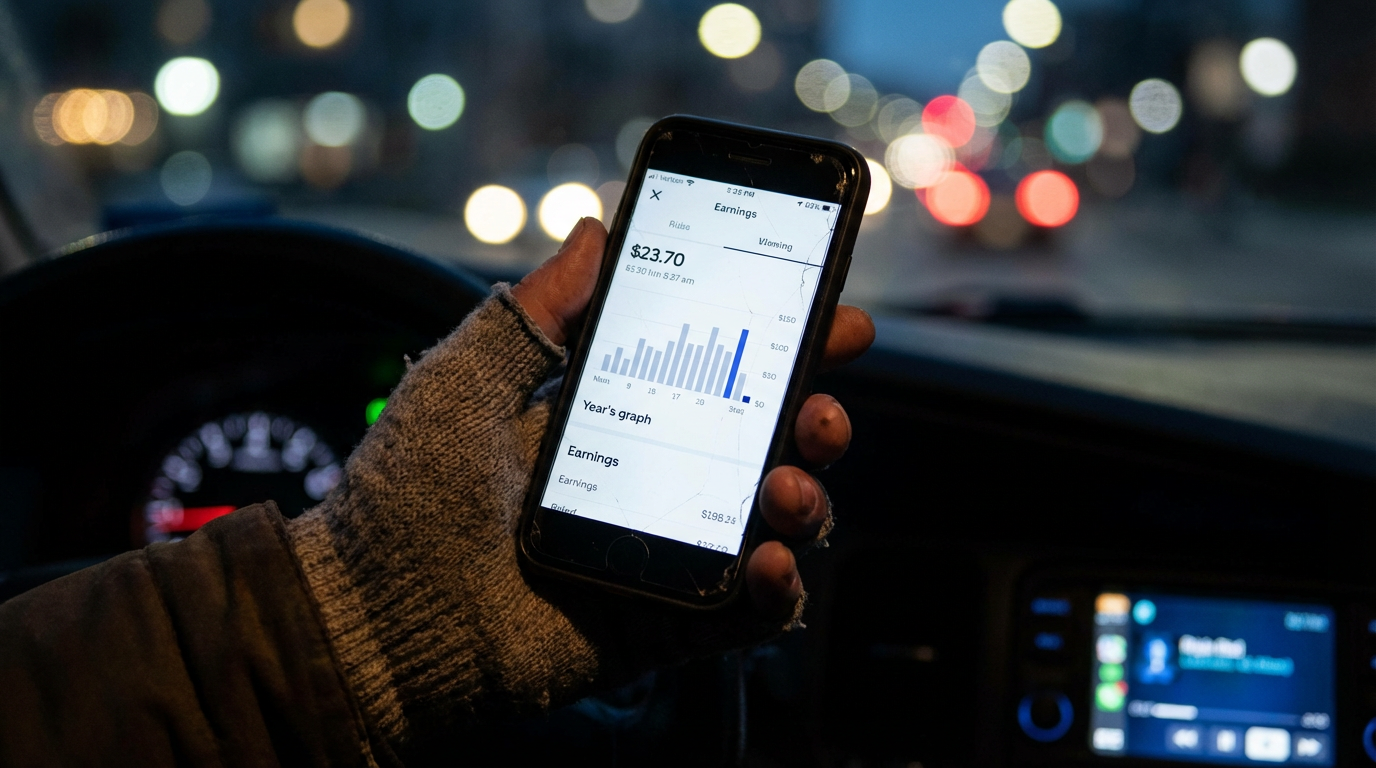
Imagine you had a strong week. Good rides, good tips, a couple of grocery delivery surges that made the math look almost reasonable. You paid the electric bill. You bought actual groceries instead of whatever was cheapest. You slept a little better — not well, but better. Then the following week came in at less than half. No explanation, no warning, just the app and its silent arithmetic. The rent math no longer works. The grocery trip you planned doesn't happen. And something shifts, not just in your account balance, but in the texture of your attention. The week after a bad week doesn't feel like a new week. It feels like the bad week continuing.
This is not a motivation problem. It is not a savings problem, though it will look like one from the outside. It is something more fundamental: income volatility, the kind that defines gig and platform work, does measurable things to how the brain allocates cognitive resources, manages time perception, and decides what is worth planning for at all. A 2025 review published in the Journal of Organizational Behavior examined this connection systematically, linking pay irregularity in gig work[1] to elevated scarcity mindset, degraded sleep quality, and measurable reductions in overall wellbeing. The mechanisms the researchers identified are not metaphorical. They are behavioral and neurological, running underneath every financial decision a person under variable income makes.
Scarcity mindset is a term that has been diluted by self-help culture into something almost meaningless — a vague cloud of negative thinking you can dispel with gratitude journaling. The research meaning is more precise and more troubling. Economists Sendhil Mullainathan and Eldar Shafir, whose foundational work on scarcity[4] shaped much of this field, showed that the experience of not having enough captures cognitive bandwidth[2] the way a background application drains a phone battery. You are still running, still functional, but slower, hotter, and with less reserve for anything complex. Their term for this is the cognitive tax of scarcity. What the 2025 review adds is the temporal layer: it is not just present scarcity that imposes this tax. Anticipated scarcity — the knowledge that next month's income is genuinely unknown — produces many of the same effects.
That distinction matters. A person who is broke right now understands that intuitively. But a person who made decent money last month and doesn't know what this month will bring is living in a specific kind of cognitive purgatory. The uncertainty itself becomes the stressor. The brain, which is deeply uncomfortable with open-ended threat, treats income volatility as a persistent alarm signal. It cannot fully relax the threat-monitoring systems when the threat has no clear shape or timeline. Sleep suffers. Concentration suffers. The horizon of what feels plannable shortens. And somewhere in that narrowing, the future starts to feel less like a place you're moving toward and more like a rumor.
When the Brain Stops Trusting Next Month
One of the more counterintuitive findings that emerges from scarcity research is that volatile income doesn't just make people more anxious — it changes what feels worth thinking about. When income is unpredictable enough, planning stops feeling like a reasonable use of mental energy. Why build a budget around numbers that won't hold? Why open a savings account when you don't know if you'll need that money to cover rent in three weeks? These aren't failures of financial literacy. They are rational responses to an environment where forward-looking thinking keeps being falsified by events. The brain learns, quickly, that the near term is the only time horizon that's real.
Psychologists describe this as a compression of temporal discounting — the phenomenon where future rewards feel less valuable than immediate ones becomes much more pronounced under stress and uncertainty. Under stable conditions, most people will wait for a larger reward later rather than take a smaller one now. Under scarcity conditions, the calculus inverts. The future becomes discounted so steeply that even modest immediate relief outweighs substantial future benefit. This is the psychological architecture behind choices that look, from the outside, like pure impulsivity: the splurge after a good week, the high-interest advance taken against a paycheck that hasn't landed yet, the subscription that should have been cancelled three months ago because it's the one thing that still feels like a choice.
“The future becomes discounted so steeply that even modest immediate relief outweighs substantial future benefit.”
The 2025 review identified sleep degradation as one of the key mediating pathways between income volatility and cognitive harm. This is worth sitting with. Sleep is not a wellness luxury. It is the primary mechanism through which the brain consolidates memory, regulates emotional response, clears metabolic waste, and restores executive function[3] — the cognitive faculty that governs planning, impulse control, and long-term decision-making. When income instability disrupts sleep, which it does through elevated cortisol, hyperarousal, and the specific rumination pattern that activates at 2 a.m. when the numbers don't add up, it is removing the very tools a person would need to manage the instability more effectively. The income problem and the cognitive problem feed each other in a loop that has nothing to do with effort or intention.
The Specific Shape of Gig Work Stress
Not all income volatility is the same. A commissioned salesperson whose income varies month to month is living differently from an Uber driver whose earnings fluctuate hour to hour, or a TaskRabbit worker whose income exists only when they win jobs in a competitive marketplace. Platform gig work has particular characteristics that intensify the psychological load. Income is often invisible until it arrives. There is no employer relationship buffering the uncertainty. There are no sick days, no predictable slow seasons, no HR department to call. The worker absorbs the full volatility of the market with no institutional cushion between them and the fluctuation.
Research on precarious employment more broadly shows that this structural exposure to unmediated risk carries its own psychological signature. Workers in high-volatility gig arrangements report not just financial stress but a persistent background sense of occupational insecurity — the feeling that their livelihood is contingent, opaque, and beyond their control. Platform algorithms make this worse because they introduce a particular kind of helplessness: you cannot predict or fully understand why a good week becomes a bad week. The algorithm changes. Demand patterns shift. A competitor enters the market. The platform adjusts its fee structure quietly. You are working hard inside a system whose rules you cannot read, and the system is deciding whether you eat well this week.
“You are working hard inside a system whose rules you cannot read, and the system is deciding whether you eat well this week.”
Researchers who study learned helplessness — the psychological state that develops when a person's actions repeatedly fail to produce predictable outcomes — have noted its particular toxicity for motivation and executive function. Learned helplessness doesn't make people passive because they are weak. It makes them passive because passivity becomes statistically reasonable. If effort and outcome are sufficiently decoupled, the brain stops treating effort as worth the metabolic cost. The gig worker who stops checking their earnings projections, who avoids doing the math on whether the week is profitable after expenses, who takes a nap instead of queuing for another shift — that behavior is not laziness. It is a nervous system that has learned, repeatedly, that the math doesn't respond predictably to input.
The Class History Underneath the Volatility
What the research tends to understate is that gig work doesn't land on a blank psychological slate. The people most likely to be doing platform gig work as a primary income source — rather than as supplemental income on top of a salaried job — are disproportionately people who already carry significant class-based financial conditioning. They may have grown up in households where money was always tight, where the electricity sometimes got turned off, where financial fragility wasn't an emergency but a baseline. That history leaves psychological residue. It shapes risk tolerance, time horizon, trust in institutions, and the baseline level of ambient financial dread a person walks around with.
When income volatility lands on top of that history, it doesn't just add stress. It confirms a story the nervous system already knows. Instability doesn't feel like a temporary problem to be solved. It feels like home, which is its own kind of trap — not because stability is undesirable, but because something familiar registers as safer than something unknown, even when the familiar thing is damaging. This is part of why financial coaching and generic budgeting advice so often fail people in high-volatility income situations. The advice assumes a stable platform from which to plan. It assumes that next month will resemble this month closely enough to make projections useful. For someone living inside genuine income volatility, that assumption is false at the structural level, not the motivational one.
What Helps, and Why It's Not What You Think
The standard financial advice for variable income is the monthly average budget: calculate your average monthly income over six to twelve months, budget to the low end, build a buffer. It is technically correct and practically brutal for anyone in the early stages of gig work, where income history is thin and the buffer is exactly what they don't have. Buffer-building advice assumes you can absorb a worse-than-average month without crisis while you're building the buffer. For a large share of gig workers, that month arrives before any buffer exists. The advice is good math and bad psychology.
What the scarcity research actually points toward is different. It suggests that reducing the cognitive load of financial uncertainty — even without changing the income itself — can meaningfully improve decision quality. This means strategies aimed at predictability over optimization: paying yourself a fixed weekly draw from earnings rather than spending directly from what comes in, automating any savings transfer however small on the day money arrives rather than the end of the month, and reducing the number of financial decisions that have to be made under stress. The goal is not to manufacture abundance that doesn't exist. It is to reduce the number of live decisions the brain is holding open at any given moment, because open decisions are what drain bandwidth.
The sleep dimension deserves its own intervention, separate from the financial one. Research on financial stress and sleep consistently shows that the rumination cycle — where financial worry activates at bedtime precisely because it's the first quiet moment — responds to containment strategies: designated financial review time during the day, written-down figures rather than numbers kept only in the head, and hard stopping points for money-related thinking before bed. None of this solves the underlying income problem. But the underlying income problem is partly sustained by the cognitive depletion the sleep problem creates. Treating them as one undifferentiated blob of stress is how people get stuck in the loop.
The Structural Problem That Doesn't Fit on a Budget Worksheet
“The problem is not that gig workers aren't thinking hard enough about money — it's that they're thinking about it constantly, in exactly the conditions that make thinking about it hardest.”
The 2025 review is careful about what its findings can and cannot justify. They document harm. They identify mechanisms. They do not conclude that gig work is inherently wrong for every person in every circumstance. But they do make it much harder to pretend that the cognitive costs of income volatility are individual failures rather than structural products. Platform companies have built enormous value on a labor model that externalizes financial risk onto workers, and that risk doesn't stay neatly in the financial column. It shows up in sleep. It shows up in attention. It shows up in the shortening of time horizons and the narrowing of what a person believes is worth hoping for. Those are not side effects. They are load-bearing features of how the model works.
The problem is not that gig workers aren't thinking hard enough about money. It is that they are thinking about it constantly, in exactly the conditions that make thinking about it hardest — with depleted sleep, compressed cognitive bandwidth, a shortened future, and a nervous system that has been trained by repeated experience to treat every good week as a temporary reprieve rather than a new normal. Calling that a mindset problem misses what a mindset is: not a mood you choose, but a cognitive adaptation to the environment you're actually in. Change the environment, and the mindset shifts with it. Leave the environment intact and hand someone a budget worksheet, and you've made the insult structural.
References
- Algorithmic management in the gig economy: A systematic review and research integration (onlinelibrary.wiley.com)
2025 Journal of Organizational Behavior review linking pay irregularity in gig work to elevated scarcity mindset, degraded sleep quality, and reduced wellbeing—the core empirical foundation of the article. - Poverty Impedes Cognitive Function (doi.org)
Provides the concept that scarcity captures cognitive bandwidth like a background application drains a phone battery—the core metaphor explaining how income volatility taxes mental resources. - The Role of Sleep and the Effects of Sleep Loss on Cognitive, Affective, and Behavioral Processes (pmc.ncbi.nlm.nih.gov)
Establishes that sleep disruption impairs executive function, memory consolidation, and cognitive control—the mechanisms the article identifies as harmed by income volatility. - Scarcity: Why Having Too Little Means So Much (en.wikipedia.org)
Foundational 2013 book by Mullainathan and Shafir on scarcity's role in poverty and decision-making, establishing the theoretical framework the article applies to gig work.
About Tessa Vane
Tessa Vane writes about scarcity, financial stress, unstable income, emotional spending, avoidance, and class conditioning — the survival logic behind money decisions that look irrational from the outside but make perfect sense from the inside. Her work focuses on what scarcity does to the nervous system and the self, and why the standard advice almost never reaches the people running on empty.
More like this

Your Paycheck Varies. Your Brain Never Recovers From That.
New research on month-to-month income swings reveals that unpredictability alone — not poverty — is enough to corrupt financial decision-making at the neurological level.

Your Brain Treats Feeling Broke the Same Way Whether You Are or Not
Research now shows that the felt sense of not having enough shrinks your thinking and kills your saving — even when your bank balance says otherwise.

The Feeling of Not Having Enough Is Its Own Financial Problem
New research shows that feeling financially stretched — regardless of what you actually earn — quietly suppresses retirement savings in ways that have nothing to do with math.