The Eddington Limit: What It Is, and How It Just Failed
The Eddington limit is supposed to cap how fast a black hole can grow — but a quasar from the early universe is eating at 13 times that rate, while simultaneously doing something the models say shouldn't be possible.
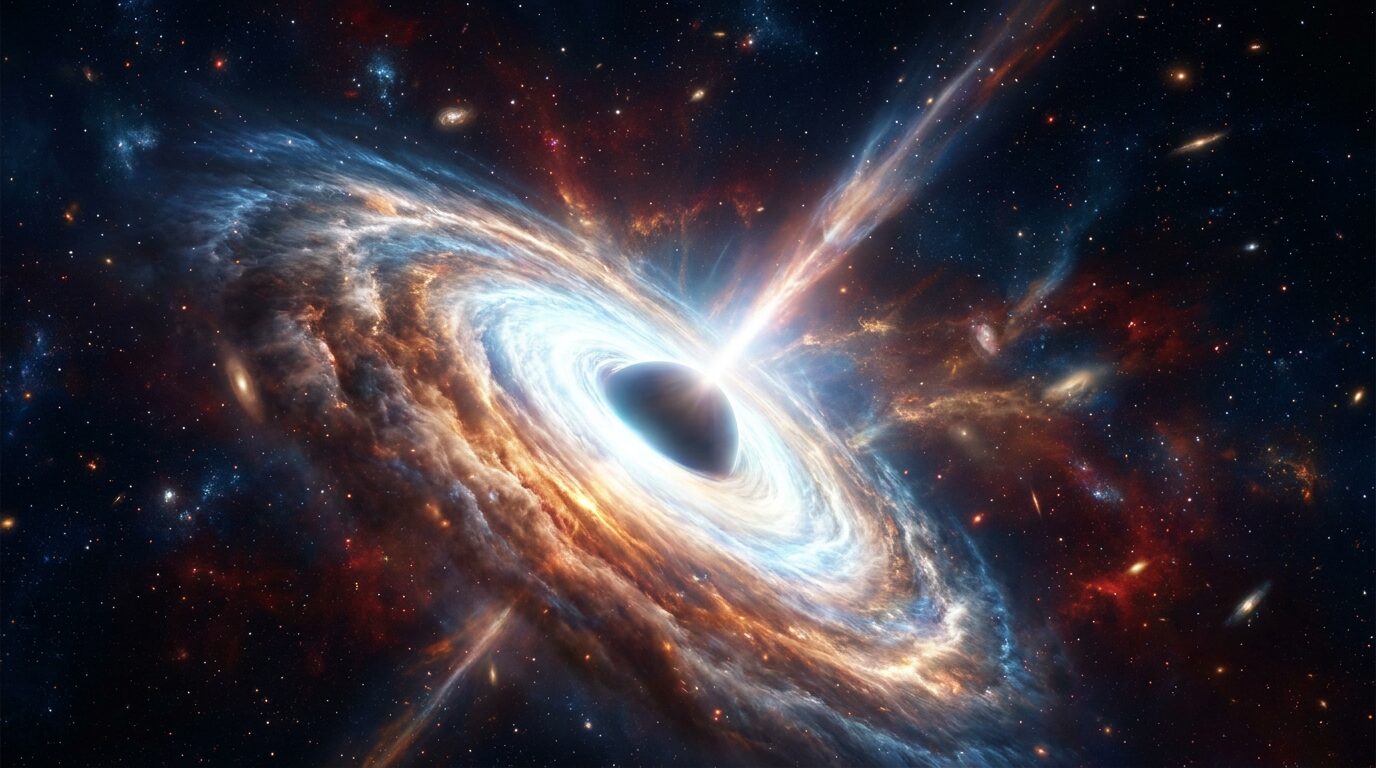
There is a speed limit built into the physics of how black holes feed. It is not arbitrary. It emerges directly from the competition between two forces: gravity pulling infalling gas inward, and the radiation that gas generates as it compresses and heats, pushing outward. At a certain accretion rate, those forces balance. Push a black hole past that equilibrium and its own light begins to blow its food away. This self-regulating ceiling is called the Eddington limit, named for Arthur Eddington, who derived it in the 1920s[2]. For nearly a century, it has served as one of the foundational constraints in astrophysics — the reason supermassive black holes were thought to grow gradually, incrementally, over billions of years.
A quasar catalogued as eFEDS J084222.9+001000 — designated ID830 — sits at a redshift of z = 3.4351, placing it roughly 12 billion years in the past, when the universe was only about 15 percent of its current age. The team estimates its black hole mass at 4.40 × 10⁸ solar masses — 440 million times the mass of the Sun — and measured an Eddington ratio from X-ray luminosity of λ_Edd,X = 12.8 ± 3.9, indicating super-Eddington accretion. That is not a rounding error. That is a black hole consuming matter at roughly 13 times the rate its own physics should permit.
The findings appear in The Astrophysical Journal as "Discovery of an X-Ray Luminous Radio-loud Quasar at z = 3.4: A Possible Transitional Super-Eddington Phase," with lead author Sakiko Obuchi from the Department of Physics at Waseda University in Tokyo.[1] The paper is notable not just for confirming extreme accretion, but for what it found happening around that accretion simultaneously — a second anomaly that current models cannot account for at all.
The Eddington Limit, Explained From the Inside Out
To understand why ID830 is strange, it helps to understand what the Eddington limit is actually describing. When gas spirals into a black hole, it does not fall cleanly. It flattens into an accretion disk — a dense, superheated structure where friction and magnetic turbulence strip away angular momentum and allow material to drift inward. As it falls, it converts gravitational potential energy into radiation. That radiation exerts pressure. As the material in the disk heats up, it produces outward radiation pressure that limits the amount of material the black hole can accrete — gravity pulls material in while radiation pushes it away. That balance point is the Eddington limit.
Super-Eddington accretion occurs when the material in an accreting system is so intense that radiation gets trapped within it — swept into the black hole before it can push gas away. In this regime, the disk structure changes fundamentally. It thickens. Radiation becomes advected rather than radiated outward. The system enters a qualitatively different state. This mechanism is theoretically permissible, but it is considered rare and difficult to sustain, and it carries specific observational signatures — particularly a suppression of X-ray emission as the thickened disk absorbs its own output.
High growth rates normally weaken X-rays as the disk structure thickens and radiation becomes trapped. Instead, ID830 shows the opposite pattern — strong X-rays emerging from a corona that appears overheated or reenergized. That is the first problem. The second is the radio.
Two Signals That Shouldn't Coexist
ID830 was identified as the most X-ray luminous radio-loud quasar in the eROSITA Final Equatorial Depth Survey field, showing a rest-frame 0.5–2 keV luminosity of log(L / erg s⁻¹) = 46.20 ± 0.12, with a steep X-ray photon index of Γ = 2.43 ± 0.21, alongside a significant radio counterpart detected with the Very Large Array FIRST 1.4 GHz and Very Large Array Sky Survey 3 GHz bands. Translated out of the spectral index notation: this object is extraordinarily bright in both X-ray and radio, across two separate physical emission mechanisms.
“Standard models predict that super-Eddington accretion should suppress the formation of large-scale radio jets. ID830 is producing both simultaneously.”
The X-ray emission is thought to originate from what astrophysicists call a corona — a thin cloud of billion-degree plasma sitting above the accretion disk, threaded by intense magnetic fields, where electrons scatter photons up to X-ray energies. Coronae are well-documented around accreting black holes. The high alpha-OX ratio observed for ID830 suggests the coexistence of a prominent radio jet and X-ray corona in this high-Eddington-accretion phase. That coexistence is the puzzle. Standard accretion theory distributes the energy budget around a black hole according to its accretion state: fast-feeding systems tend toward disk-dominated emission profiles that suppress jets; slower feeders can sustain organized jet structures. A system doing both, simultaneously, at this rate, is not supposed to fit anywhere in that framework.
The researchers did consider a simpler explanation — in some quasars, part of the X-ray light can come from the jet itself, not just from the hot region near the black hole, an effect that can make a system look brighter in X-rays than it really is. Even so, the team found that ID830 remains unusually X-ray bright compared with other black holes thought to be growing this fast. Jet contamination alone does not close the gap. Something else is energizing the corona.
A Burst, a Shredded Star, and 300 Years of Runaway Growth
The team proposes that ID830 may be in a transitional phase after an accretion burst, evolving from a super-Eddington to a sub-Eddington state — potentially triggered by a tidal disruption event with a huge gas reservoir or other mechanisms. A tidal disruption event is precisely what it sounds like: a star wandering too close to the black hole, shredded by tidal forces, its debris stream falling rapidly inward. Such events can deliver large amounts of mass in a geologically brief interval, temporarily overwhelming the system's equilibrium and driving accretion rates far above the Eddington ceiling. A massive infalling gas cloud is the other candidate — a turbulent structure in the host galaxy's interstellar medium suddenly losing orbital support and collapsing inward in bulk.
The inferred duration of this super-Eddington phase is around 300 years. On human timescales that sounds substantial. On cosmic timescales it is a camera flash — a momentary overexposure in a billion-year exposure. The observed alpha-OX excess indicates that the corona may have been reheated during this process, which would explain the X-ray brightness as a signature of that transient reactivation rather than a steady-state property of the system. The jets, in this picture, are also transitional — ignited during the burst phase and not yet extinguished as the system returns toward equilibrium.
The team proposes that ID830 may be in a transitional phase after an accretion burst, evolving from a super-Eddington to a sub-Eddington state, which could naturally describe the high alpha-OX. If that interpretation holds, then what we are seeing is not ID830's permanent nature but a rare snapshot: a black hole caught mid-surge, corona blazing, jets firing, matter pouring in faster than its own light can resist. That kind of snapshot is extraordinarily hard to catch.
The Deeper Problem: Black Holes That Got Big Too Fast
“To reach 440 million solar masses so early in cosmic history requires either an impossibly large seed or a growth mechanism the standard model wasn't built to accommodate.”
Observations place ID830's mass near 440 million solar masses at a time when galaxies had only begun assembling into complex structures — reaching that size so early requires either a very large seed black hole or a period of growth that exceeds the classical Eddington limit. This is the broader problem that ID830 sharpens rather than solves. The early universe, as surveyed by instruments like JWST, keeps producing massive black holes in places and at times where they should not yet exist. The spiral galaxy that wasn't supposed to exist yet is one version of this problem; ID830 is another, more extreme version. The structures we observe at high redshift keep arriving too early, too developed, too massive.
Even the most massive seed black holes would need to feed at the Eddington limit for more than 650 million years to reach some of their observed sizes — a feat that seems infeasible given the prodigious amounts of gas required to sustain such prolonged gorging. Episodic super-Eddington bursts, if they are more common than models assumed, offer a way around that constraint. A black hole does not need to eat steadily at the speed limit if it occasionally and violently exceeds it. ID830 may be showing us one such episode in real time — or rather, in 12-billion-year-old light.
If these results are correct, they can explain the large masses of supermassive black holes at high redshifts. But the jet problem remains genuinely open. Scientists don't yet know how super-Eddington accretion connects to jet activity, but ID830 gives a rare look at how black holes and galaxies grew together in the early universe. The published paper in The Astrophysical Journal[1] treats the simultaneous corona and jet as evidence for a transitional state rather than a steady configuration, but that framing is itself a model — a plausible interpretation of an observation that current physics cannot yet fully decode. The uncertainty is not a flaw in the analysis. It is an honest accounting of where the standard framework stops working.
What the Eddington limit actually describes is a system in balance. ID830 is a system that briefly, violently, escaped that balance — and the light from that escape, 12 billion years old and still arriving, is carrying information about a growth mechanism we do not fully understand. That the universe built black holes this large this early remains one of the central unsolved problems in cosmology. ID830 does not resolve it. It makes it more specific, more concrete, and considerably harder to explain away. That trajectory will be familiar to anyone tracking how JWST keeps pushing early-universe structures past the edge of what the models can absorb — each new object not a clean answer, but a new measurement of how far the gap actually runs.
References
- Discovery of an X-Ray Luminous Radio-loud Quasar at z = 3.4: A Possible Transitional Super-Eddington Phase (doi.org)
Provides the observational data on ID830's black hole mass, Eddington ratio, X-ray luminosity, and radio detection that form the article's core empirical claims. - Arthur Eddington (en.wikipedia.org)
Confirms that Arthur Eddington derived the Eddington limit in the 1920s, establishing the historical origin of this foundational astrophysical concept.
About Brenna Vance
Brenna Vance writes about the cosmos — stars that predate the universe's own chemistry, spacecraft flying close enough to the sun to catch it misbehaving, the physics of what the universe is still getting wrong. Her work focuses on the moments when an observation breaks a model, and what that break actually means.
More like this

The Gamma-Ray Burst That Fired for 7 Hours Doesn't Fit Any Known Physics
GRB 250702B lasted nearly twice as long as any gamma-ray burst ever recorded, and the two leading explanations for it are mutually incompatible — which means at least one of them has to be wrong.

JWST Found Objects so Red and so Strange That Astronomers Invented a New Category for Them
JWST's deep-field images are filling up with tiny, furiously red objects that fit no existing category — and the strangest one may be something the universe was never supposed to make.
The FRB That Fired Once, Left a Partner Behind, and Broke the Rulebook
A fast radio burst caught inside a binary star system just overturned the leading explanation for what produces them — and the real problem is that the burst only fired once.