The Liar's Dividend Is Already Here. Your Brain Is the Exploit.
New data on human detection rates reveals that deepfake technology's most dangerous output isn't convincing fakes — it's a world where anyone can credibly call real evidence a lie.
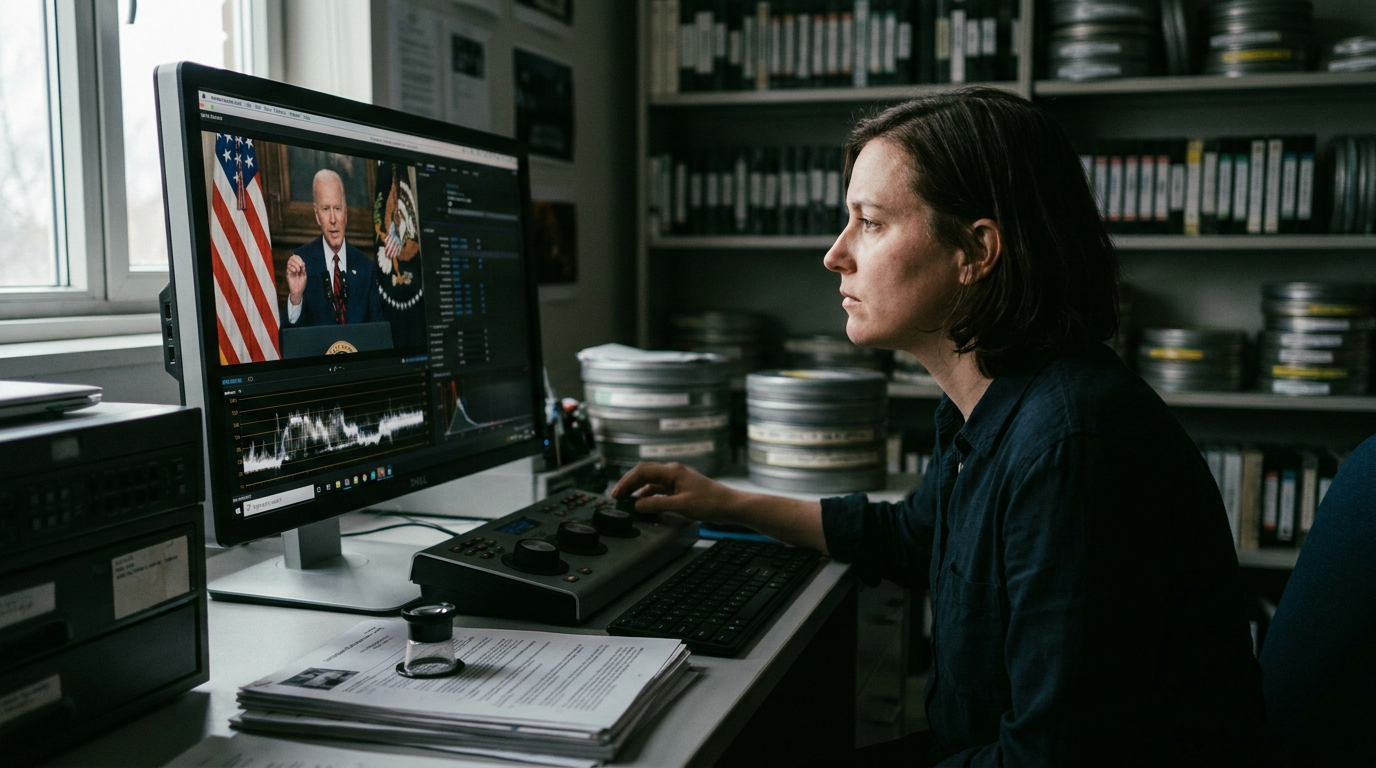
Imagine you are watching a video of a politician. He is making a specific promise in front of a crowd you recognize, at a venue you can cross-reference, on a date that matches the public record. The video is real. You know it is real. His campaign knows it is real. But in the forty-eight hours after it circulates, three separate accounts with modest followings post variations of the same claim: this was generated. Look at the ear. Look at the lighting on the left side of his jaw. The video gets ratioed. A fact-check is commissioned. By the time the fact-check clears the video, the news cycle has moved on, and a nontrivial slice of the audience has quietly filed the footage under probably fine, probably not, impossible to be sure.
The video was never the problem. The doubt was the product.
This is what legal scholars and media researchers have started calling the liar's dividend[4] — not the capacity to make convincing fakes, but the capacity to make convincing denial. As synthetic media becomes fluent enough that ordinary people cannot reliably distinguish it from authentic footage, the downstream effect is not primarily that we will be fooled by fake things. It is that we will become uncertain about real things. The asymmetry is brutal: creating doubt is cheap and fast; restoring credibility is slow and often incomplete.
The numbers that should clarify this problem are doing the opposite. Research into human detection accuracy for high-quality deepfakes has settled around a deeply uncomfortable figure: somewhere in the low-to-mid twenties, in percentage terms. One well-cited range puts accuracy at roughly 24.5 percent[1] for the most sophisticated synthetic video — meaning trained observers, shown carefully selected clips, correctly identified them at a rate not dramatically better than chance in some experimental conditions, and worse than chance in others when deepfakes were designed specifically to exploit known visual heuristics. The implication lands harder than the statistic: the human perceptual system is not a weak version of a reliable detector. It is the wrong tool for this job entirely.
The Neural Architecture That Makes Us Easy Targets
To understand why detection fails so reliably, you have to start with what vision and face-processing are actually optimized for. The human brain did not evolve to evaluate media. It evolved to evaluate faces. These are not the same task. Face processing in biological terms is a holistic, fast, and largely automatic operation — the fusiform face area[3] processes facial identity and expression in ways that are largely preconscious, arriving at a social read before the deliberative parts of the brain have even engaged. This is efficient for navigating rooms full of people. It is catastrophically inefficient for evaluating compressed video frames rendered by a generative adversarial network.
High-quality deepfakes are, in a technical sense, adversarially tuned against exactly this system. The most effective generation pipelines in current use are trained on feedback from discriminator models — networks specifically built to catch synthetic artifacts — which means the output is iteratively refined to erase the signals that detectors look for. What remains is content that satisfies the most common perceptual checks: blink rate is plausible, lip sync is close, skin texture variation is present, and microexpressions are within the normal range. What the human viewer is doing, when they try to detect a deepfake, is running an intuitive checklist against exactly the signals that have been most aggressively optimized away.
“The human perceptual system is not a weak version of a reliable detector. It is the wrong tool for this job entirely.”
There is also the question of what researchers in social cognition call truth bias — the documented tendency of people to default to believing communicated information is accurate, particularly when it arrives through trusted channels or familiar faces. This is not naivety. It is a functional prior. In most social contexts across most of human history, the person in front of you was the person in front of you. Video, until recently, was assumed to carry an indexical relationship to reality — it recorded what existed. That assumption is now structurally false, but our perceptual defaults have not updated, because they are not the kind of system that updates on policy changes.
Fraud Is the Cover Story
Deepfake coverage tends to organize itself around the fraud use case: romance scammers using synthetic faces, financial executives impersonated on video calls, revenge porn generated without consent, political figures appearing to say things they never said. These are real, serious, and worth sustained attention. But the fraud framing keeps pointing at the fake as the primary object of concern. It implies that the problem is solved when the fake is identified and the responsible party is caught. The liar's dividend operates through a different mechanism entirely, and catching individual bad actors does not disable it.
The dividend accrues to anyone who benefits from generalized epistemic uncertainty — a category that includes, but extends well beyond, the specific people producing deepfakes. A politician whose genuinely damning statement circulates in video form now has a new line of defense that was not available ten years ago. A corporation caught on camera making a discriminatory decision can fund a murmur campaign questioning the footage's provenance without ever proving anything. An executive whose voice appears in a leaked audio file can point at the ambient fact of AI voice synthesis as sufficient grounds for doubt. The fake does not need to have been made. The possibility that a fake could have been made is enough to generate the doubt, and the doubt is the commodity.
“The fake does not need to have been made. The possibility that a fake could have been made is enough.”
This is a structural shift in how power relates to evidence. Evidence has always been contestable — lawyers have spent centuries on exactly that — but the contestation used to require investment: expert witnesses, forensic analysis, procedural discovery. The liar's dividend democratizes denial. You can now cast credible doubt on a real video with a tweet, a mid-follower account, and basic familiarity with the terms the public associates with synthetic media. The cost of denial has collapsed. The cost of verification has not.
What Media Literacy Actually Gets Wrong
The standard institutional response to deepfakes is media literacy education. Teach people to look for artifacts: the warped background, the unnatural blinking, the ear geometry that does not quite match. This advice was reasonable in 2019 when the artifacts were obvious. It is actively counterproductive now, for two related reasons.
First, the artifacts that media literacy curricula target are the exact artifacts that iterative adversarial training has been eliminating. Teaching people to look for pixel smearing around the hairline in high-quality 2025 synthetic video is roughly equivalent to teaching them to screen for a disease that the pathogen has already mutated past. The checklist is out of date before it is printed. Second, and more corrosively, artifact-hunting installs a behavioral habit of suspicion that applies indiscriminately. A viewer who has been trained to scrutinize jaw geometry does not apply that scrutiny only to synthetic video. They apply it to everything. The literacy that was supposed to build discrimination between real and fake instead builds generalized distrust — which is precisely the cognitive state the liar's dividend runs on.
This is not an argument against media literacy. It is an argument that the current version of media literacy is aimed at the wrong layer. The vulnerability is not insufficient suspicion at the individual viewer level. The vulnerability is the verification infrastructure — or rather, the absence of one that works at platform scale and real-world speed. When a video is posted, the question of its authenticity needs to be resoluble within the news cycle, not three days later. Right now, that resolution is not reliably available to the institutions that would need to provide it.
Provenance, Detection, and the Infrastructure That Isn't Ready
There are serious technical approaches to this problem that are worth understanding even if none of them are yet operating at the scale required. Content provenance standards — frameworks where media carries embedded metadata about its capture device, editing history, and chain of custody — represent one serious direction. The Coalition for Content Provenance and Authenticity[2], a cross-industry group that includes camera manufacturers, major media outlets, and platform companies, has been developing technical specifications for what amounts to a cryptographic trail of evidence attached to media files. The idea is that authentic footage carries verifiable documentation of its origin, the way a notarized document carries a signature.
The structural limitation of provenance approaches is that they work forward, not backward. Files recorded before the provenance chain was established carry none of it, which means the enormous archive of existing video evidence is not covered. They also depend on adoption rates across device manufacturers, platforms, and publishing workflows that remain inconsistent. And they solve only the authentication problem — which is only half of the liar's dividend problem. Even if a video can be verified as authentic, a bad actor can still claim the provenance metadata was spoofed. Verification only works when the verification system itself is trusted, and trust systems are also attackable.
Forensic detection — AI classifiers trained to identify synthetic artifacts — is developing rapidly, but the adversarial dynamic is also escalating. Detection models are trained on known fakes; generation models train to evade known detectors; the cycle repeats. Researchers working in this space tend to describe it as an ongoing arms race rather than a problem approaching solution, and the honest ones note that detection accuracy degrades significantly when the fakes being evaluated are generated by models the detector was not trained on. In deployment terms, this means detection tools that work on last quarter's synthetic media may already be losing ground on this quarter's output.
Asymmetric Costs and the Epistemics of Daily Life
“Surveillance rarely feels like surveillance when it is packaged as personalization — and doubt rarely feels like a weapon when it is packaged as critical thinking.”
The broader consequence of living inside a liar's dividend economy is not a single dramatic epistemological collapse. It is a gradual recalibration of how much confidence people extend to video evidence as a category, and what kinds of claims they treat as verifiable versus permanently contested. This recalibration is already underway. In political contexts, factual disagreements that were once resolvable by pointing at footage are now more likely to be met with the observation that footage can be made. In legal contexts, practitioners are beginning to encounter the synthetic media question as a routine defense consideration. In personal relationships, the possibility of fabricated evidence has started to enter conversations it would not have entered five years ago.
The asymmetry that makes this durable is simple. Trust in a piece of evidence is built slowly, through institutional verification, source credibility, corroboration, and time. Doubt is installed in seconds, through a social media post, a screenshot, a comment thread citing plausible-sounding technical terminology. Restoration of trust, even when the verification arrives, is never complete — the doubt that was planted first tends to persist as a background heuristic. The cognitive science on this is not subtle: corrections update beliefs less than original exposures formed them, and corrections that arrive late update them less still.
What the 24.5 percent detection figure actually measures, then, is not how vulnerable we are to being tricked by convincing fakes. It measures the floor on which the liar's dividend operates. If even careful observers with explicit detection training cannot reliably distinguish synthetic from authentic at high quality, then the gap between real and plausibly-deniable has effectively closed for ordinary evidentiary purposes. The fakes do not need to be everywhere. They just need to be common enough that the category of synthetic media remains available as a rhetorical exit from any evidence that becomes inconvenient. At the rate generation technology is improving, and the rate that detection and provenance infrastructure is not keeping pace, that exit is getting wider and more frequently used. The exploit was never the video. It was always the doubt.
References
- Providing detection strategies to improve human detection of deepfakes: An experimental study (sciencedirect.com)
Provides the 24.5 percent human detection accuracy figure for high-quality deepfakes that the article uses as evidence of perceptual system failure. - About C2PA (c2pa.org)
Outlines C2PA's mission to develop technical specifications for establishing content provenance and authenticity at scale across industries. - The Fusiform Face Area: A Module in Human Extrastriate Cortex Specialized for Face Perception (jneurosci.org)
Describes the fusiform face area's role in holistic, preconscious face processing that the article identifies as vulnerable to adversarially-tuned synthetic media. - The Liar’s Dividend: Can Politicians Claim Misinformation to Evade Accountability? (cambridge.org)
Establishes the concept of the liar's dividend as a mechanism where misinformation serves purposes beyond direct deception, including shifting foundational trust.
About Julian Cross
Julian Cross writes about AI, automation, surveillance, digital identity, labor, human relationships with each other and automation, complex systems and attention — less about what new tools, studies and observations can do in theory than what they're already doing to how we work, spend, relate, and get measured. His work follows leads to the point where it stops being a product and starts being a condition.
More like this

Deepfakes Didn't Break Trust. They Broke the Act of Verifying.
Deepfakes rarely fool experts — but they've given anyone caught on camera a new defense, and that's quietly dismantling the evidentiary logic that holds institutions together.

Voice Cloning Has Crossed the Threshold. You Can No Longer Trust a Call.
Voice cloning has crossed a perceptual threshold that researchers say human ears can no longer reliably detect — and the way we authenticate identity in daily life hasn't caught up.

More Facts Won't Fix Polarization. One Study Just Complicated That.
A decade of motivated-reasoning research said facts backfire on committed partisans — then a Nature Communications experiment got a surprisingly different result.