When Forecasters Lose Their Tools: How Budget Cuts Are Colliding with Record Hurricanes
The Trump administration cut hundreds of the people who warn you about killer storms — right as scientists project the hottest, most extreme years in recorded history are almost certainly ahead.
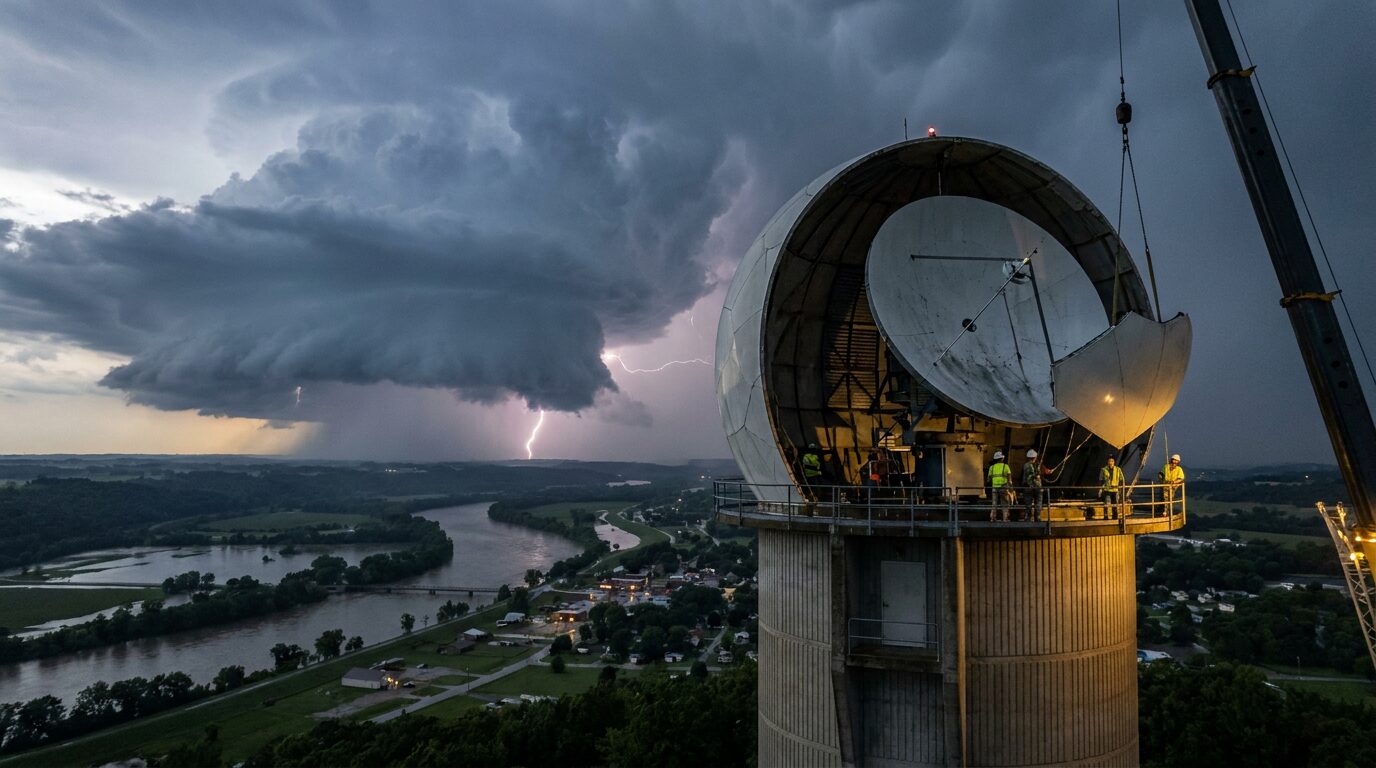
On the morning of July 4, 2025, the Guadalupe River in Texas's Hill Country rose 26 feet in 45 minutes. More than 30 centimeters of rain had poured down in a three-hour stretch. At least 120 people died, including 46 children, and more than 170 were still missing as of July 10. The National Weather Service office responsible for that stretch of Texas had gotten the forecast broadly right. It had issued warnings. And it had done all of this while operating with a 15% vacancy rate among its meteorology staff, without a science and operations officer, and without a warning coordination meteorologist — the key leader who had retired just a few months prior, along with about 400 other NWS experts who took an early retirement offer in April.
That early retirement option was part of the Department of Government Efficiency-related budget cuts designed to shrink the size of the federal government. The warning coordination meteorologist — the person whose job, in ordinary times, is to build relationships with emergency managers, run tabletop simulations, and make sure that when a warning goes out, someone is positioned to act on it — was gone. Three such positions in the relevant NWS office were left vacant as a result of what a federal inspector general's report later called "workforce optimization incentives." No risk assessment had been conducted as to the potential impact of those vacancies. That detail matters not as a simple assignment of blame for the deaths on the Guadalupe — the evidence on direct causation is genuinely complicated — but as a precise illustration of what institutional degradation actually looks like before it becomes a body count.
Now hold that image alongside this one: global average temperatures are likely to continue at or near record levels in the next five years, with annual global mean near-surface temperatures during 2026–2030 predicted to range between 1.3°C and 1.9°C above the 1850–1900 average — and there is an 86% chance that one year between 2026 and 2030 will surpass 2024 as the warmest year on record. That projection comes from the WMO's Global Annual-to-Decadal Climate Update[2], produced by the UK Met Office. An El Niño predicted for the end of 2026 increases the chances of 2027 becoming a new record year, according to the report's lead author. Warmer oceans breed more intense hurricanes. More intense hurricanes require better forecasting, more experienced staff, and more robust early-warning infrastructure. The Trump administration is systematically providing less of all three.
“The warning coordination meteorologist was gone. No risk assessment had been conducted as to the potential impact of that vacancy.”
The Machinery Being Dismantled
To understand what's been lost, you have to understand what NOAA actually does — and how deliberately it's being carved apart. On February 27, 2025, the Office of Personnel Management abruptly terminated around 880 employees, over 7.3% of NOAA's total staff[4]. Before the terminations, NOAA had approximately 12,000 employees, including 6,773 scientists and engineers. Firings occurred at the National Hurricane Center and the Storm Prediction Center; 25% of the NOAA Environmental Modeling Center was terminated. A federal court ruled those firings unlawful. The employees were ordered rehired, then put on administrative leave. Meanwhile, the National Weather Service lost close to 600 staff at a time when 40% of national weather forecast offices were facing significant staff vacancies.
The budget picture is just as grim. For fiscal year 2026, the Trump administration proposed cutting NOAA's budget by roughly 25%, including the elimination of its research division, the Office of Oceanic and Atmospheric Research. The changes suggest the Trump team may be following the Project 2025 conservative policy proposal for NOAA[3], which calls for it to be "broken up and downsized" largely because of its climate change research. Project 2025 called for NOAA to be dismantled, its climate-change research disbanded, and the National Hurricane Center forced to issue reports "presented neutrally, without adjustments intended to support any one side in the climate debate." That last demand is not a call for scientific neutrality. It is a demand that a federal weather agency pretend the physics of warming storms does not exist.
The operational damage is already spreading beyond staffing. Staffing cuts have curtailed the daily launch of weather balloons that collect weather data and left some NOAA offices without forecasters on-site overnight. In June 2025, the Department of Defense announced it would no longer provide critical weather data to scientists and forecasters, including NOAA staff. The National Weather Service's Environmental Modeling Center announced it would be discontinuing several weather models, including the North American Mesoscale Model and the High Resolution Ensemble Forecast. A retired employee from the Storm Prediction Center stated that "SPC staff who use these models universally deemed this plan a terrible idea harming forecasting" and that complaints from SPC staff were "delivered above and ignored." And NOAA's automated translation of weather alerts into Spanish — critical for reaching non-English-speaking communities in disaster zones — was suspended after the contract expired.
Then there is the data erasure. In May 2025, NOAA quietly retired its Billion-Dollar Weather and Climate Disasters database[1], a resource that had allowed taxpayers, media, and researchers to track the cost of natural disasters spanning extreme events from hurricanes to hailstorms since 1980. Discontinuing this database at a time when the frequency and costs of these devastating events have risen to unprecedented levels removes public access to information on the resulting economic impacts and loss of life, as Climate Central noted. The average length of time between billion-dollar disasters fell from 82 days during the 1980s to 19 days during the last decade. You cannot make an honest case for shrinking the infrastructure that tracks accelerating disasters and simultaneously claim to care about the people those disasters kill. The database is now maintained by Climate Central, a nonprofit, after they hired NOAA's former lead scientist to continue the work the government abandoned. That is not a success story. That is a public institution's function being absorbed by private charity because the government chose to walk away. You can read more about what disappeared with that database here.
The Institutional Logic of Making People Blind
There is a pattern here that goes beyond budget hawkery, and it is worth naming clearly. NOAA is, among other things, one of the world's premier climate science agencies. That has long made it a target for conservatives and the fossil fuel industry. Cutting NOAA's research capacity does not make storms less dangerous. It makes the political cost of storms less legible — to the public, to insurers, to emergency managers, to anyone trying to argue that climate policy has material stakes. If you cannot track what disasters cost, you cannot build the political case for preventing them. If you cannot warn communities in their own language, you have effectively decided which communities get protected and which ones don't. And if you fire the people who maintain relationships with local emergency managers before hurricane season — with an 86% probability that a record-breaking heat year is coming before 2030 — you have made a choice about whose lives are worth the operational friction of keeping those relationships intact.
The Texas flood offered a controlled experiment of sorts — one with a tragic outcome but a genuinely mixed evidentiary record that deserves honest treatment. The NWS issued a Flash Flood Warning for the area around Hunt, Texas, at 1:14 a.m., providing an estimated 106-minute lead time before the river reached flood stage — but for the city of Kerrville, just 9.5 miles downstream, the effective lead time was only 26 minutes, falling well short of the service's 65-minute performance goal. Former NOAA administrator Richard Spinrad said on CNN: "I am convinced that the staff cuts were a contributing factor to the inability of emergency managers to respond. The staffing was just fine to get the forecast out and the warnings issued, but when you send a message there's no guarantee it's being received. So someone needs to follow up, and that's the warning coordination meteorologist — a position that was vacant." That is not a claim that the cuts killed 120 people. It is a claim that the cuts degraded the connective tissue between a forecast and a human being acting on it. That distinction matters precisely because the next event will be worse, and the margin for error is shrinking.
“If you cannot track what disasters cost, you cannot build the political case for preventing them. That's not an oversight. That's the point.”
What the Numbers Actually Say Is Coming
The WMO projections are not a distant alarm. They are a near-term operational forecast. An entire year above the 1.5°C mark "means a whole range of extreme weather events, probably many so hot, wet, or dry that it exceeds anything we've experienced in the past and thus crucially, anything our city planning or agriculture" was designed for. If the next five years average more than 1.5°C since pre-industrial times, Earth will have warmed a quarter of a degree Celsius in a decade — faster than the previous rates of warming, which were closer to two-tenths of a degree Celsius per decade. Warmer oceans fuel more intense hurricanes. More intense hurricanes require more granular, more accurate, more expertly staffed forecasting systems. The Global Commission on Adaptation has estimated that a 24-hour warning of an impending storm can reduce damage by 30%. The Trump administration is cutting the people and tools that make those warnings possible — during the window when the science says those warnings will be needed most urgently. That is not an abstraction about the future. It is a policy choice with a body count already attached. And as ocean temperatures continue to set records, the infrastructure gap between the storms we are building toward and our capacity to warn people about them grows wider every quarter.
The American Meteorological Society has warned that dismantling the National Center for Atmospheric Research "will harm meteorological research and innovation in the United States with severe consequences to current and future efforts of the weather enterprise to protect life, property, and the nation's economy." Five former NWS directors, in an open letter, wrote: "Our worst nightmare is that weather forecast offices will be so understaffed that there will be needless loss of life." These are not activist organizations. These are career weather professionals describing, in measured institutional language, what they expect to happen. The administration's response has been to continue the cuts, propose deeper ones for FY2027, and — when confronted with the Texas death toll — reject the idea of investigating whether NWS cuts had left key vacancies, with the White House calling claims that cuts had anything to do with the tragedy "disgusting."
There is a word for a government that strips away early-warning infrastructure, kills the databases that document disaster costs, fires the people who translate warnings for non-English speakers, and then calls scrutiny of those choices disgusting. The word is negligent. The more structurally honest framing is that this is what it looks like when an administration decides that the political cost of acknowledging climate risk outweighs the human cost of ignoring it — and then builds policy around that calculation. The storms don't care. They are coming regardless, warmer and faster, and the people in their path will be navigating them with fewer meteorologists, fewer forecasting models, fewer translation services, and less institutional memory than they had a year ago. The question the WMO projections and the Texas flood together force into focus is simple: what is the government for, if not this?
References
- Billion-Dollar Weather and Climate Disasters (ncei.noaa.gov)
Identifies the Billion-Dollar Weather and Climate Disasters database that NOAA retired in May 2025, removing public access to disaster cost tracking since 1980. - Global Annual to Decadal Climate Update 2026-2035 (wmo.int)
Provides WMO projection that global temperatures 2026–2030 will be 1.3°C–1.9°C above 1850–1900 average, with 86% chance one year surpasses 2024 as warmest. - Fact-check: What Project 2025 says about the weather service (politifact.com)
Confirms Project 2025 calls for NOAA to be 'broken up and downsized' and National Hurricane Center to issue reports without climate-related adjustments. - NOAA in the second Trump administration (en.wikipedia.org)
Documents that 880 NOAA employees were terminated in February 2025, representing over 7.3% of NOAA's total staff.
About Rafael Tomlin
Rafael Tomlin writes about current politics from a fiercely populist perspective: pro-worker, pro-renter, anti-billionaire capture, anti-authoritarian, and deeply hostile to the machinery that turns public life into cruelty for profit. His work focuses on power, policy, class, democracy, corruption, and who actually pays when political theater becomes law.
More like this

The Disaster Database NOAA Killed — And What Vanished with It
NOAA's Billion-Dollar Disasters database was the only continuous public ledger of American climate catastrophe — until it wasn't, and the story of what replaced it reveals something more troubling than its absence.
America's Political Violence Early Warning System Is Being Dismantled Before the Midterms
Political violence is measurably rising, the early-warning infrastructure built to catch it is being stripped for parts — and the same administration doing the stripping is generating the flashpoints.

How Climate Change Turned India's Worst Heatwaves into Annual Events
A new attribution study pinpoints exactly how much climate change shifted the odds — and the answer makes this April's heat feel less like an emergency and more like a schedule.