Your Productivity Score Is Real. The Productivity It Measures Isn't.
A new wave of AI scoring tools doesn't just watch workers — it quietly rewrites what counts as good work, and the rewrite favors employers in ways most workers never see coming.

Imagine you spend forty minutes in focused silence, working through a genuinely difficult problem — synthesizing research, weighing tradeoffs, writing a careful recommendation. Then you spend ten minutes firing off quick replies to six colleagues. From the outside, the second ten minutes are probably more legible. There were keystrokes. There were messages sent. There was visible motion. AI-assisted workplace monitoring systems, the kind that are now running quietly in the background of millions of office and remote jobs, are much more likely to have noticed the second ten minutes. They often can't see the first forty at all.
A 2025 MIT Technology Review investigation into the current generation of workforce analytics platforms[2] found something that shouldn't have been surprising but was: the tools used to measure employee productivity are largely measuring the signals of productivity rather than the thing itself. Activity metrics — messages sent, applications opened, mouse movement, time logged in, keystrokes per hour, meetings attended — get aggregated into scores, dashboards, and flags that managers receive as though they were performance reports. In most cases, they are something closer to behavioral compliance reports.
This would matter less if the scores stayed internal, used only as one loose input among many. But workplace monitoring tools have grown quickly, and so has the administrative infrastructure around them. Hiring, raises, performance reviews, and layoff decisions are increasingly informed by data pulled from these systems. When a number becomes consequential, people optimize for it. And when people optimize for a metric that only imperfectly proxies what it claims to measure, the behavior of the entire organization starts bending toward the metric's definition of good — regardless of whether that definition is accurate.
The deeper problem isn't that the technology is crude, though in many respects it is. The deeper problem is what happens when a crude proxy for performance gets embedded into an institution's reward and punishment structure. It stops being a proxy. It becomes the definition. And at that point, the tool isn't measuring the workplace anymore. It's reshaping it.
What the Dashboard Actually Sees
The workforce analytics market has grown substantially over the past several years, accelerated by the sudden shift to remote and hybrid work that began in 2020. The tools go by different names — employee experience platforms, digital work analytics, intelligent performance management — but most of them share a common architecture. They collect behavioral data from computers, calendars, communication tools, and sometimes physical badge readers or video systems. They run that data through some combination of statistical analysis and machine learning. They output scores, rankings, and alerts.
The signals these systems can reliably capture are the ones that leave digital traces: how often you open your email, how quickly you respond, how long you stay in a document, how frequently you attend meetings, whether your activity patterns fall within expected norms for your role and shift. What they struggle to capture is harder to digitize: the quality of a judgment call, the value of a difficult conversation, the expertise required to know which problem is worth solving, the difference between a fast answer and a right one. Knowledge work, the category that most justifies this level of monitoring expense, is also the category most resistant to this kind of measurement.
“The signals these systems can reliably capture are the ones that leave digital traces. What they struggle to capture is harder to digitize.”
Researchers in organizational behavior and human-computer interaction have documented a consistent finding: when employees know they're being scored on activity signals, they shift toward behaviors that generate those signals. Response times shorten. Meeting attendance rises. Screen time extends. None of this is necessarily dishonest — people are adapting rationally to the incentives around them. But the adaptation is not the same as doing better work. In some cases, the research suggests, it correlates with doing worse work, because the cognitive overhead of performing visibility competes with the cognitive overhead of thinking carefully.
The Score Becomes the Standard
There is a well-established principle in social science, sometimes called Goodhart's Law[3], that says: when a measure becomes a target, it ceases to be a good measure. The workplace monitoring industry has built an elaborate infrastructure on top of exactly this problem. Managers get dashboards. Workers get scores. The scores feed into systems that affect pay and employment. The workers optimize for the scores. The scores become less meaningful. The industry sells more sophisticated tools to try to recover the meaning. Repeat.
What makes the current generation of AI-assisted tools different from earlier productivity software is the degree to which they create an ambient scoring environment — one that doesn't announce itself, doesn't send regular reminders, and doesn't require any particular act of compliance. The monitoring is simply present, always, in the background, and the score is always running. This is a different psychological situation than being reviewed quarterly or assessed annually. It installs a continuous awareness of being evaluated that many workers describe as exhausting in ways that are hard to articulate and almost impossible to prove to an employer asking why performance has dropped.
Organizational psychologists studying monitoring intensity have found that high-surveillance environments tend to suppress the kind of work that is most valuable in knowledge-economy roles: initiative, creative risk-taking, honest communication about problems, and the willingness to invest time in something uncertain. These behaviors all look bad on an activity dashboard in the short term. They generate less visible motion. They produce longer pauses. They sometimes result in abandoned drafts and changed directions. They are exactly what good knowledge work looks like from the inside, and exactly what a keystroke counter misreads as underperformance.
Visible Compliance Is Not the Same as Competence
“High-surveillance environments tend to suppress the kind of work that is most valuable in knowledge-economy roles: initiative, creative risk-taking, honest communication about problems.”
The monitoring industry's standard defense is that its tools are never meant to be used alone — they're a supplement to human judgment, not a replacement for it. This is probably true as a design intention and frequently false as an operational reality. Managers are busy. Dashboards are fast. A clean visual summary of who is hitting targets and who isn't provides an institutional shortcut that is very hard to resist, particularly in large organizations where a manager might oversee dozens of remote employees they rarely speak to in any substantive way. The number fills a gap that would otherwise require actual relationship and observation.
The result is a peculiar inversion. The employees who are best at performing productivity — who have learned to keep their screens active, their response times brisk, and their calendars full of meetings — benefit from the monitoring regime most. The employees who are doing the most genuinely difficult and valuable work may score worse, because their work is less legible to the system. In a world where layoffs are increasingly informed by productivity dashboards, this is not a small quirk. It is a structural selection pressure that disadvantages depth and rewards theater.
There is also a class dimension here that rarely gets named. The workers most subject to intensive activity monitoring tend to be those in lower and mid-tier roles — customer service representatives, administrative staff, remote data processors, call center workers. Senior knowledge workers, executives, and those with highly specialized skills tend to operate in environments where output-based evaluation still dominates, both because their work is more legible in terms of deliverables and because they have more institutional power to resist surveillance. The monitoring burden, like many burdens, is not distributed evenly.
What Gets Lost When the Algorithm Sets the Norm
One of the less examined effects of ambient workplace scoring is what it does to institutional culture over time. Organizations have always had informal norms about what good performance looks like — norms that live in shared expectations, team dynamics, managerial relationships, and professional identity. When an algorithmic scoring system enters that environment, it doesn't simply add a new data point. It begins to compete with the informal culture as the authoritative account of what performance means. And because the algorithm is consistent, scalable, and quantified, it tends to win.
This matters because informal professional norms often carry tacit knowledge that formal metrics can't encode. A newsroom culture might implicitly value the reporter who asks hard questions that make editors uncomfortable, even when those questions slow things down. A software team might prize the engineer who refactors old code quietly in the background, preventing future breakdowns that will never be attributed to her. A consulting firm might depend on the senior advisor who is terrible at self-promotion but exceptional at retaining client trust through hard conversations. None of these contributions score well on an activity dashboard. All of them have genuine organizational value. Algorithmic performance management tends to erode the culture that recognizes them.
The longer this runs, the more an organization's sense of what good work looks like drifts toward what the algorithm can see. New employees learn what is rewarded. Veterans adapt or leave. The institutional memory of harder-to-measure excellence slowly thins out. This is not a sudden transformation. It happens the way most institutional drift happens — incrementally, through small accommodations to new incentives, until the original standard has been replaced so gradually that no one can name the moment it changed.
The Asymmetry the Tools Were Designed to Create
“Algorithmic performance management tends to erode the culture that recognizes contributions the system cannot see.”
It is worth being precise about who benefits from the current design of workplace monitoring systems, because the tools did not arrive neutral. They were built by companies selling to employers, calibrated to employer priorities, and licensed to employers who control how they're deployed and what happens to the data they collect. Workers almost never have access to their own scores, cannot audit the criteria the algorithm uses, and have no meaningful way to contest a score they believe is wrong. In many jurisdictions, they also have limited legal protection against being evaluated by these systems at all.
This is a significant asymmetry. The system generates a claim about worker performance — a claim that can affect pay, job security, and opportunity — and the worker has almost no way to evaluate the claim's accuracy, challenge its methodology, or know what specific behaviors led to a specific score. The employer gets a tool that generates legible, defensible-looking output. The worker gets a number with no explanation. In employment disputes or layoffs, that number can carry the weight of an objective assessment even when it is, at best, a very crude behavioral proxy.
Some jurisdictions in Europe have begun requiring greater transparency in algorithmic employment decisions[1], and there is active policy work in several U.S. states around algorithmic accountability in hiring and performance management. But these efforts are early and the industry has moved faster than the regulatory conversation. The tools are already embedded in the workflows of large organizations, generating scores that shape careers, and the legal frameworks for contesting those scores are thin.
The productivity score in your employer's dashboard may be real in the sense that it exists, that it affects decisions, that people in your organization treat it as meaningful information. What it is not, in most cases, is a reliable account of what you actually contribute. The gap between those two things — between what the system measures and what it claims to measure — is the space where a lot of quiet damage to workers, to organizations, and to the meaning of work itself is currently accumulating. And unlike a bad performance review, it doesn't come with a conversation you can push back on. It just runs.
References
- MEPs call for new rules on the use of algorithmic management at work (europarl.europa.eu)
Documents EU Parliament recommendations for human oversight and transparency in algorithmic workplace decision-making systems. - Your boss is watching (technologyreview.com)
Provides real-world example of how algorithmic scoring systems affect worker behavior through acceptance-rate metrics that influence benefits access. - Goodhart's law (en.wikipedia.org)
Defines Goodhart's Law: when a measure becomes a target, it ceases to be a good measure—the principle underlying the article's analysis of productivity scoring.
About Julian Cross
Julian Cross writes about AI, automation, surveillance, digital identity, labor, human relationships with each other and automation, complex systems and attention — less about what new tools, studies and observations can do in theory than what they're already doing to how we work, spend, relate, and get measured. His work follows leads to the point where it stops being a product and starts being a condition.
More like this
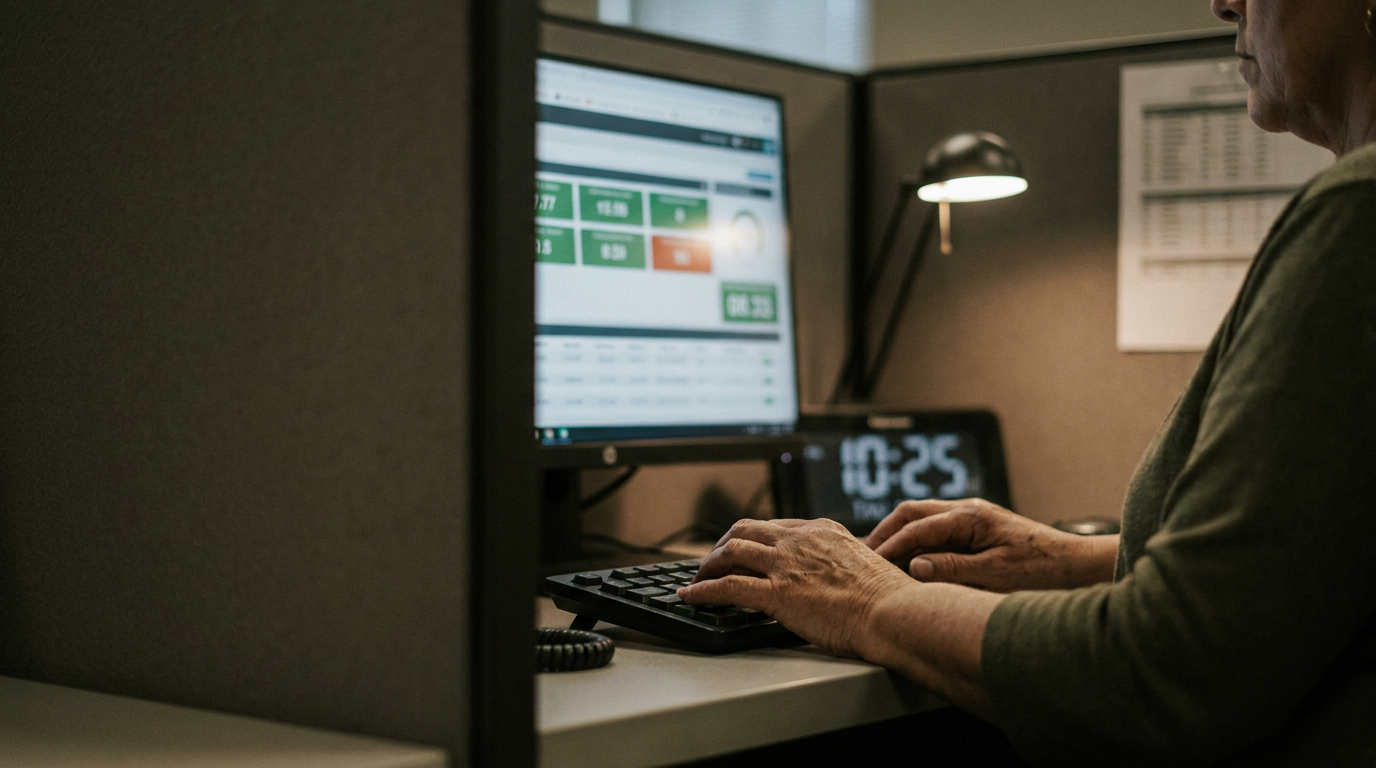
AI Is Watching You Work. It's Also Deciding What Work Means.
New research on algorithmic management reveals that workplace monitoring tools don't just measure productivity — they redefine it, rewarding whatever is easiest to see and slowly eroding everything that isn't.
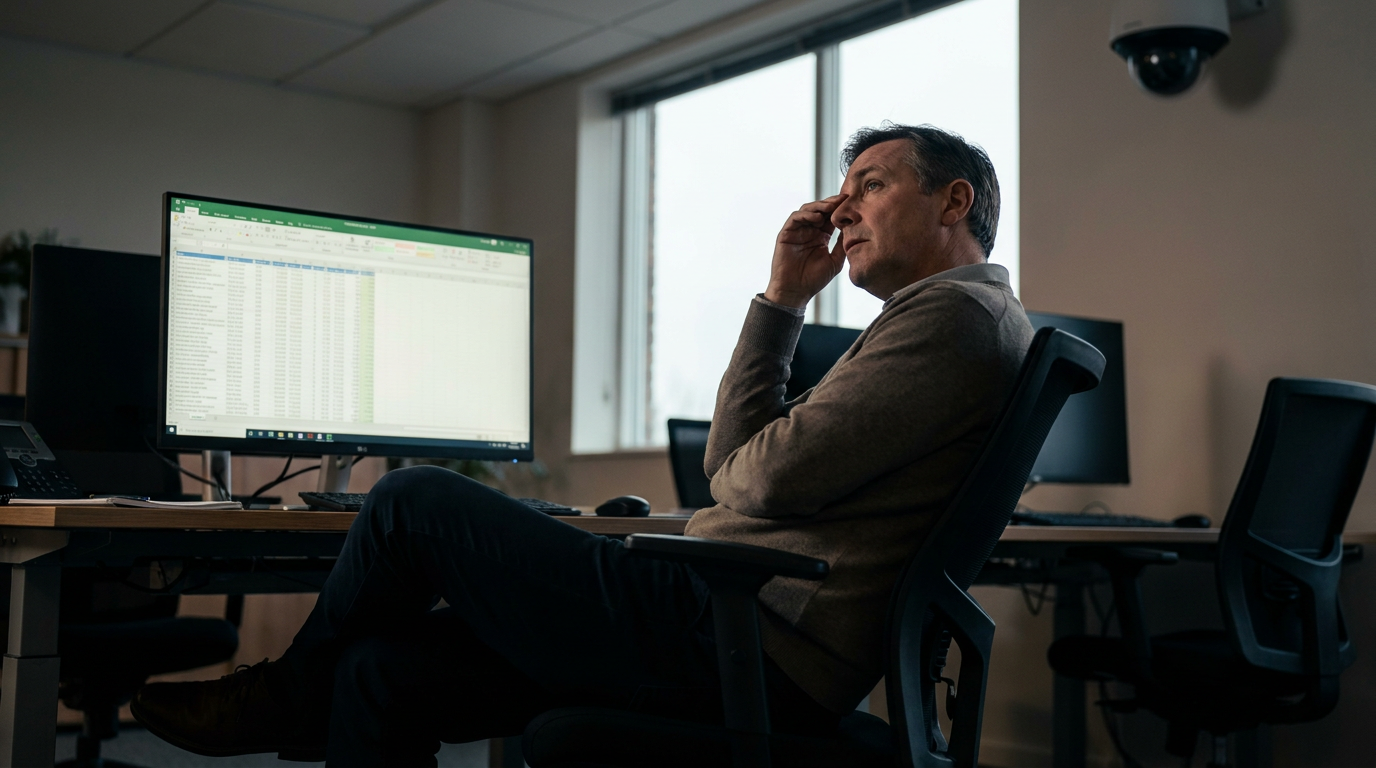
You Are Being Watched at Work. The System Doesn't Know What It's Seeing.
Workplace AI surveillance is generating mountains of data on employee behavior — but a growing body of research suggests the systems are measuring the wrong things entirely, and workers have figured that out.
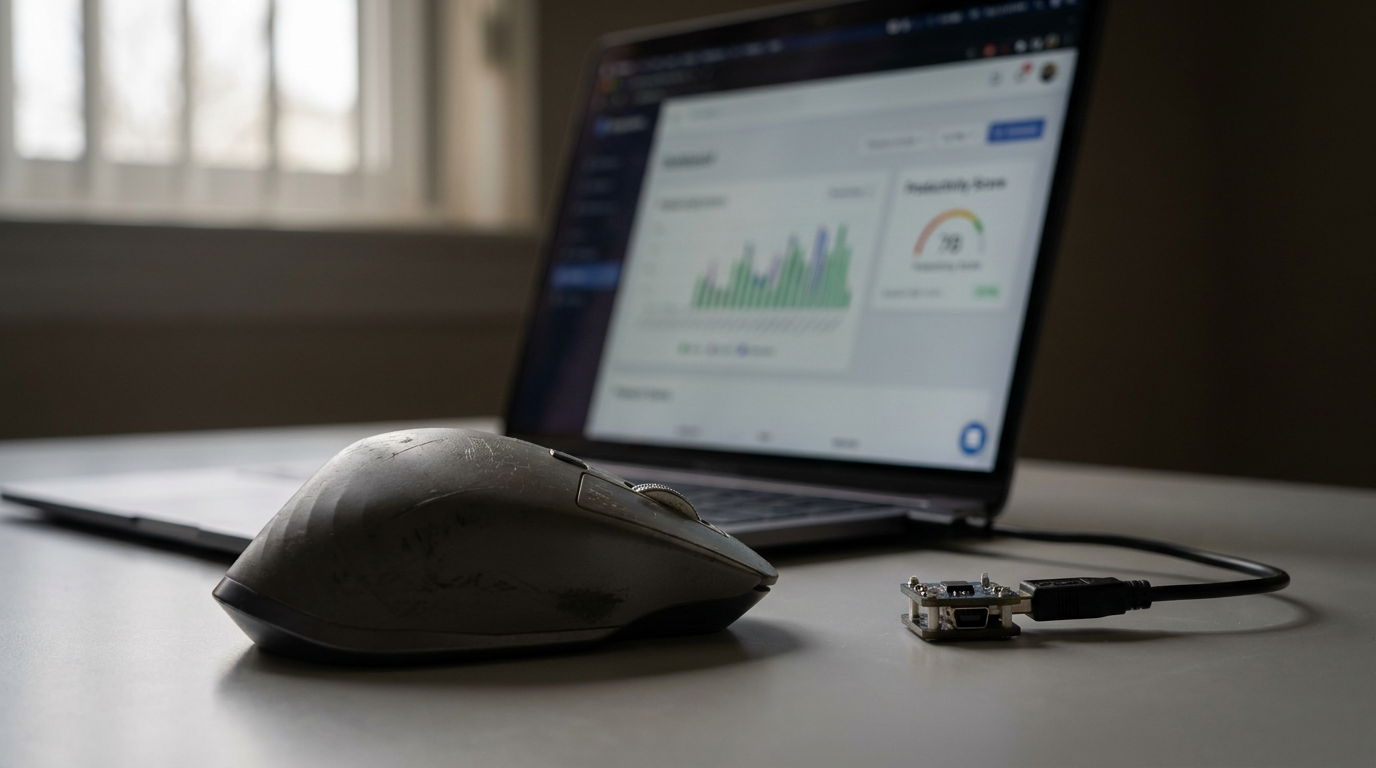
The Boss Isn't Watching You. The Algorithm Is. And It's Worse.
AI productivity tools promised to measure how well people work — instead, research suggests they're quietly teaching workers to game the measurement instead.