The Disaster Next Door Is Rewriting the Math on Homeownership
Wildfire and flood losses have quietly crossed into territory that's forcing insurers out of entire states — and most homebuyers are still running the old numbers.
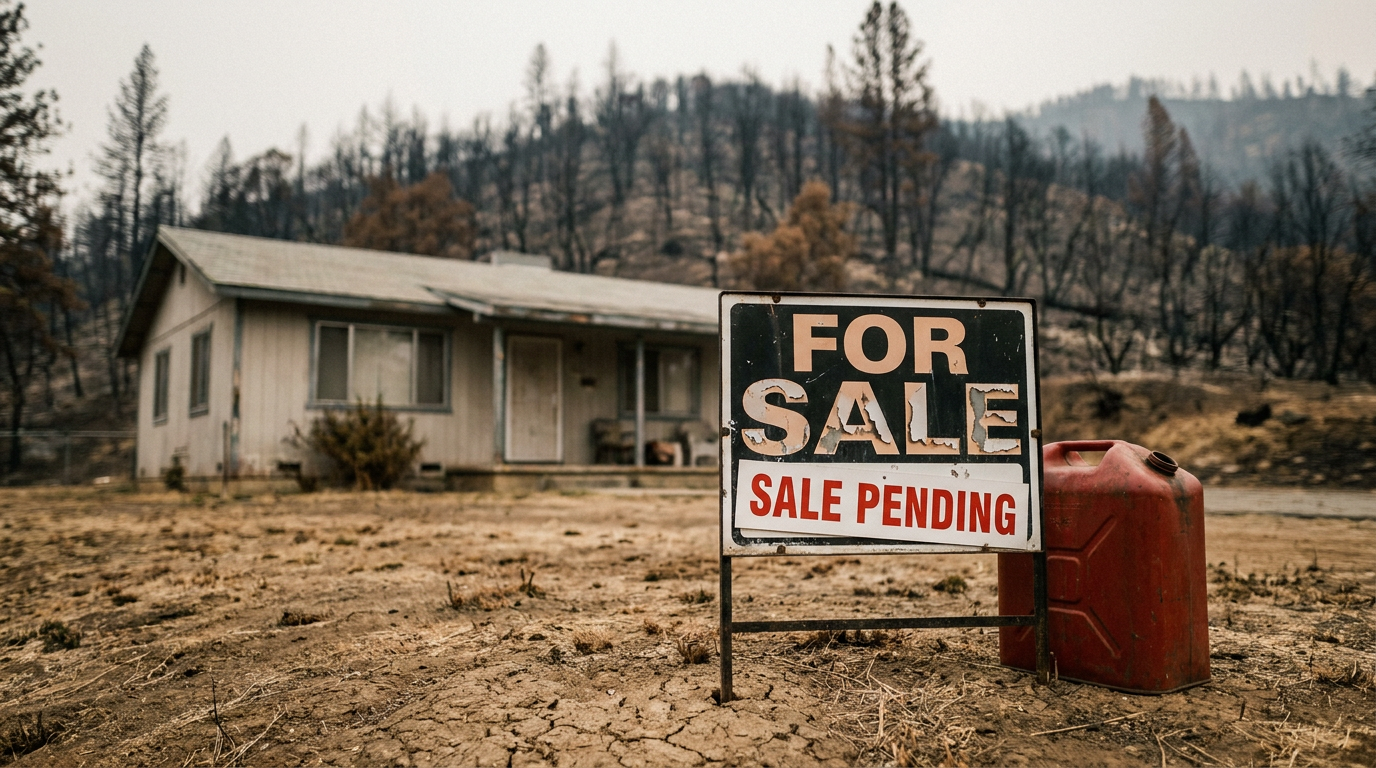
The house was everything they'd saved for. Three bedrooms, a porch that caught the afternoon light, a neighborhood with good schools and a walkable Main Street. The buyers ran their numbers carefully — mortgage payment, property taxes, a modest buffer for repairs. They felt, for the first time in years, like they had done the responsible thing. What they did not run numbers on was the line item that would unravel the whole calculation eight months later: the letter from their insurance company informing them that their policy would not be renewed.
This is becoming a common story in parts of California, Florida, Louisiana, and Colorado, and it is starting to appear in places that did not used to think of themselves as high-risk at all. The insurers who are exiting — State Farm, Allstate, and a growing list of regional carriers — are not doing so out of spite or corporate caprice. They are doing so because their actuarial models, the ones built on decades of historical loss data, no longer match what is actually happening to the physical world. The losses are outrunning the models. And the models, not the houses, are the thing that sets prices.
When a major insurer exits a state, it tends to make headlines for a week. What it does not make headlines for is the slow-motion financial restructuring it sets off in every neighborhood it abandons. Sellers who need to close quietly hunt for coverage through the state's insurer of last resort, often at two or three times the previous premium. Buyers who discover the situation mid-escrow face a choice between absorbing a dramatically higher carrying cost or walking away from a deal they've spent months assembling. Lenders start tightening. The asset that was supposed to build generational wealth is starting, in certain zip codes, to behave like the opposite.
The psychology of homeownership runs deep, and that is precisely what makes this moment so disorienting. Buying a house is not just a financial decision — it is an identity decision, a stability decision, a proof-of-adulthood decision. People do not stress-test their self-story against a shifting insurance market. They stress-test it against their down payment and their debt-to-income ratio. Those are the numbers they have been trained to watch. The numbers that are quietly changing beneath them are physical: average temperatures, fire behavior, storm intensity, sea level. And translating those into household finance requires a kind of cross-domain thinking that almost nobody does naturally.
The Risk Models Buyers Use Are Built on a Climate That No Longer Exists
Risk in real estate has traditionally been priced off historical loss data — what floods happened, how often, how severely, and where. The Federal Emergency Management Agency's flood maps, which lenders use to determine whether flood insurance is required, are built on the same logic. But research on the accuracy of FEMA flood maps[2] relative to actual flood exposure has consistently found that these maps undercount risk, particularly in areas where precipitation patterns are shifting faster than the maps are updated. The maps are not wrong in a negligent way — they are wrong in the way that any backward-looking tool is wrong when the underlying system is changing in one direction, steadily, and faster than the revision cycle.
The same structural problem exists in wildfire risk disclosure. Most states require sellers to disclose whether a property is in a designated fire hazard severity zone. But those designations lag reality. The fire seasons of the last decade have burned in areas that had never burned before, under conditions — prolonged drought, extreme heat, high winds — that are becoming more frequent as the climate continues to shift. Studies on wildfire risk assessment and property disclosure gaps have found that the regulatory designations homebuyers rely on substantially understate the probability of fire impact in a warming world. Buyers are reading a disclosure document that describes a hazard landscape from ten years ago.
“The maps are not wrong in a negligent way — they are wrong in the way that any backward-looking tool is wrong when the underlying system has changed.”
This is where the financial psychology gets genuinely complicated. Behavioral economists have documented for decades the way people discount risks that feel distant, abstract, or probabilistic — a pattern called temporal discounting and climate risk perception. A 1-in-100-year flood event sounds unlikely in any given year, which makes it easy to deprioritize when you are also managing the stress of a competitive housing market, a ticking mortgage lock, and the emotional weight of wanting to finally settle somewhere. The problem is that "1-in-100-year" is a statistical description of probability, not a guarantee of spacing. And as background conditions shift, the underlying probability shifts too — meaning the label stays the same while the actual risk quietly increases.
What Insurers Know That Buyers Don't
Insurance companies are not environmental advocates. They are risk-pricing machines, and right now, the ones with the most sophisticated catastrophe models are reaching the same conclusion that climate scientists have been publishing for years: the physical risk of owning certain properties in certain geographies has increased materially, and it will keep increasing. When State Farm announced it would stop writing new homeowners policies in California, it cited "rapidly growing catastrophe exposure[4]" and reinsurance costs. Reinsurance — the insurance that insurers buy to cover their own catastrophic losses — has become dramatically more expensive globally, because the reinsurers are updating their models more aggressively than most consumers know. The ocean has been absorbing heat at a rate that is reshaping storm behavior and coastal vulnerability in ways that compound year over year, and that energy does not disappear between hurricane seasons.
The exit of private insurers forces homeowners into state-backed plans of last resort — California's FAIR Plan, Florida's Citizens Property Insurance, Louisiana's Citizens. These plans exist to cover the uninsurable, which means they are, by definition, concentrating risk. They are also, in many cases, financially fragile. Florida's Citizens has been in a cycle of rate increases and depopulation pushes for years because the losses keep outrunning the premium base. When a state insurer of last resort becomes underfunded, the backstop is the state itself — meaning taxpayers, broadly, end up absorbing private property losses. This is not a hypothetical: it is the fiscal reality unfolding in slow motion across several states right now.
The Asset That Built Middle-Class Wealth Is Starting to Bifurcate
For most of the twentieth century, homeownership was the primary engine of middle-class wealth accumulation in the United States. The logic was straightforward: buy in, pay down, and allow appreciation to do its work over decades. That logic depended, implicitly, on a set of background conditions — stable insurance markets, functional mortgage lending, predictable maintenance costs — that are now starting to fray unevenly across geography. What is emerging instead is a bifurcated market: properties in lower-risk geographies that continue to appreciate and remain insurable, and properties in high-risk geographies where the carrying costs are rising, the insurance is disappearing, and the buyer pool is quietly shrinking.
“The asset that was supposed to build generational wealth is starting, in certain zip codes, to behave like the opposite.”
Research on climate risk and property value depreciation suggests that markets are beginning to price in physical risk, but slowly and unevenly — and that the buyers most likely to be caught on the wrong side of the repricing are first-time buyers who are budget-constrained and therefore more likely to be shopping in areas where prices are still low precisely because the risk is high. This is a particularly bitter irony. The people who can least afford to absorb a catastrophic loss are the ones most likely to buy in the geography where a catastrophic loss is most probable, because that is where the prices are accessible. The housing market is not intentionally cruel. But the way that climate risk translates into affordability translates into exposure creates a pattern that is cruel in effect.
The Cognitive Work Nobody Does Before Closing
There is a predictable emotional sequence in the homebuying process that works against clear-eyed risk assessment. You fall for a house. You calculate whether you can afford it. You go through the procedural gauntlet — inspection, appraisal, mortgage underwriting, escrow — and somewhere in that exhausting tunnel of paperwork, your brain quietly shifts from evaluating the decision to completing it. Behavioral researchers call this the sunk cost effect and commitment escalation in major purchase decisions, and it is nearly universal. The more you have invested — emotionally, financially, logistically — the harder it becomes to update your assessment of whether the underlying decision is sound. A buyer who discovers mid-escrow that insurance will cost $8,000 a year instead of $2,400 is not a person who is in a good psychological position to do fresh math.
This is compounded by how financial identity works. For many buyers, especially first-generation homeowners, the purchase carries enormous symbolic weight — it is proof that they made it, that they outran instability, that they are building something durable. Talking about money is already emotionally loaded for most people; as we've written before, the discomfort of those conversations often costs more than the conversation itself. Adding climate risk into that conversation requires asking someone, at the most hopeful moment in their financial life, to think clearly about catastrophe probability. That is genuinely hard, and the real estate industry — whose compensation depends on transactions closing — does not have a structural incentive to make it easier.
What the New Math Actually Requires
The rethinking that serious buyers in high-risk areas need to do is less about pessimism than about completeness. A home's true carrying cost is not the mortgage payment plus taxes plus a vague repair budget. In a high-risk zone, it is that plus a realistic insurance premium — including what that premium might look like in five years if a major insurer exits, plus the cost of flood or wildfire mitigation if the property requires it, plus a rough mental accounting of what the resale market looks like if the buyer pool contracts. None of these calculations require certainty, but they do require asking the question. Most buyers never ask it because nobody told them it was a question worth asking.
There are emerging tools designed to help: private risk analytics companies like First Street Foundation[3] now publish property-level flood and fire risk scores that are more current than government maps, and some of these are beginning to appear in real estate listing platforms. A handful of states have begun updating their disclosure requirements to include forward-looking risk estimates rather than just current regulatory designations. Mortgage giants Fannie Mae and Freddie Mac have begun discussing how to incorporate climate risk into their underwriting standards, though that process moves at an institutional pace that is genuinely slow relative to how quickly the physical risk is changing. The infrastructure for clearer risk communication is being built. It is just being built in the same direction as the flood.
“The infrastructure for clearer risk communication is being built — just in the same direction as the flood.”
What is harder to fix is the emotional architecture of how people buy homes. The purchase is timed, competitive, and emotionally saturated in ways that reliably undermine the kind of deliberate, forward-looking risk assessment that the current climate moment demands. The buyers who will navigate this era best are not the ones who become amateur climate scientists — they are the ones who build the habit of treating insurance availability as a primary variable rather than an administrative afterthought, who check risk scores before they fall in love with a property rather than after, and who hold lightly enough to the identity weight of homeownership to let the numbers lead. That is not a small ask. But the alternative — closing on a house with a risk profile that the previous owner's insurer had already quietly decided was unacceptable — is considerably more expensive than the discomfort of asking harder questions before the ink dries.
References
- FEMA Flood Maps Miss Risk to Millions of Homes (scientificamerican.com)
Provides First Street Foundation analysis showing FEMA undercounted nearly 8 million homes facing substantial flood risk under current and projected climate scenarios. - Many Americans are buying homes in flood zones—and don't realize it (nationalgeographic.com)
Documents that properties outside federally designated flood zones were unexpectedly flooded during recent hurricanes, illustrating FEMA map inaccuracy. - First Street Foundation (investors.zillowgroup.com)
- State Farm General Insurance Company: Update on California (newsroom.statefarm.com)
State Farm's official statement citing 'rapidly growing catastrophe exposure' as reason for stopping new homeowners policy sales in California.
About Priya Shah
Priya Shah writes about the psychology of money — why financial threat hijacks the same attentional systems as physical danger, why saving feels impossible when the brain is running triage, and how scarcity reshapes cognition in ways that compound over time. Her work focuses on what's actually happening neurologically and emotionally underneath the surface of financial behavior.
More like this

Why Saving More Money Makes Some People Feel Less Safe
The financial security threshold keeps moving upward no matter how much you save — and that's not a math problem, it's a psychological one with a specific, fixable mechanism.

The Disaster Database NOAA Killed — And What Vanished with It
NOAA's Billion-Dollar Disasters database was the only continuous public ledger of American climate catastrophe — until it wasn't, and the story of what replaced it reveals something more troubling than its absence.

The Feeling of Not Having Enough Is Its Own Financial Problem
New research shows that feeling financially stretched — regardless of what you actually earn — quietly suppresses retirement savings in ways that have nothing to do with math.