The UFO Cover-Up Was Real — Just Not the One Anyone Expected
A buried CIA confession — now surfaced in the PURSUE files — reframes everything we thought we knew about the era that built UFO mythology, and sharpens the question of what's left over.
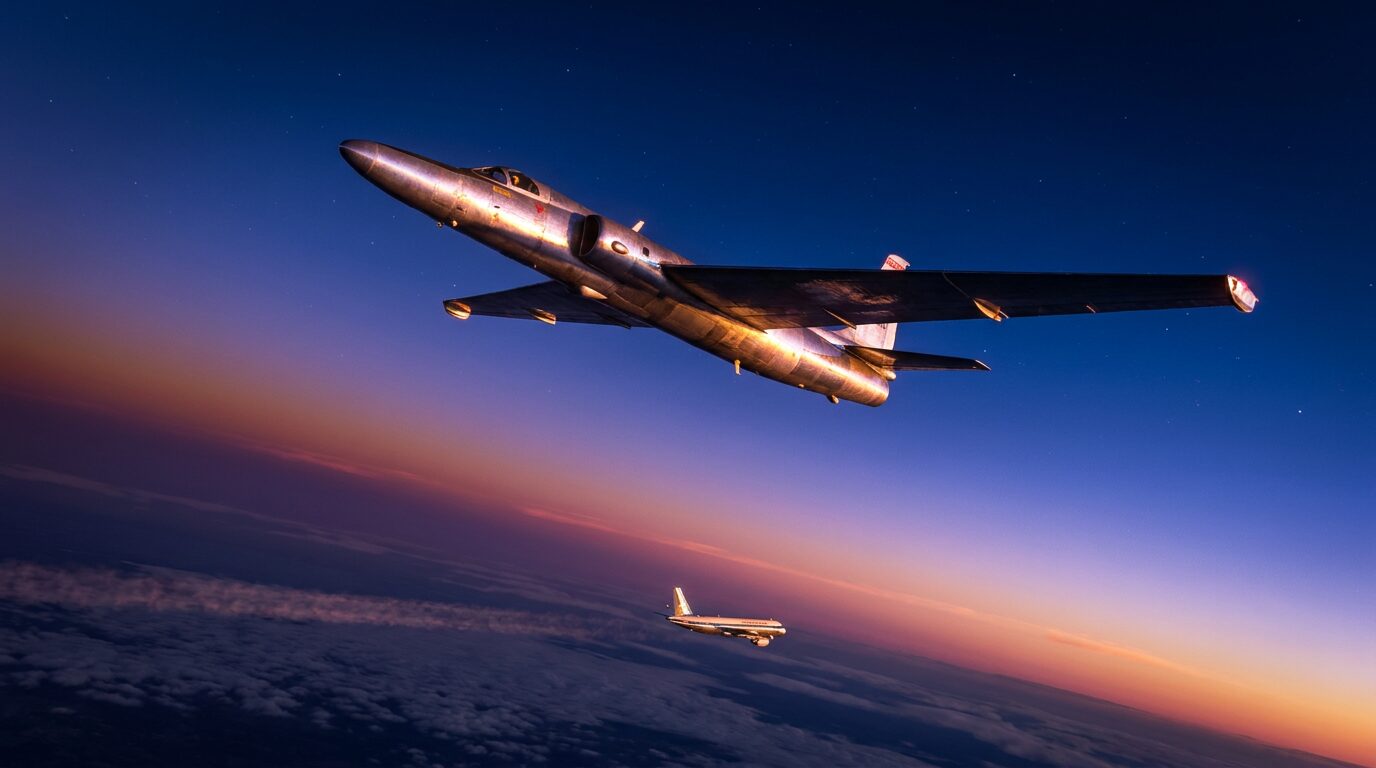
Somewhere in the sky over Nevada in the late 1950s, a silver aircraft was climbing toward 70,000 feet — roughly twice the ceiling of any commercial airliner in service at the time. Below, an airline pilot watched a bright, fast-moving object arc through the upper atmosphere and reported it to air traffic control. The sighting made its way to Project Blue Book, the Air Force's official UFO investigation unit. Blue Book investigators, discreetly checking with the CIA's U-2 project staff in Washington, confirmed the cause. Then they told the public it was probably ice crystals.
This was not a one-time improvisation. It was standing procedure. And the CIA eventually wrote it all down.
That admission has been public in fragments for years, buried in a 1992 internal CIA history and a 1998 declassified program monograph. But the third batch of PURSUE files — the [Presidential Unsealing and Reporting System for UAP Encounters[4]](https://www.war.gov/ufo/), released on June 12, 2026 — has put the document in front of a new audience, in a new context, next to reports that cannot be explained away by anything flying out of Groom Lake. That juxtaposition is what makes the admission worth reading carefully now.
What the CIA Actually Said
The key text comes from Gerald K. Haines's "CIA's Role in the Study of UFOs, 1947–90"[1], an internal agency history published in the classified journal Studies in Intelligence in 1997 and later declassified. Haines drew on an earlier internal program history by Gregory Pedlow and Donald Welzenbach covering the U-2 and OXCART programs from 1954 to 1974. The passage is not hedged: according to later estimates from CIA officials who worked on the U-2 project and the OXCART project, over half of all UFO reports from the late 1950s through the 1960s were accounted for by manned reconnaissance flights over the United States, and this led the Air Force to make misleading and deceptive statements to the public in order to allay public fears and to protect an extraordinarily sensitive national security project.
The physics behind the sightings was straightforward, even if nothing about the cover story was. High-altitude testing of the U-2 soon led to an unexpected side effect — a tremendous increase in reports of unidentified flying objects. In the mid-1950s, most commercial airliners flew at altitudes between 10,000 and 20,000 feet and military aircraft operated below 40,000 feet. Once U-2s started flying at altitudes above 60,000 feet, air traffic controllers began receiving increasing numbers of UFO reports. The early U-2s were silver and reflected the rays of the sun, especially at sunrise and sunset, and often appeared as fiery objects to observers below. A commercial pilot at 20,000 feet had no mental model for something three times higher, moving faster than anything in his experience, catching sunlight from an atmosphere still fully lit while the ground below had gone dark. What he saw was, by any reasonable definition, unidentified. It just wasn't unidentifiable — to anyone with the right clearance.
“Blue Book investigators confirmed the cause — then told the public it was probably ice crystals.”
Because the government didn't want the public to know about these clandestine flights, members of Project Blue Book would often "explain away such sightings by linking them to natural phenomena such as ice crystals and temperature inversions," according to Haines. Blue Book investigators regularly called on the CIA's project staff in Washington to check reported UFO sightings against U-2 flight logs, which enabled the investigators to eliminate the majority of the UFO reports, although they could not reveal to the letter writers the true cause of the sightings. The public received a curated residue — only the sightings that were genuinely unaccounted for, or that had been artfully re-explained. While perhaps justified, this deception added fuel to the later conspiracy theories and the cover-up controversy of the 1970s. Even the CIA's own historian had to acknowledge that.
The Machinery of a Manufactured Mystery
It is worth sitting with what "more than half" means at the scale of Cold War UFO reports. Between March and June 1952 alone, the number of UFO sightings officially reported to the U.S. Air Force jumped from 23 to 148. The U-2 program began test flights at the Groom Lake facility — what would become Area 51 — in 1955. OXCART, its successor, the Lockheed A-12, made its first flight at Groom Lake on April 26, 1962, and eventually achieved a sustained speed of Mach 3.2 at 90,000 feet[2]. At that altitude, the aircraft was genuinely behaving unlike anything a civilian observer had a reference frame for: no sonic boom at ground level, no contrail, no nav lights. Just a bright, silent object doing things that no known aircraft could do. The cover story practically wrote itself — and Blue Book was glad to write it.
What the newly available PURSUE context adds is not new evidence about the spy planes — that history is well documented. What it adds is a paper trail of the suppression mechanics themselves. The PURSUE files contain a CIA confession from 1992 stating that investigators could not reveal to letter writers the true cause of UFO sightings going back to the 1950s, and that Project Blue Book had given the public false explanations. Sitting alongside that is a 1958 memo surfaced in the same release: CIA officer R.P.B. Lohman wrote that the agency could not resolve a scientist's questions about a UFO-related transmitter because records had been destroyed by the evaluating agency, adding: "the extraordinarily noncommittal and evasive answer we were instructed to give Davidson was perhaps the only one possible if we were to avoid crossing up previous statements of our own, and other involved agencies, to this man." That scientist, Dr. Leon Davidson, had been pushing for exactly this truth. Davidson had convinced himself that the Agency carried most of the responsibility for UFO sightings, arguing that "the activities of the US Government are responsible for the flying saucer sightings of the last decade" — and because of the undisclosed U-2 and OXCART flights, Davidson was closer to the truth than he suspected.
For a deeper look at how classification shapes — and distorts — what the public actually sees in these releases, the pattern is consistent across decades; it is the same architecture described in our analysis of how redaction functions as its own kind of disclosure.
The 40 Percent Nobody Can Account For
Here is where the Cold War confession stops being historical and starts being operational. The CIA's own accounting hands over a clean explanation for a majority of the era's sightings. But a majority is not everything. The percentage of what the Air Force considered unexplained UFO sightings fell to 5.9 percent in 1955 and to 4 percent in 1956 — years when U-2 flights were generating the heaviest volume of misidentified sightings. That residue, small as it was as a fraction, represented real reports that Blue Book genuinely could not explain by checking the flight logs.
Fast-forward to the present. AARO Director Dr. Jon Kosloski, in a report signed June 5, 2026, described an orange "mother" orb launching smaller red orbs and explained that 40 percent of the reported phenomena lack a reasonable explanation and remain unresolved. That figure comes from AARO's operational caseload, which is militarily sourced and sensor-corroborated in ways the 1950s Blue Book reports never were. The Pentagon's FY2024 consolidated UAP report[3] gives a sense of the evidentiary baseline: AARO determined 21 cases merit further analysis by its IC and science and technology partners, and "a very small percentage" of overall cases, after initial analysis, still carry anomalous characteristics — less than two-and-a-half percent — that AARO continues to study.
“The CIA explained away half the UFOs. The question now is what methodology explains the other 40 percent — and whether we trust the instruments doing the asking.”
What the CIA confession does for that modern residue is methodological, not explanatory. It tells us that the baseline rate of human misidentification — even among trained observers, even from military aircraft — is staggeringly high when a novel technology enters the sky without public knowledge. The U-2 flew at altitudes nobody expected. Commercial airline pilots flying at 20,000 feet in the late 1950s had no frame of reference for an aircraft cruising at 70,000 feet; when sunlight reflected off the U-2's silver wings at those altitudes, especially at dusk, the result looked like a bright, fast-moving object that didn't match anything in the observer's experience. Today's observers, including military pilots, carry different perceptual blind spots — sensor artifacts, infrared parallax, Starlink trains — and AARO is still working to characterize them. AARO increasingly receives cases that it is able to resolve to the Starlink satellite constellation. The taxonomy of the explainable keeps expanding. Which is exactly why the cases that survive that expansion deserve more serious attention, not less.
What the Confession Clears — and What It Doesn't
There is a temptation, once you understand the U-2 effect, to reach for it as a universal solvent — to assume that most unexplained sightings, across all eras, probably have a mundane classified origin we just haven't been told about yet. That comfort is not warranted by the evidence. The CIA did not say that spy planes explain everything; it said they explained the majority of reports during a specific, bounded period when a radically novel aircraft entered service in secret. The logic does not generalize automatically to radar-corroborated encounters in the 21st century, to objects tracked by multiple independent sensor modalities, or to cases like those documented in the Pentagon's 64 UAP files where the sensors themselves are the story.
The Pentagon has confirmed that the materials archived in PURSUE are unresolved cases, meaning the government is unable to make a definitive determination on the nature of the observed phenomena. That is a different kind of statement than "probably ice crystals." What the CIA confession does is establish, in the agency's own words, that the government's track record on UFO explanations is one of systematic misdirection calibrated to protect programs more sensitive than public credulity. That history does not prove anything exotic about what remains. But it does establish what kind of institution has been doing the explaining — and how much of that explaining was, by the CIA's own account, deliberately false.
The 40 percent that AARO's Kosloski cannot account for does not need to be exotic to be significant. It needs only to be real. And the document that just admitted the government spent a decade lying about the other 60 percent is, at minimum, a compelling reason to take the residue seriously on its own terms — with better instruments, more rigorous methodology, and considerably less faith in the explanations we're offered.
References
- "CIA's Role in the Study of UFOs, 1947–90" (cia.gov)
Contains Gerald K. Haines's 1997 internal CIA history stating over half of late-1950s–1960s UFO reports were U-2 and OXCART flights, with Air Force making misleading public statements. - A-12 OXCART - CIA (cia.gov)
Confirms OXCART achieved sustained speed of Mach 3.2 at 90,000 feet, establishing the aircraft's performance capabilities that made sightings appear anomalous to civilian observers. - FY24 CONSOLIDATED ANNUAL REPORT ON UAP 508 (media.defense.gov)
Provides AARO's FY2024 data showing 40 percent of reported phenomena lack reasonable explanation and remain unresolved in modern UAP caseload. - Presidential Unsealing and Reporting System for UAP Encounters (war.gov)
Provides the June 12, 2026 release of PURSUE files containing CIA documents about UFO cover-ups and U-2 flight suppression.
About Brenna Vance
Brenna Vance writes about the cosmos — stars that predate the universe's own chemistry, spacecraft flying close enough to the sun to catch it misbehaving, the physics of what the universe is still getting wrong. Her work focuses on the moments when an observation breaks a model, and what that break actually means.
More like this
The Pentagon Built a UAP Sensor. It Found Mostly Balloons. That's Not the Whole Story.
The Pentagon's new UAP sensor system quietly entered field testing — and what it's already revealing is less about what's up there than about how badly we've been trying to look.
The Pentagon Released 162 UAP Files. The Unresolved Ones Are the Interesting Part.
The May 2025 file release is historic, but the official language used to explain every unresolved case quietly reveals something more useful than any alien hypothesis.
The Pentagon's New UAP Files Have a Sensor Problem No One Is Talking About
The May 2025 PURSUE disclosure is historic — but the cases that stayed unexplained share a quiet technical flaw that changes what 'unresolved' actually means.