Webb Traced a Gamma-Ray Burst Back 13.2 Billion Years—And Found Something Unexpected
A gamma-ray burst detected in March led Webb back to a dying star from the universe's infancy — and to the faint smudge of a galaxy that almost wasn't there.
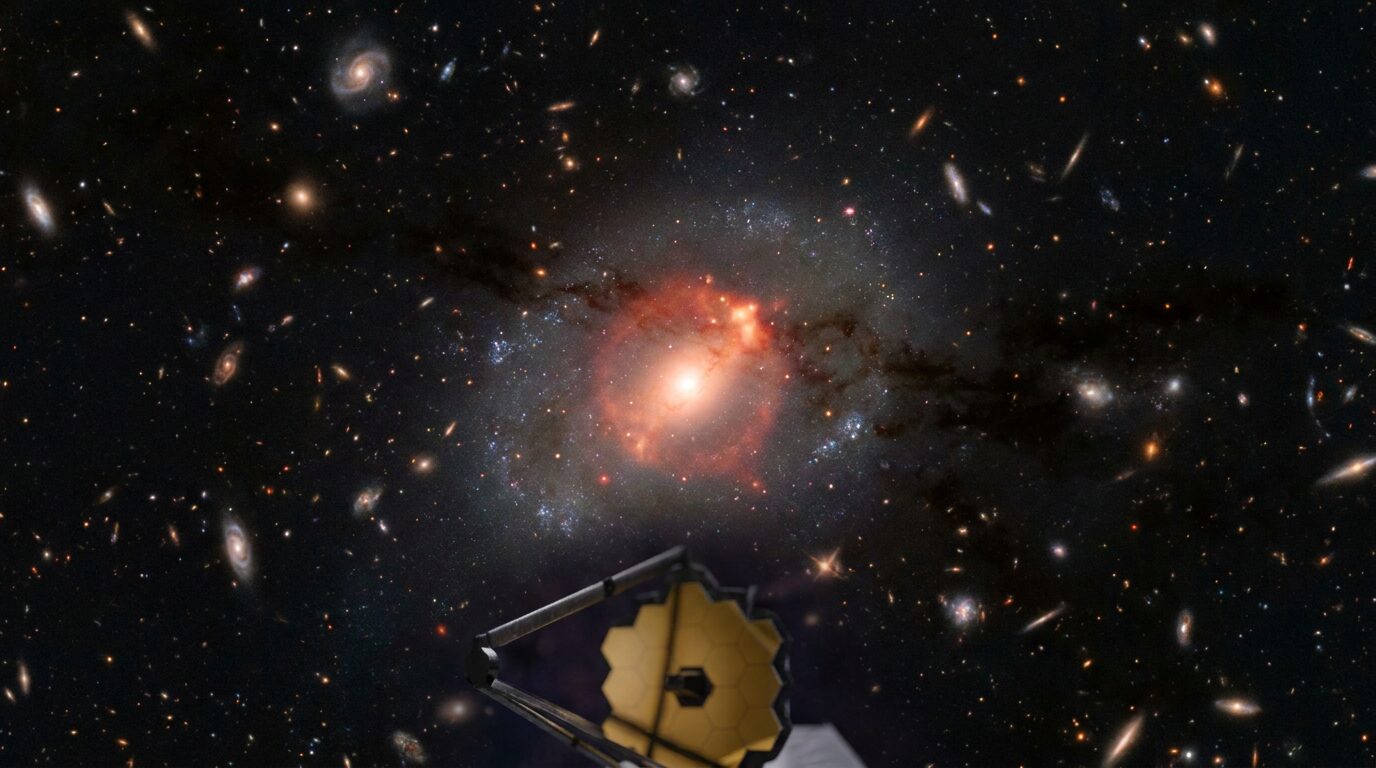
The flash came first. In mid-March of this year, an international network of space telescopes caught a gamma-ray burst — an intense, short-lived eruption of high-energy light — blazing across the sky. These bursts are among the most energetic events in the known universe, typically the product of a massive star collapsing and exploding. What made this one different was not its brightness, extraordinary as that was. It was where the light had come from, and how long it had been traveling.
Four hours after the initial detection, the European Southern Observatory's Very Large Telescope in Chile measured the burst's redshift and placed its origin at a staggering distance: 730 million years after the Big Bang.[1] The universe was still in its early chapter, not yet a billion years old. Then, on July 1, NASA turned the James Webb Space Telescope toward the same patch of sky. What it returned was the clearest confirmation yet of what had happened there: a supernova, the earliest ever detected, in a host galaxy so faint it had previously been invisible to any instrument on Earth or in orbit.
A Flash, a Galaxy, and a Very Long Wait
According to NASA[1], these were quick-turn observations — the kind that require coordination, speed, and a telescope capable of pivoting to a newly flagged target on short notice. Webb's near-infrared imaging capabilities are what made the follow-up meaningful. Gamma-ray bursts fade. The afterglow that lingers in their wake is what gives astronomers a narrow window to study the object that produced the burst before it dims below the detection threshold of any instrument available to us. Webb caught that window.
What it found, beyond the supernova itself, was the host galaxy — a structure so remote and faint that it had collapsed into a few pixels in the final image, appearing as a reddened smudge against the darkness. That smudge is, nonetheless, a galaxy. A collection of stars that existed when the universe was less than six percent of its current age. As NASA noted in its release, what can be learned about it is still limited. But seeing it at all is a breakthrough.
“There are only a handful of gamma-ray bursts in the last 50 years that have been detected in the first billion years of the universe.”
Why Gamma-Ray Bursts Are the Key to the Early Universe
Gamma-ray bursts have been observed since the late 1960s[2], but their connection to the deaths of massive stars — and their potential as probes of the early cosmos — has taken decades to establish. As astronomer Andrew Levan noted in the NASA announcement, events like this one are extraordinarily rare: in fifty years of gamma-ray burst detection, only a handful have been traced to the first billion years of cosmic history. This particular burst, designated GRB 250314A, sits at the far end of that rare category. It is not simply old. It is the oldest confirmed supernova of its type.
This connects to something that makes the early universe particularly difficult to study. The first stars were enormous — far more massive than most stars that exist today — and they burned fast, living and dying in geological instants by cosmic standards. When they collapsed, they produced supernovae and gamma-ray bursts. The problem is that those events happened so far away, and the light has been stretched so dramatically by the expansion of the universe, that even detecting the burst in real time is only half the challenge. Pinning down the host galaxy — the structure that nurtured the star that died — requires a telescope capable of resolving extremely faint infrared signals at cosmological distances. That is, in short, what Webb was built for. We have previously covered the strange things Webb has been surfacing from the early universe, and this detection continues that pattern of reaching back further than instruments could previously manage.
What the Afterglow Can Still Tell Us
The observation on July 1 captured the supernova roughly three months after the burst itself — late enough that the initial explosive brilliance had faded, but early enough for Webb's instruments to still detect the residual signal and image the host galaxy against the background. A two-part illustration released by NASA represents GRB 250314A both at the moment of explosion and at the point when Webb observed it, showing the star clusters at the edges of a galaxy that, under any other circumstance, would be practically invisible to us.
The research team has already secured approval for further observations. Their new aim is deliberately ambitious: to use the afterglow of future gamma-ray bursts as a kind of backlight for distant galaxies, allowing Webb to extract a chemical and structural fingerprint from the glow itself. As Levan described it, that glow will help Webb see more and give researchers a fingerprint of the galaxy — its composition, its density, the elements its stars have already forged and expelled. For a galaxy that otherwise appears as a reddened smudge, that afterglow method could be the only way to read it at all.
The detection of GRB 250314A is, in the clearest sense, a demonstration of what a coordinated, worldwide observational network can do when it is working well. The burst was flagged by a multi-telescope alert system. The redshift was measured hours later in Chile. The follow-up imaging came from a space telescope in orbit at the second Lagrange point, more than a million miles from Earth. And together, they traced a single dying star — one massive enough to end in a gamma-ray burst — to a moment in cosmic history that was previously beyond reach. What we can conclude from that faint smudge of a host galaxy is still limited. What it represents, as a detection, is not.
The universe's first stars are sometimes called Population III stars — hypothetical, never directly observed, inferred from the physics of what must have come before everything else.[3] The star that produced GRB 250314A was not one of those, not quite: 730 million years after the Big Bang is not the very beginning. But it is close enough that the galaxy in that smudge may carry chemical signatures from whatever came first. That fingerprint is what the team is now planning to read. We found the location. We confirmed the event. The stars that lived and died before it are still telling their story through the chemistry they left behind.
References
- NASA’s Webb Identifies Earliest Supernova to Date, Shows Host Galaxy - NASA Science (science.nasa.gov)
Provides the core finding: Webb observed the earliest supernova at 730 million years old and imaged its faint host galaxy on July 1. - Gamma-ray burst (en.wikipedia.org)
Establishes that gamma-ray bursts have been observed since the late 1960s, providing historical context for the rarity claim. - Stellar population (en.wikipedia.org)
Defines Population III stars as hypothetical, never directly observed stellar objects inferred from early-universe physics.
About Rowan Ellery
Rowan Ellery writes about anomalies, unexplained sightings, strange signals, and the uneasy border between observation, misinterpretation, and genuine mystery. Their work focuses on keeping curiosity alive without letting evidence dissolve into folklore.
More like this
How Webb Captured Stars at Every Age in a Single Season
From a protostar's first outflows to a planet that outlived its dying sun, Webb's recent observations span nearly the entire life cycle of stars — and the earliest supernova ever detected.
The Universe's Oldest Supernova Just Rewrote What Stars Could Do at Cosmic Dawn
JWST confirmed a supernova from when the universe was just 730 million years old — and its unsettling resemblance to modern explosions is forcing astronomers to rethink what the earliest stars were even supposed to be.
The Gamma-Ray Burst That Fired for 7 Hours Doesn't Fit Any Known Physics
GRB 250702B lasted nearly twice as long as any gamma-ray burst ever recorded, and the two leading explanations for it are mutually incompatible — which means at least one of them has to be wrong.