How Webb Captured Stars at Every Age in a Single Season
From a protostar's first outflows to a planet that outlived its dying sun, Webb's recent observations span nearly the entire life cycle of stars — and the earliest supernova ever detected.
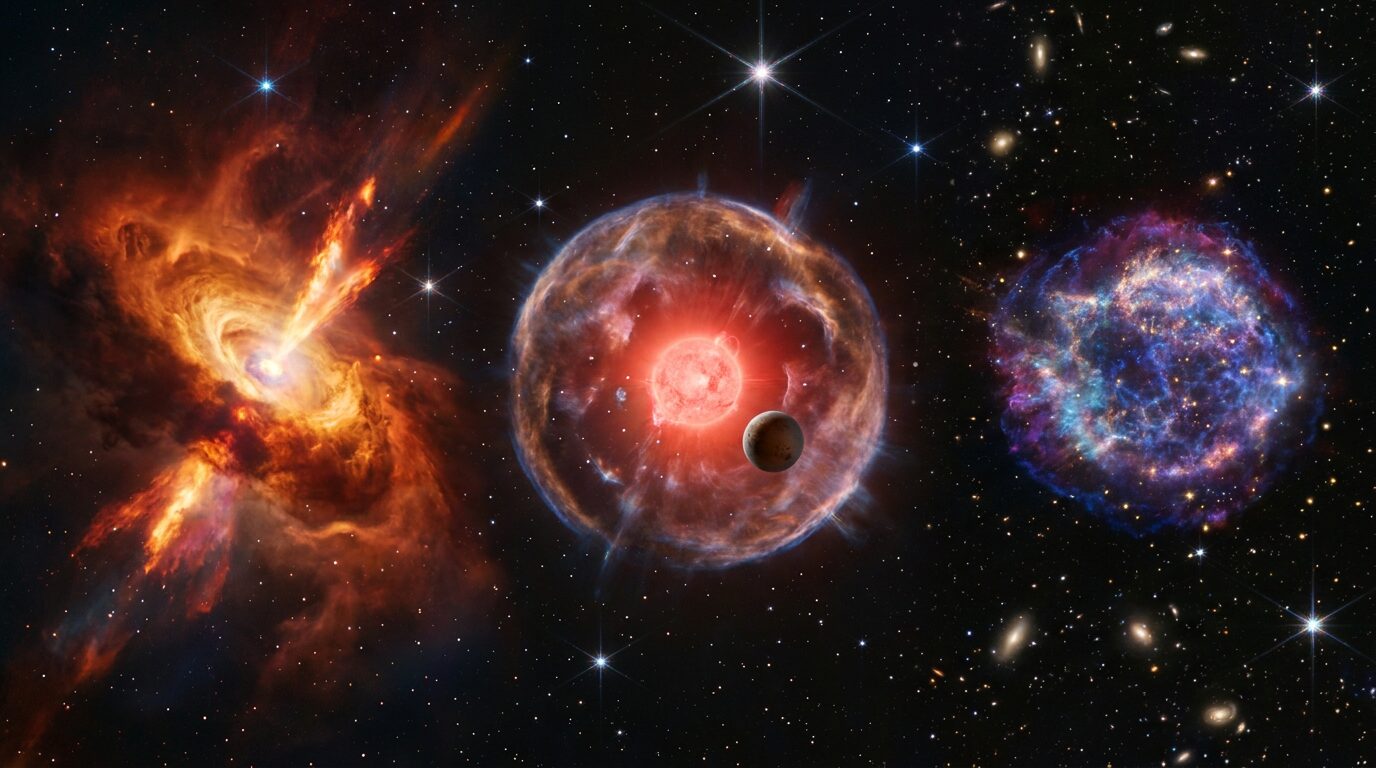
There is a version of Webb's story that gets told as spectacle — gorgeous false-color images, gaseous pillars, celestial nurseries rendered in orange and gold. That version is not wrong. But it misses what makes the instrument genuinely strange: its ability to compress billions of years of stellar history into a single observing season, catching objects at radically different moments in their lives and letting astronomers hold them side by side.
In a recent series of observations, NASA's James Webb Space Telescope[1] captured three events that have almost nothing in common in terms of scale, distance, or cosmic age — and yet, read together, they trace something close to a complete stellar biography. A protostar just catching its first outflows. A planet that somehow survived the death of its parent star. And a supernova so ancient that it detonated when the universe itself was barely 730 million years old.
Each finding, on its own, would be a solid result. Together, they sketch the full arc of what stars do over time — ignite, burn, expand, die, and sometimes leave something unexpected behind.
FS Tau: A Star That Is Still Becoming
The star system FS Tau sits inside a dense, dusty region that most wavelengths of light cannot penetrate cleanly. Infrared light can, which is precisely why Webb is the right instrument for the job. In Webb's view of the region, bright protostars emerge from the murk — objects still in the process of collapsing, not yet stable enough to be called stars in the conventional sense. FS Tau B, an orange protostar, appears to be the source of orange outflows threading through the surrounding dust and gas. These outflows — jets of material expelled as the protostar accretes — are among the earliest readable signs that a star-forming process is underway.
What Webb contributes here is resolution and sensitivity. The varying textures of dust and gas across the region become legible in infrared in a way they simply are not at other wavelengths. The color information itself carries data: light at bluer wavelengths gets absorbed and scattered by dust, while redder-wavelength light slips through. Background galaxies behind thicker foreground dust appear more reddened; those with less dust in front appear yellower. The few white stars visible in the image are nearby, relatively unobscured, and their whiteness is an artifact of that proximity — not brightness alone, but position relative to the intervening material.
The protostar's light, in some parts of the image, is reflected rather than direct — bounced off surrounding material before reaching the detector. Webb's sensitivity is sufficient to distinguish reflected light from direct emission, which allows astronomers to map the geometry of the dust cloud in three dimensions rather than just documenting its projected appearance on the sky. This is the difference between a snapshot and a structural survey.
“These outflows are among the earliest readable signs that a star-forming process is underway — and Webb can now read them in a dusty region where other telescopes would see almost nothing.”
The Planet That Survived a Red Giant
Move forward in time by several billion years and the story changes entirely. A Sun-like star — one that, long ago, burned through its hydrogen fuel, swelled into a red giant large enough to engulf its inner planets, and then ejected its outer layers — has left behind a hot, dense white dwarf. This is the standard endpoint for stars of roughly solar mass, and it is, eventually, the fate our own Sun is thought to share. What makes this particular white dwarf worth examining is what Webb found orbiting it[2]: a Jupiter-sized exoplanet, circling every 34 hours at a separation of less than two solar radii.
The orbital geometry alone raises questions. A red giant expanding to the scale required to shed its outer layers should, by most models, have consumed or severely disrupted anything orbiting that close. That a Jupiter-sized body survived — and survived in a tight orbit — suggests that either the planet migrated inward after the star's death, or the dynamics of the mass-loss event were more complex than standard models anticipate. The observation doesn't resolve which mechanism is responsible. It documents that the outcome exists.
The researchers framed the finding with an unusual kind of temporal reasoning. As one team member put it, studying planets in orbit around the remnants of Sun-like stars is a way of learning what might happen in our own solar system in the far future — a form of looking forward rather than back, using a distant system as a time machine aimed at our own eventual endpoint. The results were published in the journal Nature and taken with Webb's Cycle 1 General Observer program 2243.
A Supernova from the Early Universe
The third observation requires a different kind of distance measurement. Not billions of years in the future, but billions of years into the past — specifically, to a moment when the universe was only 730 million years old. That is when a massive star, whose light has only now reached us, detonated in a supernova. Webb's detection makes it the earliest supernova of its kind confirmed to date.
The detection itself was not planned in isolation. An international network of telescopes registered a super-bright flash of light — a gamma-ray burst — in mid-March. Webb was tasked with a rapid-response follow-up observation on July 1, targeting the location of that burst to identify its source and, if possible, its host galaxy. Webb's near-infrared imaging located the supernova and allowed astronomers to identify the faint galaxy that hosted it. That galaxy, at this distance, is compressed into a few pixels — what the team described as a reddened smudge — but its detection is itself significant. Webb's earliest supernova detection adds a data point to a part of the timeline that remains poorly sampled.
What the researchers can extract from a few-pixel galaxy is limited, and they acknowledged as much. But the afterglow of the gamma-ray burst — which lingers after the initial flash — can itself serve as a probe, illuminating the host galaxy's gas and allowing Webb to take a spectroscopic "fingerprint" of what the galaxy contains. The team has secured follow-up observation time to pursue exactly that: using the dying light of the explosion to read the chemistry of the galaxy that produced it.
“The afterglow of the gamma-ray burst can serve as a probe — illuminating the host galaxy's gas and allowing Webb to take a spectroscopic fingerprint of what the galaxy contains.”
What These Three Observations Share
None of these findings are anomalies in the sense of unexplained signals or unresolved detections. They are clean observations of real objects, well-documented and peer-reviewed. But they share something worth naming: each one extends the observable range of stellar physics in a direction that was previously inaccessible. Webb sees protostars through dust that blocked earlier infrared instruments. It identifies a survivor planet in a regime where our models predicted erasure. It catches a supernova whose host galaxy older observatories would have missed entirely.
The telescope's value is not just resolution. It is what resolution does to the categories we already have. A protostar's outflow, a white dwarf's companion, a gamma-ray burst's aftermath — these were detectable in coarser form before Webb. What changes with Webb is that the data gets precise enough to test models rather than merely suggest them. The gap between what was seen and what can be concluded narrows, one infrared image at a time. That is a slower and more honest kind of progress than discovery as spectacle, but it tends to be the kind that holds.
References
- NASA’s Webb Reveals Stars Sparking to Life in Cosmic Celebration - NASA Science (science.nasa.gov)
Provides Webb infrared observations of FS Tau B protostar and its orange outflows in the dusty star-forming region. - NASA’s Webb Studies How Planet Survived Death of its Star - NASA Science (science.nasa.gov)
Documents Webb's detection of a Jupiter-sized exoplanet orbiting a white dwarf every 34 hours, surviving the star's red giant phase.
About Rowan Ellery
Rowan Ellery writes about anomalies, unexplained sightings, strange signals, and the uneasy border between observation, misinterpretation, and genuine mystery. Their work focuses on keeping curiosity alive without letting evidence dissolve into folklore.
More like this
Webb Traced a Gamma-Ray Burst Back 13.2 Billion Years—And Found Something Unexpected
A gamma-ray burst detected in March led Webb back to a dying star from the universe's infancy — and to the faint smudge of a galaxy that almost wasn't there.
The Universe's Oldest Supernova Just Rewrote What Stars Could Do at Cosmic Dawn
JWST confirmed a supernova from when the universe was just 730 million years old — and its unsettling resemblance to modern explosions is forcing astronomers to rethink what the earliest stars were even supposed to be.
Where Are Omega Centauri's Missing Black Holes? Hubble Found One by Watching a Star Dance.
Astronomers didn't look for light or heat to find it — they watched how a single star moved, and the invisible thing pulling on it had no other explanation.