Self-regulation
The ability to manage your own thoughts, emotions, and behaviors toward a goal, even when it's difficult or uncomfortable.
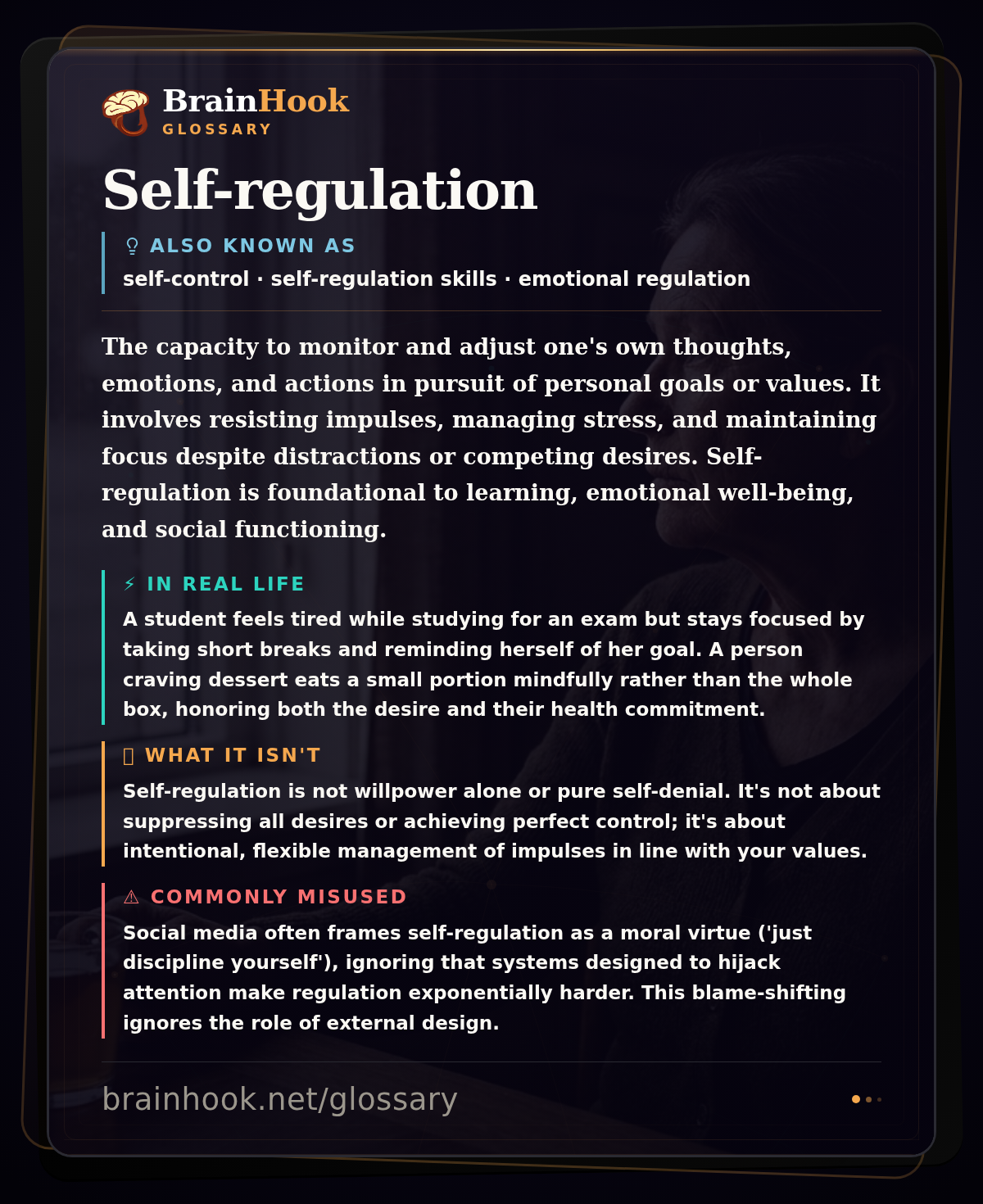
The capacity to monitor and adjust one's own thoughts, emotions, and actions in pursuit of personal goals or values. It involves resisting impulses, managing stress, and maintaining focus despite distractions or competing desires. Self-regulation is foundational to learning, emotional well-being, and social functioning.
What this means in real life
A student feels tired while studying for an exam but stays focused by taking short breaks and reminding herself of her goal. A person craving dessert eats a small portion mindfully rather than the whole box, honoring both the desire and their health commitment.
What it isn’t
Self-regulation is not willpower alone or pure self-denial. It's not about suppressing all desires or achieving perfect control; it's about intentional, flexible management of impulses in line with your values.
Commonly misused online
Social media often frames self-regulation as a moral virtue ('just discipline yourself'), ignoring that systems designed to hijack attention make regulation exponentially harder. This blame-shifting ignores the role of external design.