How One Bacterial Gene Decides Whether You'll Ever Smell
Scientists have now mapped the complete molecular assembly line inside Staphylococcus hominis — and the switch that shuts it off entirely in some people sits not in the bacteria, but in your own DNA.
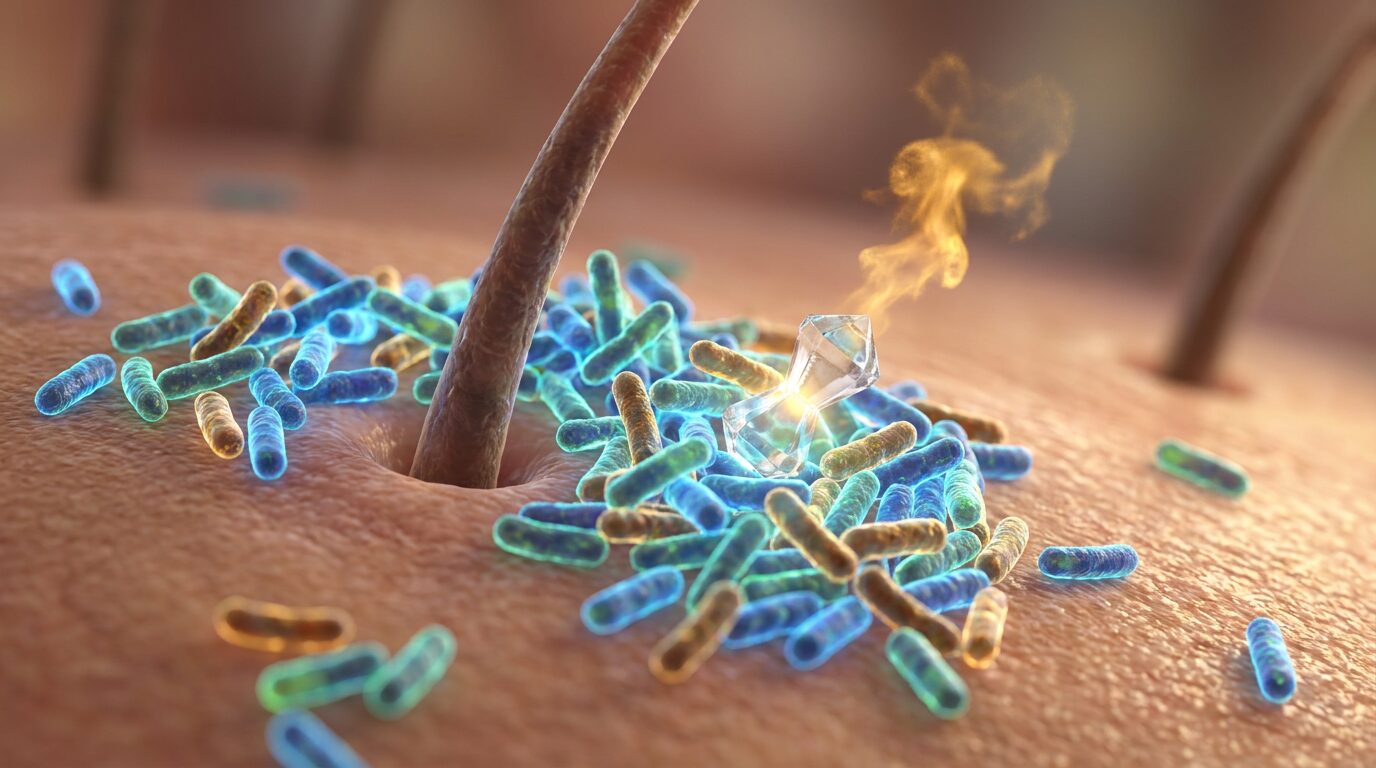
Put your arm down for a moment and consider what's actually happening in there. Your apocrine sweat glands — the ones tucked deep in the hair follicles of your armpit — are releasing a fluid that is, chemically speaking, completely odorless. Not weakly odored. Not almost odored. Genuinely, measurably inert. The smell that eventually emerges has nothing to do with the sweat itself. It is made, from scratch, by bacteria.
That's been understood in broad strokes for decades. But the precise molecular machinery behind it — the specific enzymatic steps, the proteins involved, the exact gene that makes certain bacteria capable of producing body odor at all — has only come into full focus recently, through a sequence of structural biology studies that followed the chemistry one reaction at a time. What those studies have revealed is a production line of startling specificity, and a single genetic toggle that, in a significant fraction of the world's population, leaves that production line permanently idle.
The Odorless Precursor and the Bacteria That Unlock It
The production of human body odor is the result of commensal skin bacteria, including Staphylococcus hominis, acting to biotransform odorless apocrine gland secretions into volatile chemicals like thioalcohols such as 3-methyl-3-sulphanylhexan-1-ol — known by its shorthand, 3M3SH. That molecule, 3M3SH, is the primary source of the characteristic sharp, sulfurous smell most people associate with underarm odor. Thioalcohols get their stinky quality from sulfur and, despite being present in only trace amounts, are some of the most pungent volatile organic compounds produced by the body. How pungent? They are detectable in concentrations as little as one part per trillion.
The precursor molecule the bacteria start with is called Cys-Gly-3M3SH — a conjugate of the thioalcohol bound to two amino acids, cysteine and glycine, that neutralize its odor completely. Apocrine metabolism produces an odorless S-glutathione conjugate that is transferred by ABCC11 transporters into secretory vesicles, deglutamylated to S-Cys-Gly-3M3SH, and exuded to the skin surface. So the gland isn't releasing smell — it's releasing smell's raw ingredients, safely wrapped. The bacteria waiting on the skin surface are the factory that does the unwrapping.
But not all bacteria can do this. Most of the staphylococci living in the armpit — including S. epidermidis, the most abundant species there — unequivocally do not metabolize these precursors, despite being the most abundant Staphylococcus species present in the axilla. The ones that can are a much smaller, closely related group. Using phylogenetics, biochemistry, and structural biology, researchers demonstrated that a cysteine-thiol lyase known as PatB — a PLP-dependent enzyme — moved horizontally into a unique monophyletic group of odor-forming staphylococci about 60 million years ago, and has subsequently tailored its enzymatic function to human-derived thioalcohol precursors. That timing, roughly when primates were beginning to diversify, implies that body odor as we know it is not incidental chemistry — it is an ancient, co-evolved relationship between primate bodies and the specific microbes they carry.
“The gland isn't releasing smell — it's releasing smell's raw ingredients, safely wrapped. The bacteria waiting on the skin surface are the factory that does the unwrapping.”
The Three-Step Assembly Line, Now Fully Mapped
The conversion of inert precursor to pungent thioalcohol happens in three enzymatic steps, and researchers have now identified all three. First, the precursor has to get inside the bacterium. Structural and biochemical work published in eLife[3] showed that S. hominis uses a transport protein in its membrane to bring the odorless precursor inside, where it is converted to the sulphurous thioalcohol 3M3SH in the bacterial cytoplasm before being released into the environment. X-ray crystallography captured snapshots of this transporter mid-action, revealing exactly how the protein grips the precursor molecule.
Once inside the cell, the precursor still can't be processed directly. The PatB enzyme specifically recognizes the Cys-3M3SH precursor and not the dipeptide-conjugated Cys-Gly-3M3SH, meaning that an intracellular staphylococcal dipeptidase is essential as an intermediate step in the production of human malodor. That missing middle enzyme — the one that strips the glycine residue and hands a trimmed substrate to PatB — was the last gap in the pathway. A 2024 study in the Journal of Biological Chemistry02430-X/fulltext) closed it: purification of this activity from S. hominis extracts led to the identification of the M20A-family PepV peptidase (ShPepV) as the primary Cys-Gly-3M3SH dipeptidase.
The full picture is now this: a peptide transporter pulls the precursor into the cell; ShPepV clips off the glycine; then PatB executes the decisive cleavage, breaking the carbon-sulfur bond that releases volatile 3M3SH into the air. This provides evidence for the missing mechanistic step in the full pathway for thioalcohol-based malodor production in S. hominis — and because the DtpT transporter and PepV peptidase are found widely across staphylococci, it supports the finding that the occurrence of patB, encoding the cysteine-S β-lyase, correlates very strongly with malodor production. The transporter and the dipeptidase are ordinary cellular machinery, shared across many bacterial species. What makes S. hominis a smell factory is that it also has PatB — and that PatB is exquisitely tuned to one substrate.
Just how tuned? When researchers transferred the PatB gene alone into non-odor-producing staphylococci, those bacteria immediately began generating 3M3SH. Transfer of this enzyme alone to non-odor-producing staphylococci confers odor production, demonstrating that the C-T lyase is both necessary and sufficient for thioalcohol formation. The gene is the thing. All the other machinery is borrowed from general cellular metabolism; this one enzyme is the switch that makes it produce smell.
The Human Gene That Starves the Bacteria
Here is where the story crosses from microbiology into human genetics — and into one of the more quietly remarkable facts about human variation. The bacteria can only do their work if the precursor molecule actually reaches the skin surface. That delivery depends on a human transporter protein called ABCC11, encoded by a gene of the same name in your own genome. A single nucleotide polymorphism in the ABCC11 gene is responsible for determining human earwax type and the presence of underarm odor.
The loss of a functional ABCC11 gene is caused by a 538G>A single-nucleotide polymorphism, resulting in a loss of body odor in people who are specifically homozygous for it. The substitution changes a single amino acid at position 180 of the ABCC11 protein, rendering it unstable — the cell's quality-control system flags it for destruction, and the protein never reaches the membrane where it would do its job. If the ABCC11 gene is non-functional, sweat molecules are unable to cross the membrane barrier to reach the armpit, which starves bacteria on the skin surface of the organic compounds they need to metabolize, and as a result, odorant substances are not produced.
The frequency of this variant is strikingly uneven across human populations. The T allele is seen in 80–95% of East Asian populations (Chinese, Japanese, and Korean) but is quite rare — 0–3% — among individuals of European and African descent. A 2024 study in Scientific Reports[1] tracing ABCC11 genotypes across a multigeneration family pedigree confirmed the downstream effect at the microbiome level: the C allele of ABCC11 correlated with the bacterial PatB gene in Staphylococcus hominis, while PatB was absent in hosts with homozygous TT alleles encoding the ABCC11 loss-of-function mutation. Without ABCC11 functioning, the precursor never arrives at the surface; the S. hominis that live there — deprived of their substrate — remain metabolically quiet. The smell never happens. Not because something suppresses it, but because the factory floor never receives its raw materials.
“PatB moved into odor-forming staphylococci roughly 60 million years ago and tailored itself to human sweat. The relationship between our bodies and this bacterium is older than our genus.”
What This Actually Tells Us About Deodorant
Traditional deodorants and antiperspirants act by non-selectively killing underarm bacteria or by blocking sweat glands. Both approaches are chemically crude relative to what the research now shows is possible. The pathway has three specific, targetable proteins — the transporter DtpT, the dipeptidase ShPepV, and the lyase PatB — each performing a discrete, structurally characterized function. In principle, a compound designed to block any one of them could suppress thioalcohol production specifically, without altering the broader microbial community of the skin. That matters more than it sounds: the armpit microbiome, like the microbial ecosystems elsewhere on and in the body, has ecological relationships we don't yet fully understand. Scorching it wholesale with broad-spectrum antimicrobials to solve an odor problem is not especially sophisticated.
There's also the question of what else the bacteria get out of this. Most skin-resident staphylococci would stand to benefit from the products of the biotransformation of Cys-Gly-3M3SH, since the resultant glycine from the PepV reaction can be used directly for protein synthesis and also forms a major part of the crosslink between glycan chains of the staphylococcal peptidoglycan. In other words, the bacteria are not producing odor as their goal — they are eating a substrate and leaking a pungent byproduct. The smell is incidental to their metabolism. Which makes it an even stranger quirk of evolutionary co-existence: the most characteristic smell of the human body is a bacterial exhaust product, generated because one microbe picked up a useful enzyme tens of millions of years ago, and we happened to keep carrying it.
Meanwhile, the people who don't smell — the roughly 80 to 95 percent of East Asians who carry two copies of the non-functional ABCC11 allele — are, from the bacteria's perspective, simply poor hosts. Not because they have different microbes. Not because they wash more thoroughly. But because their cells never release the molecular substrate the bacteria need. The armpit is there. The bacteria are there. The enzyme is there. The single nucleotide that shuts down the precursor supply means none of it ever comes to anything. You can think of it as a very long, very quiet stalemate — written into the genome, playing out invisibly, every single day. You can check which side you're on by looking at your earwax. Dry and flaky means the precursor never arrives. Wet and amber means it does — and so does the smell, one bacterial enzyme at a time.
References
- Interplay of human ABCC11 transporter gene variants with axillary skin microbiome functional genomics (nature.com)
Confirmed that ABCC11 C allele correlates with bacterial PatB gene presence, while homozygous TT loss-of-function variant eliminates PatB in hosts. - *Journal of Biological Chemistry* (jbc.org)
Identified ShPepV peptidase as the missing intermediate enzyme that strips glycine from the precursor before PatB processes it. - Structural basis of malodour precursor transport in the human axilla (elifesciences.org)
Provides structural and biochemical evidence of how S. hominis transports the odorless precursor molecule into bacterial cells via membrane transport protein.
About Aris Thorne
Aris Thorne is a microbiologist who writes about the hidden mechanics of ordinary life: the microbes running your home, the chemistry unfolding in food and water, the physics built into familiar objects, and the biological systems quietly keeping the human body alive. His work follows science from kitchens, bathrooms, dust, soil, and city air into wounds, immune responses, infections, medicines, cells, and other worlds. He is most interested in the moment something familiar stops looking simple and reveals the living machinery underneath.
More like this
Your Gym Clothes Smell Worse the More You Wash Them — Here's the Chemistry
Synthetic athletic fabric doesn't just trap body odor — it selectively breeds the bacteria responsible for it, turning every wash cycle into a missed opportunity.
Decomposition Has a Smell for Every Stage — And Science Is Finally Mapping It
The odor rising from a decomposing body isn't a single stench — it's a shifting chemical record written by bacteria, and forensic scientists are learning to read it like a clock.
Your Breath Is a Readout of Your Gut Microbiome. Scientists Just Proved It.
A 2025 Cell Metabolism study confirmed what scientists suspected for years: the microbial fermentation churning through your gut is chemically leaking into your breath — and that volatile signature might be the future of gut diagnostics.