The Universe's First Stars Were 10,000 Times the Size of the Sun. We Just Found the Ash.
A nitrogen fingerprint in an ancient galaxy suggests the universe's first stars were so massive that no modern physics textbook accounted for them — and their collapse seeded everything that came after.
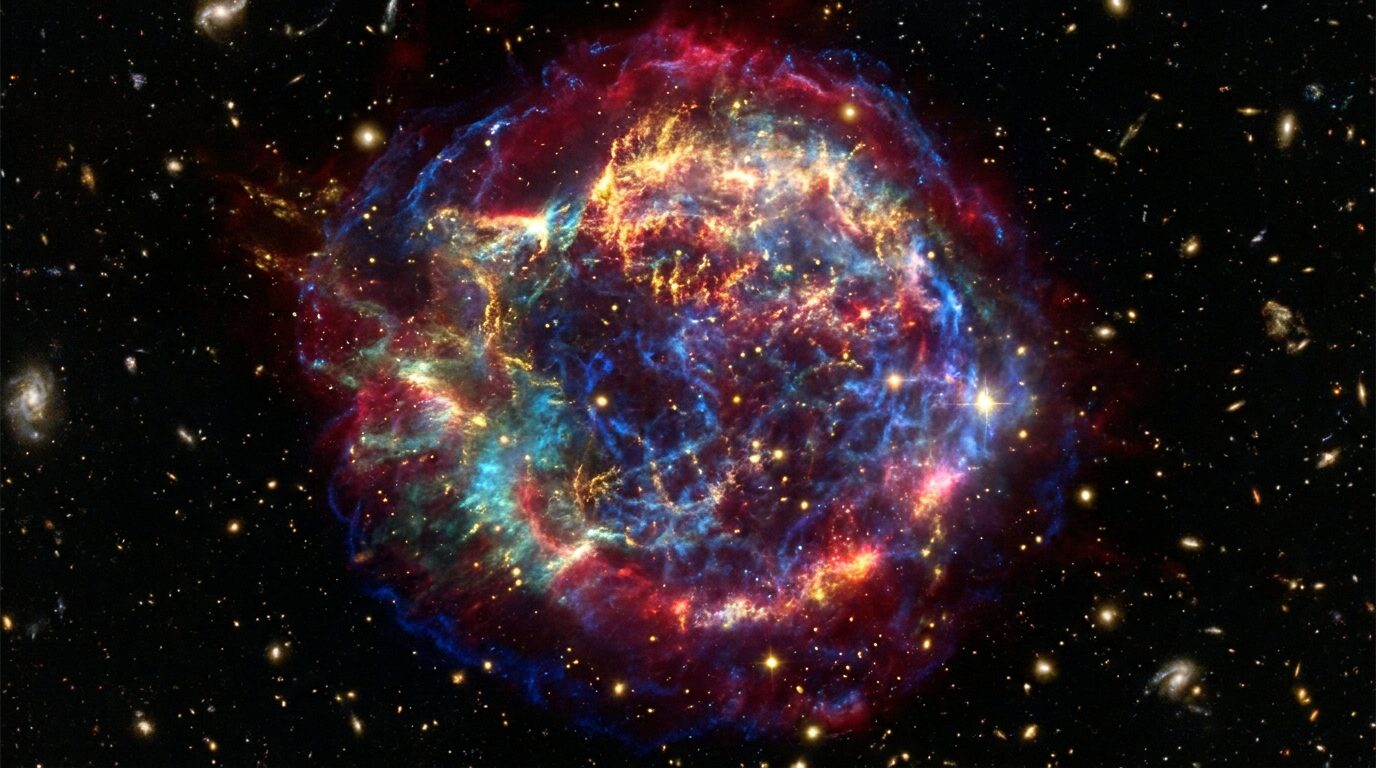
Somewhere in the spectrum of a galaxy that formed when the universe was less than a billion years old, there is too much nitrogen. Not slightly too much — embarrassingly too much, the kind of excess that breaks the math astronomers use to describe how ordinary stars live and die. For years, spectra like this were an inconvenience, a number that didn't fit, quietly set aside. Now, with the James Webb Space Telescope resolving early galaxies in detail that was previously impossible, that excess has become something more useful: a signature. Evidence. The ash of something enormous.
The objects in question are called supermassive primordial stars, or sometimes, more bluntly, monster stars — bodies theorized to have formed in the chaotic first few hundred million years of cosmic history and massed anywhere from a thousand to ten thousand times the weight of our sun. They were never directly observed. They couldn't be: they burned fast, collapsed hard, and left the universe before any instrument existed to catch them. What they left behind, according to recent work from the Harvard-Smithsonian Center for Astrophysics published in The Astrophysical Journal Letters, is chemistry. Specifically, an overabundance of nitrogen relative to oxygen and carbon in the spectra of early globular cluster precursors — a ratio that only makes sense if something unimaginably large once processed gas under pressures and temperatures that no ordinary stellar interior could sustain.
This is what evidence looks like when the crime scene is thirteen billion years old. You do not find the body. You find the elements it scattered on the way out.
To understand why this matters — why a nitrogen surplus in a faint smear of ancient light is being treated as a landmark detection rather than a measurement error — it helps to go back to the very beginning. Not the beginning astronomers usually talk about, with its orderly periodic table and its hydrogen clouds condensing into the first modest stars. The actual beginning, which was messier, denser, and more violent than the cleaned-up version suggests.
The Universe Before Ordinary Stars
The first few minutes after the Big Bang produced a very short ingredient list: hydrogen, helium, and trace amounts of lithium. That was it. No carbon, no nitrogen, no oxygen, no iron — none of the heavier elements that would eventually build planets, atmospheres, and the organic chemistry of living things. The universe began as a nearly pure hydrogen-helium gas, and the story of everything heavier is the story of what stars did to that gas over billions of years. Astronomers call this process nucleosynthesis, and it is one of the most important chains of events in cosmic history: stars fuse light elements into heavier ones, die, and release those heavier elements into the medium between stars, where they get folded into the next generation of stellar material. We are, in the most literal chemical sense, the recycled output of dead stars. The piece "Dead Stars Seeded Your Bones — Here's the Exact Chain of Events" traces that inheritance in detail worth reading alongside this one.
But the very first stars — astronomers call them Population III stars — formed in a universe that had none of those heavier elements yet. They were working with pure primordial gas. And the absence of heavy elements changes everything about how a gas cloud collapses. Heavy elements act as coolants: they radiate away the heat generated by compression, allowing gas to fragment into smaller, denser clumps. Without them, the early gas clouds could not shed heat easily, which meant they collapsed as larger, hotter, more massive objects. Standard models of Population III star formation predict objects perhaps a hundred to several hundred solar masses — already extraordinary by modern standards, where the most massive stars we routinely observe top out around 150 solar masses before radiation pressure tears them apart.
The monster stars now being invoked to explain the nitrogen excess are a more extreme extension of this logic. Under certain conditions — particularly inside the dense, turbulent cores of what would become the universe's first globular clusters — gas could have funneled continuously onto a single growing protostar faster than radiation pressure could stop it, building objects with masses that would be almost satirically large by contemporary stellar standards. A star of ten thousand solar masses is not just a bigger version of our sun. It is a fundamentally different physical regime: core temperatures high enough to drive nuclear reactions our sun never approaches, lifetimes measured in millions of years rather than billions, and an eventual collapse so energetic that it challenges the boundary between stellar death and something closer to a contained cosmological event.
“A star of ten thousand solar masses is not just a bigger version of our sun — it is a fundamentally different physical regime.”
What Nitrogen Remembers
Here is the specific chemistry at the center of the detection. In the cores of supermassive stars, temperatures are high enough to drive what is known as the CNO cycle — a chain of nuclear reactions in which carbon, nitrogen, and oxygen act as catalysts for fusing hydrogen into helium. The CNO cycle is not unique to monster stars; our own sun runs a version of it, and it is the dominant energy source in stars more massive than about 1.3 solar masses. What makes the supermassive case different is the extreme temperatures involved. Above roughly 100 million Kelvin, the CNO cycle shifts into a regime where nitrogen is produced much faster than it is destroyed, accumulating inside the stellar core in quantities that ordinary massive stars simply cannot match. When a supermassive star dies — and it dies quickly, probably within a few million years — it expels this nitrogen-enriched material into the surrounding gas, leaving a chemical tag on everything that forms from that gas afterward.
That tag is what JWST is reading now. The telescope's near-infrared and mid-infrared instruments can parse the spectra of galaxies formed when the universe was roughly 400 to 600 million years old with a precision that previous observatories could not approach. In several of these early systems — compact, densely starred structures that appear to be the precursors of today's globular clusters — the nitrogen-to-oxygen and nitrogen-to-carbon ratios are far outside the range that ordinary stellar populations produce. Studies attempting to model these abundances using standard Population III or Population II stellar physics consistently fall short. The only models that reproduce the observed ratios require a contribution from objects in the supermassive range, objects that processed gas through hot CNO cycling at temperatures no normal stellar core reaches. The nitrogen is not decoration. It is a fossil of the process.
Reading Backward from Damage
JWST has been delivering surprises about the early universe at a pace that has kept cosmologists genuinely off-balance. Massive, mature-looking galaxies appearing far earlier than standard models predicted. Objects so red and structurally anomalous that they required a new observational category. Stellar populations with metallicities and mass distributions that don't fit the timeline cleanly. The nitrogen excess in early globular cluster progenitors fits into this broader pattern of the early universe being stranger and more structurally complex than the models built on pre-JWST data assumed. What the telescope is doing, essentially, is revealing how much of early cosmic history was compressed into the first few hundred million years — and how extreme the conditions in that compression were.
The reconstruction method here is the same one that makes geology and planetary science so powerful: you read the present state of a material and work backward to the process that created it. A crater's shape encodes the angle and velocity of impact. An isotope ratio in a meteorite encodes the temperature and pressure of its parent body's interior. A nitrogen surplus in an ancient galaxy's spectrum encodes the nuclear physics of the objects that enriched it. None of these are direct observations of the original event. They are the preserved consequences of events that ended long before the evidence was collected. Scientists call this kind of reasoning chemical forensics, or stellar archaeology, depending on the scale — and it is, practically, the only tool available for studying objects that burned out before any telescope existed.
“The nitrogen is not decoration. It is a fossil of the process that made it.”
The Questions the Ash Cannot Answer
There are real uncertainties here, and they are worth naming clearly. Chemical forensics of this kind is not as unambiguous as a direct detection. The nitrogen excess is real and well-measured, but the interpretation — that it requires supermassive primordial stars specifically — depends on eliminating other explanations, and that elimination is still ongoing. Could very massive but not supermassive Population III stars, in large enough numbers, produce the same ratios? Could Wolf-Rayet stars, which eject nitrogen-enriched material through powerful winds, account for the excess without invoking any objects outside the normal mass range? Researchers modeling these alternatives have so far found them inadequate at the extremes observed, but stellar nucleosynthesis modeling carries its own uncertainties, and the parameter space is not fully explored. What can be said with confidence is that the observed nitrogen abundances are anomalous, that the anomaly is systematic across multiple early systems rather than isolated to a single object, and that the supermassive star hypothesis currently offers the most self-consistent explanation. That is strong evidence. It is not yet proof in the sense that a direct detection would provide.
The fate of these objects is also still a matter of active theoretical work. Stars in the range of a few hundred solar masses are expected to die as pair-instability supernovae — a specific kind of collapse in which the stellar core produces electron-positron pairs that drain energy from the radiation pressure supporting the star, triggering a runaway implosion and then a total disruption with no remnant left behind. Stars above roughly 300 solar masses may collapse directly into black holes without a conventional supernova, which would affect how and whether their enriched material gets distributed. At ten thousand solar masses, the physics is even less settled: the collapse pathway, the remnant mass, and the fraction of nucleosynthetic products ejected into the surrounding medium all remain genuinely uncertain. Theoretical work on very massive star collapse and black hole seeding connects these monster stars to another longstanding puzzle — where the supermassive black holes that power the bright quasars seen in early JWST data came from, since standard stellar-mass black hole seeds don't grow fast enough through conventional accretion to reach the observed masses in the available time.
What the Cosmos Kept
“The universe's first stars may be gone, but they wrote their chemistry into everything that formed in their aftermath.”
There is something almost archival about the way stellar chemistry persists. A star that burned for two million years and collapsed thirteen billion years ago is, in one obvious sense, completely gone: no light from it reaches us, no image of it will ever be made, no instrument will ever resolve its photosphere or measure its luminosity directly. And yet the gas it processed, the elements it overproduced, the ratios it imposed on the material around it — those persist. They get incorporated into the next generation of stars, and the next, and eventually into the gas clouds that form galaxies, and eventually into the spectra that JWST reads with its gold-coated mirrors in the second decade of the twenty-first century. The universe does not discard its chemistry. It inherits it, compounds it, passes it forward. What we are reading in the nitrogen surplus of an ancient galaxy is not just evidence of a star. It is evidence that a process happened — that gas fell inward under conditions of extraordinary density, that nuclear physics ran at temperatures our sun will never reach, that something burned at a scale we have no modern analog for, and that the burning left a residue that thirteen billion years of cosmic evolution could not erase. The first stars were monsters. We just found the proof in what they left behind.
About Mira Solen
Mira Solen writes about deep time, cosmic history, extinct stars, ancient impacts, and the long memory stored in rock, dust, and light. Her work specializes in making the oldest stories in the universe feel vivid, physical, and strangely near.
More like this
The Universe's Oldest Supernova Just Rewrote What Stars Could Do at Cosmic Dawn
JWST confirmed a supernova from when the universe was just 730 million years old — and its unsettling resemblance to modern explosions is forcing astronomers to rethink what the earliest stars were even supposed to be.
Ghosts of the First Stars: What Ancient, Metal-Poor Suns Are Telling Us About the Universe's Earliest Chemistry
A small population of stars in the Milky Way's outer halo carries chemical signatures from before the universe knew how to make iron — and what spectrometers are finding in them is forcing a rethink of how fast the early cosmos grew complex.

This Star Is Older Than the Universe — And the Math Might Be Right
HD 140283 has been clocking in at 14-plus billion years old, which is a problem, because the universe is only 13.8 billion — and resolving that contradiction is quietly rewriting how we measure cosmic time.