The Sun's Surface Is 5,500°C. Its Atmosphere Is 2,000,000°C. Something Is Wrong.
Solar physicists have known about the corona's impossible heat for eighty years, and a spacecraft now flying closer to the sun than any instrument before it is finally close enough to catch the culprit in the act.
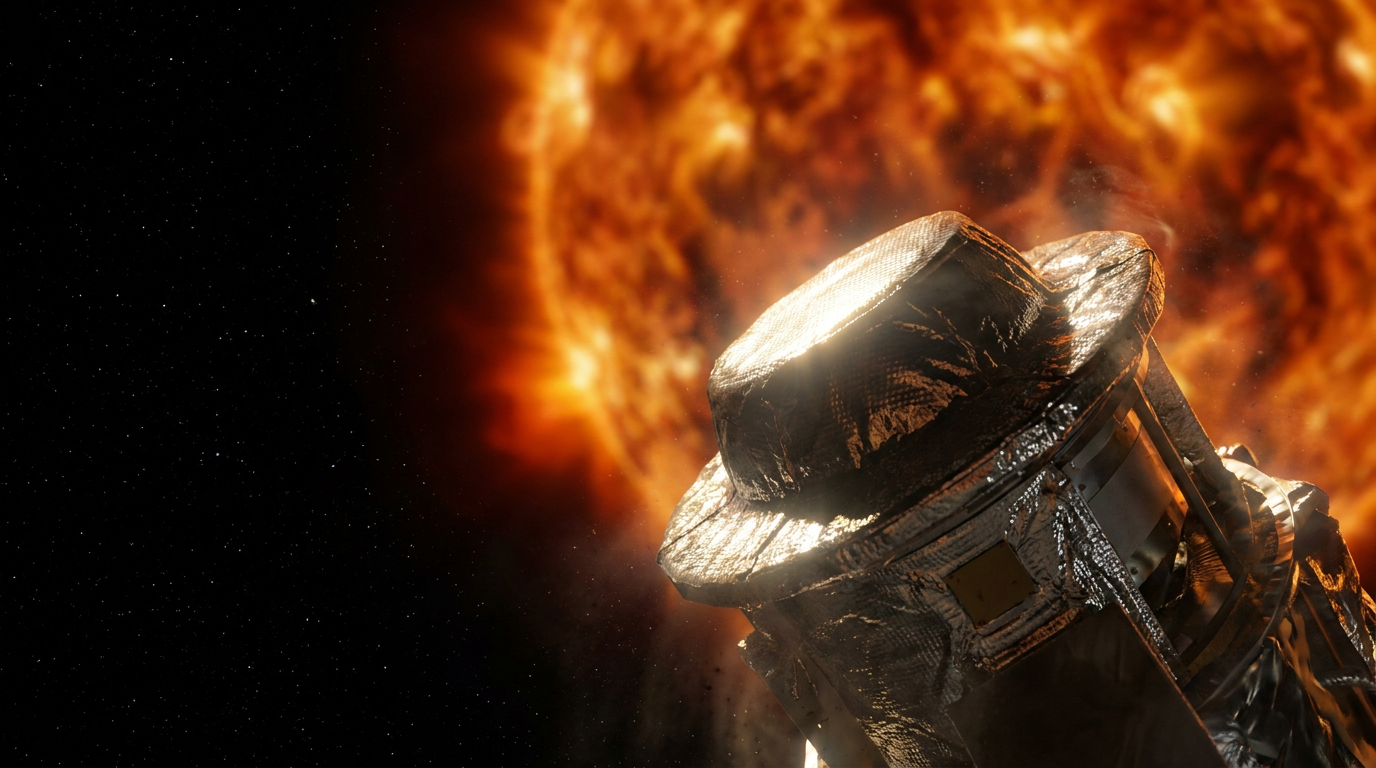
There is a rule the universe generally follows: things get colder as you move away from a heat source. Hold your hand over a candle flame, then raise it a foot higher. The warmth drops off. This is not a complicated principle. It is thermodynamics, and it governs everything from campfires to stellar interiors. The sun obeys it too — right up until it doesn't.
The visible surface of the sun, the photosphere, sits at roughly 5,500 degrees Celsius. The layer just above it, the chromosphere, runs hotter, between 6,000 and 20,000 degrees. Then comes the corona — the wispy, structurally complex outer atmosphere that blooms outward for millions of kilometers and glows with ionized plasma — and the temperature leaps to somewhere between one and three million degrees Celsius, with some active regions measured well above that. Moving outward from the photosphere into the corona, you gain roughly two million degrees. No obvious heat source intervenes. No fusion is happening out there. The corona is simply, stubbornly, impossibly hot.
This is not a new problem. The extreme temperature of the corona has been known since the 1940s, when the Swedish physicist Bengt Edlén[3] identified emission lines in the solar spectrum as coming from highly ionized iron — iron stripped of thirteen or more electrons, which requires temperatures in the millions of degrees to achieve. The discovery upended assumptions. Astronomers at the time had expected the corona to be a dim, cool haze. What Edlén's spectroscopy revealed instead was a plasma so energetic that it demands an explanation that eighty subsequent years of solar physics have not yet settled into consensus.
The Parker Solar Probe, launched by NASA in August 2018[1], was designed in part to get close enough to the sun to gather data that ground-based observatories and Earth-orbiting spacecraft could not reach. Its trajectory uses repeated Venus gravity assists to progressively tighten its orbit, eventually bringing it to within roughly 6.1 million kilometers of the solar surface — closer than any previous human-made object, close enough that its heat shield faces temperatures exceeding 1,300 degrees Celsius on the sun-facing side while instruments behind it operate near room temperature. What it has returned from those close passes is beginning to clarify, though not yet fully resolve, one of the oldest open questions in solar physics.
Two Leading Suspects
Solar physicists have spent decades building and refining two broad classes of explanation for the corona's heat. The first is wave heating. The sun's surface is in constant, violent convective motion — plasma rising and sinking, driven by the nuclear furnace in the interior, creating a roiling, granular texture visible in high-resolution solar imagery. This motion generates waves that propagate upward along the sun's magnetic field lines. The leading candidate within this class is the Alfvén wave: a magnetohydrodynamic wave that travels along magnetic field lines much the way a vibration travels along a plucked guitar string. Alfvén waves carry energy, and if that energy is transferred efficiently to the surrounding plasma in the corona rather than simply passing through it, the result is heating. Observations from multiple spacecraft, including the Solar Dynamics Observatory and earlier work with Hinode, have confirmed that Alfvén waves exist in the corona and carry significant energy. The open question has always been whether they deposit that energy efficiently enough, in the right places, to account for the full temperature profile.
The second class of explanation involves magnetic reconnection — a process in which oppositely directed magnetic field lines are forced together, snap apart into a new configuration, and release energy as they do. Reconnection events on large scales drive solar flares and coronal mass ejections, the enormous eruptions that can compress Earth's magnetosphere and disrupt satellite communications. But the hypothesis relevant to coronal heating is that reconnection also happens constantly at much smaller scales, in countless tiny events distributed across the solar atmosphere. The physicist Eugene Parker[4], after whom the probe is named, proposed in the 1980s that these small events — sometimes called nanoflares — might collectively heat the corona the way a sustained drizzle fills a reservoir. Each individual event is too small to detect directly with any instrument built so far. Their existence is still an inference, supported by modeling and by the statistical behavior of larger reconnection events, but not yet directly confirmed.
“Each nanoflare releases roughly a billionth the energy of a major solar flare — and the hypothesis is that trillions of them, firing constantly, add up to a corona hot enough to strip thirteen electrons from an iron atom.”
These two mechanisms are not mutually exclusive. The corona is a complex, magnetically structured environment, and there is no particular reason the energy balance has to be maintained by a single process. In quieter coronal regions, Alfvén wave dissipation may dominate. In magnetically tangled active regions above sunspot clusters, nanoflare reconnection may do more of the work. The difficulty has been that testing either mechanism precisely requires observations much closer to the sun than was previously possible — because the corona's structure changes as you move outward, and what you measure at Earth's distance is already a downstream consequence of heating that happened much nearer the surface.
What the Probe Is Actually Measuring
Parker Solar Probe carries four instrument suites. FIELDS measures electric and magnetic fields, radio waves, and plasma waves directly in the solar environment. SWEAP — the Solar Wind Electrons Alphas and Protons investigation — captures the properties of the particles that constitute the solar wind: their velocities, densities, and temperatures. WISPR, the Wide-field Imager for Solar PRobe, images the corona and inner heliosphere in visible light. And IS⊙IS, the Integrated Science Investigation of the Sun, tracks energetic particles across a wide range of energies. Together they give scientists in situ measurements from within the corona and the young solar wind, rather than remote observations made from a distance.
Among the early findings that drew sustained attention were structures the FIELDS and SWEAP teams began calling switchbacks — sudden, sharp reversals in the direction of the solar wind's magnetic field that coincide with localized spikes in the wind's velocity. These are not subtle perturbations. In some cases the field direction flips by close to 180 degrees over a matter of seconds, then snaps back. The plasma accelerates through the event. The first question was whether switchbacks were artifacts of solar wind evolution at some distance from the sun, phenomena that develop as the wind expands outward and might not be present near the source. Data from the early close passes established that they are present very close to the photosphere, which shifted the question toward origin: are they generated by magnetic reconnection near the surface, or are they the folded, kinked signatures of Alfvén waves propagating outward from below?
The debate over switchback origin matters because it touches directly on the coronal heating problem. If switchbacks arise from reconnection events low in the solar atmosphere, they would support a picture in which energy released by magnetic field-line rearrangement contributes significantly to both coronal heating and solar wind acceleration. If they are instead the remnants of wave propagation, that strengthens the wave-heating case. The current state of the literature does not resolve this cleanly. Analysis of Parker data has found evidence consistent with both origins, and some researchers have proposed that switchbacks are a mixed population — that more than one formation mechanism contributes depending on solar conditions and latitude.
The Temperature Inversion Up Close
One of the persistent puzzles within the coronal heating problem is not just the overall temperature excess, but its structure. The corona is not uniformly hot. It is organized along magnetic field lines into loops, streamers, plumes, and sheets, each with its own temperature and density profile. Coronal holes — regions where the magnetic field opens outward rather than looping back — are somewhat cooler than closed-loop regions and are the primary source of the fast solar wind, which streams outward at 700 to 800 kilometers per second or more. The magnetically closed regions above active areas run hotter and source the slower, denser wind. Understanding the corona's temperature means understanding both the bulk energetics and this fine spatial structure, which is organized at scales down to tens or hundreds of kilometers — small enough that resolving it has required either extremely close proximity or extraordinarily powerful instruments.
“The corona is not a uniform hot shell above the sun — it is a magnetically sculpted environment where temperature, density, and field geometry vary so dramatically from one region to the next that a single heating mechanism may never fully explain all of it.”
Parker Solar Probe has been operating in concert with other observatories to triangulate on these structural questions. The Solar Orbiter, a joint ESA and NASA mission launched in February 2020, carries imaging instruments and a spectrometer suite capable of observing the corona in extreme ultraviolet and X-ray wavelengths while also making in situ plasma measurements. Because Solar Orbiter can observe the corona remotely at high resolution while Parker flies through it making direct measurements, the two missions together can sometimes study the same solar region from different vantage points simultaneously. This kind of multi-point coverage is not common in solar physics, and it has allowed researchers to connect remote observations of coronal structure with direct measurements of the particles and fields inside that structure — an approach that previously was not possible.
High-resolution imaging from Solar Orbiter has also revealed features called campfires[2]: small, short-lived brightening events in the low corona and upper chromosphere, first reported in 2020 from the mission's early close approach. These are smaller than anything previously resolved in the corona — roughly a few hundred to a few thousand kilometers across, lasting between ten and two hundred seconds — and they have the morphological signatures of magnetic reconnection events. Whether campfires are nanoflares observed directly, or a distinct but related class of reconnection events, is still being worked out. They are, at minimum, evidence that small-scale energy release in the low corona is real, frequent, and spatially widespread.
Why the Solar Wind Complicates Everything
The corona and the solar wind are not separate topics. The wind is the corona in motion — or more precisely, the corona's outer regions expanding outward along open magnetic field lines at velocities that overwhelm the sun's gravity. Understanding coronal heating is therefore entangled with understanding solar wind acceleration, because whatever energy mechanism heats the corona also drives that expansion. Alfvén waves, if they are efficiently dissipated in the low corona, would heat it. But if they are not fully dissipated there, they could continue propagating outward and accelerate the wind directly. Reconnection events could also launch jets and plasmoids that contribute to wind acceleration. The mechanisms interact, and their relative contributions likely change with solar latitude, solar cycle phase, and proximity to active regions.
Parker Solar Probe has sampled both fast and slow wind populations at unprecedented proximity, and the measurements have complicated older models in useful ways. The slow solar wind — previously thought to be a fairly uniform, quasi-steady outflow — turns out to be highly structured and intermittent at close range, filled with sharp velocity spikes, current sheets, and the switchback structures described earlier. This is not what a slowly and steadily heated, smoothly accelerating wind looks like. It looks more like a wind that has been impulsively driven — energized by discrete events rather than a continuous background process. That observation does not rule out wave heating, but it is more naturally consistent with episodic energy release, the kind that reconnection-driven nanoflares would produce.
What Remains Unanswered, and Why That Is Not a Failure
Parker Solar Probe has not solved the coronal heating problem. It would be misleading to suggest it has. What it has done is pushed the observational frontier close enough to the sun that mechanisms previously inferred only from modeling can now be constrained by real measurement — and in some cases, the measurements have surprised the models. The prevalence and structure of switchbacks were not predicted at the level of detail observed. The impulsive, structured character of the slow wind near its source was not fully anticipated. The campfire events resolved by Solar Orbiter were not part of any consensus picture before they were seen. Each of these findings revises the parameter space within which a correct theory of coronal heating has to operate.
“Parker Solar Probe has not solved the coronal heating problem — it has made the problem more specific, which in physics is often more useful than a premature answer.”
There are still fundamental gaps. The direct detection of nanoflares — individual reconnection events small enough to fit the heating budget — remains beyond any current instrument's resolution. The efficiency with which Alfvén waves transfer energy to the surrounding plasma in the low corona is still measured with significant uncertainty. The precise mapping of how coronal temperature varies with height, with magnetic topology, and with solar cycle phase is not complete. And the connection between what happens in the chromosphere — the thin, complex layer between the photosphere and the corona where much of the magnetic field energy is thought to be injected upward — and what ultimately heats the corona above it is still being traced.
Parker Solar Probe's closest orbital passes continue to tighten. Each Venus flyby nudges the perihelion inward. By the time its mission concludes, the probe will have spent hundreds of hours closer to the sun than any instrument before it, inside the region where the solar wind first becomes supersonic, gathering data in an environment that the sun has been maintaining for four and a half billion years without ever being asked to explain itself. The corona's heat is real, measurable, and precisely documented. The mechanism sustaining it remains one of the genuinely open questions of modern astrophysics — not because physicists have been careless, but because the sun is large, complex, magnetically wild, and has had several billion years more practice than we have.
References
- Parker Solar Probe - NASA Science (science.nasa.gov)
Confirms Parker Solar Probe's August 2018 NASA launch and its mission to orbit closer to the Sun than any previous spacecraft. - Solar Orbiter’s first images reveal ‘campfires’ on the Sun (esa.int)
Documents Solar Orbiter's discovery of miniature solar flares called 'campfires' near the Sun's surface, relevant to small-scale heating mechanisms. - Bengt Edlén (en.wikipedia.org)
Establishes that Swedish physicist Bengt Edlén identified ionized iron spectral lines in the solar corona in the 1940s, revealing the corona's extreme temperature. - Parker Solar Probe (en.wikipedia.org)
Provides biographical context that Eugene Parker, the physicist after whom the Parker Solar Probe is named, proposed the nanoflare hypothesis in the 1980s.
About Brenna Vance
Brenna Vance writes about the cosmos — stars that predate the universe's own chemistry, spacecraft flying close enough to the sun to catch it misbehaving, the physics of what the universe is still getting wrong. Her work focuses on the moments when an observation breaks a model, and what that break actually means.
More like this
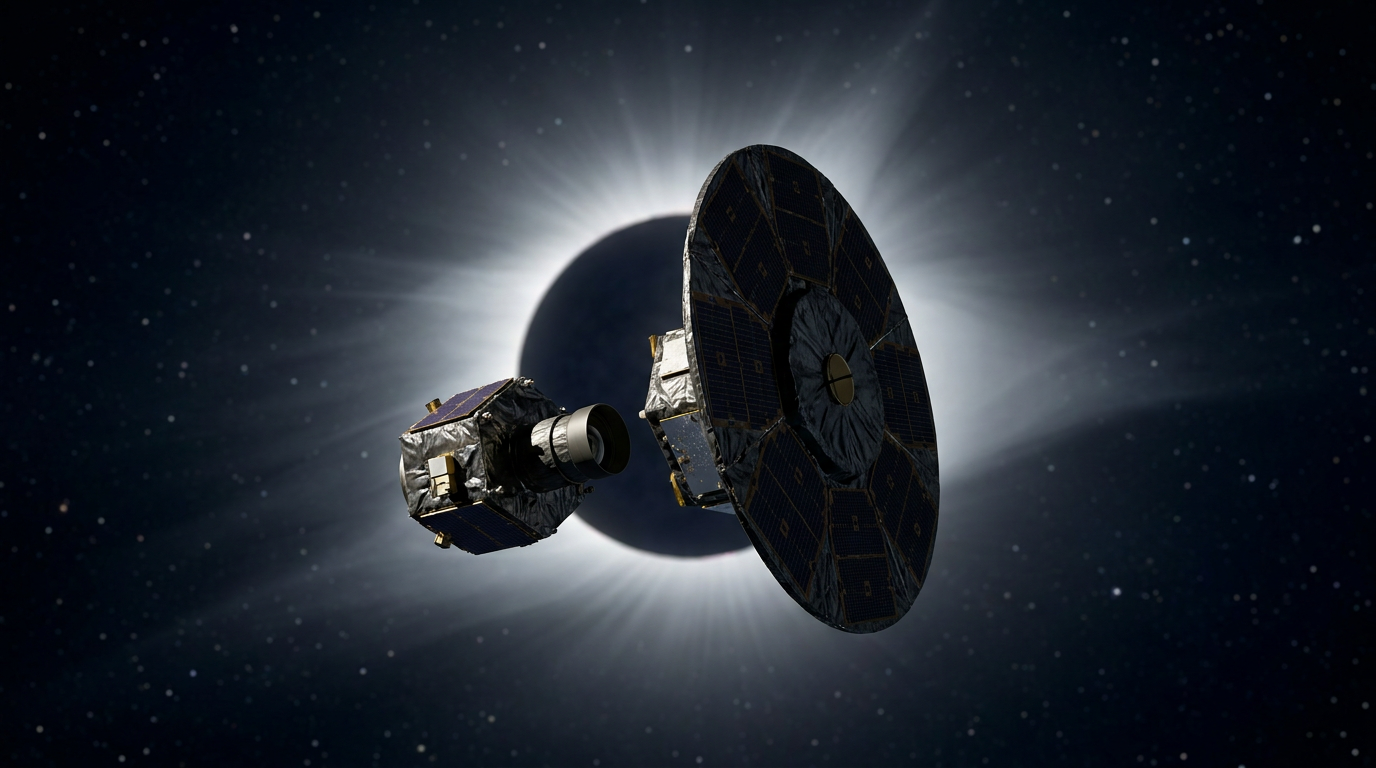
ESA Built a Machine That Creates Solar Eclipses on Demand
ESA's Proba-3 mission flies two spacecraft in lockstep formation to block the sun on demand — unlocking a continuous view of the solar corona that has defeated astronomers for a century.
Astronomers Watched a Magnetar Be Born. The Universe Was Blinking.
A supernova's strange, rhythmic afterglow gave astronomers their clearest look yet at the moment one of the universe's most extreme objects switches on.
JWST Found a Planet That Shouldn't Exist — Orbiting a Dead Star, Raining Diamonds
A Jupiter-mass planet orbiting a millisecond pulsar carries a helium-and-carbon atmosphere that no known formation pathway can produce — and the physics of what falls from its sky is stranger still.