Why the Universe's Expansion Rate Refuses to Match Its Oldest Light
DESI's second data release measured the universe's expansion with unprecedented precision — and the answer doesn't quite match what the oldest light in existence tells us.
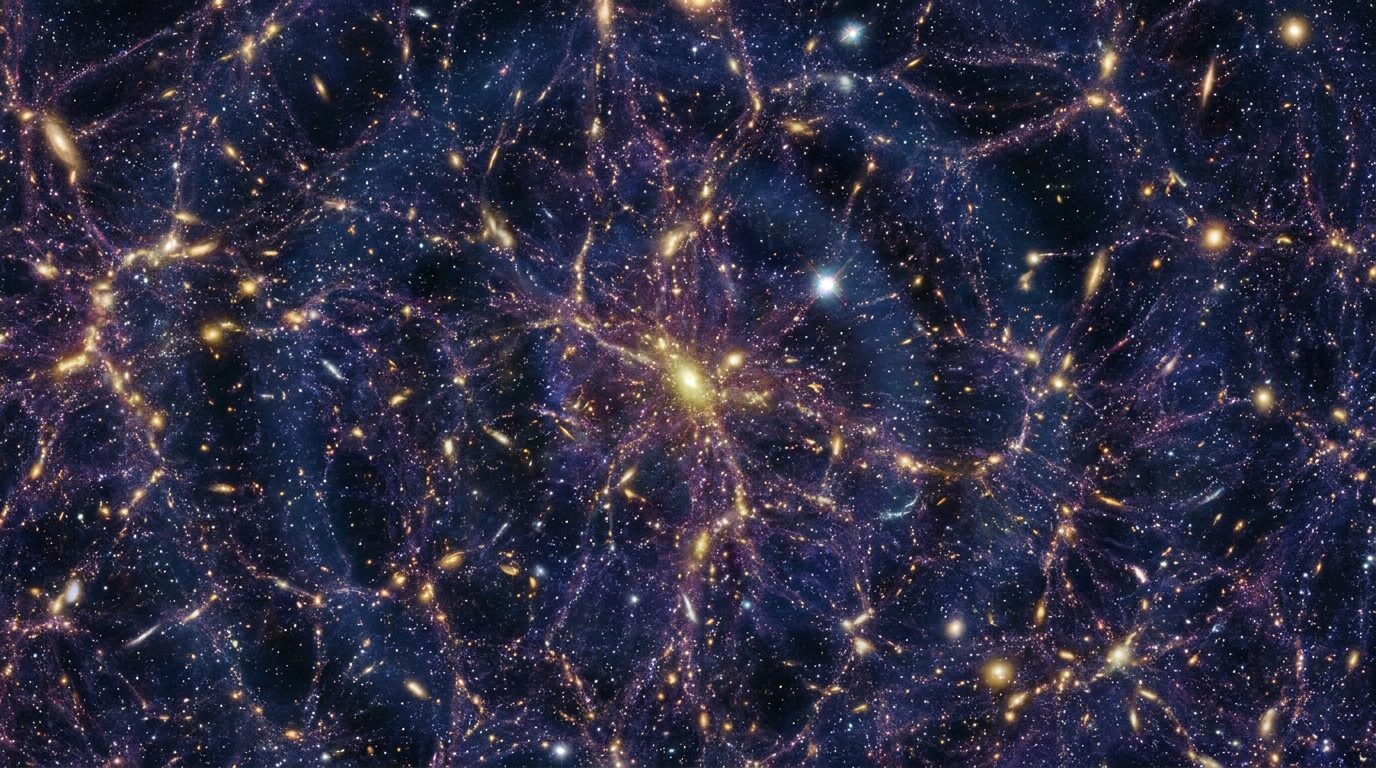
There is a sound encoded in the structure of the universe. It is not a sound anyone can hear — it is a ripple, a pressure wave that propagated through the early cosmos before atoms had even fully formed, then froze in place when the universe cooled enough to let electrons bind to protons. That frozen ripple is called the baryon acoustic oscillation, and astronomers have spent the last two decades learning to use it as a ruler. The idea is elegant: because the physics of that early acoustic wave is well-understood, the distance it traveled is known. If you can identify where galaxies preferentially cluster at that same scale today, you have a standard length against which to measure the expansion of the universe across cosmic time.
The Dark Energy Spectroscopic Instrument — DESI — was built specifically to refine that measurement. Mounted on the Mayall Telescope at Kitt Peak in Arizona, it is capable of capturing the spectra of tens of millions of galaxies and quasars, mapping the three-dimensional distribution of matter across enormous swaths of the observable universe. Its first data release drew significant attention. Its second, released in early 2025 and published on arXiv[1], covers more sky, more objects, and a wider redshift range — extending the cosmic tape measure further back in time and with sharper precision than any previous survey. The results are, depending on how much you want the standard model of cosmology to be correct, either reassuring or quietly alarming.
What the Ruler Found
At the most basic level, the DESI DR2 BAO analysis[1] confirms what its predecessor found: the distance-redshift relationship derived from baryon acoustic oscillations matches what supernovae compilations show across the same redshift range. The two independent measurement methods — one based on the clustering of galaxies, one based on the brightness of exploding stars — agree. That agreement is not trivial. It tells you that across hundreds of millions of light-years and multiple different observational strategies, the geometry of the universe is behaving consistently. The flat ΛCDM model — the standard cosmological model, in which the universe is geometrically flat and dark energy is a cosmological constant, a fixed, unchanging energy density of space itself — describes the results well. The DESI Collaboration states this plainly in the paper: "The DR2 BAO results are consistent with DESI DR1 and SDSS, and their distance-redshift relationship matches those from recent compilations of supernovae (SNe) over the same redshift range."
Consistency with previous surveys is the baseline expectation. What draws attention is the gap that emerges when the DESI BAO results are compared not to supernovae or to previous galaxy surveys, but to the oldest available signal in cosmology: the cosmic microwave background.
Two Descriptions of the Same Universe
The cosmic microwave background — the CMB — is the afterglow of the Big Bang, emitted roughly 380,000 years after the universe began. It is the same epoch in which those baryon acoustic oscillations froze into place, which makes the CMB the natural cross-check for any BAO measurement. The Planck satellite's extraordinarily precise map of the CMB[2] has given cosmologists a highly constrained set of cosmological parameters: values for the matter density, the Hubble constant, the baryon density, and the implied geometry of the universe. When you use those parameters to predict what BAO measurements should look like, the prediction and the DESI DR2 observation are not perfectly aligned. The tension is described in the paper as mild — 2.3 sigma — which means it falls short of the five-sigma threshold physicists conventionally require before claiming a discovery. But 2.3 sigma is not nothing. It is a discrepancy that has persisted across two DESI data releases, and that stubbornness is itself informative.
“ΛCDM is being challenged by the combination of DESI BAO with other measurements, and dynamical dark energy offers a possible solution.”
The standard cosmological model handles dark energy by treating it as a constant — the famous cosmological constant, denoted Λ, that Einstein introduced and later called his greatest blunder before observational evidence rehabilitated the concept in the late 1990s. The constant means that dark energy's effect on the expansion of the universe is the same today as it was billions of years ago and the same as it will be billions of years from now. The problem the DESI Collaboration is pointing at is that when BAO data is combined with other cosmological measurements, the constant may not be quite constant enough. Dynamical dark energy — models in which the energy density of space changes over time — fits the combined dataset better. This possibility, noted in both DESI's first and second data releases, is what makes the results genuinely unsettling for anyone invested in the tidiness of ΛCDM. If dark energy evolves, the equations governing the future of the universe are different from what we currently assume. We have already covered earlier DESI findings along these lines in depth — see our piece on whether dark energy may be changing over time, and a closer look at whether ΛCDM can actually survive this new pressure.
What the Survey Actually Measured
The DR2 paper draws on galaxy spectroscopy combined with DESI's Lyman-alpha forest BAO results, presented in a companion paper. The Lyman-alpha forest is a different observational strategy: rather than tracking galaxy positions directly, it uses the absorption features in quasar light to map the distribution of hydrogen gas between us and very distant sources, probing redshifts where individual galaxy surveys become impractical. Together, the galaxy and Lyman-alpha measurements give DESI sensitivity across an unusually wide range of cosmic epochs — from the relatively recent universe to lookback times that reach into the first few billion years after the Big Bang. That range is what gives the distance-redshift relationship its constraining power. A single BAO measurement at one redshift is a data point. A coherent sequence of them across many redshifts is a curve — and the shape of that curve encodes how dark energy has behaved across cosmic time.
The Limitation Worth Keeping in Mind
The 2.3-sigma tension with CMB-inferred parameters is real, but it demands careful interpretation. Statistical tension at this level has a history of resolving when more data arrives — shrinking confidence intervals sometimes close gaps rather than confirming them. It also has a history of growing, which is what happened with the Hubble tension, the persistent disagreement between early-universe and late-universe measurements of the universe's expansion rate[3] that has occupied cosmologists for the better part of a decade. The DESI BAO tension is not the same as the Hubble tension, but it shares the same structural character: two independent ways of reading the universe, using different signals from different epochs, arriving at parameters that do not quite agree. Whether that disagreement is a systematic error hiding somewhere in the measurements, a statistical fluctuation that more data will wash out, or the first clean statistical signal of genuinely new physics is the question the collaboration's next data release will sharpen — though it is unlikely to settle cleanly.
The standard model of the universe is not broken by these results. It is strained. That is a different thing, and the distinction matters. ΛCDM remains the best single description of the observed cosmos — but cosmology now has multiple independent data sources pointing at the same uncomfortable question: whether the energy content of space is truly static, or whether it is something more dynamic and stranger, something that has changed across the life of the universe and will continue to change. A two-point-three-sigma discrepancy in a cosmological parameter is not a headline that announces a revolution. It is the quieter kind of anomaly — documented, persistent, and not yet explained — that tends to precede one.
References
- DESI DR2 Results II: Measurements of Baryon Acoustic Oscillations and Cosmological Constraints (arxiv.org)
Provides the DESI DR2 BAO measurements and analysis showing 2.3-sigma tension with CMB-inferred cosmological parameters. - Cosmological constant problem (en.wikipedia.org)
Provides context on the Planck satellite's CMB measurements that constrain cosmological parameters used to predict what DESI BAO results should show. - Hubble's law (en.wikipedia.org)
Provides the definition and context for the Hubble tension, the persistent disagreement between early and late-universe expansion rate measurements the article compares to the DESI BAO tension.
About Rowan Ellery
Rowan Ellery writes about anomalies, unexplained sightings, strange signals, and the uneasy border between observation, misinterpretation, and genuine mystery. Their work focuses on keeping curiosity alive without letting evidence dissolve into folklore.
More like this
Dark Energy Is Not a Constant. Three Years of Data Say So.
The DESI survey's third year of data has made the case for a changing dark energy disturbingly strong — which means the force expanding the universe may not be what physicists have spent thirty years assuming.
Dark Energy Just Survived Its Biggest Challenge yet. That Should Worry Us More.
A landmark rebuttal restored the standard model of cosmic acceleration — but the galaxy survey quietly doing more damage than the debunked study ever could is still running.

This Star Is Older Than the Universe — And the Math Might Be Right
HD 140283 has been clocking in at 14-plus billion years old, which is a problem, because the universe is only 13.8 billion — and resolving that contradiction is quietly rewriting how we measure cosmic time.