AI Is Watching You Work. It's Also Deciding What Work Means.
New research on algorithmic management reveals that workplace monitoring tools don't just measure productivity — they redefine it, rewarding whatever is easiest to see and slowly eroding everything that isn't.
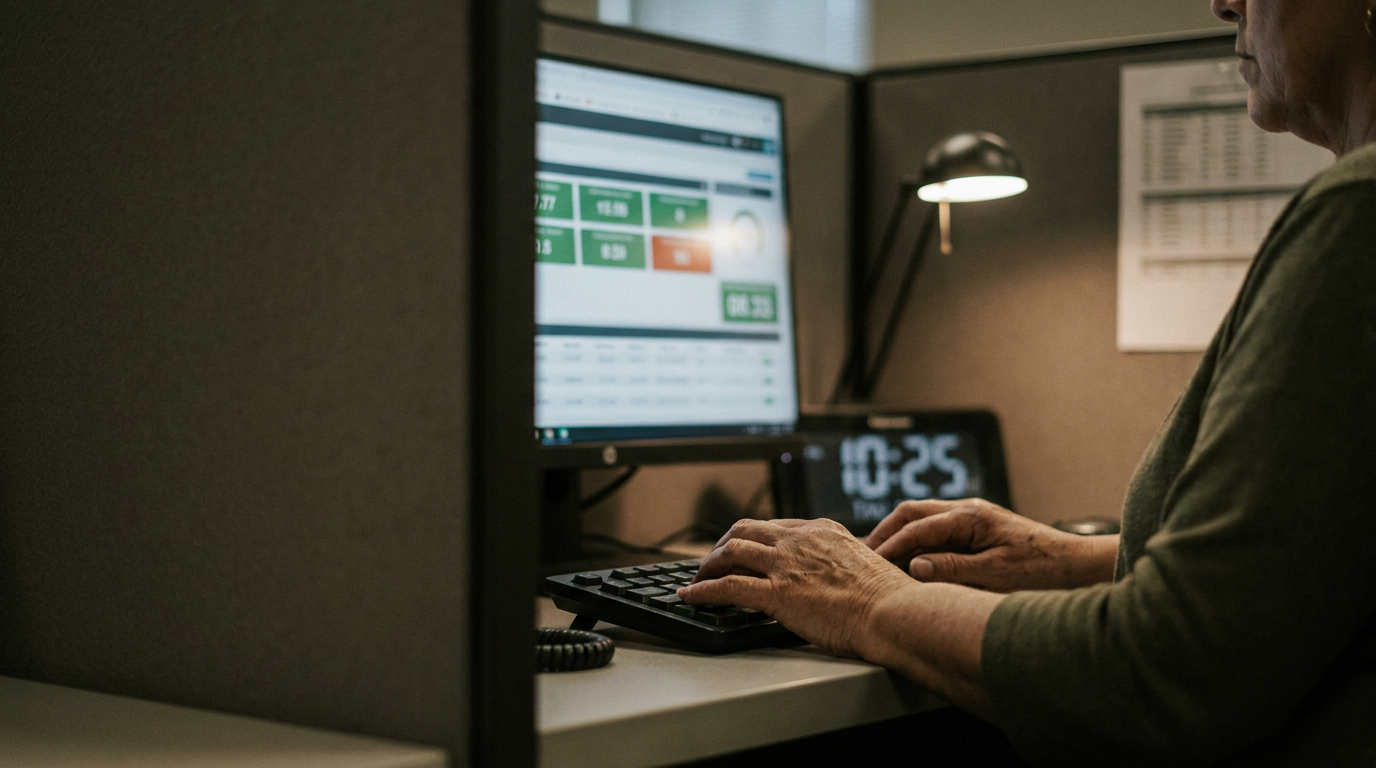
Somewhere in a contact center, a worker is typing faster than she normally would. Not because the task requires speed, but because she knows the system is measuring her keystrokes per minute and flagging gaps longer than ninety seconds. She has learned, not from a manual but from trial and error, that the gap is the problem. She has adjusted her behavior accordingly. She is, by every metric the platform can see, being productive.
This is how algorithmic management actually works in practice — not as a surveillance camera bolted to the ceiling, visible and contestable, but as a layer of software that interprets behavior, generates scores, and quietly reshapes what workers believe they should be doing. The camera watches. The algorithm decides what watching means.
A wave of research published in and around 2025[1] has made this dynamic harder to ignore. A European Parliament study on algorithmic management systems and a SAGE-published analysis of AI-enabled workplace surveillance both converged on a finding that goes further than the usual privacy concerns: these tools do not merely observe work. They redefine it. By making certain behaviors measurable and rewarding visibility over substance, they install a new and largely invisible standard for what a good worker looks like — one written not by managers or employees but by the architecture of the software itself.
The implications are worth taking seriously, because they run deeper than most workplace technology coverage suggests. This is not a story about bosses spying on remote workers. It is a story about how measurement systems become behavioral systems, how metrics become norms, and how the tools we use to evaluate work end up restructuring the culture of work from the inside out.
What the Software Can See
Algorithmic management is not a single product. It is a category of tools — workforce analytics platforms, productivity monitoring software, AI scheduling systems, performance dashboards — that share a common architecture. They collect behavioral signals, process them through automated scoring models, and surface the results to managers, HR systems, or sometimes directly to workers themselves. In distribution centers, the system might track pick rates and idle time. In call centers, it might analyze speech patterns, measure handle time, and score emotional tone. In white-collar environments running productivity monitoring software, it might log active application use, count mouse movements, or transcribe meeting participation.
What unites these tools is not the data they collect but what they do with it. They transform observable behavior into a signal of value. And because the system can only see what it can measure, it treats the measurable as the meaningful. This is not a design flaw. It is the design.
“A metric does not just measure behavior — it selects for it.”
The research on algorithmic management draws on a concept with a long history in economics and organizational psychology: Goodhart's Law[2], which holds that when a measure becomes a target, it ceases to be a good measure. What makes AI-driven monitoring different from older forms of performance management is scale and speed. A supervisor running weekly reviews creates a slow and relatively transparent feedback loop. An algorithm scoring workers in near-real time creates a continuous and largely opaque one. Behavior adjusts faster, more reflexively, and often without conscious deliberation. Workers learn what the system rewards not by reading policy documents but by noticing what happens when they do or do not do certain things.
The Feedback Loop Nobody Announced
One of the more striking findings in recent algorithmic management research is that workers frequently modify their behavior in response to monitoring systems even when they have only partial knowledge of how those systems work. They infer the rules from the outputs. A warehouse picker notices that her productivity rating drops on days she spends time helping a new colleague and stops offering help. A customer service agent learns that longer calls hurt his metrics regardless of customer satisfaction and starts steering conversations toward faster resolutions. A remote knowledge worker realizes that a certain productivity platform rewards active window time and starts keeping work applications open while doing thinking-heavy tasks that require no screen interaction.
None of these adaptations are irrational. Each one is a reasonable response to a legible incentive structure. And that is exactly the problem. The system is not forcing anyone to do anything. It is simply creating a gradient, and humans, like water, tend to flow downhill. The European Parliament research flagged this as a core mechanism of algorithmic control: workers regulated not by direct command but by the internalized logic of the scoring system. The result is a form of self-discipline that feels like personal motivation but is actually the platform's behavioral architecture running in the background.
The behaviors that get squeezed out are often the ones most important to organizational health: mentoring, knowledge-sharing, creative problem-solving, the careful thinking that looks like nothing from the outside. These activities are genuinely hard to quantify. They rarely produce a clean data signal. In an environment where data signals drive evaluation, they become a professional liability.
Visibility as the New Merit
There is an older version of this problem that most workers will recognize: the office politics dynamic in which people who are seen as productive matter more than people who are productive. Showing up early, leaving late, speaking often in meetings, being present in visible ways — these behaviors have always carried social and professional weight, even when disconnected from actual output. Algorithmic management does not eliminate this bias. It digitizes it.
“Algorithmic management doesn't replace the politics of visibility — it automates them.”
What changes is the texture of the dynamic. Human managers at least bring contextual knowledge to their assessments. They know that the quiet analyst who produces one decisive insight per quarter is worth three talkative ones who generate noise. They know that the employee who spent last Tuesday helping a struggling colleague prevented a larger problem on Wednesday. The algorithm does not know these things, because it was not designed to know them. It was designed to score observable inputs efficiently, which it does.
The SAGE analysis of AI surveillance in workplace settings identified a consistent pattern: platforms trained to optimize measurable productivity metrics tend to surface workers who are good at being measured. This is distinct from workers who are good at their jobs, though the two can overlap. Over time, as algorithmic scores increasingly influence promotion, retention, scheduling, and compensation decisions, the distinction collapses in practical terms. Being measurably productive and being valuable start to mean the same thing — not because they are the same thing, but because the system cannot tell the difference and the consequences now flow from the system.
Who Designed These Norms, Exactly
One of the least-discussed aspects of algorithmic management is that the behavioral standards embedded in these tools are not neutral. They reflect assumptions made by engineers, product teams, and clients during the design and deployment process — assumptions about what efficiency looks like, which behaviors indicate effort, and what kinds of work matter. These assumptions are then encoded into the system and applied at scale, without the scrutiny that would accompany, say, a new HR policy rolled out company-wide.
A policy document can be read, contested, and revised through established institutional channels. A scoring algorithm is often proprietary, its criteria opaque even to the managers using it. Workers subject to algorithmic evaluation frequently report not knowing exactly how their scores are calculated, which means they cannot effectively contest assessments they believe are wrong. The European Parliament study noted this as a significant governance gap: the entities making consequential decisions about workers' professional lives are often systems whose logic is not available for inspection by the workers themselves, or sometimes by anyone at the company beyond the vendor relationship.
This is an asymmetry of power wrapped in the neutral language of data. The algorithm appears objective because it is consistent and quantitative. But consistency and objectivity are different things. A system can consistently reward the wrong behaviors at scale while appearing to do exactly what it was designed to do.
The Slow Erosion of Professional Judgment
“When an algorithm grades your judgment, you gradually stop trusting it.”
There is a subtler consequence of algorithmic management that the research is only beginning to trace: its effect on how workers relate to their own professional judgment. When the score becomes the primary feedback mechanism, workers start to organize their decisions around the score rather than around what they believe is the right call. This happens incrementally and largely unconsciously. A nurse prioritizes documentation completeness because the system scores it over a task that is harder to log. A software engineer optimizes for closing tickets over doing the slower architectural work that would reduce future tickets. A teacher designs lessons around trackable engagement metrics rather than harder-to-measure depth of understanding.
What erodes is not competence but confidence — the professional's willingness to trust their own reading of a situation when the data says something different. Algorithmic management systems are often sold to organizations as a way to make evaluation more consistent and less subject to managerial bias. And they do reduce some kinds of bias. But they introduce a different kind: a systematic preference for what can be seen, counted, and returned as a score over what requires sustained professional judgment to recognize. Over time, organizations optimized by these systems may find themselves populated by workers who are very good at the metrics and less confident in the decisions the metrics were supposed to proxy.
Resistance, Adaptation, and What Comes Next
Workers are not passive in this story. Some game the metrics openly and without apology, treating the algorithm as a bureaucratic obstacle to be managed rather than an evaluator to be impressed. Some develop informal networks for sharing knowledge about how particular systems work and how to preserve autonomy within them. Some leave. In sectors where labor markets are tight and skills are transferable, the rise of algorithmically managed environments has contributed to turnover that costs organizations far more than the monitoring tools were meant to save.
There is also a regulatory current picking up speed, particularly in the European Union, where algorithmic management has attracted serious legislative attention under labor law frameworks and AI governance proposals. The argument is straightforward: if an automated system makes or meaningfully shapes consequential employment decisions, workers have an interest in knowing how it works and a right to contest its outputs. This is not a radical position. It is roughly the standard we already apply to human managers.
What makes the moment distinctive is not the novelty of the technology — versions of workplace monitoring have existed for decades — but the degree to which AI-driven systems can now operate continuously, at scale, across entire organizations, generating scores and shaping behavior in ways that individual workers often cannot see clearly enough to push back against. The speed and opacity together create a new kind of institutional drift, where the norms of an organization shift not because anyone decided to change them but because the measurement infrastructure quietly changed what it was rewarding.
The contact center worker typing faster than she needs to is not being oppressed in any dramatic sense. She is doing something humans have always done: reading the environment and adjusting. The problem is that the environment has been redesigned by software, at scale, in ways that few people in the organization fully understand, and the adjustments accumulating across thousands of workers like her are slowly changing what the organization values, what skills it rewards, and what it means to be good at a job. That is not a story about surveillance. It is a story about how tools install culture — quietly, persistently, and usually before anyone thinks to ask whether this is the culture they wanted.
References
- More complaints, worse performance when AI monitors work (news.cornell.edu)
Documents that AI monitoring systems increase worker complaints, reduce productivity, and raise quit intentions unless framed as developmental support. - Goodhart's law (en.wikipedia.org)
Provides the foundational economic principle that when a measure becomes a target, it ceases to be a good measure—the core concept explaining algorithmic management's behavioral effects.
About Julian Cross
Julian Cross writes about AI, automation, surveillance, digital identity, labor, human relationships with each other and automation, complex systems and attention — less about what new tools, studies and observations can do in theory than what they're already doing to how we work, spend, relate, and get measured. His work follows leads to the point where it stops being a product and starts being a condition.
More like this

Tracked by Software, Judged by Nothing: How AI Surveillance Is Quietly Breaking the Workplace
A new study found that AI workplace monitoring produces worse outcomes than human oversight — and the reason turns out to be less about privacy than about something older and stranger.

Your Productivity Score Is Real. The Productivity It Measures Isn't.
A new wave of AI scoring tools doesn't just watch workers — it quietly rewrites what counts as good work, and the rewrite favors employers in ways most workers never see coming.

You Are Being Watched at Work. The System Doesn't Know What It's Seeing.
Workplace AI surveillance is generating mountains of data on employee behavior — but a growing body of research suggests the systems are measuring the wrong things entirely, and workers have figured that out.