The Boss Isn't Watching You. The Algorithm Is. And It's Worse.
AI productivity tools promised to measure how well people work — instead, research suggests they're quietly teaching workers to game the measurement instead.
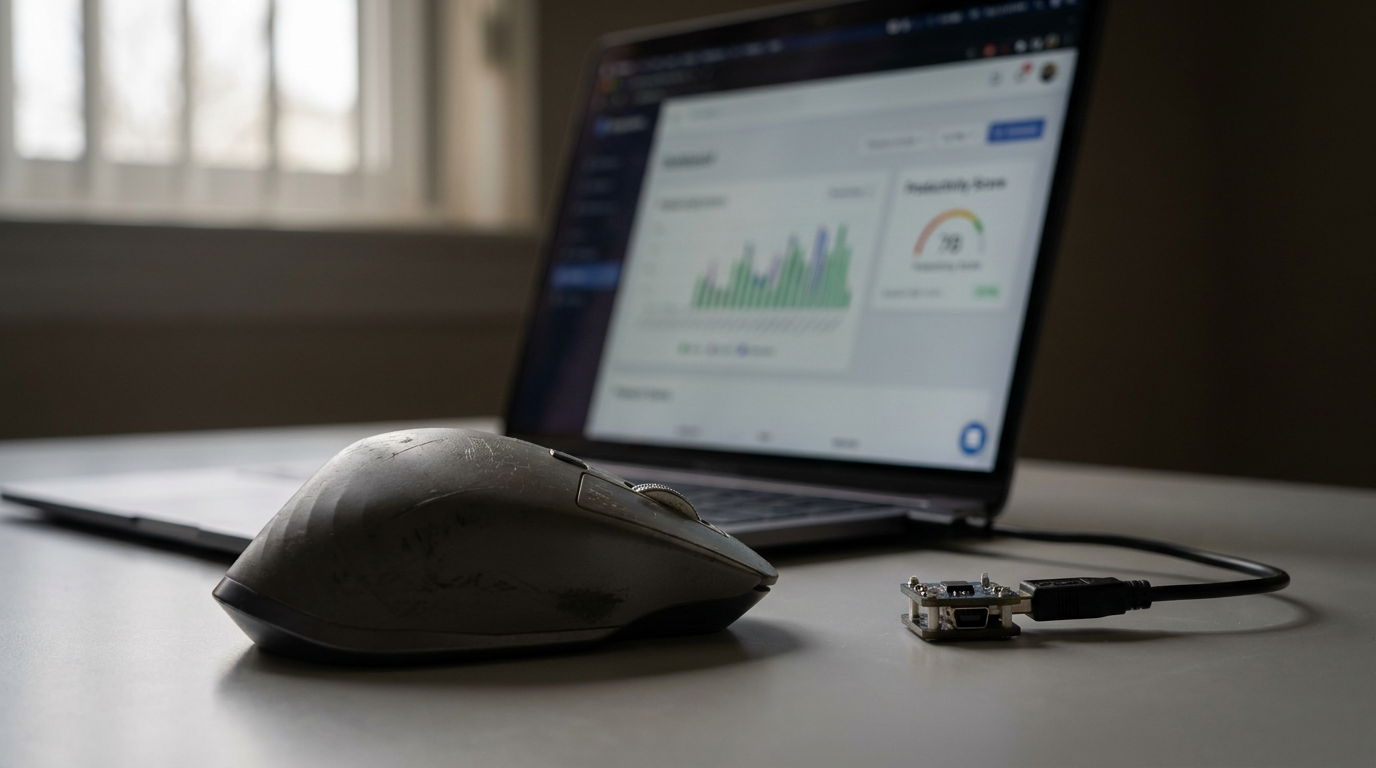
There is a kind of work that looks exactly like work without being work at all. A mouse moved in regular intervals. An email drafted with careful, upbeat phrasing. A camera-ready posture held for the duration of a video call. The task behind these behaviors is not the job you were hired to do — it is the secondary job that AI monitoring software has assigned you without explanation: appear productive to a system that cannot tell the difference.
Over the past several years, a market for workplace AI surveillance has quietly expanded into the ordinary infrastructure of white-collar employment. Tools now sold under names that invoke insight and optimization track keystrokes, mouse movements, application switching, idle time, browser activity, sentiment scores in emails and messages, video call attentiveness, and output rates measured against baseline aggregates of your own past behavior. Employers receive dashboards. Workers receive scores. The system, vendors promise, will surface who is actually working and who is coasting.
The reality these tools are producing is stranger and more damaging than either the vendors or their customers anticipated. Research into algorithmic oversight — including work from organizational behavior scholars at institutions like Cornell — has found that being monitored by an automated system produces distinctly different responses than being overseen by a human manager. And not better ones. Workers under algorithmic surveillance show higher rates of what researchers call counterproductive work behavior[2]: they disengage, they resist, they perform the signals the system rewards while quietly abandoning the substance underneath. They also quit at higher rates.
What the productivity dashboards are measuring, in other words, is increasingly a performance of productivity. The tool set up to fix the problem of unmeasured labor is generating a new problem: labor that is measured, tracked, scored — and fake.
What the System Actually Sees
To understand why this is happening, it helps to understand what these systems are actually measuring. The flagship promise of AI productivity monitoring is objectivity. Unlike a manager, who might favor certain personalities or overlook certain failures, an algorithm watches everyone the same way. It does not have favorites. It does not lose interest. It simply counts.
But what it counts is defined by what is countable. Keystrokes are countable. Deep thinking is not. The number of emails sent is countable. The quality of a single well-timed decision that changed a project's direction is not. Sentiment analysis can flag an email with low positivity scores, but it cannot distinguish between a message that is negative because the worker is disengaged and one that is negative because the worker is delivering honest feedback about a failing strategy. The gap between what these systems measure and what organizations actually need from skilled workers is not incidental — it is structural. It is built into the logic of what a sensor can sense.
“The gap between what these systems measure and what organizations actually need from skilled workers is not incidental — it is structural.”
This is not a new problem in the history of management. Frederick Winslow Taylor spent the early twentieth century trying to convert labor into measurable units, and the century since has been partly a story of how those metrics warp the behavior they were meant to describe. When call centers measure average handle time, workers rush calls. When hospitals measure readmission rates in isolation, edge cases get denied admission. The name for this in economics and policy research is Goodhart's Law[4]: when a measure becomes a target, it ceases to be a good measure. AI monitoring tools are Goodhart's Law running at machine speed, applied to the full surface area of a knowledge worker's day.
The Resistance the Dashboard Cannot See
Research into how workers actually respond to algorithmic oversight reveals something that productivity vendors tend not to include in their sales decks. Being monitored by an automated system triggers a distinctly different psychological response than being monitored by a person. Human oversight, even when uncomfortable, comes with the implicit possibility of context. A manager can notice you are struggling. A manager can be reasoned with, appealed to, or at least seen looking at you. A manager might ask what is going on.
An algorithm cannot do any of that. What organizational psychologists have found is that algorithmic monitoring tends to activate a sense of procedural injustice — the feeling that a system is evaluating you through a process that is fundamentally unable to see you accurately. And procedural injustice, across decades of workplace research, is one of the most reliable predictors of reduced effort, increased rule-bending, and exit. Not because workers are lazy or petulant, but because humans who feel evaluated unfairly tend to disengage from the standards of the evaluation. They stop trying to do well by the measure that cannot measure them, and they start trying to manage it.
This is how you get the mouse-jiggler industry. Physical mouse jigglers — small USB devices that move the cursor automatically — have existed for years, but demand spiked visibly during the remote-work era as employers rolled out monitoring software. The same pattern showed up in software: apps designed to simulate keyboard activity and application switching. The existence of an entire consumer market for tools that fool productivity monitoring is not a story about worker dishonesty. It is a story about what happens when people feel that the evaluation mechanism is fundamentally broken. They do not try to satisfy it. They try to escape it.
“The existence of a consumer market for tools that fool productivity monitoring is not a story about worker dishonesty. It is a story about what happens when people feel the evaluation mechanism is fundamentally broken.”
The Performance Layer
The more sophisticated response to algorithmic oversight — and the more consequential one — is not circumvention. It is adaptation. Workers who are not trying to cheat the system are still changing their behavior to satisfy it, and those changes carry their own costs.
A software developer who knows their system is tracking idle time will avoid the long, still period of thinking through a problem before typing a single line of code. Instead, they will type — drafts, experiments, placeholders — to keep the activity signal alive. The actual thinking does not disappear; it gets compressed, rushed, or skipped. A knowledge worker whose email sentiment is being scored will soften feedback, hedge criticism, and optimize for tone over honesty. A customer service employee whose handle time is measured will cut off nuanced conversations before they become productive. In each case, the behavior that the system is shaping is worse than the behavior the system displaced.
What is accumulating across these individual adaptations is something like an organizational self-deception. The dashboard shows healthy numbers. The underlying reality is a workforce that has learned to maintain the appearance of high performance rather than the substance of it. Managers read the scores and feel informed. Workers produce the scores and feel surveilled. The distance between those two experiences is where trust goes to die.
Who Benefits, and From What
It would be too simple to describe this as a story about bad technology. The employers deploying these systems are not, for the most part, malicious actors trying to grind their workers down. Many adopted monitoring tools in response to a genuine management problem: the shift to remote work removed the ambient visibility that offices provide, and some managers struggled to feel confident that distributed teams were actually functioning. Productivity monitoring was sold — convincingly, to a lot of people under real pressure — as a way to restore that visibility without reinstating the office.
The vendors selling these systems are, by almost any measure, winning. The employee monitoring software market has grown substantially over the past five years, with projections continuing upward as AI features become more sophisticated and cheaper to deploy. The product pitch has evolved too: early tools were fairly blunt instruments, but current offerings incorporate machine learning to build individualized behavioral baselines, flag anomalies, and generate automated reports that require minimal manager attention. The system is becoming more autonomous and more granular at the same time, which is exactly the direction its incentives push it.
The worker, in this structure, has the least leverage and the most exposure. The employer can decide to deploy, modify, or discontinue a monitoring system. The vendor can update its algorithms and redefine what counts as productive. The worker must adapt to whatever the current version of the system rewards, with little information about what is being measured, why it is being measured that way, or how the score is actually being used. This asymmetry is not a bug in algorithmic workplace surveillance. It is the feature that makes it commercially attractive.
What Better Oversight Actually Looks Like
None of this means that measuring work is wrong or impossible. Organizations do need to understand whether people are doing their jobs. Managers do need information. Remote and hybrid teams do create real coordination challenges that the casual visibility of a shared office used to solve for free. The question is not whether to measure work, but what measurement does to the thing being measured — and whether the people being measured know what that thing is.
Organizations that have deliberately pulled back from ambient monitoring and shifted toward outcome-based evaluation report some consistent findings: clearer goal-setting becomes more important, not less; management conversations become harder to avoid and more substantive when they happen; and workers report higher autonomy and higher engagement. None of this is particularly mysterious. Outcome accountability requires explicit conversations about what good looks like in a role. Process surveillance does not — it just watches. One of these builds the shared understanding of expectations that actually drives performance. The other replaces that understanding with a score.
“Outcome accountability requires explicit conversations about what good looks like in a role. Process surveillance does not — it just watches.”
Some jurisdictions are beginning to regulate the disclosure side of the problem. Several European countries, under GDPR-adjacent labor frameworks, now require employers to tell workers what monitoring is in place and what data is collected. New York City has enacted disclosure requirements for AI-based employment decisions[1]. These rules do not eliminate algorithmic oversight, but they begin to address the specific psychological harm of invisible evaluation — the sense that you are being scored by something that will not show you the rubric. Transparency is not a solution to bad measurement, but it is a prerequisite for any honest conversation about what is being measured and why.
The Deeper Shift
There is a longer story here, underneath the immediate problem of mouse jigglers and sentiment scores. Algorithmic workplace surveillance is one instance of a larger pattern in how AI is being deployed in institutions: as a replacement for human judgment rather than a support for it. The assumption baked into productivity monitoring tools is that continuous automated measurement is more reliable than a manager's ongoing relationship with their team. That assumption may be comforting, given how often managers get things wrong. But the alternative the tools offer is not actually better judgment. It is the removal of judgment and its replacement with a proxy.
The proxy, as it turns out, can be gamed. Workers learn the proxy's logic faster than their employers do. This is not unique to algorithmic monitoring — it is the standard trajectory of any measurement system that becomes high-stakes. But the speed at which AI tools can scale surveillance, and the opacity with which they can be deployed, compresses the timeline dramatically. The dysfunction that Taylorism took decades to fully install can now be imported into an organization in a quarter, quietly, via a SaaS subscription.
The score on the dashboard is real. The productivity it is supposed to represent is increasingly not. What the algorithm is producing, in workplace after workplace, is not a clearer picture of how people work — it is a new kind of labor, the hidden second job of managing your own metrics, performed silently alongside whatever the actual job is supposed to be. That second job does not appear on any productivity report. It does not show up as a cost. But it is where an increasing portion of the working day is going, one carefully timed keystroke at a time.
References
- Automated Employment Decision Tools (AEDT) (nyc.gov)
Establishes NYC's legal requirement that employers audit AI employment tools for bias before use, providing regulatory context for monitoring software oversight. - The impact of electronic monitoring on employees' job satisfaction, stress, performance, and counterproductive work behavior: A meta-analysis (sciencedirect.com)
Defines counterproductive work behavior that workers exhibit under algorithmic monitoring, including disengagement and resistance. - Employee monitoring in the home office: tools to counter micromanagement (computerworld.com)
Documents that demand for mouse-jiggler devices spiked during remote work as employers deployed monitoring software. - Goodhart's law (en.wikipedia.org)
Provides the economic principle that when a measure becomes a target, it ceases to be a good measure, applied to AI monitoring.
About Julian Cross
Julian Cross writes about AI, automation, surveillance, digital identity, labor, human relationships with each other and automation, complex systems and attention — less about what new tools, studies and observations can do in theory than what they're already doing to how we work, spend, relate, and get measured. His work follows leads to the point where it stops being a product and starts being a condition.
More like this
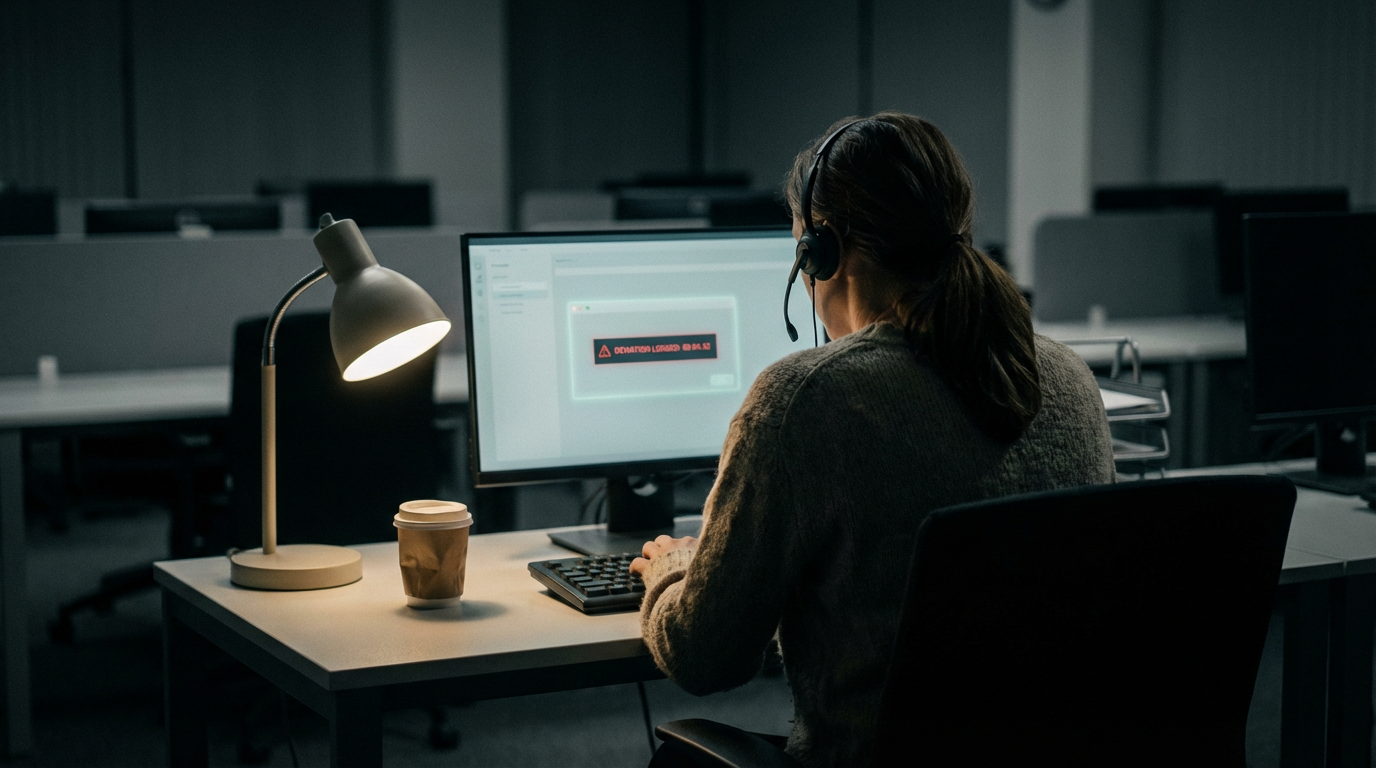
Tracked by Software, Judged by Nothing: How AI Surveillance Is Quietly Breaking the Workplace
A new study found that AI workplace monitoring produces worse outcomes than human oversight — and the reason turns out to be less about privacy than about something older and stranger.
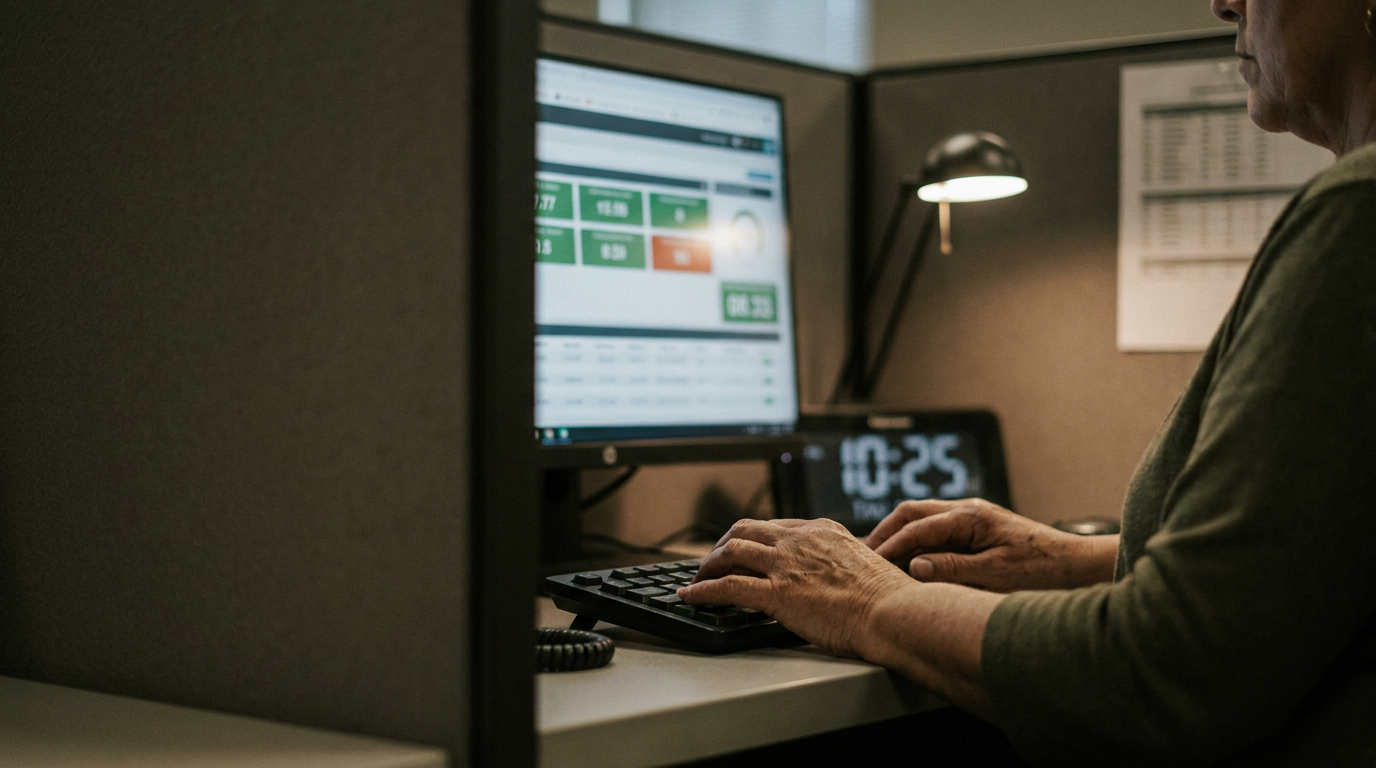
AI Is Watching You Work. It's Also Deciding What Work Means.
New research on algorithmic management reveals that workplace monitoring tools don't just measure productivity — they redefine it, rewarding whatever is easiest to see and slowly eroding everything that isn't.
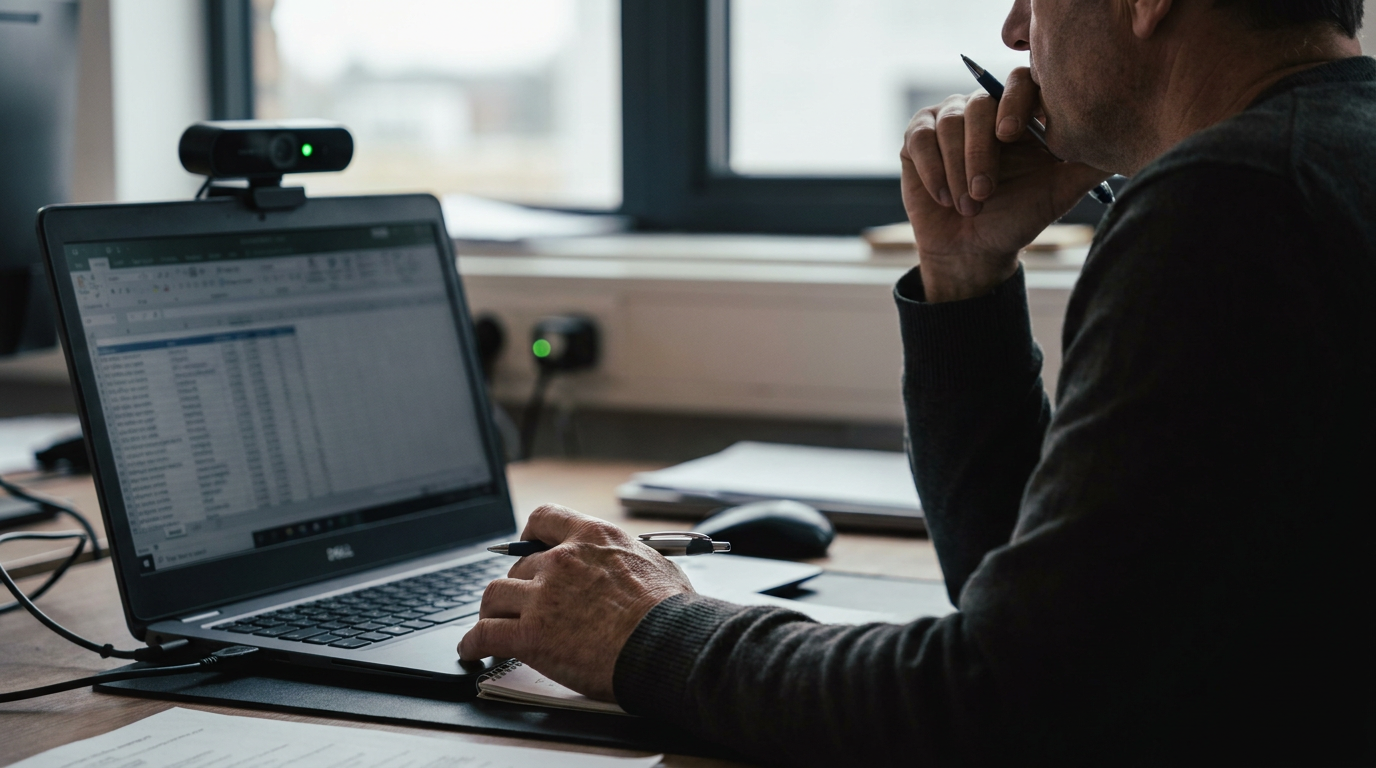
Your Productivity Score Is Real. The Productivity It Measures Isn't.
A new wave of AI scoring tools doesn't just watch workers — it quietly rewrites what counts as good work, and the rewrite favors employers in ways most workers never see coming.