You Are Being Watched at Work. The System Doesn't Know What It's Seeing.
Workplace AI surveillance is generating mountains of data on employee behavior — but a growing body of research suggests the systems are measuring the wrong things entirely, and workers have figured that out.
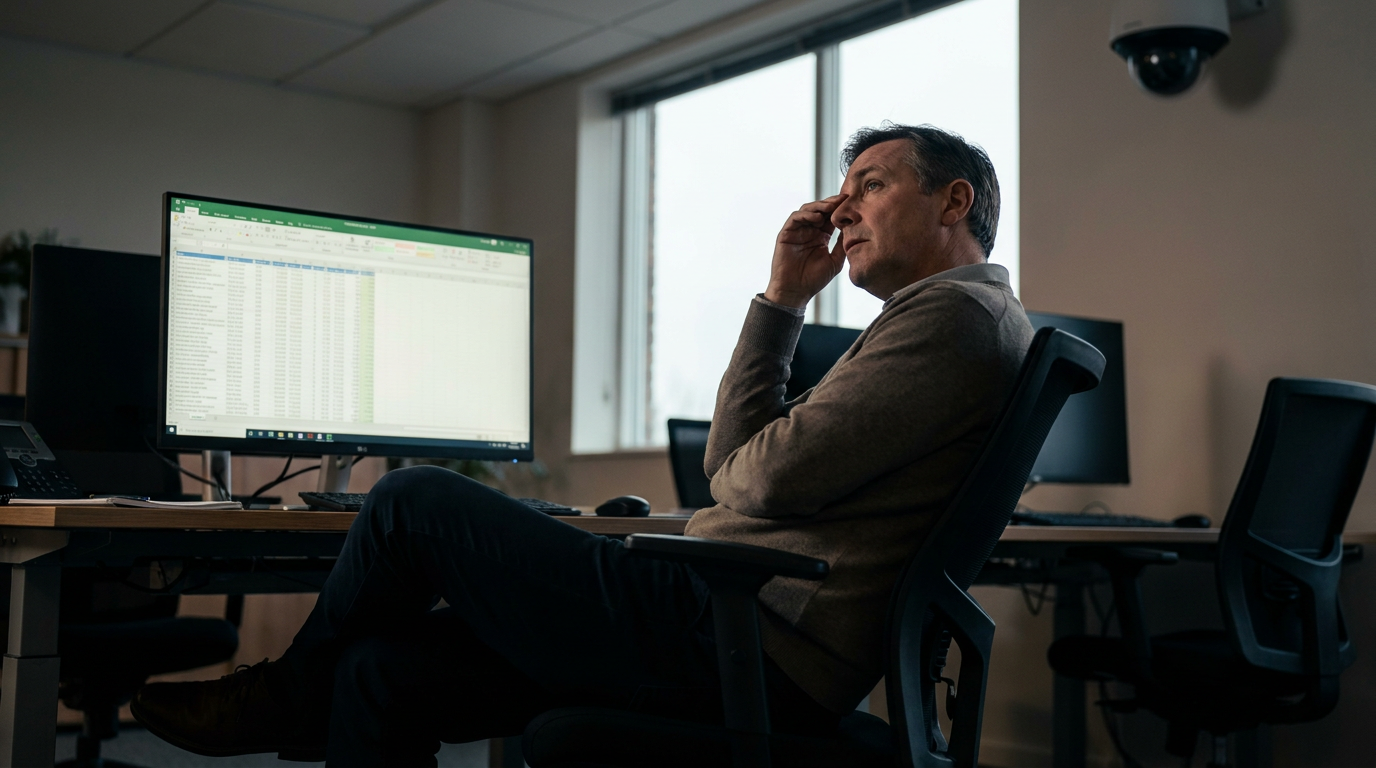
There is a particular kind of afternoon that knowledge workers know well. You are not typing. You are not moving your mouse. You are staring at a problem — a pricing anomaly, a personnel conflict, a strategic question that requires you to hold several contradictory possibilities in your head until one of them resolves. Nothing is happening on your screen. A great deal is happening in your mind. To anyone watching the surface, you look inert.
Increasingly, someone is watching the surface. In 2023, surveys by researchers tracking post-pandemic workforce management found that roughly 80 percent of large employers were using some form of automated employee monitoring software, up from about 30 percent before 2020[2]. These systems log keystrokes, track cursor movement, take periodic screenshots, measure application usage, monitor email metadata, and in some cases flag any stretch of apparent inactivity longer than a few minutes. The dashboards they produce are meant to show managers where productivity is happening and where it isn't. They show something else entirely.
A 2025 study out of Cornell's ILR School examined how AI-assisted monitoring systems interpreted knowledge worker behavior across a range of white-collar roles. The findings were not subtle. The systems consistently penalized what the researchers called "high-cognition low-motion" work — the category that includes analysis, planning, deliberation, and creative problem-solving. These activities generate minimal trackable screen behavior. The monitoring tools, trained on surface signals, registered them as idle time. Meanwhile, the systems reliably rewarded fast, visible, continuous activity: rapid email replies, frequent application switching, steady mouse movement. It was a good model for measuring a data-entry clerk in 1987. It was a poor model for measuring almost any contemporary office worker.
What makes this more than an interesting measurement error is what happened next. Workers noticed. They adapted. And the adaptation has quietly reshaped what goes on in a large number of monitored workplaces — not by making people more productive, but by making them more legible to machines that don't actually understand what they're looking at.
The Metric Is Not the Work
The core problem is not that employers want to know how their employees are spending time. That interest is legitimate and ancient. The problem is that AI monitoring systems generate a particular kind of data — granular, continuous, and quantified — that creates the illusion of objective measurement while actually measuring something much narrower. Keystrokes per hour is not productivity. Application switches are not engagement. Response time to email is not a proxy for quality of thought. These metrics are measurable, which gives them the authority of numbers, but they describe the texture of work rather than its substance.
This gap between what surveillance captures and what work actually is has a long intellectual history. Sociologists studying industrial labor noticed it in the era of time-motion studies: once you optimize for a measured output, you tend to get more of the measured output and less of everything the measurement was supposed to represent. The phenomenon has several names in the research literature — Goodhart's Law[3] is the most cited — but the basic mechanism is simple. When a measure becomes a target, it ceases to be a good measure. Applied to surveillance capitalism's entry into the office, the consequence is that the monitoring data companies are collecting may be generating a detailed, continuous, systematically misleading picture of what their employees are doing.
“When a measure becomes a target, it ceases to be a good measure — and the more sophisticated the monitoring, the more sophisticated the performance.”
The Cornell researchers were particularly interested in the asymmetry between roles. For workers whose output is itself digital and countable — software commits, customer tickets closed, calls handled — the monitoring systems produced reasonably coherent signal. The problem was concentrated in exactly the jobs where the output is hardest to quantify: managers, analysts, writers, strategists, researchers, and anyone whose primary value lies in judgment rather than volume. These are also, not coincidentally, among the higher-paid and more consequential roles in most organizations. The surveillance was most confident and most wrong precisely where accurate measurement mattered most.
The Performance Layer
Workers in monitored environments figured out the signals fairly quickly. This is not surprising — people have always learned to manage how they appear to authority. What is new is how specific the adaptation has become, and how openly it is discussed. On workplace forums, threads dedicated to specific monitoring platforms routinely include detailed breakdowns of exactly which behaviors trigger flags, which generate favorable scores, and how to maintain the appearance of continuous activity without actually sustaining it. Mouse-jiggler devices[4] — small accessories that keep the cursor moving without human input — became a minor retail phenomenon during the remote-work era. They are still selling.
But the more consequential adaptation is subtler than a gadget. It is a cognitive reorientation — a learned habit of performing for the monitoring layer while doing the actual work in whatever space the monitoring layer cannot see. Employees in the Cornell study described checking in to visible tasks before returning to difficult ones. They described breaking concentration to send an email, not because the email needed to be sent, but because the activity generated a favorable timestamp. They described the experience of holding two simultaneous registers: the work they were doing and the work they were performing. Several used the same phrase independently: playing the game.
“The surveillance didn't eliminate bad actors or install discipline — it installed a performance layer between the employee and the employer, and now both sides are operating through it.”
This is what makes the surveillance problem structurally different from a simple measurement error that can be corrected with a better algorithm. The behavior being measured is now partly a response to the measurement. Employers are looking at data that reflects, in some significant portion, how well their employees have learned to produce the data employers want to see. This is not manipulation in any useful moral sense — it is a rational behavioral response to an incentive structure. People who feel watched adjust what they show. That is as ordinary as it gets. The extraordinary thing is that a multi-billion-dollar industry of monitoring software has been built on the premise that the watched party's behavior remains unchanged by the watching.
Who the System Rewards
There is a distributional story embedded in this pattern, and it runs in a troubling direction. The workers who suffer most under systems that misread high-cognition low-motion work are those whose actual work is most cognitively demanding. A senior analyst who spends forty-five minutes thinking through a model before touching the spreadsheet is penalized. A junior associate who rapidly processes routine tasks looks excellent. Over time, if performance evaluations are influenced by monitoring scores — and in many organizations they increasingly are — this creates a systematic bias against exactly the kinds of sustained, effortful thinking that produce the most valuable output.
Simultaneously, the workers who adapt most fluently to surveillance regimes are not necessarily the best workers. They are the most surveillance-literate workers — people who are good at modeling the system, identifying its blind spots, and managing their visible behavior accordingly. This is a real skill, but it is not the skill employers intended to select for. There is some irony in the fact that the same cognitive flexibility that makes someone good at gaming the monitoring system might also make them genuinely high-performing. But there is no reason to assume the two groups overlap reliably. The surveillance is selecting for one of them and hoping it catches the other.
There is a class dimension worth sitting with here. High-surveillance, high-scrutiny monitoring tends to be implemented most intensively for workers with the least bargaining power — call center employees, remote workers in lower-wage roles, gig workers whose entire relationship to an employer is mediated by an algorithmic score. These workers often have the fewest resources to push back, the least access to legal support, and the most to lose from a bad rating. Meanwhile, executives and senior leadership are typically not subject to the same systems. The people setting monitoring policy are not the people living inside it.
What Companies Actually Get
Companies that deploy these systems are buying something they are probably not receiving in the form they expect. They are receiving a stream of behavioral data that is continuous, granular, and numerically authoritative-looking. What they are getting, in substance, is a combination of: accurate signal about a subset of work that happens to be surface-visible; noise generated by workers adapting their behavior to the monitoring; systematic gaps where the most cognitively valuable work registers as nothing; and a cultural output — mistrust, resentment, performativity — that almost certainly affects the actual quality of work in ways that do not show up in any dashboard.
The trust erosion is worth taking seriously as a material business problem rather than just an ethical one. Research in organizational psychology consistently finds that employee discretionary effort[1] — the work people do beyond the minimum required, the problems they flag before they become crises, the creative contributions that are never technically required — depends heavily on perceived fairness and mutual trust. Surveillance that is experienced as distrust tends to compress discretionary effort back toward the minimum. It is possible to build a system that monitors employees intensively enough to guarantee they are present and active, and simultaneously destroy the conditions under which they would do their best work.
“You can monitor someone into showing up and still monitor them out of caring.”
The Feedback Loop Nobody Planned
The deeper structural problem is that the monitoring industry has no strong corrective mechanism. Employers buy the systems, the systems produce data, managers use the data, and the performance review cycle continues. The feedback loop that might reveal the measurement failures — workers doing worse over time despite high surveillance scores, or better work happening in unmeasured ways — is slow and causally murky. Correlating long-term output quality against monitoring regime is hard. Correlating keystroke frequency against quarterly earnings is harder. The data that would reveal the system's failures is exactly the kind of data the system is worst at collecting.
Vendors, for their part, have strong incentives to show employers what they paid to see: that monitoring reveals something actionable. The platforms are not neutral instruments. They have dashboards designed to surface outliers, generate alerts, and give the impression that the system is catching something real. Whether the caught behavior reflects actual performance problems or reflects a misread of cognitively demanding work is not a distinction the dashboard is designed to make visible. The product's value proposition depends on the employer believing the signal is reliable. That is a significant conflict of interest sitting at the center of an industry that now touches tens of millions of workers.
The Quiet Cost of Getting This Wrong
What is accumulating, across thousands of workplaces, is something like a slow institutional reorientation. Organizations are training themselves — through the incentives embedded in the monitoring systems, through the evaluations those systems influence, through the workers those evaluations promote — to value visible activity over invisible thought. That is not a new organizational pathology; bureaucracies have always had this tendency. What is new is that the tendency is now being systematized at scale, given a numerical veneer, and sold as a solution to the problem of not knowing what employees are doing.
There is a version of the future where the measurement problem gets addressed — where monitoring systems learn to track output rather than activity, integrate self-reporting with behavioral data, and acknowledge the categories of work they cannot see. Some vendors are moving in this direction. But the economic and psychological logic pushing companies toward surveillance is not primarily about accuracy. It is about control, legibility, and the feeling of oversight. Those desires do not disappear when the measurement turns out to be bad. They find a new instrument. The question for any organization trying to do this better is whether it can resist the seduction of a dashboard that makes work look simple when the work itself has never been simple. So far, the market's answer has been mostly no.
References
- The Neuroscience of Organizational Trust and Business Performance: Findings From United States Working Adults and an Intervention at an Online Retailer (pmc.ncbi.nlm.nih.gov)
- 20+ Employee Monitoring Statistics [2023]: Benefits, Trends, and Legal Risks - Zippia For Employers (zippia.com)
Provides the statistic that employer use of automated employee monitoring software rose to roughly 80 percent by 2023, up from about 30 percent before 2020. - Goodhart's law (en.wikipedia.org)
Defines Goodhart's Law—'when a measure becomes a target, it ceases to be a good measure'—the core principle explaining why surveillance metrics misrepresent actual work. - Workers Are Using ‘Mouse Movers’ So They Can Use the Bathroom in Peace (vice.com)
Documents mouse-jiggler devices as a worker adaptation to surveillance systems, showing how employees maintain visible activity without actual work engagement.
About Julian Cross
Julian Cross writes about AI, automation, surveillance, digital identity, labor, human relationships with each other and automation, complex systems and attention — less about what new tools, studies and observations can do in theory than what they're already doing to how we work, spend, relate, and get measured. His work follows leads to the point where it stops being a product and starts being a condition.
More like this
AI Is Watching You Work. It's Also Deciding What Work Means.
New research on algorithmic management reveals that workplace monitoring tools don't just measure productivity — they redefine it, rewarding whatever is easiest to see and slowly eroding everything that isn't.

Your Productivity Score Is Real. The Productivity It Measures Isn't.
A new wave of AI scoring tools doesn't just watch workers — it quietly rewrites what counts as good work, and the rewrite favors employers in ways most workers never see coming.
The Boss Isn't Watching You. The Algorithm Is. And It's Worse.
AI productivity tools promised to measure how well people work — instead, research suggests they're quietly teaching workers to game the measurement instead.