Your Employer Is Training Its Replacement on Your Keystrokes
Workplace monitoring has quietly shifted from measuring performance to harvesting the behavioral data needed to automate the people being measured — and most workers have no idea which side of that line they're on.

Somewhere in the background of your workday, something is counting. How many keystrokes you make per hour. How long you spend in a document before saving it. Which phrases you use most often in email. How quickly you respond to a customer complaint, and which words you reach for when you do. None of this tracking is secret, exactly. It's buried in the terms of whatever productivity platform your employer licenses, or disclosed in the onboarding paperwork you signed and forgot. But the fact that it is technically disclosed is doing a lot of work in that sentence. Most workers know they are being monitored in some general sense. What they do not know — what almost no one tells them — is what the monitoring is ultimately for.
The standard story about workplace surveillance is a story about accountability. Companies say they need to know that remote workers are actually working, that customer-service agents are hitting their metrics, that warehouse workers are moving at a pace the business model requires. This story is real. But it is increasingly incomplete. A parallel story has been emerging in the coverage of enterprise AI deployment, documented by reporters at MIT Technology Review and reflected in the product roadmaps of the companies selling these platforms: the behavioral data collected from monitoring workers is being used to train the automation systems intended to replace them. The employee and the training set are the same person.
This is not a conspiracy. It does not require a villain issuing a secret memo. It is a structural feature of how modern AI systems get built, and how modern enterprises are choosing to build them. If you want to automate a task, you need data describing how that task gets done. The richest source of that data is the people currently doing it. Surveillance infrastructure already pointed at workers for productivity purposes turns out to be extraordinarily useful for a second, less advertised purpose: behavioral capture. The monitoring system and the training pipeline share the same inputs. One watches you work. The other learns from what it sees.
What makes this particular loop so difficult to exit is that the workers inside it have almost no vantage point from which to see it. You can ask your manager how your performance is being evaluated. You cannot easily ask which of your work patterns are being fed into a model, what that model is learning, or whether your role exists on a timeline that ends with you training your own successor. The asymmetry is not incidental. It is built into the architecture of how these systems are sold, deployed, and described — almost always in the language of efficiency and support, almost never in the language of replacement.
What the Monitoring Actually Captures
Modern workplace monitoring platforms have moved well past keystroke counting and screenshot audits, though those still exist and are still in use. The more sophisticated systems — sold under branding that emphasizes productivity analytics, workforce intelligence, or employee experience — capture something richer: the texture of how work actually gets done. They log which applications a worker switches between and in what order. They analyze communication patterns across email and internal messaging, tracking response times, sentiment, and the social graph of who talks to whom. They record how workers navigate complex systems, which steps they take first, which errors they make, and how they recover from them. In customer-facing roles, they capture conversation flows, escalation decisions, and the informal scripts workers develop over time to handle edge cases.
This is not monitoring as a blunt instrument. It is behavioral capture at a level of granularity that was simply not possible ten years ago. And the data it produces is precisely the kind of data that large language models and process-automation systems need to become useful in complex, context-dependent environments. A general-purpose AI model can write a grammatically correct email. An AI system trained on thousands of hours of your company's actual customer-service interactions — capturing the specific phrasing, the decision trees, the escalation logic that experienced agents have developed — can do something much closer to the actual job. The difference between a useful automation and a generic one is often the behavioral specificity of the training data. Workers provide that specificity every day without knowing it.
“The difference between a useful automation and a generic one is often the behavioral specificity of the training data — and workers provide that specificity every day without knowing it.”
The Enterprise AI Pipeline Nobody Explains to Employees
Enterprise AI vendors are not coy about this dynamic when they talk to buyers. The sales pitch for workflow automation tools frequently emphasizes the ability to learn from existing employee behavior — to capture best practices, to model how your top performers work, to scale those patterns across the organization. This is pitched as a feature. The word used is almost always something like augmentation. The system watches how your best people do the job and helps everyone else do it similarly. What is less emphasized in that pitch is the logical extension: once the system has learned to do the job similarly, the threshold for how many humans you need to do it starts to move.
The timeline matters here, because it explains why workers find the loop so hard to see from inside. The monitoring phase and the automation phase are separated in time, sometimes by years. A company installs productivity analytics today — often for genuinely mundane reasons, like managing remote teams or identifying bottlenecks in a workflow. The behavioral data accumulates. The AI tools improve. The automation pilots begin in a different department, or a different country, or under a different budget line. By the time the connection between the monitoring and the displacement becomes visible to the workers who were monitored, the causal chain is long enough to feel deniable. The surveillance didn't replace you. The efficiency initiative did. The restructuring did. The technology transition did.
“The surveillance didn't replace you. The efficiency initiative did. The restructuring did. The technology transition did.”
What gives this dynamic institutional staying power is that it does not require any single actor to be consciously deceptive. The HR team that implements the monitoring platform is thinking about absenteeism and remote work compliance. The IT team managing the data infrastructure is thinking about storage and security. The business-unit leader commissioning the automation pilot is thinking about cost reduction in the abstract. The AI vendor is thinking about model performance. No one in the chain is required to explicitly acknowledge that the worker being monitored is also the training data for the worker's eventual replacement. The system produces that outcome without anyone having to say so.
Who Is Most Exposed
The workers most exposed to this dynamic are not the ones with the least data footprint. They are the ones with the most structured, most legible, most richly documented work. Roles that involve navigating software systems, communicating through digital channels, following decision trees, handling inbound requests, and producing text-based outputs are extremely well-suited to behavioral capture. That describes an enormous share of the modern knowledge economy: customer service, claims processing, loan underwriting, content moderation, paralegal work, back-office finance, lower-tier software development, and large portions of administrative work across every industry.
Research into labor displacement and automation vulnerability has consistently found that the risk is not simply a function of whether a job involves physical or cognitive work. It is a function of how routine, how observable[2], and how well-defined the behavioral sequence is. Workplace monitoring accelerates this because it converts tacit knowledge — the informal, intuitive, hard-to-articulate expertise that experienced workers develop — into explicit, structured data. Before surveillance platforms existed at this level of granularity, that tacit knowledge was largely invisible to automation. A worker might know intuitively how to de-escalate an angry customer, but that knowledge lived in their head and couldn't easily be extracted. Log every conversation, tag every outcome, and run it through a model long enough, and the tacit becomes a training signal. The expertise gets legible, and once it is legible, it gets transferable.
The Consent Problem Nobody Is Solving
There is an obvious question sitting in the middle of all of this, which is whether workers should have a meaningful say in whether their behavioral data is used to train automation systems. Current legal frameworks in most jurisdictions offer very little here. Employment law generally gives employers wide latitude to collect data about how work is performed on company systems during company time. Privacy regulations like GDPR in Europe[1] have created some constraints — employees in the EU have stronger rights to know what data is collected and why — but enforcement in the workplace context has been inconsistent, and the specific question of whether behavioral data collected for performance monitoring can be repurposed for AI training remains genuinely unsettled.
What makes this a hard policy problem, and not just an obvious fix, is that the repurposing is often not a discrete decision. There is no moment when someone decides to take the monitoring data and hand it to the AI team. The data flows into systems that are themselves evolving. The uses change as the tools change. An enterprise platform that is sold today as a productivity analytics tool may, in three years, offer AI automation features that were not in the original deployment plan and that are trained, at least in part, on the accumulated behavioral logs the company has been generating all along. Regulating that requires either very broad worker data rights that follow the data wherever it goes, or disclosure requirements that companies currently have little incentive to adopt voluntarily.
“There is no moment when someone decides to take the monitoring data and hand it to the AI team — the data flows into systems that are themselves evolving, and the uses change as the tools change.”
What Visibility Would Actually Require
The workers' rights organizations and labor researchers who have engaged most seriously with this problem tend to land in a similar place: the issue is not primarily about banning monitoring, which is both politically unrealistic and not necessarily the right frame. The issue is about information asymmetry. Right now, the employer knows what data is collected, how it is used, what it feeds into, and what the strategic intent behind the monitoring system is. The worker knows almost none of that. Closing that gap would require something like a genuine right to algorithmic transparency in the employment relationship — not just disclosure that monitoring happens, but disclosure of what the behavioral data is being used to build, and on what timeline.
Some researchers in labor economics and organizational behavior have proposed collective bargaining as the most viable near-term mechanism: unions and worker organizations negotiating data rights alongside wage and benefits packages, requiring employers to disclose AI training uses of employee data and to share in the productivity gains that result. This has happened in isolated cases, particularly in creative industries[3] where the analogous problem — using workers' creative output to train generative AI — has been a visible flashpoint. But it has not reached the broader service and knowledge economy, where the surveillance loop is arguably most advanced and where worker organizing is also most constrained.
The Habit This Installs
What strikes me most about this dynamic is not the automation endpoint. It is the habit it installs in the present, before any particular job is automated. Workers who know they are being intensively monitored change how they work. Research on surveillance and performance finds that monitoring tends to compress behavior toward whatever the system rewards visibly, at the expense of the less measurable things — the informal knowledge-sharing, the creative deviation, the slow institutional understanding that doesn't show up on a productivity dashboard. When workers suspect, even without confirmation, that they are also training their eventual replacements, the logical adaptive response is to become less transparent, more performative, more mechanical. Which is, in a grim irony, exactly the kind of legible, structured behavioral data that is easiest to learn from. The surveillance shapes the workers into better training sets, whether they cooperate or not.
Most people at work are not thinking about this on a systems level. They are thinking about their task queue, their next meeting, the response they owe someone. That is exactly how structural changes tend to work — not through moments of visible rupture, but through the gradual accumulation of small adjustments, defaults, and dependencies that reorganize daily life before anyone has named what is happening. The monitoring platforms are already deployed. The behavioral data is already accumulating. The automation tools are already learning. The only part of this system that does not yet have good information about how it works is the part that built it in the first place.
References
- Employee Monitoring Moving Target Regulation (eurofound.europa.eu)
Provides context on privacy regulations like GDPR in Europe that govern workplace monitoring practices. - Automation and New Tasks: How Technology Displaces and Reinstates Labor (aeaweb.org)
Establishes that automation risk depends on how routine, observable, and well-defined work behavior is, not just physical versus cognitive labor. - Belaboring the Algorithm: Artificial Intelligence and Labor Unions - Yale Journal on Regulation (yalejreg.com)
About Julian Cross
Julian Cross writes about AI, automation, surveillance, digital identity, labor, human relationships with each other and automation, complex systems and attention — less about what new tools, studies and observations can do in theory than what they're already doing to how we work, spend, relate, and get measured. His work follows leads to the point where it stops being a product and starts being a condition.
More like this

Your Productivity Score Is Real. The Productivity It Measures Isn't.
A new wave of AI scoring tools doesn't just watch workers — it quietly rewrites what counts as good work, and the rewrite favors employers in ways most workers never see coming.
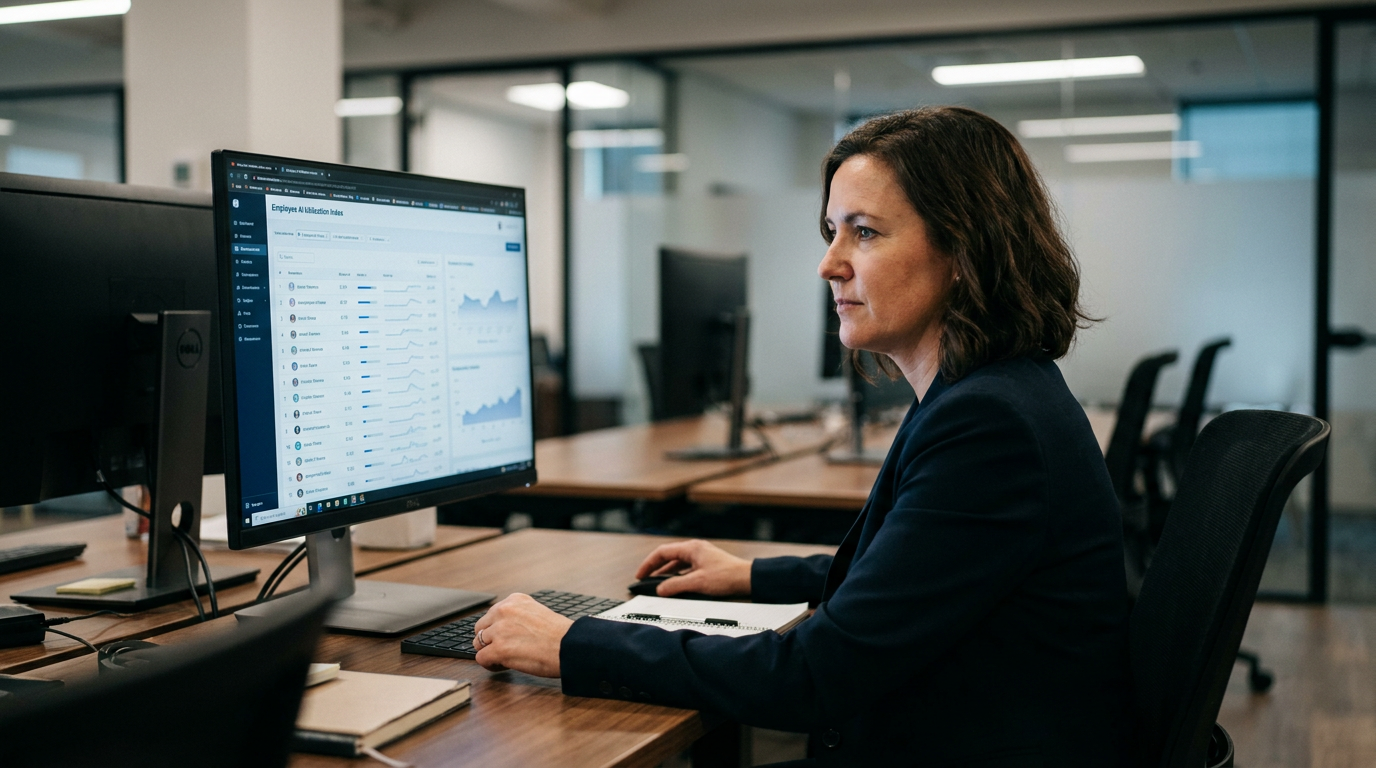
Your Employer Is Tracking How Much You Use AI. That's the New Performance Review.
Internal leaderboards ranking employees by AI usage aren't measuring productivity — they're measuring compliance, and the difference is quietly reshaping who gets promoted and who gets managed out.
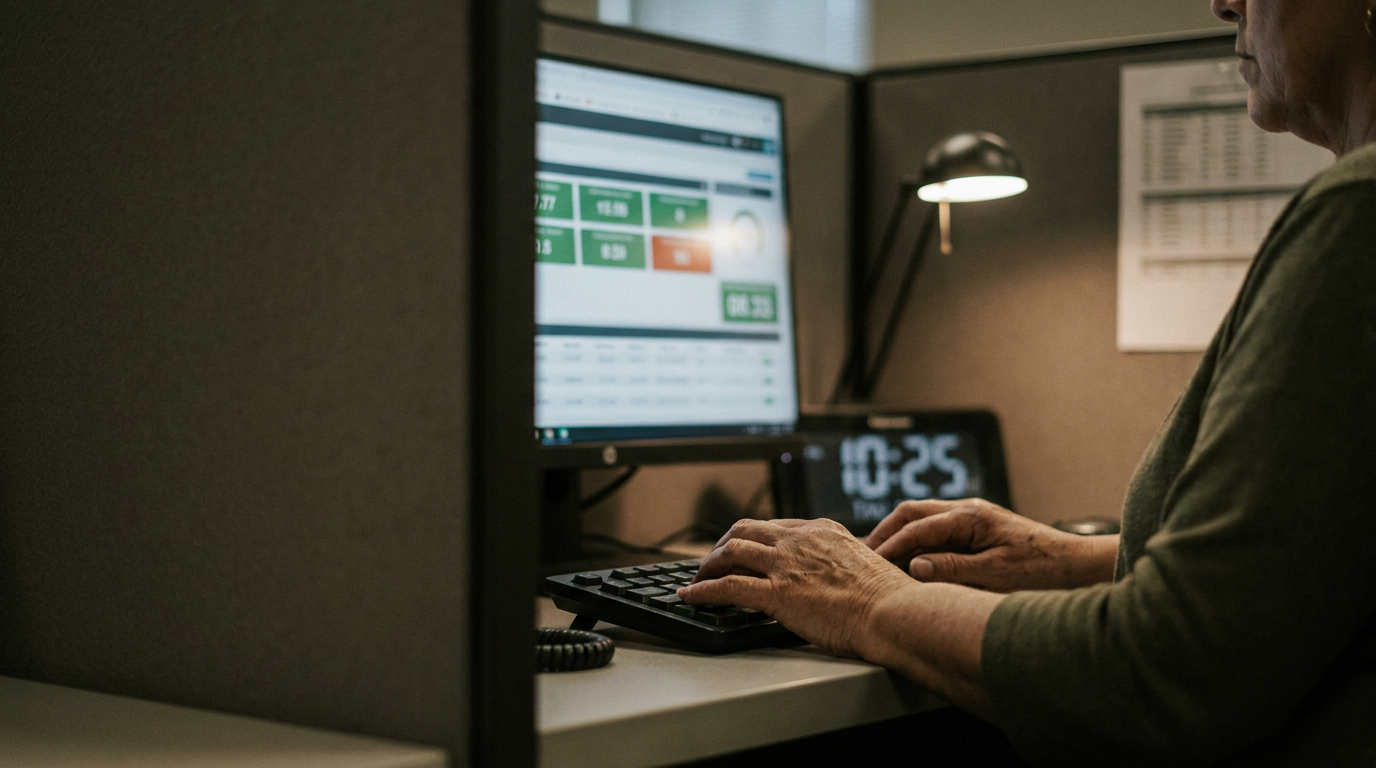
AI Is Watching You Work. It's Also Deciding What Work Means.
New research on algorithmic management reveals that workplace monitoring tools don't just measure productivity — they redefine it, rewarding whatever is easiest to see and slowly eroding everything that isn't.