America's Political Violence Early Warning System Is Being Dismantled Before the Midterms
Political violence is measurably rising, the early-warning infrastructure built to catch it is being stripped for parts — and the same administration doing the stripping is generating the flashpoints.
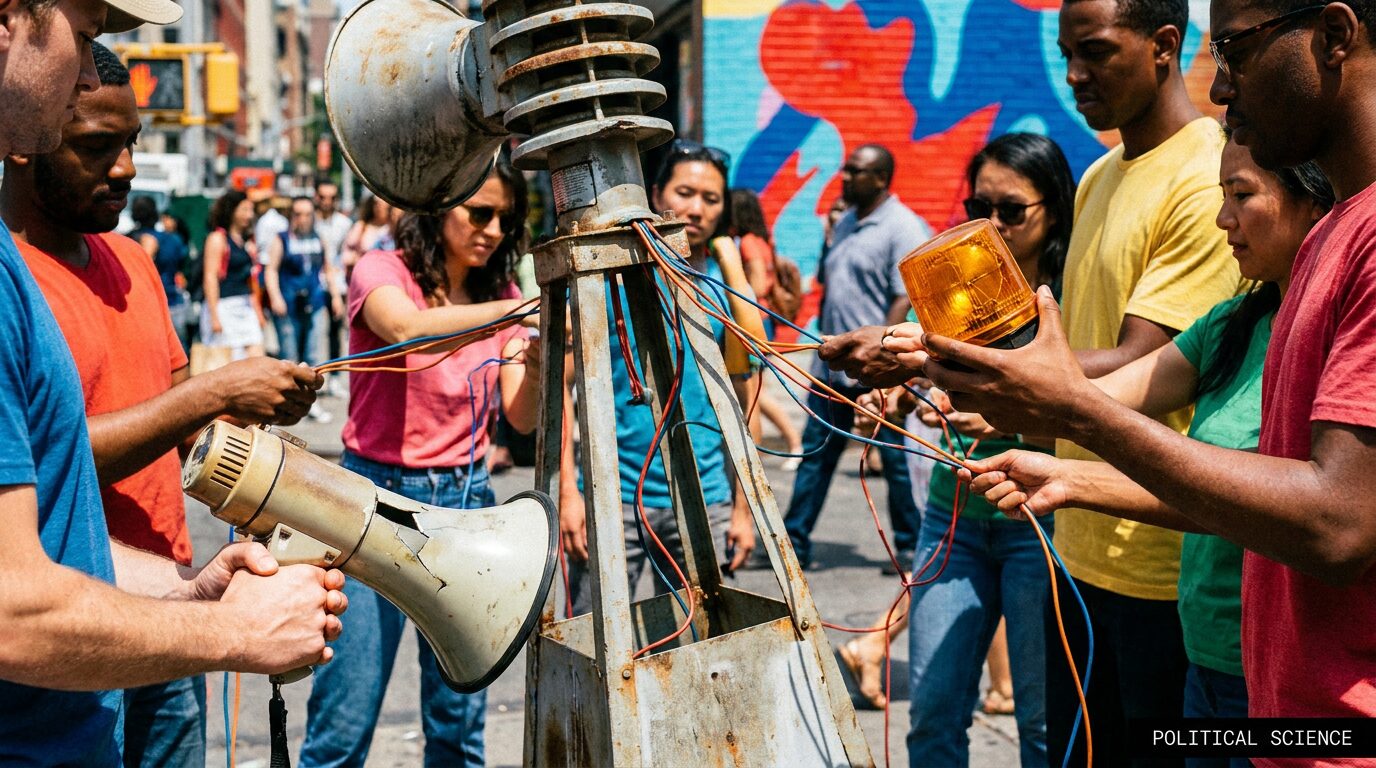
Here is what a functioning early-warning system for political violence looks like: databases that track terrorism and targeted violence in near real-time, federal agencies with personnel dedicated to threat assessment and community prevention, grant programs funding local de-escalation networks, and fusion centers sharing intelligence between federal, state, and local law enforcement. Here is what that system looks like right now: gutted. The databases are offline. The grant programs are zeroed out. The personnel are gone or reassigned to immigration sweeps. And the midterm elections are less than six months away.
This is not a story about budget austerity. It is a story about a specific, traceable decision to remove the instruments that detect danger while simultaneously pulling levers that generate it. The Bridging Divides Initiative (BDI) at Princeton University[4], one of the country's most credible non-partisan trackers of political violence, has documented both sides of this equation — the rising threat environment and the collapsing infrastructure meant to manage it — in a report published this spring. The picture it draws is not one of accident or oversight. It is one of compounding, self-reinforcing systemic failure with a clear class of beneficiaries and a clear class of people left exposed.
The Numbers Before the Erasure
Start with what the data showed before the data was deleted. According to the National Consortium for the Study of Terrorism and Responses to Terrorism (START) at the University of Maryland, "there was a 34.5% increase in total [terrorism and targeted violence] events" in the first eight months of 2025 relative to the same period in 2024. That dataset — the Terrorism and Targeted Violence (T2V) project[2] — was the only publicly available, comprehensive source for tracking domestic terrorism, hate crimes, and school shootings across the country. The Global Terrorism Database's T2V project was an open-source database containing information on thousands of domestic terrorist attacks, covering targeted attacks including workplace violence, school shootings, hate crimes, and attacks on critical infrastructure.
START's T2V dataset was forced to discontinue its data collection program in March 2025 when the Trump administration cancelled its funding. The database was terminated after Trump cancelled nearly $20 million of funding for 24 projects related to violence prevention. The timing is worth sitting with. Several days before the team received notice of the project's termination, they had identified a 25 percent increase in terrorism and targeted violence threats in the first two months of 2025 compared to the same time in 2024. The administration pulled the plug on the only tool capable of measuring the fire — while the fire was growing.
The T2V data had found that "grievance-motivated mass violence — a type of public safety harm that has been understudied and virtually ignored by the homeland security community — is the deadliest form of targeted violence in the United States." The data also showed an increasing "intersection of terrorism, hate crime (especially anti-Semitism), and school-based mass violence — something that state and local law enforcement are neither trained nor prepared to detect and counter." That intelligence no longer flows to the people who need it. The team can no longer use the data to train more than 15,000 law enforcement officers on the contemporary threat landscape.
The Infrastructure Being Stripped
The T2V cancellation was not a one-off. It was the opening act of a broader dismantlement. This dismantling of the country's terrorism and extremism prevention programs began in February 2025, when staff of USAID's Bureau of Conflict Prevention and Stabilization were put on leave. In March, the Center for Prevention Programs and Partnerships at the Department of Homeland Security — which worked to prevent terrorism with a staff of about 80 employees — laid off about 30% of its staff. Staff at the State Department's Office of Countering Violent Extremism and Bureau of Conflict and Stabilization Operations, which led U.S. anti-violent extremism efforts, were laid off and the units shuttered on July 11, 2025.
At DHS, the Trump administration gutted the Center for Prevention Programs and Partnerships, which had previously awarded nearly $90 million to community groups and law enforcement agencies in 41 states and the District of Columbia that work to prevent terrorism and targeted violence. Additionally, the DOJ terminated hundreds of violence prevention grants awarded to law enforcement agencies, nonprofit organizations, and state and local governments — including 56 hate crime prevention and anti-extremism grants. The cuts came at a time of near-record-high rates of reported hate crimes. The administration also dismantled a national database used to track domestic terrorism and hate crimes, discern trends in extremist tactics and develop strategies to address them.
Then there is CISA — the Cybersecurity and Infrastructure Security Agency — which, among other functions, served as the connective tissue for election security coordination between federal and state officials. The agency shuttered entire divisions and lost roughly one-third of its personnel, becoming a punching bag for the president after CISA contradicted his false claims of widespread election fraud in 2020. Now the administration wants to go further. The proposed 2027 budget would notably eliminate CISA's election security program entirely, including cutting funding for information-sharing support to state and local officials and removing dedicated election security advisors across the country. The proposed cuts decrease CISA's budget by $707 million and completely eliminate CISA's Election Security Program. The nation heads into the midterms with that architecture largely dismantled, or on the way out.
“The administration pulled the plug on the only tool capable of measuring the fire — while the fire was growing.”
Cuts have been announced or are under consideration for a range of federal agencies, including CISA, which plays a key role in election security; the DHS Office of Intelligence & Analysis, which supports the National Fusion Centers that operate as data-sharing and threat analysis hubs for local law enforcement; and even the FBI, with reports that agents have been pulled from core responsibilities and local law enforcement assistance to aid in immigration operations. That last piece matters. Counterterrorism professionals, seasoned by years of domestic threat work, are being reassigned to immigration enforcement. The pipeline of expertise doesn't just pause — it dissolves. The work done within the prevention infrastructure wasn't perfect, but it was highly specialized, with expertise built over two and a half decades.
The Flashpoints Being Generated
What makes this a systems failure rather than just ordinary budget cutting is the simultaneity: as the detection and prevention infrastructure comes down, the conditions for political violence are being actively inflamed. The BDI's special report on 2025 trends[1] documents the environment clearly. In the aftermath of high-profile assassinations and shootings, threats against public figures and even private citizens have surged, compounding the chilling effects of violence. The U.S. Capitol Police reported an increase in "threat assessment cases" against members of Congress for the third year in a row in 2025, with a 58 percent rise from 2024.
Results from BDI's survey of local elected officials with CivicPulse, a non-profit research organization, show that 75 percent of officeholders are now less willing to engage in key political activities like working on controversial issues or running for higher office due to concerns about hostility. That is not a fringe finding. Three out of four local elected officials — school board members, county supervisors, city councilors — are pulling back from democratic participation because they are afraid. That is democratic backsliding in its most concrete form: not a coup, not a law, just fear doing the work that repression usually has to do openly.
BDI recorded more than 80 incidents targeting local public officials in September alone — a 280% increase from August and the highest monthly total in 2025. Already in 2026, the risk landscape has continued to intensify with the fatal shootings of Renee Nicole Good and Alex Pretti by federal agents in Minnesota, the Trump administration's consideration of the Insurrection Act and plans for additional federal deployments, and the FBI raid of a Georgia election facility ahead of the midterms. These are not ambient social conditions that governments inherited. They are the direct product of specific choices by a specific administration.
Then there is the pardon question. On the first day of his second term, Trump granted blanket clemency to all people — nearly 1,600 — convicted of or awaiting trial or sentencing for offenses related to the January 6 Capitol attack. Trump's grant of clemency was described by counterterrorism researchers as encouraging future political violence. At the FBI, the Trump administration's post-clemency vows of payback sidelined a cohort of senior officials who oversaw the January 6 portfolio of cases, resulting in the loss of some of the bureau's most seasoned counterterrorism professionals. The people with the most institutional knowledge about organized domestic extremism were pushed out. The people they had spent years monitoring were let out. The database tracking the resulting threat landscape was shut down. This is a sequence, not a coincidence.
Who Fills the Gap — and What That Costs
“Fear is doing the work that repression usually has to do openly: three out of four local elected officials are pulling back from democratic participation because they are afraid.”
The Princeton BDI report does identify some resilience in the system. Monitoring and data-sharing networks at the state, local, and civil society levels are stepping up to fill the gap left by funding cuts to trusted federal resources for violence detection and prevention. BDI and partners across the risk mitigation ecosystem have worked for years to improve reporting and communication on political violence in the U.S., building the infrastructure necessary for a data-driven early warning system. Community-level de-escalation trainers, local officials who have built horizontal coordination networks, and civil society organizations are holding pieces of the system together with limited and unstable resources. As the piece we've written about democratic backsliding argues, this kind of slow institutional erosion rarely announces itself — it depends on the gradual exhaustion of the people doing the compensatory work.
Demand will likely continue to increase as local leaders prepare for the 2026 midterm elections, especially in the wake of federal cuts to key agencies like CISA. Participatory research from BDI, based on interviews with over 30 leading practitioners, finds that even as the ecosystem is evolving to keep pace, sufficient funding and policy support is lagging behind. The gap between what communities need and what they have access to is growing faster than civil society can close it. "Leading practitioners are telling us that the demand for community safety and de-escalation resources to address the risk of political violence has surged over the past 10 years, and especially since the start of the new administration," said Shannon Hiller, executive director of BDI.
This is what institutional failure actually looks like from the inside. Not a sudden collapse, but an accumulation of removed safeguards — each one described as waste, censorship, or redundancy — until the system can no longer do what it was built to do. The administration cancels the terrorism database. It guts the prevention grants. It fires the counterterrorism specialists. It pardons the seditious conspirators. It deploys federal agents in ways that generate flashpoints. And then, when something breaks, it will reach for the Insurrection Act and call it order. The detectors were removed. What happens next gets called a surprise.
References
- Special Report Key Political Violence And Resilience Trends 2025 (bridgingdivides.princeton.edu)
Provides 2025 data on threat surge: 58% rise in threat assessment cases against Congress members and 280% increase in incidents targeting local officials in September. - Terrorism And Targeted Violence T2v United States (start.umd.edu)
Reports 34.5% increase in terrorism and targeted violence events in first eight months of 2025 versus 2024; identifies grievance-motivated mass violence as deadliest form of targeted violence. - Killing Grants That Have Saved Lives: Trump’s Cuts Signal End to Government Work on Terrorism Prevention (propublica.org)
Documents Trump administration's cancellation of nearly $20 million in funding for 24 violence prevention projects. - To Counter Rising Political Violence, America Needs to Reinforce Its Early Warning Infrastructure (justsecurity.org)
Establishes BDI as credible non-partisan tracker documenting both rising political violence and collapsing prevention infrastructure.
About Rafael Tomlin
Rafael Tomlin writes about current politics from a fiercely populist perspective: pro-worker, pro-renter, anti-billionaire capture, anti-authoritarian, and deeply hostile to the machinery that turns public life into cruelty for profit. His work focuses on power, policy, class, democracy, corruption, and who actually pays when political theater becomes law.
More like this
When Forecasters Lose Their Tools: How Budget Cuts Are Colliding with Record Hurricanes
The Trump administration cut hundreds of the people who warn you about killer storms — right as scientists project the hottest, most extreme years in recorded history are almost certainly ahead.
The White House Is a Corruption Machine. Senator Murphy Just Documented Every Moving Part.
Senator Chris Murphy just spent half an hour on the Senate floor reading a documented timeline of corruption — and the pattern it reveals is worse than any single scandal.
50,000 Federal Workers Just Lost the Right to Fight Back
Schedule Policy/Career strips due process, silences whistleblowers, and hands the president a workforce he can fire at will — and the administration did it after nine in ten public commenters said no.