The Yuba County Five Drove 70 Miles the Wrong Way. No One Has Ever Explained Why.
The Yuba County Five case isn't cold because the evidence ran out — it's cold because the evidence that survived keeps pointing in directions that don't meet.
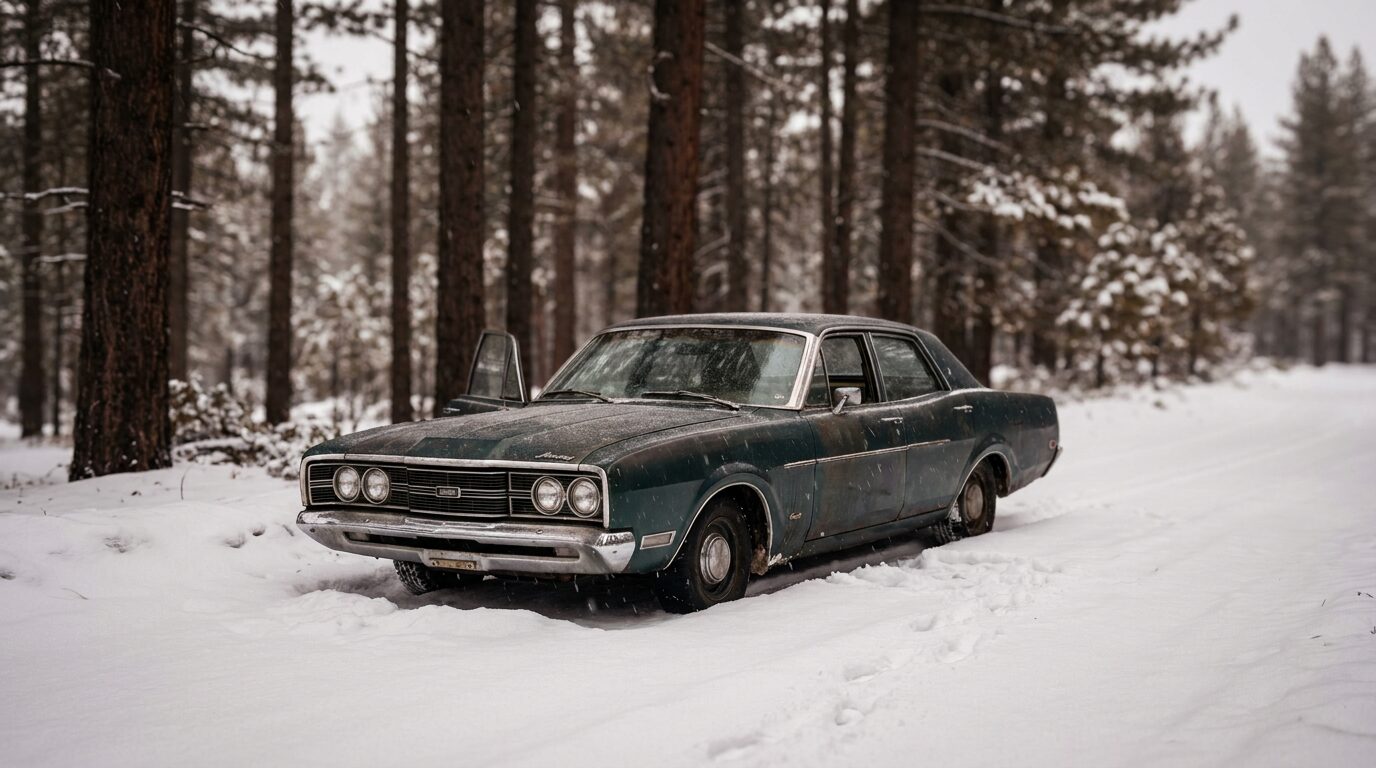
On the evening of February 24, 1978, five men left a Cal State Chico basketball game and got into a 1969 Mercury Montego. They were headed back to Marysville, California — a drive of roughly 50 miles, almost entirely flat valley road, highway the whole way. What the car actually did was drive 70 miles in the opposite direction, into the Sierra Nevada foothills, up a Forest Service road in the middle of a snowstorm, and stop. The car was found the next morning, engine off, keys in the ignition, no mechanical failures, two feet of snow on the ground, and no five men.
The men were Gary Mathias, 25; Ted Weiher, 32; Jack Madruga, 30; Jackie Huett, 24; and Bill Sterling, 29. All five had intellectual disabilities. Four had diagnoses associated with what was then termed mild to moderate mental retardation. Gary Mathias had a more complicated history — a prior psychiatric hospitalization, a diagnosis of paranoid schizophrenia, a period of methamphetamine use, but also a stretch of sobriety and stability in the months before the disappearance. He was, by most accounts from people who knew him, doing well. He had joined a supported-living basketball team, the Gateway Gators, and February 24th was a road game. The five of them had made similar trips before.
The searches that followed were not small. Hundreds of volunteers, search and rescue teams, and aircraft covered the Plumas National Forest over multiple weeks. Four of the five men were eventually found — in fragments, in stages, over months, the last body recovered in the summer. One man, Gary Mathias, was never found at all. The deaths were ruled exposure. The direction the car had traveled was never explained. And the case has sat in that condition, documented and unresolved, for 46 years.
It is not a case that suffers from a lack of physical evidence. The car is real. The bodies are real. The timeline is mostly traceable. What the case suffers from is a set of details that each make partial sense individually and refuse to cohere when laid against each other. That refusal is the thing that keeps the file from closing.
What the Car and the Road Actually Tell Us
The Mercury Montego was found on Oroville-Quincy Road, also called Forest Road 33, near the Plumas National Forest. It was parked — not crashed, not stuck in a ditch. Parked, as though someone had made a decision to stop. The gas tank was empty, which suggests the car had been driven until it ran dry, not abandoned at some arbitrary point in panic. Two feet of snowpack surrounded it. There were no signs of mechanical distress, no flat tires, no engine damage. Whatever the five men did next, they did it on foot in a blizzard in the dark, in street clothes, without survival gear. Madruga's car had been driven along this road before — the family confirmed he was familiar with the area, though not the specific stretch they ended up on. That detail neither explains the route nor dismisses it.
The route they took is reconstructable in broad strokes. From Chico, the Montego headed northeast rather than southwest. At some point the car was seen by other witnesses on the road — a camper reported seeing the vehicle and, in some versions of the account, stopping to offer help, which the men declined. This reported interaction is one of several witness accounts that investigators could not fully corroborate. The camper's testimony placed the men seemingly calm, not distressed. If accurate, it rules out the simplest explanation: that the men were terrified and fleeing something, since fear does not typically produce a polite refusal of help in a snowstorm.
“The car was not crashed. It was not stuck. It was parked — as though someone had made a decision to stop.”
What the Bodies Tell Us, and What They Don't
Ted Weiher was the first found, in June 1978, inside an unlocked Forest Service trailer roughly 19 miles from where the car had been parked. He was in a sleeping bag. He had been there for weeks, possibly months, based on the decomposition state. The trailer contained food — military-issue survival rations — a space heater, and matches. Weiher had apparently eaten some of the food and used the sleeping bag. He had not lit the heater. He had not, as far as investigators could determine, tried to leave or signal for help. His fingernails and toenails had grown significantly, indicating he had survived in the trailer for a substantial period — estimates ranged from eight to thirteen weeks — before dying of exposure and starvation. He weighed 98 pounds at recovery. The trailer had been there and stocked precisely because the area was used by snowbound travelers. He had access to warmth and food and remained where he was until he died.
The other three recovered men — Sterling, Huett, and Madruga — were found closer to the vehicle, in various states of exposure-related death. Their positions and conditions were consistent with people who had walked into the cold and succumbed relatively quickly. Weiher's survival, by contrast, was prolonged. That gap — one man surviving for months while others died within days — has never been satisfactorily explained. The five men were together when the car stopped. They left it together, presumably. At some point the group separated, and Weiher ended up 19 miles away in a structure that was genuinely survivable, while others died close to the road.
Gary Mathias was never found. The search covered the forest extensively. No remains, no clothing, no physical trace has ever been attributed to him. This absence has generated its own branch of speculation — that he survived, that he fled intentionally, that he caused whatever happened — but absence is not evidence of any particular scenario. His disappearance is documented fact; everything appended to it is conjecture. Forensic investigations of unresolved disappearances in wilderness settings have consistently shown that in dense mountain terrain, human remains can go unrecovered for decades, particularly in areas with significant wildlife activity. The absence of Mathias's body is strange. It does not, on its own, mean anything more than that.
“Weiher had food, matches, and a sleeping bag. He survived for months. He did not light the heater.”
The Question No Theory Has Answered
The central problem is the route. Every theory about the Yuba County Five must account for why Madruga — who was the driver and was familiar with the road between Chico and Marysville — drove 70 miles in the wrong direction. The valley highway is not ambiguous. It is a flat, well-marked, frequently traveled route. The Sierra Nevada foothills are visually and geographically distinct. The weather was bad, but not instantly disorienting at the valley level. Something caused Madruga to turn north and east when he needed to go south and west, and to continue driving for an extended period in the wrong direction, through increasingly challenging terrain, until the tank ran dry.
The theories in circulation break into rough categories. The foul play theory holds that someone in another vehicle either lured the men off course or directly directed them — following them, threatening them, using the car's vulnerability to force the wrong route. This theory has found no supporting physical evidence: no witness described an aggressive interaction, no forensic evidence from the car suggested a confrontation, no person has been credibly named. The disorientation theory holds that some combination of weather, stress, and unfamiliarity with nighttime driving caused Madruga to lose his bearings at a critical junction and simply continue in the wrong direction without realizing it. This is the most structurally plausible explanation and also the most uncomfortable, because it requires accepting that a man drove 70 miles without anyone in the car noticing. The Mathias theory suggests that Gary Mathias, with his psychiatric history, may have experienced some kind of episode that influenced the group's behavior — but this requires speculating about a medical event with no documented evidence, and Mathias's recent history prior to that night showed stability, not crisis.
The response of the men in the cold — leaving the car, separating, Weiher failing to activate basic survival resources — has drawn some attention from researchers interested in decision-making under acute stress in cognitively vulnerable populations. What is documented in the behavioral literature on severe cold exposure is that hypothermia itself impairs cognition rapidly[1], producing confusion, poor judgment, and paradoxical behavior including undressing in freezing conditions[2]. This is well-established physiology. It explains some of what happened after they left the car. It does not explain why they left the car, or why Weiher, who reached shelter, did not use the heater.
The Forensic Record and Its Limits
The Yuba County Sheriff's Office investigated and eventually closed the case as accidental death by exposure. That determination was not made carelessly — investigators interviewed witnesses, examined the vehicle, and reviewed the physical evidence. What it reflects is that the evidence available supported exposure as cause of death and could not establish foul play. That is a specific and limited conclusion. It answers how the men died. It does not answer why they were where they were, why Weiher behaved as he did in the trailer, or what happened to Mathias.
One detail that investigators noted but could not interpret fully: the keys were left in the ignition. This is sometimes cited as evidence of panic, or of an intention to return to the car. It could also simply mean nothing in particular — leaving keys in an ignition is not an unusual behavior in a crisis. But it is part of a small cluster of details from the car's recovery that suggest the departure was not planned, not methodical, and not connected to any obvious external threat that would have been preserved in the physical record. Cold cases involving unidentified or partially identified remains face compounding difficulties as time passes, as forensic laboratories managing evidence backlogs have documented in related contexts — and the Yuba County case, with its 1978 evidence standards, reflects what was possible before modern forensic tools existed. Whether newer techniques applied to archived evidence would change anything is unknown, because no such reexamination has been publicly reported.
“The official determination answers how the men died. It does not answer why they were where they were.”
What Remains Unresolved
The Yuba County Five case appears regularly in discussions of unexplained disappearances and wilderness deaths in North America, partly because it sits at an unusual intersection: the deaths are explained, but the behavior preceding them is not. That gap is not small. It spans the entirety of the route — 70 miles, an empty tank, a snowstorm, a parking decision — and then Weiher's extended survival and his failure to use basic resources within reach. These are not minor anomalies at the edge of the record. They are the central events, and they do not have settled explanations.
The families of the five men have lived with this for nearly five decades. The men themselves have sometimes been reduced, in coverage of the case, to their diagnoses — described in terms that emphasize their vulnerability rather than their specificity as people. Jack Madruga had held a job. Ted Weiher was known for his warmth. Bill Sterling was the youngest. Jackie Huett's mother searched for him personally for years. Gary Mathias's family has never had a body to bury. These are not details that change the evidence. They are reminders that the case is not a puzzle. It is the end of five lives, and whatever happened in that car on February 24, 1978, the people it happened to were real and specific and have not been explained.
The fog around the Yuba County Five is not the theatrical fog of ghost stories or conspiracies. It is the specific, documented fog of a real event that left behind a car, four bodies, one permanent absence, and a route that no one has satisfactorily accounted for. The case is not cold because investigators failed it, though it is worth noting that forensic identification of remains in unresolved cases has improved enormously in the decades since. It is cold because what happened is substantially recorded and still does not add up — and that particular kind of unresolved is harder to sit with than a missing file. A missing file, at least, gives you somewhere to look.
References
- Fatal hypothermia: an analysis from a sub-arctic region (pmc.ncbi.nlm.nih.gov)
Establishes that hypothermia impairs cognition rapidly, explaining some post-abandonment behavior but not the initial wrong-direction drive. - Hypothermia (en.wikipedia.org)
Documents paradoxical undressing as a severe hypothermia symptom, supporting the article's explanation for irrational behavior in freezing conditions.
About Silas Crane
Silas Crane writes from the edges of the record: cold cases, cryptids, declassified files, strange disappearances, forensic science, fringe science, mysterious illnesses, eerie technologies, serial killers, cults, state experiments, UAPs, and claims that cannot be cleanly proved or dismissed. His work also examines crime, deviance, corruption, policing, punishment, and the institutions that decide which harms are investigated, sensationalized, ignored, or allowed to continue. A documentarian at heart, he builds unease from verifiable detail and is always drawn back to the gap the file cannot close.
More like this

Your Phone Is the Escape Route. That's Exactly the Problem.
A 90-day study tracking real phone behavior found that using your screen to escape bad feelings doesn't quiet the anxiety or the depression — it quietly locks them together.
The Isdal Woman Had Nine Aliases, Fourteen Countries, and No Name. Norway Still Doesn't Know Why.
A burned body, a coded notepad, and labels cut from every piece of clothing — the Isdal Woman case is not short on evidence. It is short on a name, and the difference turns out to matter enormously.

Serial Killers Don't Have a Type. They Have an Imprint.
New analysis of FBI confession transcripts and the world's largest serial killer database suggests victim selection isn't a preference — it's a neurologically reinforced behavioral loop with a traceable origin.