The Voyager's Incredible Voyage: In November 2026, Voyager 1 Crosses a Distance Measured Only in Light
In November 2026, a 1970s spacecraft will pass a threshold so remote that the physics of light itself becomes the only useful ruler.
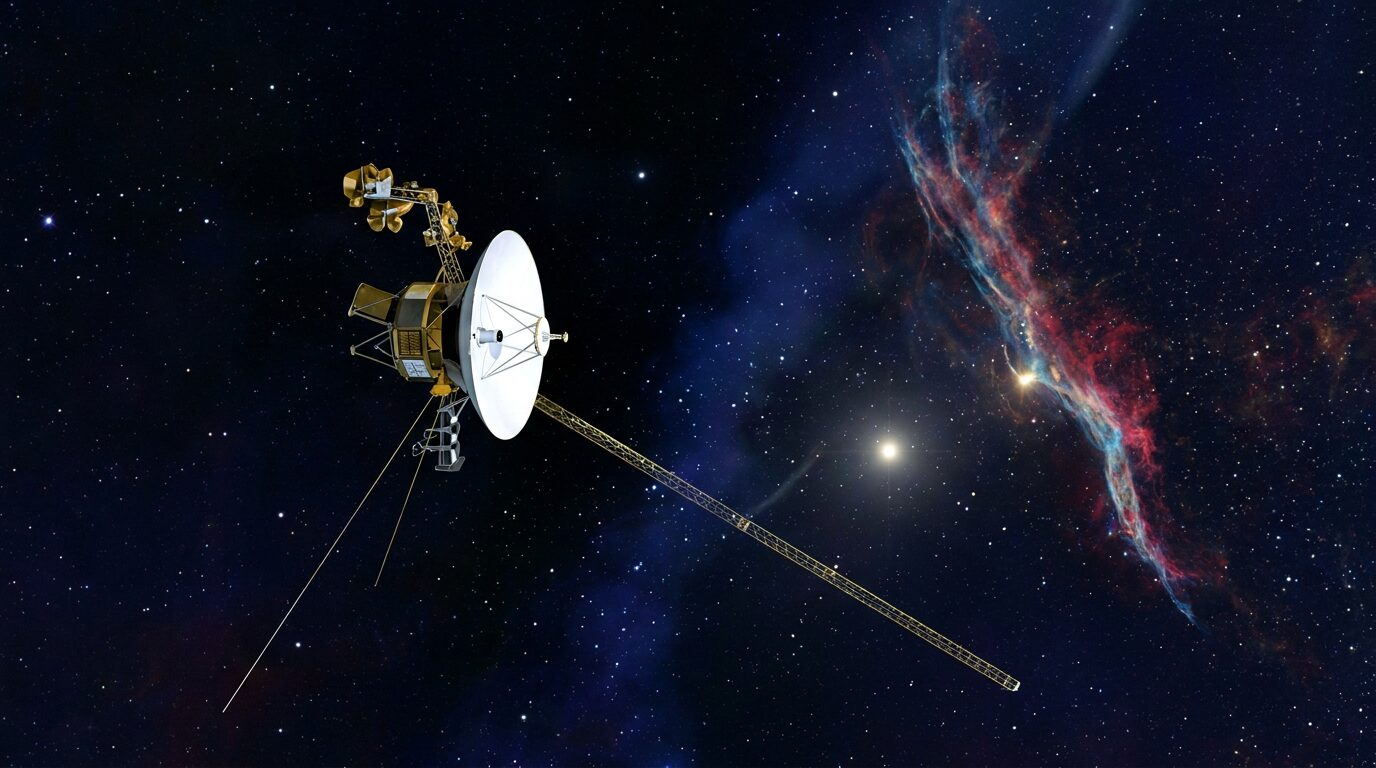
On November 18, 2026, at 2:16 a.m. Pacific Time, NASA's Voyager 1 will be exactly one light-day from Earth — the distance light covers in 24 continuous hours of travel, approximately 25.9 billion kilometers. That is a number that conveys almost nothing on its own, so consider what it implies in terms of signal delay: if a flight controller at NASA's Jet Propulsion Laboratory sends a radio command to Voyager 1 at 8 a.m. on a Monday, the acknowledgment will not arrive until Wednesday morning. A full two-day round trip for the speed of light. For a spacecraft launched when Jimmy Carter was president, this is not a metaphor for anything. It is the operational reality.
The scale compounds the longer you sit with it. When Voyager 1 reaches that one-light-day mark, it will be 5.6 times farther from Earth than Neptune. And yet, staggering as that sounds, it represents only 0.0027 percent of the distance to Proxima Centauri, the nearest star. We are celebrating the crossing of a threshold that, against the true scale of the galaxy, barely registers as a first step. That tension — the enormity of what human engineering has achieved, set against the indifference of interstellar distances — is what makes Voyager 1's story worth telling clearly, without inflation.
What the Spacecraft Is, and How It Got Here
Voyager 1 launched from Kennedy Space Center on September 5, 1977[3], riding a trajectory designed around a rare planetary alignment that occurs once every 176 years[2]. That alignment allowed mission planners to use Jupiter and Saturn as gravitational slingshots — a technique called a gravity assist — extracting kinetic energy from the planets' orbital motion without burning additional propellant. The result was a spacecraft accelerated beyond what any onboard fuel budget could have achieved alone. Voyager 1 now moves at roughly 61,000 kilometers per hour, headed toward the constellation Ophiuchus on a trajectory it has maintained, unmodified, since its Saturn flyby in November 1980. It has had no propulsive trajectory adjustment in 46 years. The path it is on now is determined entirely by the physics it inherited from those planetary encounters.
The formal planetary mission was always short. Voyager 1 reached Jupiter in 1979, discovering a thin ring around the planet and two previously unknown moons — Thebe and Metis[3] — and producing the first close images of volcanic activity on Io. At Saturn, the spacecraft found five new moons and confirmed that Titan harbors a dense nitrogen atmosphere. Then it was done with planets. Its trajectory after Saturn curved sharply upward, out of the ecliptic plane, placing it on a one-way route away from the solar system. The mission everyone remembers as a planetary tour was officially over in 1980. The spacecraft has been in extended operation for more than four decades since.
Crossing the Heliopause
The Sun does not simply end. It exhales — a constant outflow of charged particles called the solar wind, which inflates a vast magnetized bubble around the solar system known as the heliosphere. The heliopause is the boundary where the outward pressure of the solar wind balances the inward pressure from the interstellar medium. Cross it, and the Sun is no longer the dominant force shaping the particle environment around you. On August 25, 2012, after 35 years of flight, Voyager 1 crossed that boundary at a distance of 121 astronomical units from the Sun[1] — roughly 121 times the Earth-Sun distance — becoming the first human-made object to enter the interstellar medium[1].
The confirmation was not immediate. NASA didn't formally announce the achievement until thirteen months after the fact, because the evidence was difficult to read. High-energy particles from the Sun vanished, and cosmic rays from beyond the solar system intensified after Voyager's passage — signs consistent with heliopause crossing. But the spacecraft's plasma instrument had failed years earlier and couldn't directly record the jump in particle density scientists expected. And the magnetic field direction, which theorists predicted would shift sharply upon entering interstellar space, barely changed — a discrepancy that remains only partially resolved. What eventually settled the question was a solar storm. Eruptions from the Sun in March 2012 sent pressure waves outward that eventually reached Voyager and caused the surrounding plasma to oscillate, producing detectable radio emissions. The frequency of those plasma oscillations indicated an 80-fold increase in electron density — the interstellar medium, not heliospheric plasma. The Sun itself provided the proof that its own influence had ended.
“The Sun itself provided the proof that its own influence had ended.”
What Voyager 1 has found in interstellar space has not been featureless. The Plasma Wave Subsystem instrument has been detecting plasma oscillations since 2012, allowing scientists to measure the electron density of the interstellar medium continuously — the most complete such map ever assembled. The data show the density is not uniform. In 2020, the magnetometer registered an abrupt increase in field intensity and the plasma density rose, a pattern that has since persisted rather than reverting to baseline. Whether this reflects a pressure wave propagating outward from the Sun, or whether Voyager 1 has entered a denser cloud of ancient interstellar plasma — possibly the remnant of a past stellar formation event — remains an open question. Two instruments are now actively trying to resolve it.
The Machine Itself: 1970s Technology at the Edge of the Galaxy
Voyager 1's three onboard computers share 68 kilobytes of memory between them, and their processors run at 250 kilohertz. Commands are uplinked at 16 bits per second. Data comes back at 160 bits per second — roughly half a million times slower than a domestic broadband connection, as the signal fans out across 25 billion kilometers of vacuum, growing fainter with every kilometer, until it arrives as a whisper that requires multiple antenna arrays from NASA's Deep Space Network to detect at all. The spacecraft is powered by three radioisotope thermoelectric generators mounted on a boom: each contains 24 pressed spheres of plutonium-238 oxide, and the heat of radioactive decay is converted to electricity by thermocouples. At launch, the RTG arrays produced about 470 watts at 30 volts. Due to both the 87.7-year half-life of the plutonium and the degradation of the thermocouples, the probes now operate on roughly two-thirds of their original power.
That power budget has forced a steady process of triage. Of the ten science instruments Voyager 1 originally carried, seven have been shut off, the most recent being the Low-Energy Charged Particle instrument, deactivated in April 2026. As of 2026, only two instruments remain operational: the Plasma Wave Subsystem and the magnetometer. Engineers are currently developing what they're calling the "Big Bang" fix — a plan to swap several powered devices on both Voyager probes to lower-power alternatives simultaneously — which, if successful, could extend the mission into the mid-2030s and potentially allow the LECP to be reactivated. Current projections suggest the RTGs may supply enough power to return engineering data until 2036, though science instrument operation depends on how effectively the power management strategy holds.
There have been genuine crises. In November 2023, Voyager 1 began transmitting corrupted data — a repeating pattern of ones and zeros indicating its Flight Data Subsystem had locked up. Engineers spent five months diagnosing the problem across a 22-plus-hour signal delay, eventually tracing it to a damaged memory chip in the FDS, likely struck by a high-energy particle or simply worn out by age. They reprogrammed the spacecraft remotely, routing around the bad memory, and restored coherent data transmission by April 2024. That repair was conducted in slow motion, with each command-and-response cycle taking nearly two full days. Between May 2025 and February 2026, the Deep Space Station 43 antenna in Canberra, Australia — the only antenna capable of commanding both Voyager probes — was offline for major upgrades, with only limited contact windows available in August and December 2025. The mission has survived on engineering ingenuity and patience.
The Record That Will Outlast the Spacecraft
Bolted to the spacecraft is an object that will survive long after the last telemetry fades: the Golden Record, a 12-inch copper disk plated in gold, sealed inside an aluminum cover. The record contains 116 images, natural sounds, musical selections from different cultures and eras, spoken greetings in 55 languages, and human sounds including footsteps and laughter. The committee that selected its contents was chaired by Carl Sagan, and among the life signs included was an hour-long recording of the heartbeat and brainwaves of Ann Druyan, who later married Sagan — compressed to a minute to fit the medium. The cover is etched with playback instructions encoded in diagrams, a pulsar map locating the Sun using 14 pulsars as navigational reference points, and a sample of uranium-238 whose radioactive decay ratio allows any recipient to calculate how long the record has been in space. Uranium-238 has a half-life of 4.468 billion years, which makes it a more durable clock than anything biological. The record was designed to be legible across geological time — not to a civilization that happens to intercept it in a few centuries, but to whatever might find it across the deep future.
“The record was designed to be legible across geological time — not to a civilization that happens to intercept it in a few centuries, but to whatever might find it across the deep future.”
The odds of interception are vanishingly small. It will be forty thousand years before Voyager 1 makes a close approach to any other stellar system — a pass within 1.7 light-years of the star Gliese 445, currently in Camelopardalis. The interstellar medium is not crowded. The probability of the record encountering anything intentional is, as Sagan acknowledged, essentially dependent on a civilization already advanced enough to be looking. What the record actually does — what it has already done — is function as a statement of intent: that at least one species, in at least one brief window of its existence, reached far enough outward to send something. You could connect the ambition behind the Golden Record to a broader human habit of transmitting signals into the unknown, a habit explored whenever we examine the strangest signals that have emerged from deep space and wondered what, if anything, was on the other end.
One Light-Day: What the Number Actually Means
The one-light-day threshold is not a physical boundary. Nothing changes at 25.9 billion kilometers that does not also apply at 25.8 or 26.0. What the number does is provide a unit of measurement scaled to human intuition in a way that raw kilometers cannot. A light-second — the distance light travels in one second — is about 300,000 kilometers, roughly the Earth-Moon distance. A light-minute is 18 million kilometers. A light-hour is about 1.08 billion kilometers, roughly the distance from the Sun to Jupiter. A light-day is 24 of those hours stacked end to end. When you hold that in mind, one light-day stops being an abstraction and becomes a compression of time: a full rotation of the Earth, an entire day of light in motion, covering a gap that human engineering has needed nearly fifty years to cross at 61,000 kilometers per hour.
NASA has calculated the exact crossing moment as November 18, 2026, at 2:16:07 a.m. Pacific Time. The precision is characteristic of how the mission is managed: Voyager 1's position can be calculated with high accuracy because its velocity and trajectory have been mathematically fixed since 1980, with no untracked perturbations. The spacecraft is effectively a ballistic projectile on a known arc through a known gravitational field. What engineers at JPL cannot predict with precision is how much longer it will keep talking. The RTG power curve is well-modeled, but the thermocouples degrade in ways that compound over time, and the spacecraft's aging electronics face ongoing radiation damage from the very interstellar cosmic rays it was sent to measure. Voyager 2, for context, will not reach one light-day from Earth until 2035 — likely beyond its operational lifetime.
When Voyager 1 eventually goes silent — whether in 2030 or 2036 or somewhere between — the Golden Record will not stop moving. The copper disk, sealed in its aluminum case, will continue outward at 61,000 kilometers per hour through the local interstellar medium, past whatever density gradients and magnetic anomalies its now-dead instruments once measured, for timescales that make the spacecraft's 49-year journey look like a clearing of the throat. The engineering mission ends. The physical object keeps going. What Voyager 1 demonstrates, in the end, is not that humanity can reach the stars — the numbers are clear on that — but that a machine built with mid-20th-century electronics, powered by decaying plutonium, steered by a team communicating across a two-day signal delay, can still, right now, send data home from interstellar space. That is the actual achievement. The light-day is just the cleanest way to say how far away the achievement is happening.
References
- Interstellar Mission - NASA Science (science.nasa.gov)
Confirms Voyager 1 crossed the heliopause in 2012 at 121 astronomical units from the Sun. - Then There Were Two: Voyager 2 Reaches Interstellar Space (jpl.nasa.gov)
Explains the rare planetary alignment occurring once every 176 years that enabled Voyager 1's gravity-assist trajectory. - Voyager 1 (science.nasa.gov)
Documents Voyager 1's discovery of Jupiter's moons Thebe and Metis, and five new moons at Saturn.
About Elias Voss
Elias Voss writes about astronomy, space missions, telescope discoveries, and cosmic anomalies - and why it matters to us here on Earth. When the universe's physics reaches down and touches life on our planet, he follows it there too. He specializes in translating dense data into vivid, precise stories without sacrificing accuracy.
More like this
This Star Is Older Than the Universe — And the Math Might Be Right
HD 140283 has been clocking in at 14-plus billion years old, which is a problem, because the universe is only 13.8 billion — and resolving that contradiction is quietly rewriting how we measure cosmic time.
The Object From Interstellar Space Got Scanned for Signals. Here's What Was Actually Found.
Breakthrough Listen and the SETI Institute both pointed instruments at 3I/ATLAS — and the null result tells us something specific, limited, and genuinely worth understanding.
The Sun's Surface Is 5,500°C. Its Atmosphere Is 2,000,000°C. Something Is Wrong.
Solar physicists have known about the corona's impossible heat for eighty years, and a spacecraft now flying closer to the sun than any instrument before it is finally close enough to catch the culprit in the act.