The UAP Files Mention 'Green Fireballs' 209 Times. Nobody Can Explain Them.
The newly declassified DoD UAP documents don't prove anything extraterrestrial — but the geography and repetition of the sightings reveal a clustering pattern that official explanations still can't fully account for.
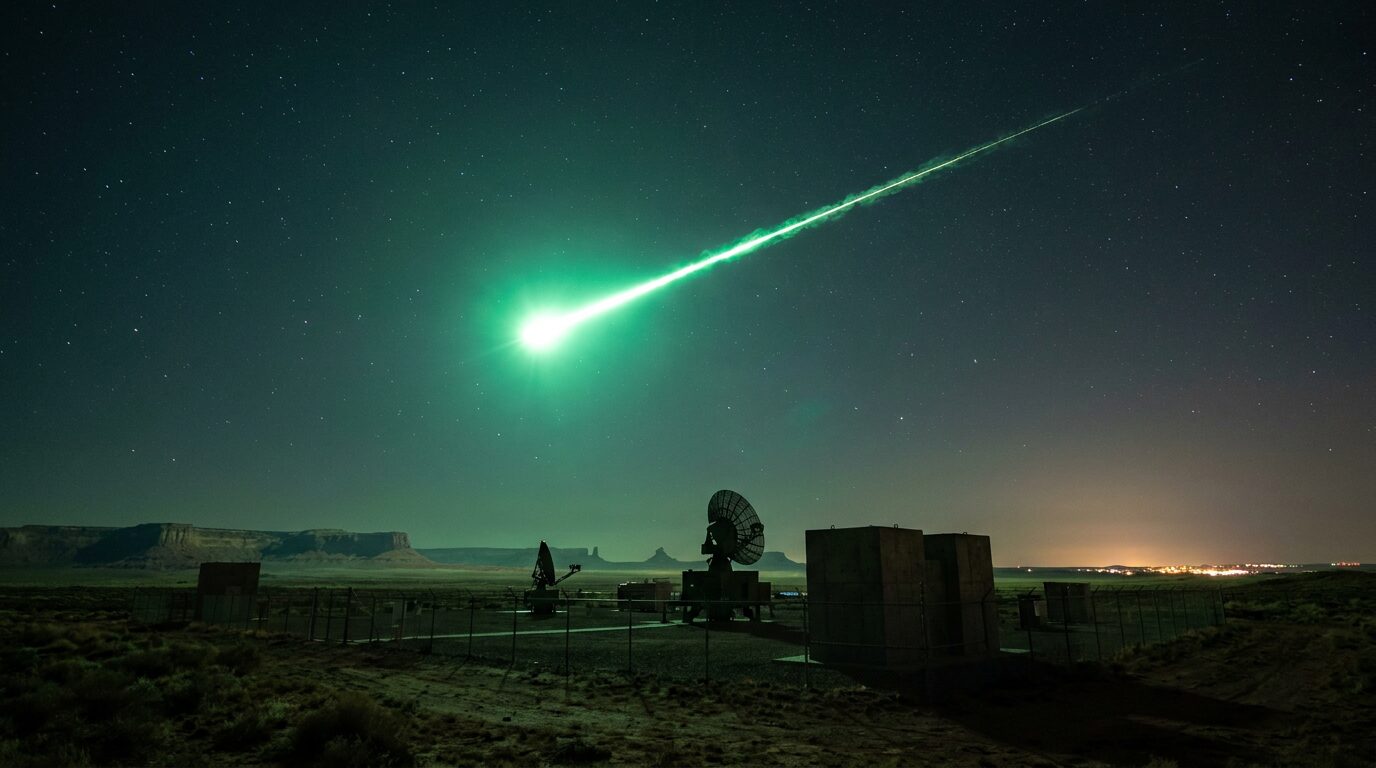
The phrase 'green fireball' appears 209 times in the newly declassified Department of Defense UAP files released in May 2026[1]. That number is not a punchline. It is a measurement problem. The files span roughly a decade of Cold War–era observation records, instrument logs, witness statements, and internal memos, many of them flagged for restricted circulation at the time they were written. Reading through them now, what stands out is not the strangeness of any single sighting. It is the repetition, the geography, and the almost procedural frustration of analysts who kept writing variations of the same sentence: observed, unresolved, no definitive explanation identified.
Green fireballs were not a new phenomenon when the military started tracking them seriously in the late 1940s. Meteor showers produce brilliant bolides. Atmospheric optics generate artifacts that can fool experienced observers. Military pilots, flying at altitude under stress, can misread distance, speed, and luminosity badly enough to turn a conventional object into something that reads as impossible. These are not small caveats. They explain a substantial portion of UAP reports in every era. But the green fireball cases that accumulate most densely in the newly released files share a feature that makes the conventional explanations harder to close on: they cluster, with unusual consistency, around installations associated with nuclear weapons research and storage[4].
Los Alamos. Sandia. Kirtland Air Force Base. The Hanford Site. White Sands. A reader could map the sightings in the files against a map of mid-century nuclear infrastructure and find a correlation that is at minimum uncomfortable to dismiss. The analysts writing these memos in the 1940s and 1950s noticed the same pattern. Some of them said so directly. Others documented it without commentary, which in classified bureaucratic language is its own kind of statement.
None of this constitutes proof of anything. That sentence needs to be said plainly, before the pattern gets inflated into a narrative it cannot support. What the files document is a series of observations that were taken seriously by people with relevant expertise, logged with more rigor than popular accounts usually acknowledge, and then filed away under classifications that kept them out of the public record for decades. The question the May 2026 release forces back into daylight is not whether the objects were alien. It is whether the pattern itself was ever adequately investigated, and if not, why.
What the Files Actually Contain
The release runs to several thousand pages. The material is not uniformly dramatic. Most of it is the tedium of institutional record-keeping: form numbers, weather data, instrument calibration notes, times and coordinates logged in the clipped prose of people writing for other specialists. Buried in that tedium are the anomalies. A radar operator at a site adjacent to a weapons storage facility logs a return that does not match any scheduled flight, moves at a speed his equipment flags as outside normal parameters, and then disappears without a corresponding optical sighting. A perimeter guard files a report describing a green luminous object moving parallel to a restricted fence line at low altitude, making no sound, before accelerating out of visual range. A meteorologist attached to a weapons testing program notes in an internal memo that the object reported by three separate observers that evening was not consistent with any meteor trajectory he could reconstruct given the reported angle of descent.
These reports are not equivalent to each other in evidential weight. Single witness accounts with no instrument corroboration occupy a different tier than radar returns logged by trained operators and cross-referenced against optical observation. The files contain both, and the strongest cases — the ones where a ground radar track, an airborne observation, and an independent witness account all point at the same event — are the ones that most resist the standard battery of mundane explanations. They are also, reliably, the cases nearest nuclear infrastructure.
“The analysts writing these memos noticed the geographic pattern. Some said so directly. Others documented it without commentary, which in classified bureaucratic language is its own kind of statement.”
The Lincoln LaPaz Problem
The files return repeatedly to the work of Lincoln LaPaz, a meteor physicist at the University of New Mexico[3] who was brought in during the late 1940s to assess whether the green fireballs being reported over New Mexico could be explained as meteoric phenomena. LaPaz was not a credulous investigator. He had spent his career studying actual meteors with actual instruments, and his assessment of the green fireball reports was careful and technical. He concluded that they were probably not meteors. His reasoning was specific: the observed trajectories were too flat, the descent angles too shallow, the terminal velocities inconsistent with what a bolide of that apparent size and luminosity would produce. He noted the absence of recovered debris[2] in cases where a meteoritic object of that scale should have left a recoverable strewn field.
LaPaz's analysis has been cited selectively for decades — sometimes by UFO enthusiasts as proof of anomalous craft, sometimes by skeptics as an example of an expert overstepping his domain. The fuller picture, visible now in the declassified material, is more interesting than either use of him. LaPaz was not claiming the objects were artificial. He was claiming that the meteor hypothesis did not survive his scrutiny, and that a more thorough investigation was warranted. The distinction matters. 'Not a meteor' is not the same as 'therefore extraterrestrial.' It is a constraint on the solution space, not a solution. The files suggest his recommendation for a sustained physical investigation was heard, discussed, and ultimately not funded at the scale he proposed.
“'Not a meteor' is not the same as 'therefore extraterrestrial.' It is a constraint on the solution space, not a solution.”
The Clustering Problem and What It Might Mean
There are several ways to think about geographic clustering of anomalous sightings near nuclear sites, and most of them are less dramatic than they first appear. The most obvious: nuclear facilities are heavily staffed and heavily watched. The number of trained observers, radar operators, and security personnel stationed at and around these sites during the Cold War was substantially higher than at comparable areas of open desert or civilian airspace. More observers means more reports. This is a real reporting-density effect, and it explains a portion of the clustering without requiring any special significance in the objects themselves.
A second possibility involves electromagnetic environment. Nuclear facilities, particularly those with active research programs, generated substantial electromagnetic interference during this period. Some researchers in the atmospheric optics and plasma physics communities have proposed that high-tension electrical infrastructure, combined with specific geological and atmospheric conditions, can produce luminous plasma phenomena — ball lightning analogues, piezoelectric effects, ionization events near rocky terrain — that would appear as moving lights to an observer and might generate spurious radar returns under certain conditions. This is not a fully worked-out theory. The physics of anomalous plasma phenomena near the ground remains genuinely incomplete. But it is a mechanistically plausible direction that received essentially no serious funding during the period the files cover.
A third possibility, more uncomfortable for official histories, is that some fraction of the sightings near nuclear sites during the early Cold War were Soviet reconnaissance assets — balloons, early drone prototypes, or other platforms that the United States either could not track reliably or could not publicly acknowledge tracking without revealing the limits of its own sensor coverage. The declassified files contain redactions that are specifically dense around discussion of potential foreign-origin explanations. This may mean nothing. Redaction in intelligence documents follows its own bureaucratic logic that does not necessarily map onto significance. But the pattern of where redactions cluster is noted, and it is noted near nuclear sites.
What the Pattern Cannot Tell Us
A pattern in data is not an explanation. It is a question with coordinates. The green fireball sightings cluster near nuclear infrastructure — but clustering is consistent with the reporting-density effect, with electromagnetic environment effects, with foreign reconnaissance, with genuine atmospheric phenomena that science has not fully characterized, and, at the far end of the probability spectrum, with something else entirely. These explanations are not equally supported by the available evidence, but several of them are simultaneously possible for different events within the larger dataset. That is the difficulty. Treating the entire corpus of 209 green fireball references as a single phenomenon requiring a single explanation is exactly the kind of analytical move that produces confident-sounding nonsense.
What the files do establish, with reasonable clarity, is that the events were taken seriously at the time by people whose professional training gave them grounds to evaluate them, that the explanations available to those analysts did not fully close the cases, and that the institutional response was to classify and contain rather than to investigate and publish. This does not mean the government knew something extraordinary and hid it. Governments classify things for many reasons, most of them boring: bureaucratic habit, interagency competition, the desire to avoid public alarm, the reluctance to publicize sensor capabilities or their limits. Classification is not proof of knowledge. It is proof of a decision.
“Classification is not proof of knowledge. It is proof of a decision.”
Why the Unresolved Cases Still Matter
There is a version of this story that treats the May 2026 declassification as confirmation of what UFO researchers have argued for decades: that the government was aware of genuine anomalies, failed to explain them, and buried the evidence. That version is not supported by what the files actually say. There is also a version that dismisses the entire corpus as the predictable product of Cold War anxiety, limited sensor technology, and human pattern-seeking projected onto explainable atmospheric events. That version is not fully supported either.
The cases that remain genuinely unresolved after more than seventy years are not unresolved because investigators were incurious or incompetent. Many of them were neither. They are unresolved because the data collection at the time was not designed for this kind of investigation, because follow-up resources were not allocated, and because the classification system that was meant to protect national security also protected these cases from the kind of sustained scientific scrutiny that might have closed them. The strongest multi-witness, instrument-corroborated sightings from this period exist in a state of suspended uncertainty that is not mystical, not conspiratorial, and not trivial. They simply have not been answered.
The honest read of the newly released files is this: something was being observed over nuclear sites during the early Cold War with enough consistency and corroboration that trained analysts flagged it repeatedly and explicitly, the range of mundane explanations available then — and now — does not fully account for the strongest cases, and the investigation those cases deserved was never conducted with the rigor and resources the analysts themselves were requesting. The 209 references to green fireballs are not evidence of alien surveillance of America's nuclear program. They are evidence that a phenomenon was detected, documented, and left deliberately unresolved. That is its own kind of story, and it is a stranger one than either believers or cynics tend to tell.
References
- newly declassified Department of Defense UAP files released in May 2026 (war.gov)
Provides the declassified Department of Defense UAP files released in May 2026 containing 209 mentions of 'green fireballs' spanning Cold War–era observation records. - Green fireballs (en.wikipedia.org)
Confirms green fireballs were reported since early 1950s primarily in southwestern United States, particularly New Mexico, with early observations dating to late 1948. - Lincoln LaPaz (en.wikipedia.org)
Establishes Lincoln LaPaz as an American astronomer and meteor pioneer from the University of New Mexico who studied the green fireball phenomenon. - When Mysterious Green Fireballs Worried the US Government (history.com)
Documents LaPaz's assessment that green fireballs were likely either U.S. secret defensive devices or Soviet spying devices, and scientists' animated response to interplanetary vehicle hypothesis.
About Rowan Ellery
Rowan Ellery writes about anomalies, unexplained sightings, strange signals, and the uneasy border between observation, misinterpretation, and genuine mystery. Their work focuses on keeping curiosity alive without letting evidence dissolve into folklore.
More like this
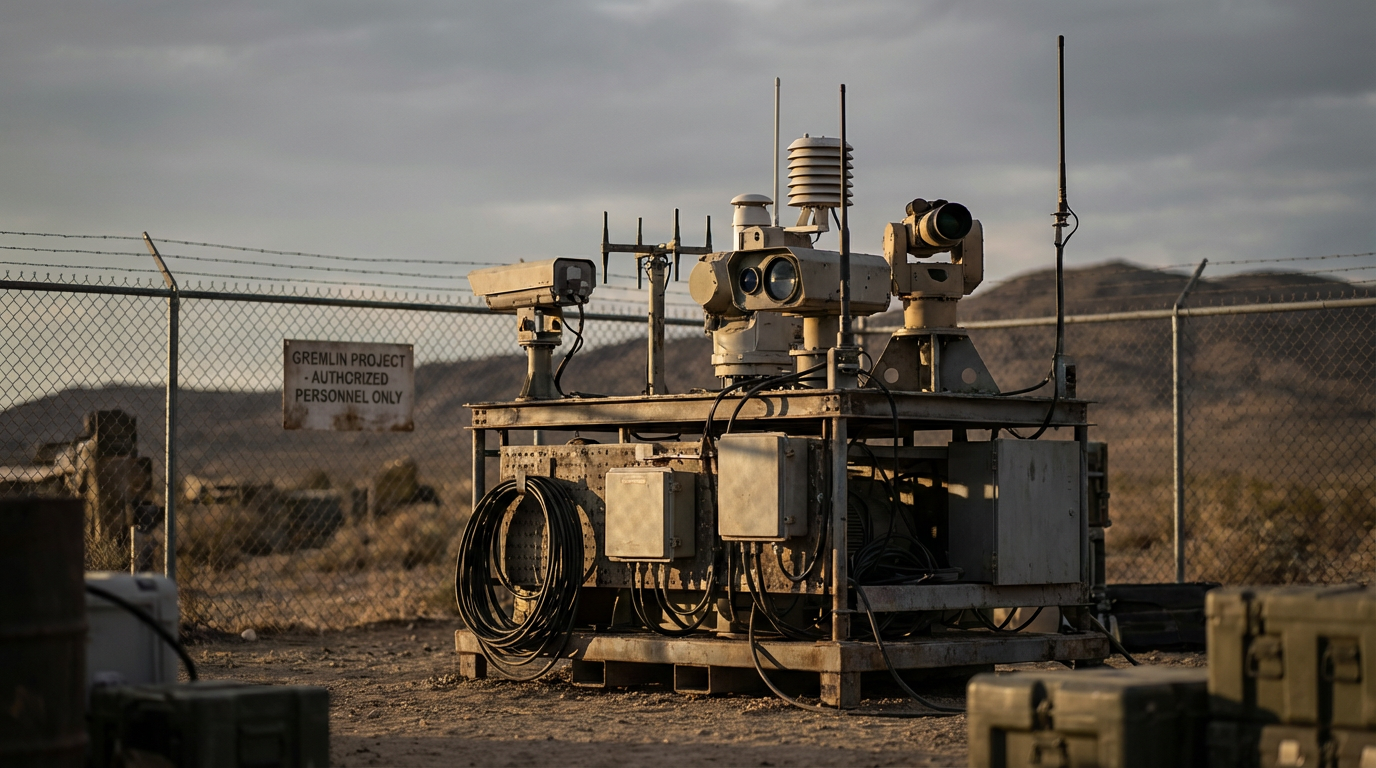
The Pentagon Built a UAP Sensor. It Found Mostly Balloons. That's Not the Whole Story.
The Pentagon's new UAP sensor system quietly entered field testing — and what it's already revealing is less about what's up there than about how badly we've been trying to look.
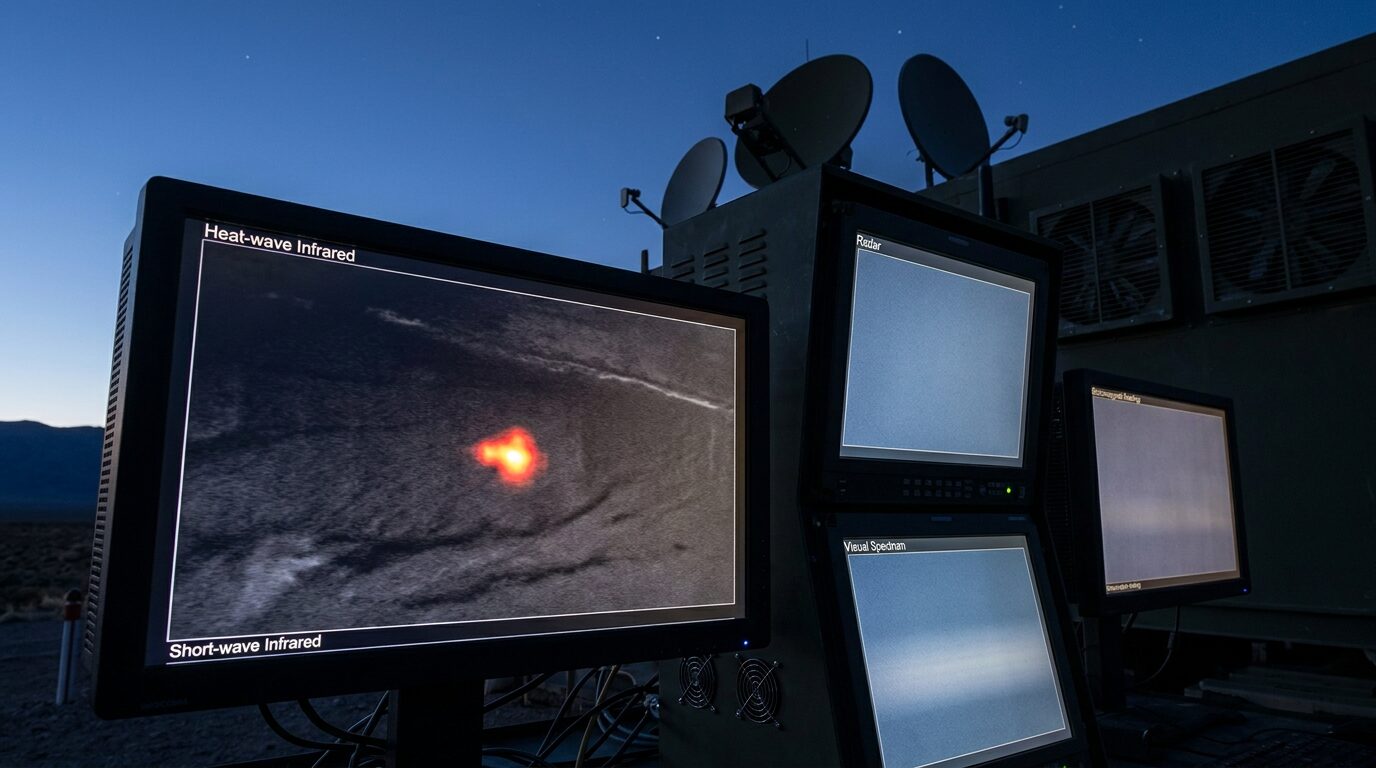
The Pentagon's New UAP Files Have a Sensor Problem No One Is Talking About
The May 2025 PURSUE disclosure is historic — but the cases that stayed unexplained share a quiet technical flaw that changes what 'unresolved' actually means.
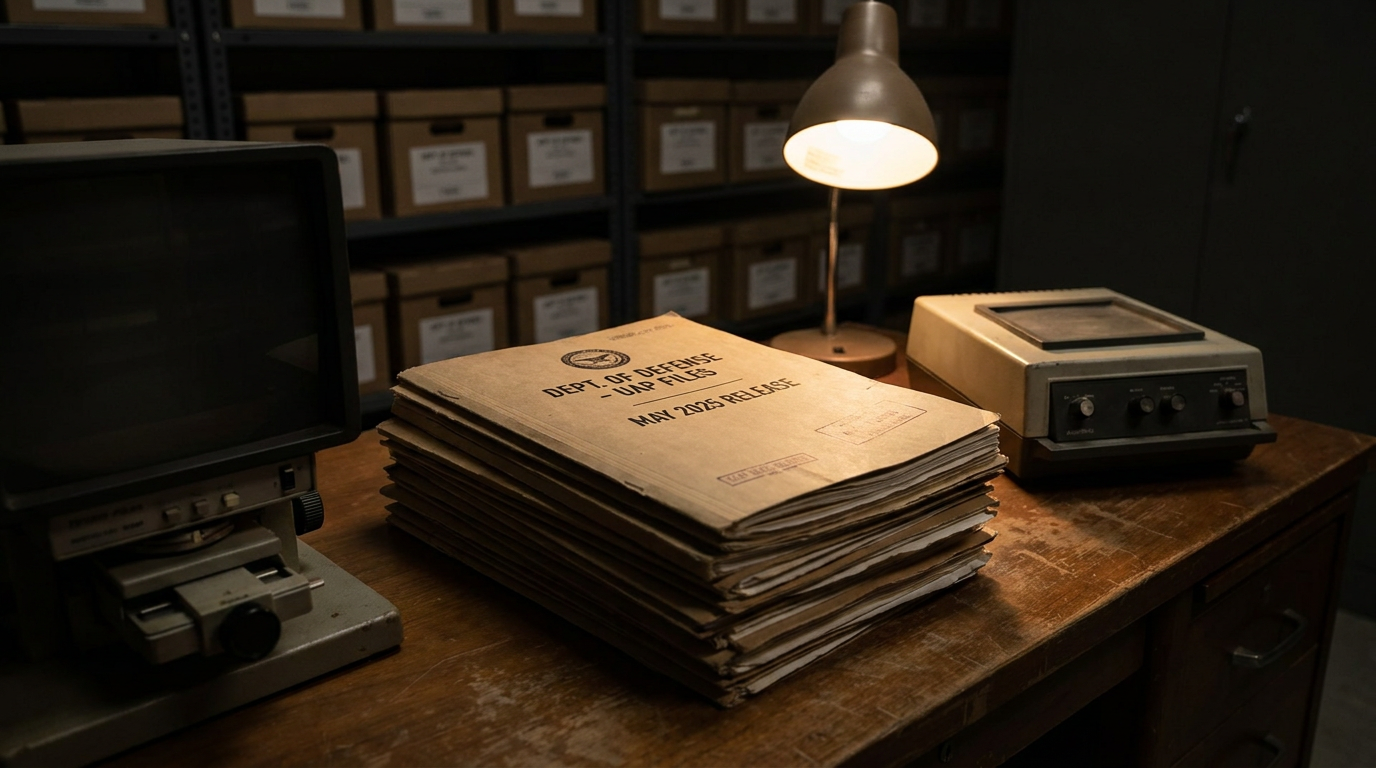
The Pentagon Released 162 UAP Files. The Unresolved Ones Are the Interesting Part.
The May 2025 file release is historic, but the official language used to explain every unresolved case quietly reveals something more useful than any alien hypothesis.