The Read Receipt Is Making You a Worse Reader of People
Every blue checkmark and last-seen timestamp quietly teaches your nervous system that human silence is data — and it's making you worse at the kind of reading that actually matters.
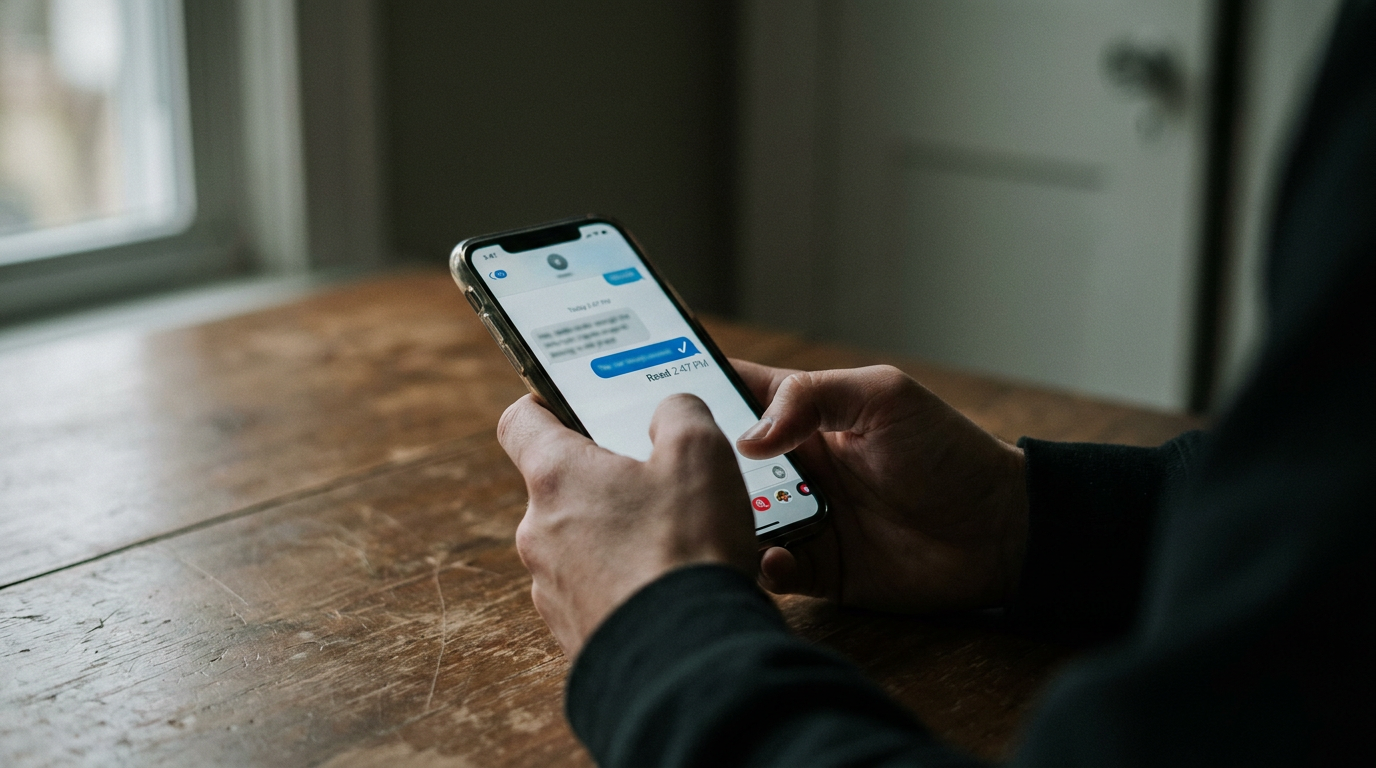
You send a message. A minute passes. You know they've read it — the receipt says so — and still nothing comes back. Your brain, confronted with this gap, does not wait patiently. It starts building. It begins assembling a story from what should be structural silence: maybe they're angry, maybe you said something wrong, maybe this relationship is quietly unwinding in real time. The read receipt has given you a fact — seen, 2:47 PM — and your nervous system is treating that fact like an open wound.
This is not an overreaction in the clinical sense. It is a learned response, trained by years of living inside messaging systems that have taught us, very effectively, that silence has metadata. The problem is that silence in real human life does not have metadata. People are distracted, overwhelmed, mid-thought, stuck in an emotion they haven't named yet, holding their phone while thinking about something entirely unrelated to you. The gap between a read receipt and a reply means almost nothing about the relationship — and yet we have been trained to read it like it means almost everything.
What modern messaging design has quietly accomplished, over roughly a decade of widespread adoption, is the outsourcing of emotional interpretation. Platforms took the ambient ambiguity of human communication — a notoriously difficult thing to sit with — and replaced it with legibility signals: read receipts, typing indicators, last-seen timestamps[4], the little ellipsis bubble that appears and then vanishes. These signals feel like information. They have the appearance of data. But they are data about behavior, not about meaning, and the distinction is one most people stopped making a long time ago.
The effect runs deeper than momentary anxiety about an unanswered text. What researchers in attachment and interpersonal communication increasingly suspect is that this architecture is reshaping how people process relational ambiguity at a more fundamental level — eroding the tolerance for not-knowing that healthy relationships require in enormous quantities. We are getting better at reading signals and worse at reading people.
The Emotional Labor Platforms Took Over
Before the read receipt existed, waiting for a response meant sitting with uncertainty in its purest form. You had no idea whether your message had arrived, been seen, been set aside, or landed in the wrong mood. The ambiguity was total. And while this was sometimes maddening, it also meant that the absence of a reply carried almost no interpretive weight on its own. You could not read it as rejection because rejection required evidence. The silence was just silence — textured, human, and genuinely unresolved.
Read receipts changed the interpretive game entirely. The moment a platform tells you that your message has been seen, the silence after it stops being neutral. It becomes loaded. Researchers who study interpersonal communication and what's sometimes called the psychology of digital interaction have noted that these signals do something specific to the receiver's cognitive processing: they collapse the ambiguity of non-response into a much narrower interpretive window[3]. The message was received. The person is choosing not to reply. Now what does that mean? This is where the mind accelerates into territory it was never supposed to enter so quickly — into reading motive, intent, emotional state, relational standing — on the basis of nothing but a timestamp.
“The read receipt didn't give us more information about people — it gave us more information about behavior, and convinced us that was the same thing.”
The typing indicator is a subtler instrument of the same problem. Watch someone type and stop, type and stop, and you are watching your nervous system write a script in real time. They started and deleted something. They're weighing their words. They're upset. Or maybe they got a phone call. Maybe autocorrect kept breaking the sentence. Maybe they are holding a coffee cup with one hand. The indicator shows behavior at a pixel-level resolution that human emotional interpretation was never designed to process. We evolved to read faces, posture, tone, context — rich, multi-channel signals with enormous redundancy. The typing bubble is a single, stripped data point, and we are treating it like a full emotional transmission.
Ambiguity Tolerance and Why It Matters for Relationships
Psychologists have long recognized ambiguity tolerance as a meaningful individual difference — the capacity to sit with uncertainty without immediately reaching for a resolution, whether that resolution is accurate or not. People with lower ambiguity tolerance tend to jump faster to interpretations, prefer clear social rules, and experience more distress when relational signals are mixed or absent. This trait appears in research on attachment, on anxiety[2], and on how people navigate intimacy. And crucially, it is not fixed — it shifts in response to environmental conditions, including the conditions that environments repeatedly train us to expect.
Here is the mechanism worth attending to: if you spend years in communication environments that reliably provide legibility signals — that tell you whether your message was received, whether someone is currently formulating a response, when they were last active — you are training your expectation architecture. You are teaching yourself that relational silence comes with metadata, that gaps have explanations available on request, that uncertainty is a temporary state preceding disclosure. And then you walk into the rest of your relationships — face-to-face, phone calls, slow-building friendships, professional dynamics, romantic attachments — where none of that infrastructure exists, and your calibrated nervous system finds it extremely hard to tolerate what used to be ordinary human opacity.
This matters most in the places where ambiguity is not a glitch but a feature — in early romance, where uncertainty is part of the attraction; in conflict, where people need space before they can respond honestly; in grief, where someone going quiet isn't withdrawal but processing; in friendship, where the rhythms of contact are naturally irregular and carry no relational meaning on their own. These are the contexts that require a stable, well-practiced capacity to not-know. And they are precisely the contexts that platform design has spent ten years quietly undermining.
How the Signal Becomes the Relationship
“When you outsource the interpretation of silence to a platform, you stop practicing the thing that relationships most demand: staying present inside not-knowing.”
There is a particular cognitive loop that digital messaging tends to produce when anxiety is involved, and it runs on intermittent reinforcement — the same motivational architecture that makes slot machines effective[1]. You check whether someone has responded. They haven't. You wait, check again. The variability in when a response arrives keeps the checking behavior active in a way that a consistent delay never could. But what is less often discussed is what happens to the interpretation layer during this loop. Each time you check and find nothing, you are generating a micro-theory about the relationship. And those micro-theories accumulate. They start to feel like evidence. They start to feel like a read.
What you are actually doing is practicing interpretive projection — filling a void with your own attachment anxieties, your own narrative assumptions, your own fears about how you are perceived. This has always been something humans do in relational uncertainty. But messaging platforms have dramatically increased the frequency at which this practice runs. They have turned it from an occasional response to prolonged silence into an almost continuous low-grade activity. The result is not a sharper reading of other people. It is a more elaborate reading of yourself, mistaken for a reading of them.
Attachment researchers would note that this process maps cleanly onto anxious attachment dynamics — the hypervigilance to relational signals, the catastrophizing of gaps, the compulsive search for reassurance in behavioral cues. But crucially, platform design does not only affect people with pre-existing anxious attachment. It produces attachment-anxious behaviors in people who don't have that pattern in face-to-face relationships. The environmental pressure is strong enough to generate the behavior independently of the underlying wiring. The platform creates the conditions, and the nervous system learns to live in them.
The Skills That Are Actually Degrading
The erosion is not dramatic. It doesn't feel like a loss. It feels like heightened attentiveness — like you're just paying closer attention to relational cues than you used to. But there are specific interpretive capacities that appear to weaken under this kind of sustained digital training, and they are worth naming clearly.
The first is contextual patience — the ability to hold a relational uncertainty in suspension while gathering richer, slower information about what it means. Healthy readers of people know that a person's behavior on Tuesday only makes sense in the context of their behavior across months, and that a single gap in response is almost always noise. Digital messaging compresses the interpretive timeline dramatically, training the brain to demand resolution at a speed that relationships cannot sustain.
The second is what might be called charitable default — the baseline tendency to assume, in the absence of evidence, that another person's silence or distance is about their internal state, not about their feelings toward you. This default is not naivety; it is statistically accurate. Most silences in human communication are about the person being silent, not about the person waiting. But this assumption requires practice to maintain, because it runs against the brain's threat-detection instincts. Platform signals, by providing behavioral data without context, actively feed the threat-detection pathway and starve the charitable one.
The third is presence under uncertainty — the capacity to remain emotionally engaged in a relationship while not-knowing how the other person is feeling. This is arguably the deepest relational skill there is. Long-term intimacy requires it constantly. People change, go quiet, withdraw, recalibrate — and the person across from them has to be able to stay without demanding immediate legibility. Messaging design has made legibility feel like a right, a feature, something that well-functioning relationships should provide. The expectation that you can know, at any moment, where things stand is both novel and quietly corrosive.
What We Lose When Silence Gets a Timestamp
“Silence used to be a space where relationships could breathe. Now it arrives with a timestamp, and we treat it like a verdict.”
None of this is an argument for turning off read receipts, though some people do and find real relief in it. The infrastructure is not going anywhere, and individual opt-outs don't change the broader training environment that messaging culture has created. What matters more is understanding what is actually happening inside the interpretive loop — recognizing when you are reading a signal and calling it an understanding of a person, noticing when you are treating behavioral metadata as emotional evidence, catching the moment when a timestamp starts doing the work that conversation should be doing.
This is not a skill that platforms will teach. Their design interest runs exactly opposite to it. Every feature that increases engagement — every read receipt that brings you back to check the thread, every typing indicator that holds your attention for thirty more seconds, every last-seen timestamp that pulls you into wondering — is a feature that benefits from your reduced tolerance for ambiguity. The less comfortable you are with not-knowing, the more time you spend inside the system that appears to offer knowing. The anxiety and the design are not in conflict. They are collaborators.
The more honest version of what these platforms taught us is not that we can know people better through their digital traces. It is that we became deeply practiced at reading traces, and somewhere along the way, we started confusing that for reading people. The two skills feel similar. They are not. Traces are about behavior. People are about interiority. Interiority does not come with a checkmark, a timestamp, or an indicator that it's currently typing. It arrives slowly, contextually, and only when someone feels safe enough to let it through — which is precisely the kind of arrival that requires the person waiting to be willing to sit with silence without turning it into a story first.
References
- Hypernatural Monitoring: A Social Rehearsal Account of Smartphone Addiction (frontiersin.org)
Explains the intermittent reinforcement mechanism underlying compulsive checking behavior in messaging, similar to slot machine psychology. - Intolerance of uncertainty mediates the relationship between adult attachment and worry (sciencedirect.com)
Establishes research foundation linking attachment patterns and anxiety to how people tolerate uncertainty in relationships. - collapse the ambiguity of non-response into a much narrower interpretive window (tidsskrift.dk)
Establishes that read receipts narrow the interpretive window for non-response, shifting silence from neutral to loaded with meaning. - read receipts, typing indicators, last-seen timestamps (seejph.com)
Provides research foundation on silence and blocking in instant messaging systems and their interpersonal relationship effects.
About Noah Chen
Noah Chen writes about internet culture, digital identity, fandom, parasociality, creator economies, algorithms, and the ways media platforms reshape attention, status, belief, loneliness, and selfhood. His work follows culture where it increasingly lives: inside feeds, fandoms, comment sections, recommendation systems, online movements, and synthetic relationships, without reducing digital life to either moral panic or technological inevitability.
More like this

Posting Something Personal Online Puts Your Nervous System in a Slot Machine
The pause between hitting send and the first like isn't dead time — it's an emotional architecture that platforms built on purpose, and it's quietly changing how you process approval, rejection, and the feeling of existing in front of others.

Two Weeks Without Mobile Internet Made People Feel 10 Years Younger
A rigorous experiment quietly confirmed what most of us already half-suspect — and put a surprisingly precise number on the damage.

Your Phone Is the Escape Route. That's Exactly the Problem.
A 90-day study tracking real phone behavior found that using your screen to escape bad feelings doesn't quiet the anxiety or the depression — it quietly locks them together.