Ambiguity Tolerance
This is the capacity to sit with uncertainty without rushing to a resolution. Low tolerance leads people to jump to interpretations and feel distress when social or relational signals are unclear.
Not to be confused with: Uncertainty Tolerance
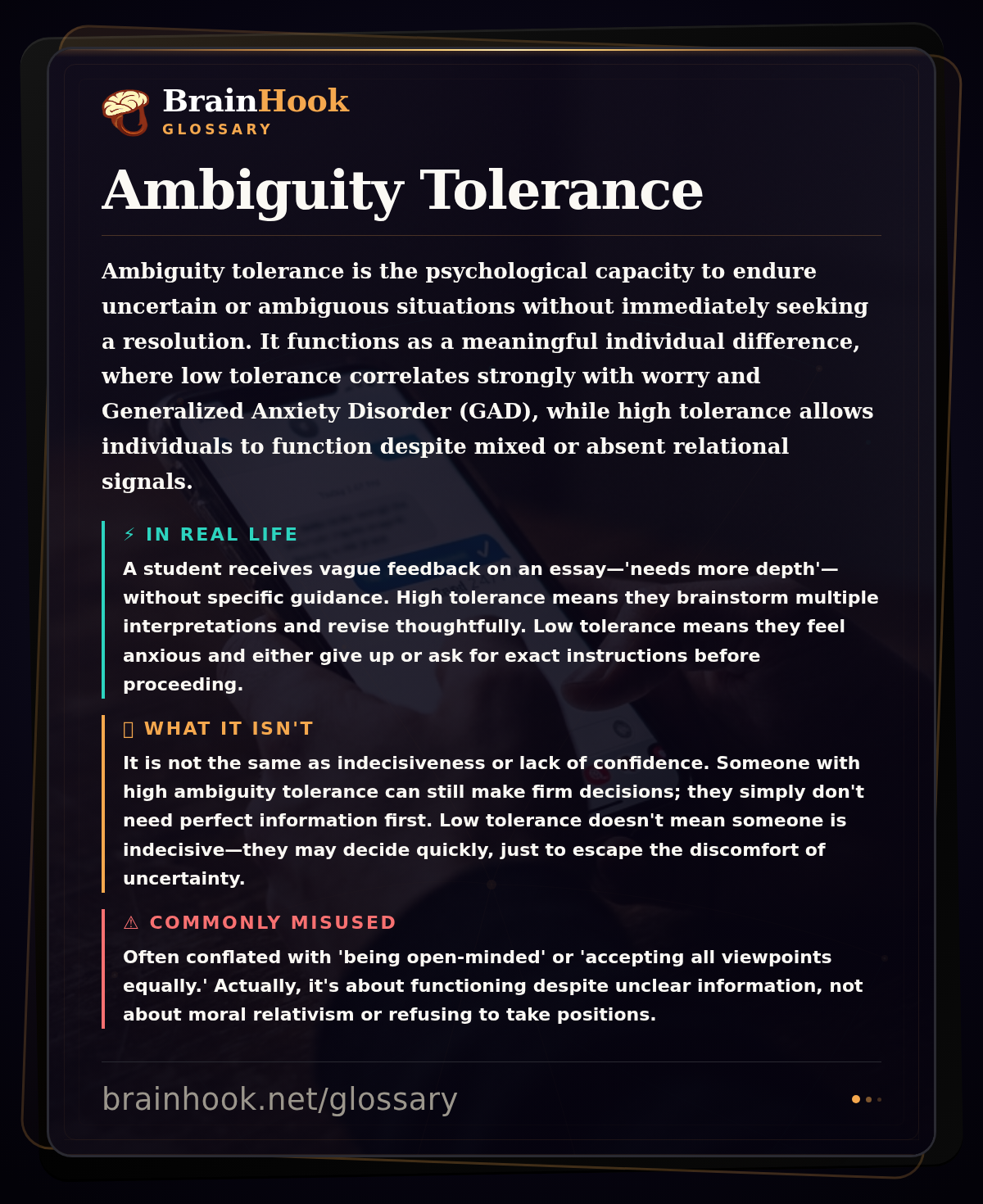
Ambiguity tolerance is the psychological capacity to endure uncertain or ambiguous situations without immediately seeking a resolution. It functions as a meaningful individual difference, where low tolerance correlates strongly with worry and Generalized Anxiety Disorder (GAD), while high tolerance allows individuals to function despite mixed or absent relational signals.
What this means in real life
A student receives vague feedback on an essay—'needs more depth'—without specific guidance. High tolerance means they brainstorm multiple interpretations and revise thoughtfully. Low tolerance means they feel anxious and either give up or ask for exact instructions before proceeding.
What it isn’t
It is not the same as indecisiveness or lack of confidence. Someone with high ambiguity tolerance can still make firm decisions; they simply don't need perfect information first. Low tolerance doesn't mean someone is indecisive—they may decide quickly, just to escape the discomfort of uncertainty.
Commonly misused online
Often conflated with 'being open-minded' or 'accepting all viewpoints equally.' Actually, it's about functioning despite unclear information, not about moral relativism or refusing to take positions.
Based on 4 reference sources, including NIH material. Last verified July 12, 2026.